Telescopes
 Call Kai
 Learn
Learn Practice Test
 Spaced Repetition
 Match
Match Flashcards
 Knowt Play
1/44

There's no tags or description
Looks like no tags are added yet.
Name | Mastery | Learn | Test | Matching | Spaced | Call with Kai |
|---|
No analytics yet
Send a link to your students to track their progress
45 Terms
What is a telescope?
A telescope is an instrument that collects and focuses electromagnetic radiation from distant objects to make them easier to observe.
Why are telescopes needed?
Distant objects are very faint. Telescopes collect much more radiation than the eye, allowing astronomers to observe them.
What is the objective lens?
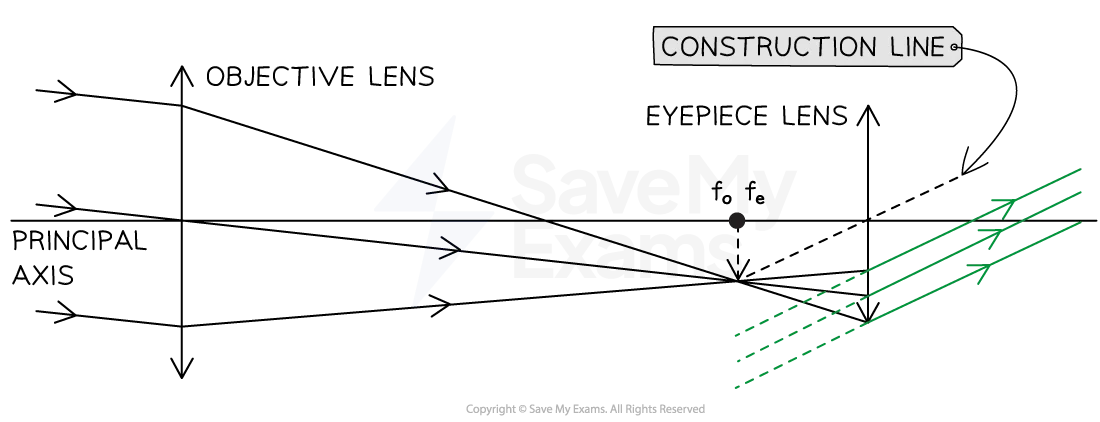
The objective lens is the large lens or mirror that collects radiation and forms the first real image.
What is the eyepiece lens?
The eyepiece lens magnifies the image formed by the objective lens.
What is a refracting telescope?
A telescope that uses lenses to collect and focus light.
Advantages
Simple design
Closed tube
Disadvantages
Chromatic aberration
Large lenses difficult to manufacture
What is a reflecting telescope?
A telescope that uses mirrors to collect and focus light.
Advantages
No chromatic aberration
Large mirrors easier to support
Disadvantages
More complex alignment
Refracting telescope in normal adjustment diagram
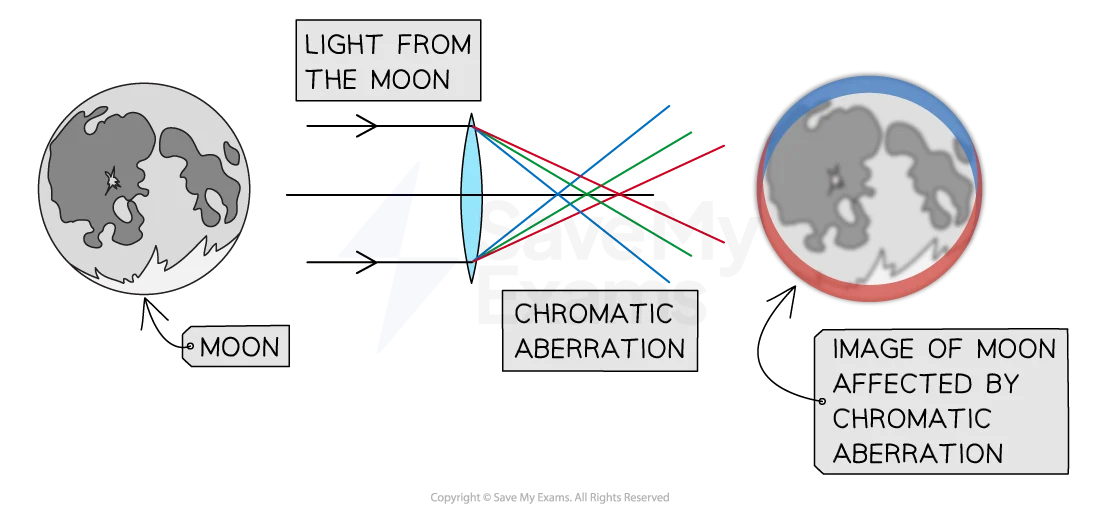
What is chromatic aberration?
Different wavelengths are refracted by different amounts by a lens.
Chromatic aberration diagram
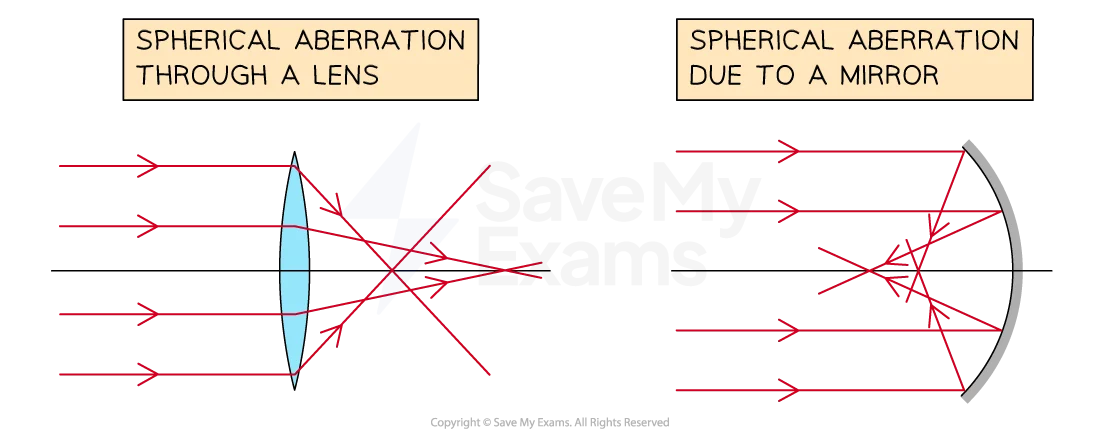
What is spherical aberration?
Rays passing through the edge of a lens or mirror focus at a different point from rays near the centre.
Spherical aberration diagram
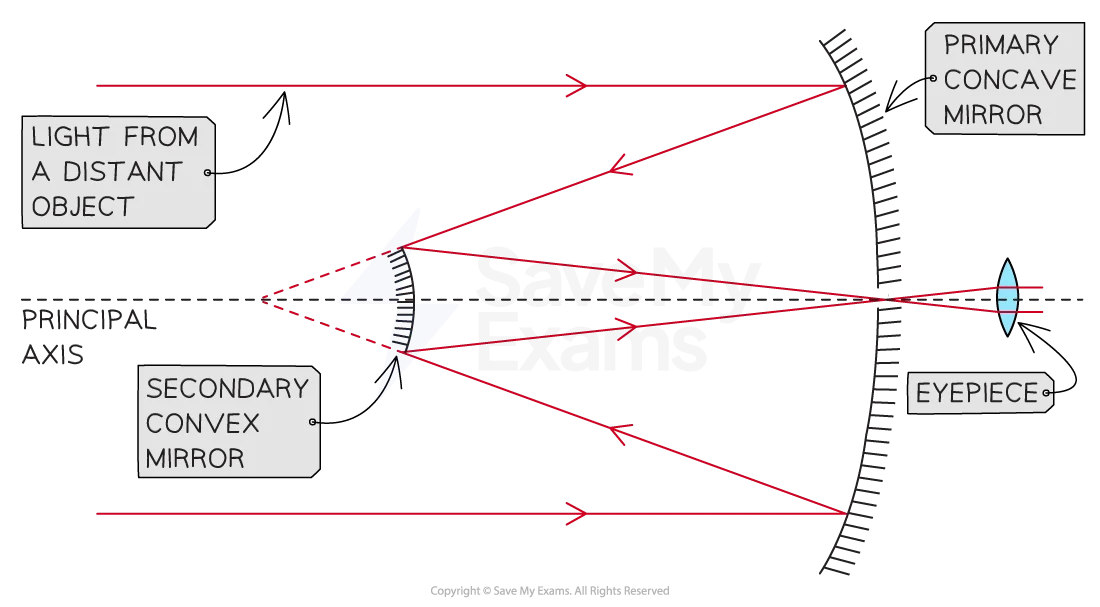
What is the Cassegrain arrangement?
The Cassegrain arrangement is a reflecting telescope design that uses a large concave primary mirror and a small convex secondary mirror.
Cassegrain arrangement diagram
What are the advantages of reflecting telescopes over refracting telescopes?
No chromatic aberration (mirrors reflect all wavelengths equally)
Large mirrors are easier and cheaper to make than large lenses
Mirrors can be supported from behind, preventing sagging
Greater collecting power because much larger mirrors can be built
Less light absorption since light does not pass through thick glass
What is collecting power?
Collecting power is a telescope's ability to collect electromagnetic radiation.
Collecting power is proportional to the diameter sqaured
What is resolving power?
Resolving power is the ability to distinguish two close objects as separate. (how much detail you can see)
What limits resolving power?
Diffraction causes light to spread out, limiting a telescope's ability to distinguish close objects.
What is an Airy disc?
An Airy disc is the bright central spot produced when light is diffracted as it passes through a telescope's circular aperture.
What is the Rayleigh criterion?
Two objects are just resolved when the central maximum of one diffraction pattern falls on the first minimum of the other.
What is the Rayleigh criterion equation?
θ = λ/D
Where:
θ = minimum angular resolution
λ = wavelength
D = diameter of objective
How can resolution be improved?
Increase objective diameter
Use shorter wavelengths
What is telescope magnification?
Magnification is the ratio of the angle subtended by the final image to the angle subtended by the object.
What is the magnification equation?
M=fo/fe
Where:
fo = focal length of objective
fe = focal length of eyepiece
What is a radio telescope?
A radio telescope uses a large dish antenna to detect radio waves from space.
Why are radio telescopes so large?
Radio waves have long wavelengths.
A larger diameter is needed to achieve good resolution.
What is radio interferometry?
Using multiple radio telescopes together to act as one large telescope.
Why do astronomers use non-optical telescopes?
Different astronomical objects emit different wavelengths of electromagnetic radiation.
Observing multiple wavelengths provides more information.
Why are infrared telescopes often placed on mountains or in space?
Water vapour in Earth's atmosphere absorbs infrared radiation.
Why are ultraviolet telescopes usually in space?
Most ultraviolet radiation is absorbed by Earth's atmosphere.
Why must X-ray telescopes be in space?
Earth's atmosphere absorbs X-rays before they reach the ground.
Why must gamma-ray telescopes be in space?
Earth's atmosphere absorbs gamma rays.
What is a CCD?
A Charge-Coupled Device (CCD) is a detector that converts incoming photons into electrical signals.
How does a CCD work?
Photons strike the CCD and release electrons.
The number of electrons produced is proportional to the intensity of the light.
How does a CCD work? 6 marks
CCD consists of an array of pixels made from silicon.
Each pixel contains a potential well to store electrons.
Incoming photons strike the silicon.
Photons release electrons (photoelectric effect).
Electrons are collected and stored in the potential wells.
The number of electrons stored is proportional to the light intensity.
Charges from each pixel are transferred across the CCD.
The charges are converted into digital signals.
A computer processes the signals to produce a digital image.
What is a pixel in a CCD?
A pixel is a small light-sensitive element that stores charge produced by incoming photons.
Why is silicon used in CCDs?
Silicon is used because when photons strike it, they can release electrons from the silicon atoms.
Silicon is a semiconductor.
What is a potential well in a CCD?
A potential well is a region in a CCD pixel where released electrons are collected and stored.
What is quantum efficiency?
Quantum efficiency is the percentage of incident photons that produce electrons.
What is quantum efficiency of the human eye?
1%
What is quantum efficiency of a CCD?
70-80%
What is quantum efficiency of photographic film?
4%
What are the advantages of CCDs over photographic film?
Higher sensitivity
Higher quantum efficiency
Detect fainter objects
Digital output
Linear response
Easy computer analysis
How is a digital image formed using a CCD?
Each pixel stores charge proportional to the intensity of light received.
A computer converts the charges into a digital image.
Ground-based vs space-based telescopes?
Ground-Based
Cheaper
Easier maintenance
Atmospheric distortion
Space-Based
No atmospheric distortion
Access to X-ray, UV and gamma-ray observations
More expensive
Reflecting vs refracting telescopes?
Reflecting
Uses mirrors
No chromatic aberration
Larger apertures possible
Refracting
Uses lenses
Chromatic aberration
More difficult to build large versions