Econ Jargon/Definitions - Foundation 2
 Call Kai
 Learn
Learn Practice Test
 Spaced Repetition
 Match
Match Flashcards
 Knowt Play
1/51

There's no tags or description
Looks like no tags are added yet.
Name | Mastery | Learn | Test | Matching | Spaced | Call with Kai |
|---|
No analytics yet
Send a link to your students to track their progress
52 Terms
microeconomics
The part of the discipline of economics that deals with individual markets and firms.
macroeconomics
The part of the discipline of economics that deals with the economy as a whole.
gross domestic product (GDP)
The dollar value of all of the goods and services produced for final sale in the United States in a year.
market basket
Goods that average people buy and the quantities they buy them in.
price of the market basket in the base year
National average of the total cost of the market basket.
GDP deflator (GDPDEF)
The price index used to adjust GDP for inflation, including all goods rather than a market basket.
real gross domestic product (RGDP)
An inflation-adjusted measure of GDP.
discouraged-worker effect vs encouraged-worker effect
Bad news induces people to stop looking for work, causing the unemployment rate to fall. vs Good news induces people to start looking for work, causing the unemployment rate to rise (until they succeed in finding work).
frictional unemployment
Short-term unemployment during a transition to an equal or better job.
structural unemployment
State that exists when people lose their jobs because of a change in the economy that makes their particular skill obsolete.
seasonal unemployment
State that exists when people lose their jobs predictably every year at the same time.
cyclical unemployment
State that exists when people lose their jobs because of a temporary downturn in the economy.
labor force productivity
The measure of productivity that is expressed as output per labor hour.
Total factor productivity or Multifactor productivity
The measure of productivity that is expressed as the output that cannot be explained by an increase in labor, capital, or materials.
business cycle
Regular pattern of ups and downs in the economy.
recovery - the part of the growth period of the business cycle from the trough to the previous peak.
expansion - The part of the growth period of the business cycle from the previous peak to the new peak.
recession - The declining period of at least two consecutive quarters in the business cycle.
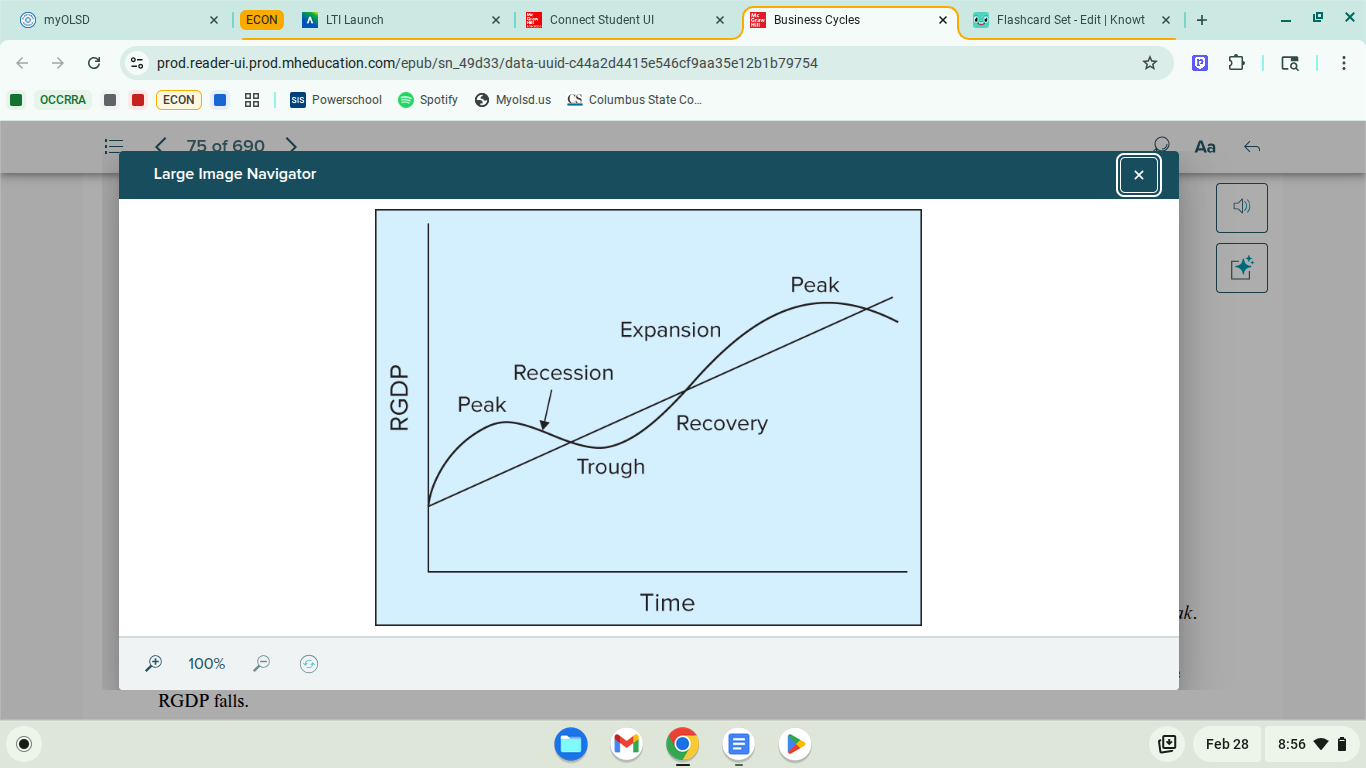
Great Moderation + Great Recession
The period from 1983 to 2007 in which economic growth was stable and inflation and unemployment were low. The two recessions the period were short in duration and shallow. + The recession that began in late 2007 and lasted through June 2009 in which unemployment peaked at 10 percent. To that point it was considered the worst post-World War II recession.
divisibility
The ability to divide money into progressively smaller units.
portability
The ability to carry money.
privacy
The attribute of money where transactions are not easily traced.
Interest rate market
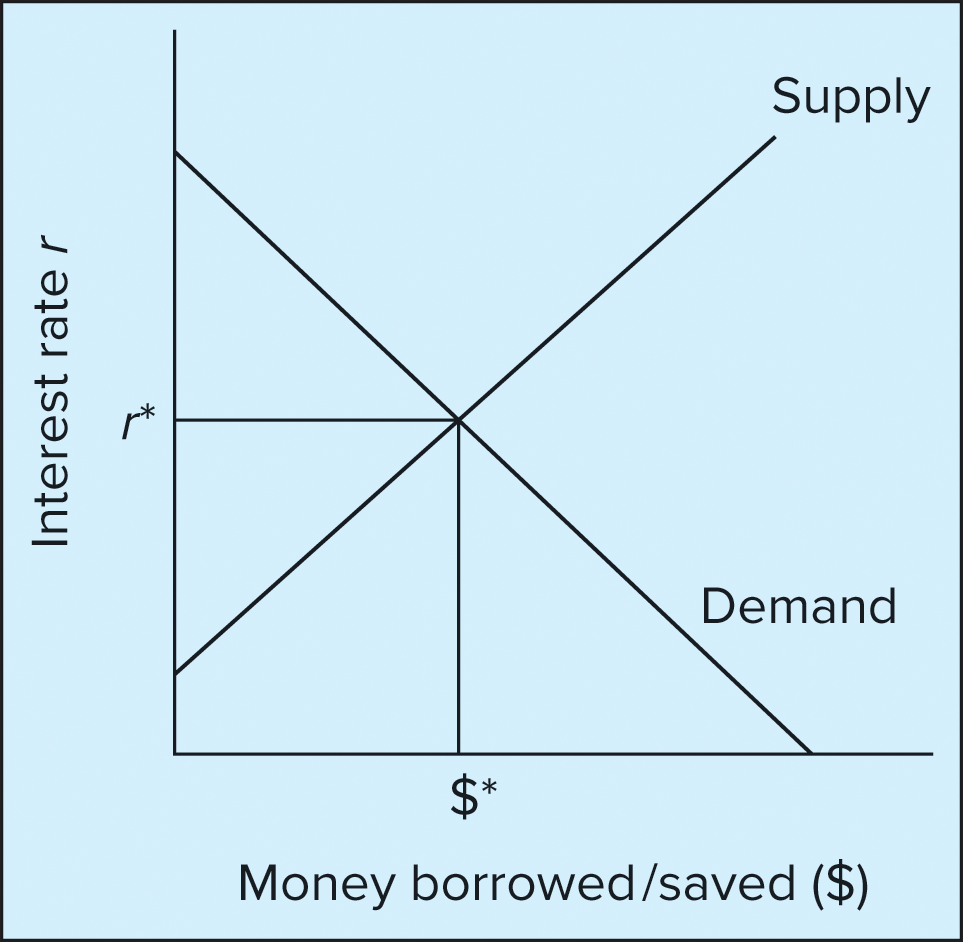
nominal vs real interest rate
advertised interest rate vs interest rate after inflation is accounted for
present value
The interest-adjusted value of future payment streams.

internal rate of return
The interest rate where the present value of costs and benefits is equal.
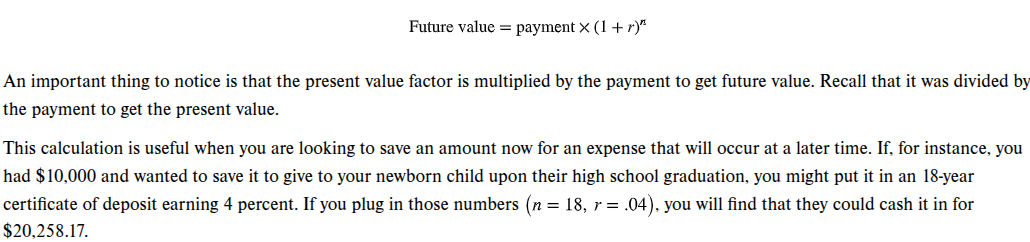
future value
The interest-adjusted value of past payments.
default vs market risk
where the borrowers doesn’t pay the debts vs where the market value of a stock or bond changes unexpectedly
risk premuim
The reward investors receive for taking greater risk.
yield curve
The relationship between reward and the time until the reward is received.
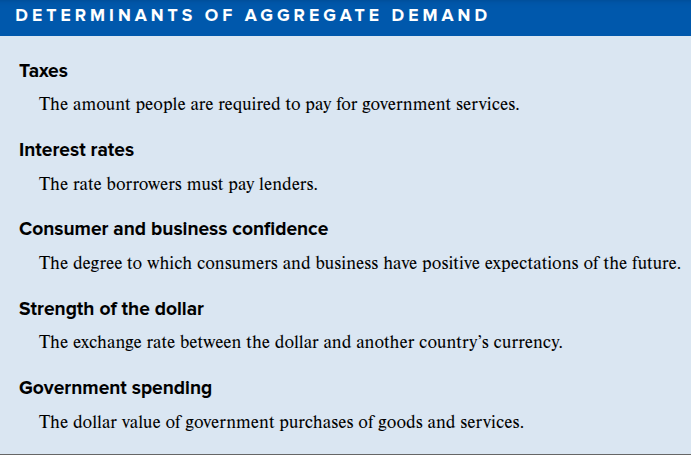
aggregate demand (AD)
The amounts of real domestic output that domestic consumers, businesses, governments, and foreign buyers collectively will desire to purchase at each possible price level.
anything that affects the components of GDP will effect it.
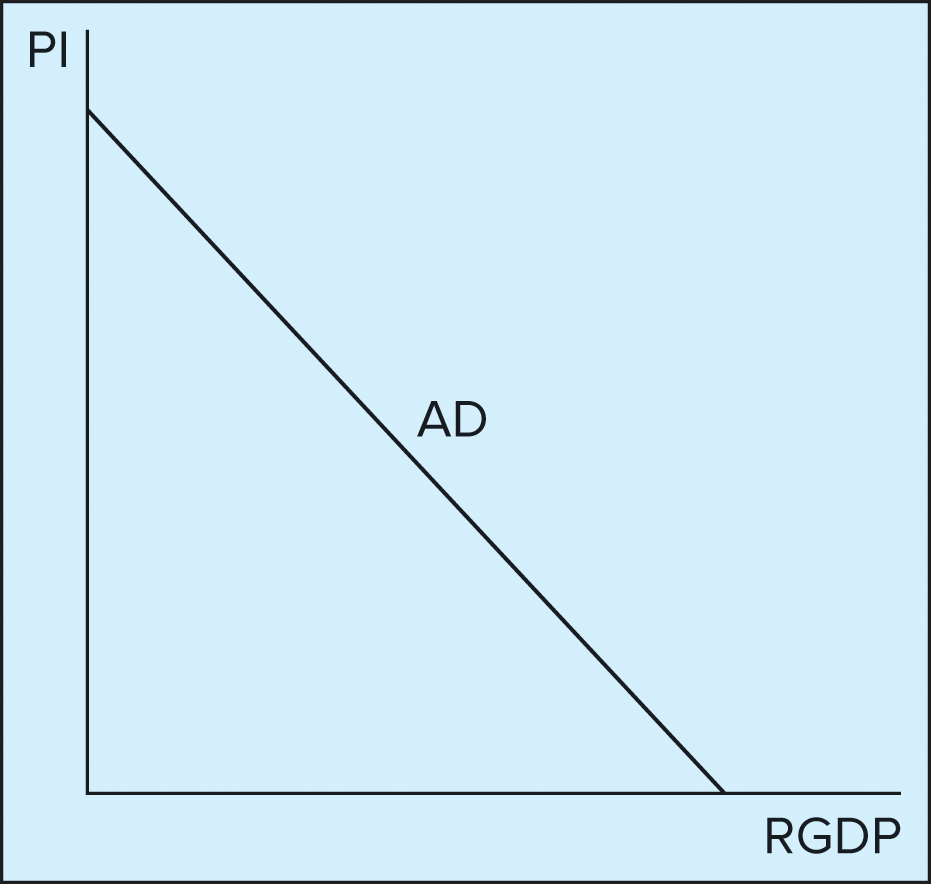
Real balances effect
Because higher prices reduce real spending power, prices and output are negatively related. How much society has in terms of forms of money that bear no interest.
foreign purchases effect
When domestic prices are high relative to their imported alternatives, a country will export less to foreign buyers and a country will import more from foreign producers. Therefore, higher prices lead to less domestic output.
interest rate effect
Higher prices lead to inflation, which leads to less borrowing and a lowering of RGDP.
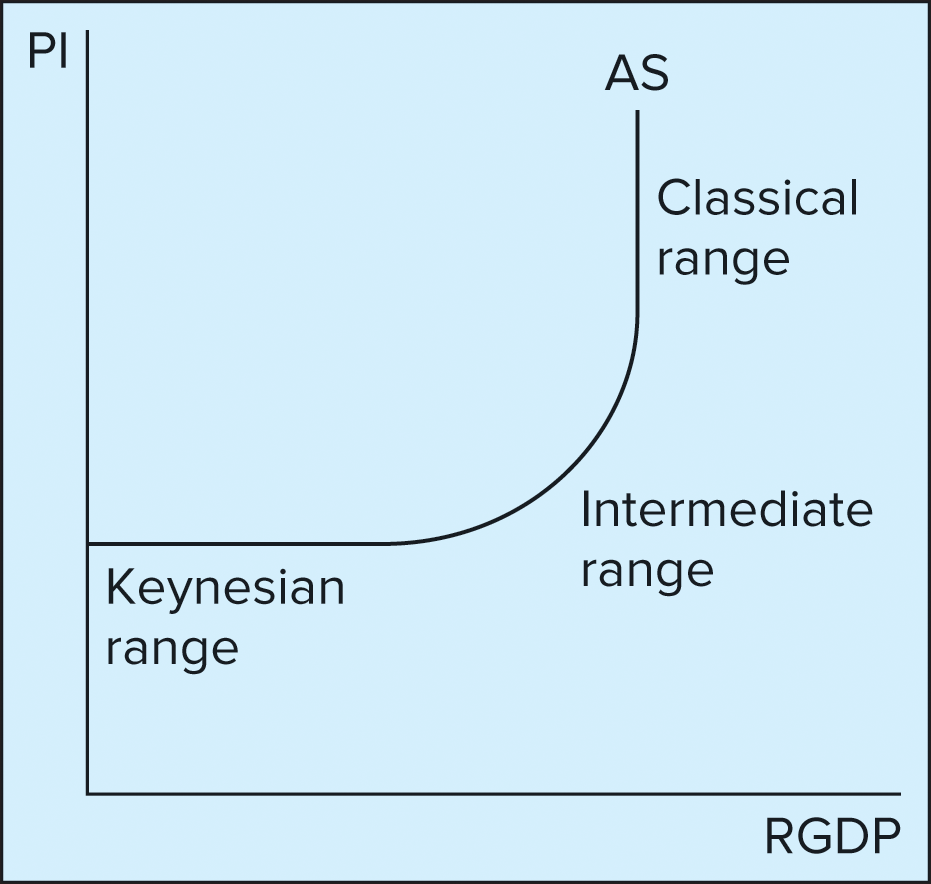
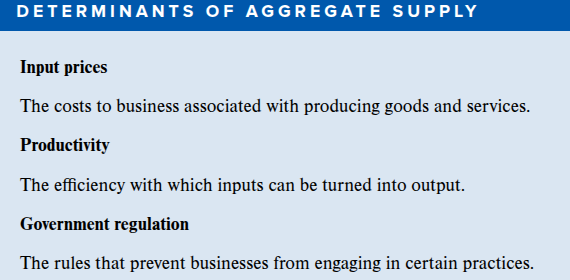
aggregate supply (AS)
The level of real domestic output available at each possible price level.
full employment
The level of unemployment that would exist if cyclical unemployment were zero.
classical vs keynesian
people who don’t get a minimum wage job because they want better don’t count and we are always at full employment vs we are never going to be at full employment because there will never be enough jobs because there can always be more.
determinants of aggregate demand
determinants of aggregate supply
demand-pull inflation and cost-push inflation
D: Inflation caused by an increase in aggregate demand.
C Inflation caused by a decrease in aggregate supply.
supply-side economics
Government policy intended to influence the economy through aggregate supply by lowering input costs and reducing regulation.
absolute advantage
The ability to produce a good better, faster, or more quickly than a competitor.
comparative advantage
The ability to produce a good at a lower opportunity cost of the resources used.
terms of trade
The amount of a good one country must give up to obtain another good from the other country, usually expressed as a ratio.
outsourcing (off-shoring)
A firm’s use of contractors to perform services that were previously performed within the firm. (A form of outsourcing where the services are performed in another country.)
dumping
The exporting of goods below cost to drive competitors out of business.
balance of payments
The accounting system for how money moves between countries to facilitate the purchase of goods, services, financial instruments, and physical investments.
current account
The portion of the balance of payments accounting that represents the impacts of trade, short-term investment payments, and American payments of foreign taxes, foreign payments of American taxes, and the net transfer of private money.
capital account
The net flow of assets when people enter or leave the United States, pay gift or inheritance taxes in another country, or transfer intellectual property (copyrights, patents, and trademarks).
financial account
Represents the changes in holding of longer-term financial and physical assets by citizens of one country in another country.
foreign exchange
The conversion of the currency of one country for the currency of another.
floating exchange rate system
Foreign exchange rate system where there is no government control over exchange rates.
fixed exchange rate system
Foreign exchange rate system whereby the country (or group of countries) must stand ready to purchase or sell its currency in exchange for foreign currencies or gold so that any excess demand or excess supply is immediately eliminated.
gold standard
The use of gold to achieve a fixed exchange rate system. Under such as system, each currency would be worth a specific amount of gold.
managed float exchange rate system
Foreign exchange rate system whereby governments decide the range of exchange rates they will allow the market to create, and act only when either the top end or the bottom end of that range is breached.