BU288 Final Exam - Greg Irving
 Call Kai
 Learn
Learn Practice Test
 Spaced Repetition
 Match
Match Flashcards
 Knowt Play
1/63

There's no tags or description
Looks like no tags are added yet.
Name | Mastery | Learn | Test | Matching | Spaced | Call with Kai |
|---|
No analytics yet
Send a link to your students to track their progress
64 Terms
What is Conflict?
• A process that begins when one party perceives that another party has negatively affected, or is about to negatively affect something that the first party cares about.
What are the causes of conflict?
Breakdowns in Communication
Value Clashes
Personality Clashes
Culture Clashes
Work Policies and Practices
Adversarial Management
CONFLICT: Define Breakdowns in Communication
• Breakdowns in Communication - greatest sources of personal conflict, happens often
CONFLICT: Value Clashes
• Value Clashes - differences in values, people have different values on what's right and wrong)
- Can be avoided in the HR system where they select specific employees that share values
- Socialization (taking someone from the outside and getting them socialized before entering the organization)
CONFLICT: Personality Clashes
• Personality Clashes people have different communication styles, different levels of dominance, people who are detailed oriented (can clash with others)
CONFLICT: Culture Clashes
• Culture Clashes - people of different cultures are forced to work together, people from these backgrounds can clash because of their diff values, economies
CONFLICT: Work Policies and Practices
• Work Policies and Practices - when an organization has confusing standards on wages, benefits, and more. People see little correlation between job performance and compensation
CONFLICT: Adversarial Management
• Adversarial Management - where a supervisor may regard employees/managers as the enemy. It makes it difficult to give or receive constructive criticism
What are the 3 strategies for dealing with conflict?
1. Win/Lose - where conflict is limiting by having one person win
- Achieved at the expense of someone else
- Used depending on severity, short term, situations where people cannot agree on anything
- Loser may feel anger, resentment, feelings of upset - will try to regain their position
2. Lose/Lose - eliminates by having both individuals lose something
- Both parties must give in to one another
- May have a neutral third party that imposes a solution
- Distributive approach
3. Win/Win
- Integrative approach
- Creating a trusting atmosphere
What are the 5 dimensions for conflict-handing intentions? Any of these approaches are appropriate for the right circumstances
1. Avoiding
- Low on cooperative & assertiveness
- Used: when it's minor issue, when it will waste time and energy
2. Accommodating
- High on cooperativeness & low on assertiveness
- Used: When it's not of concern to one of the parties, picking your battles
3. Compromising
- Medium on cooperativeness & assertiveness
- Used: there really isn't one best way, both parties have good points
4. Competing
- Low on cooperativeness & high on assertiveness
- Used: when you feel extremely strong about your opinion, don't really care about the other party
5. Collaborating
- High on cooperativeness & high on assertiveness
- Similar to a win win, both parties disucss the issues and find a mutually beneficial decision
What is Stress?
• Stress is a person's adaptive response to a stimulus that places excessive psychological or physical demands on that person.
- Things people are stressed over:
- Work life
- Health issues
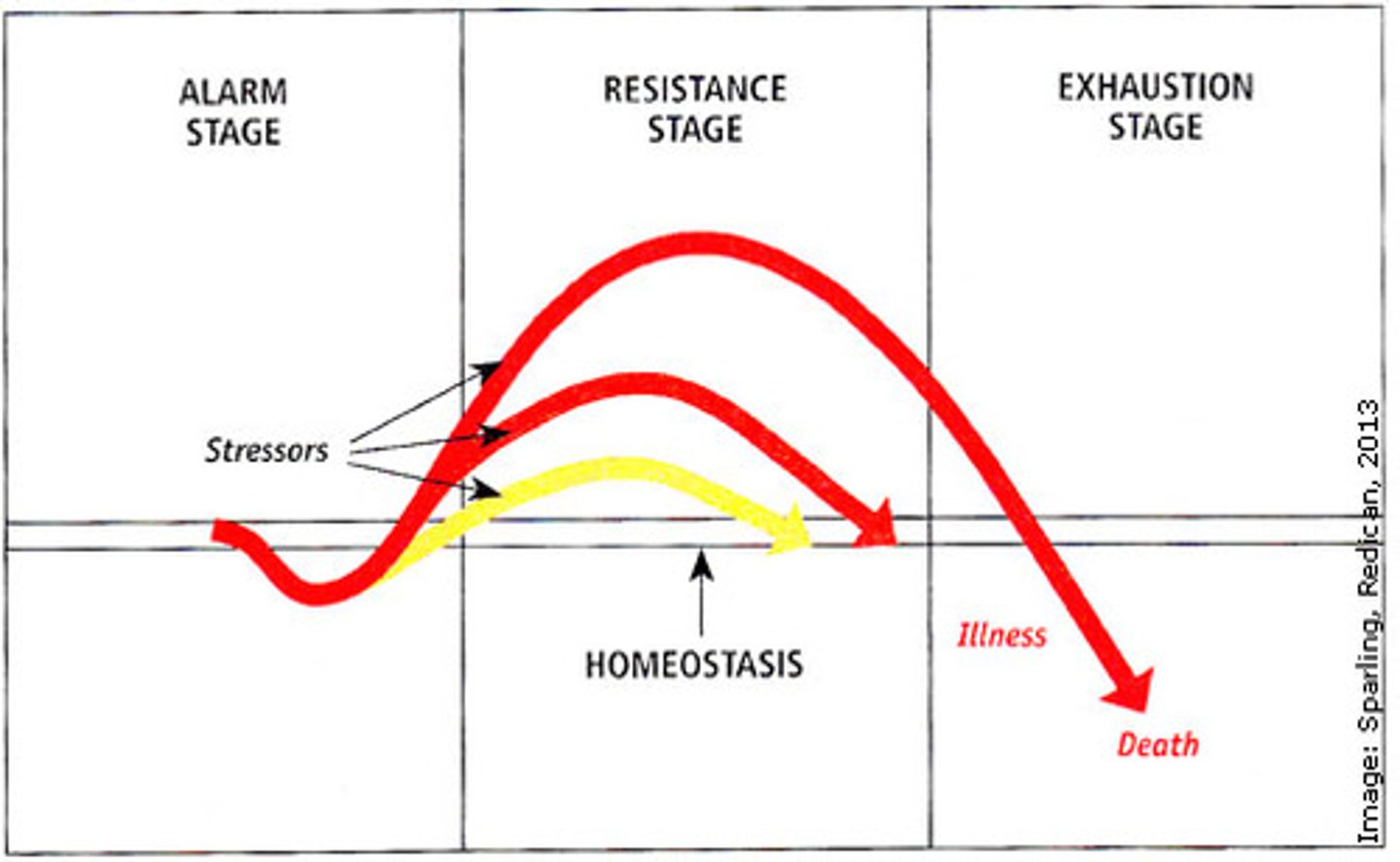
What is GAS? What are the 3 stages?
• The General Adaptation Syndrome, or GAS, describes three stages of the stress process:
• How people react to stressors
• Stage 1: Alarm - where the person encounters the stressor, mobilize the resources
• Stage 2: Resistance - where you learn to cope with the stressor
• Stage 3: Exhaustion - reserves depleted
What is good stress? bad stress?
• Eustress
- Good stress!
Ex.The pleasurable stress that accompanies positive events. For example, a person may receive a $5,000 bonus and experience stress deciding how to spend the money.
• Distress
- Bad stress
Ex. The unpleasant stress that accompanies negative events. For example, a person gets fired and experiences stress regarding having no income.
What are the two types of people?
- Type A: very competitive, devoted to work, have a sense of time urgency
- Type B: less competitive, less devoted to work, less sense of time urgency
What are the characteristics of Type A?
• Intense sense of time urgency - people are always racing against the clock
• Inappropriate aggression/hostility - very competitive
• Polyphasic behaviour - basically multitasking (toaster in the car)
• Goal directedness without proper planning - will rush into work without knowing how to accomplish the desired results (wasted time + errors later)
• Work focused; achievement oriented, impatient
What is Hardiness and Optimism?
• Hardiness
- A person's ability to cope with stress.
- Strongly committed to the activities of their lives
- View changes as an opportunity of growth
• Optimism
- The extent to which a person sees life in relatively positive or negative ways.
- Glass half full vs half empty type person
- Optimistic people handle stress a little better in comparison
What are Organizational Stressors? AKA Causes of stress.
- Tasks demands (stressors associated with a specific job that a person performs)
- Occupation (firefighters, police officer, surgeon)
- Security
- Overload
- Physical demands
- Temperature (miners)
- Office design
- Role demands
- Ambiguity (rises when a role is unclear)
- Conflict (when the messages and cues are clear but contradictory/mutually exclusive)
- Overload (occurs when expectations for the role exceed capacity lawyers are expected to product 80 billable hours)
- Interpersonal demands
- Group pressures
- Leadership style
- Personalities
What are the Individual Consequences of Stress?
1. Behavioural
- Alcohol abuse
- Drug abuse
- Violence
2. Psychological
- Sleep disturbances
- Depression
3. Medical
- Heart disease
- Headaches
What are the Organizational Consequences of Stress?
1. Decline in performance
- need some stress to kickstart motivation
2. Absenteeism and Turnover
3. Decreased motivation and satisfaction; burnout
What are some individual coping strategies to stress?
- Exercise
- Relaxation
- Time Management
- Support Groups
- Role Management
What are some organizational coping strategies to stress?
Organizational Coping Strategies
- Programs outside the organization that they pay for to deal with stress (blackberry used to pay for their employees gym memberships)
- Institutional Programs
- Collateral Programs
What is leadership?
Leadership - the influence that particular individuals exert on the goal achievement of others in an organizational context
- Implies that it largely involves influencing others
What are the two types of leadership theories?
Trait leadership
Behavioural Leadership
What is trait leadership?
Trait - born to be a leader, methodology includes finding a leadership characteristic (drive, motivation, integrity, confidence) and then observing people
What is behavioural leadership?
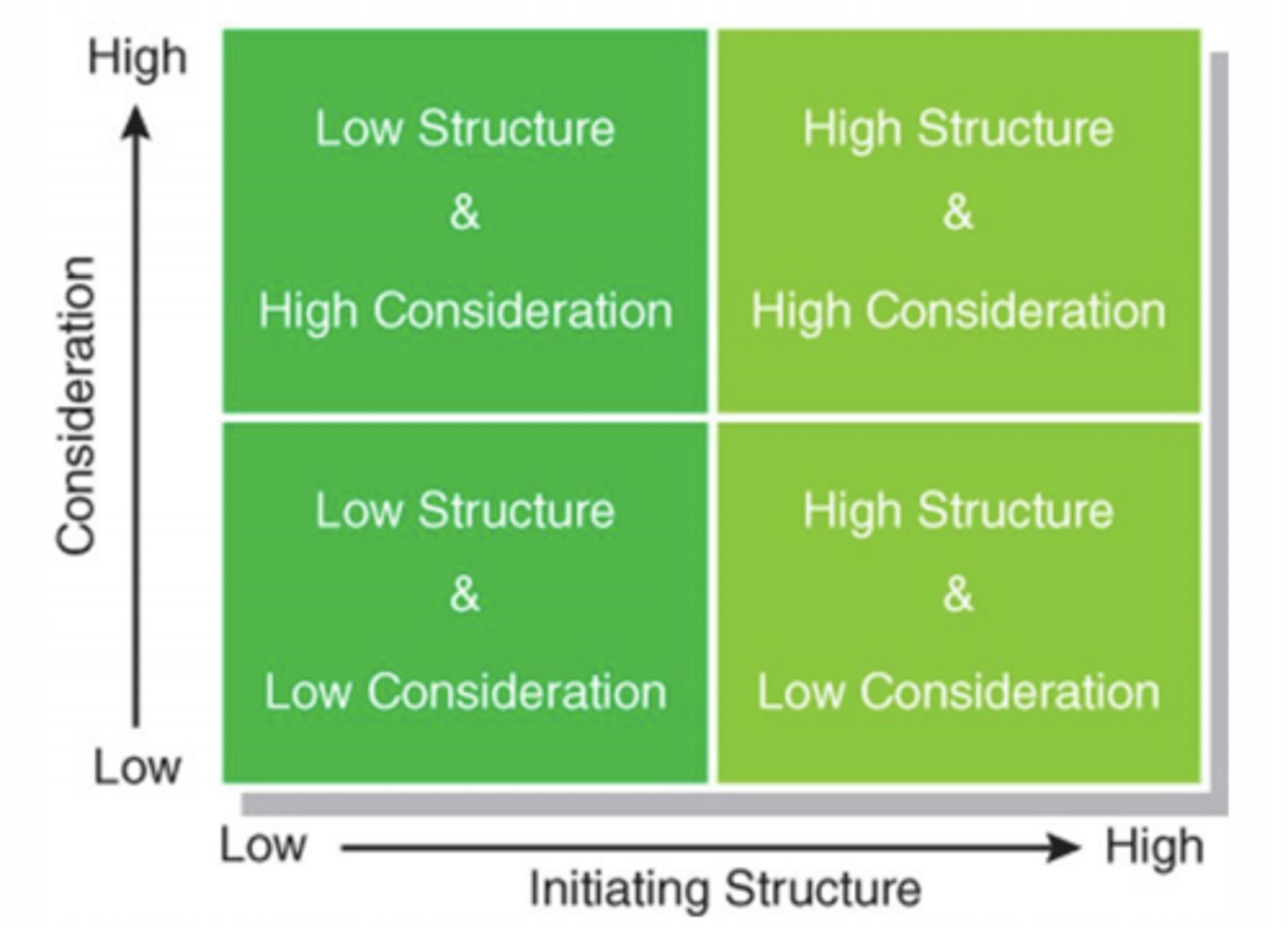
Behavioural - finding what do leaders do to make them effective (shifted from traits to leadership behaviour)
Consideration - the degree to which the supervisor's behaviour communicates respect and mutual trust/warmth. Encourage 2-way communication, good rapport, friendly, approachable
Initiating structure - describes the leaderships role in terms of organizational goals, organize and drive group activities
What is Fiedler's LPC Contingency Theory
Situational Approach: Fiedler's LPC Contingency Theory
- Effective leadership is a joint function between a leader and the function where the leadership is exercised
• The Least Preferred Coworker
- Task Oriented Leader (Low LPC) - uses positive terms to describe (focused on tasks not relationships)
- Relationship Oriented Leader (High LPC) - uses negative terms (focused on relationships not tasks)
What is situational control? Explain the 3 factors that relate to situational control.
• Situational Control (favorable to leader)
- Low Situational Control (negative leader-member relations, low task structure, low position power)
- High Situational Control (positive leader-member relations, high task structure, strong position power)
1. Leader members relations - the degree to which the group likes and trusts the leader to follow them
2. Leader position power - what is the power that the leader has? Promote, demote
3. Task structure
What is contingency approach? What are the 4 elements? Explain.
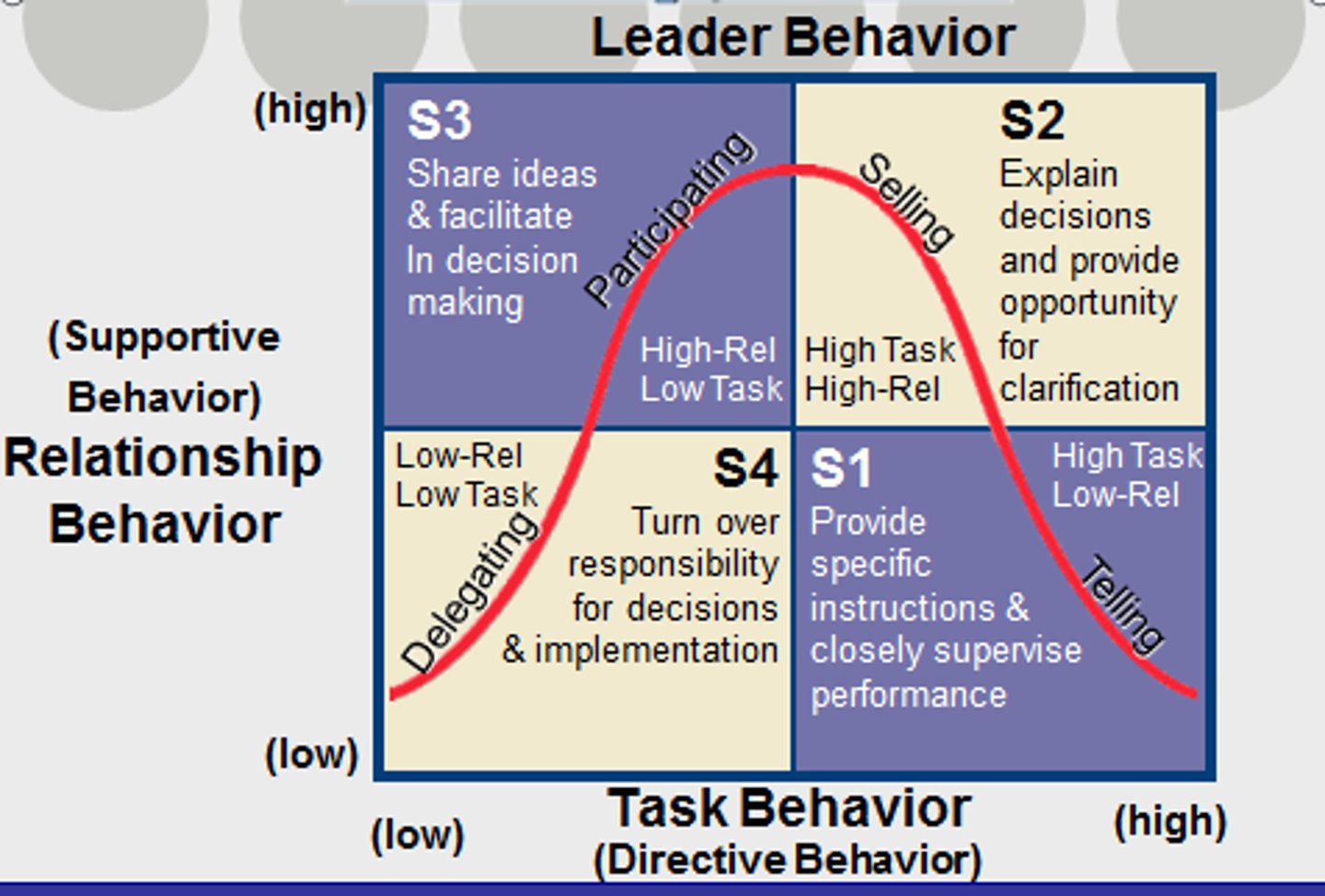
• Directive: informs subordinates of expectations, gives guidance, shows how to do tasks
• Supportive: friendly and approachable, shows concern for status, well-being and needs of subordinates
• Participative: consults with subordinates, solicits suggestions, takes suggestions into consideration
• Achievement oriented: sets challenging goals, expects subordinates to perform at highest level, continuously seeks improvement in performance, has confidence in highest motivations of employees
What are some characteristics of charismatic leaders?
· Articulate a vision (vision that is often appealing and optimistic)
· Use strong, expressive communication
· Take personal risks (self-sacrifices)
· Express optimism and confidence
· Model behaviors consistent with vision
· Build identification with group
· Empower followers
What are the 4 dangers to charismatic leaders?
- Excessive confidence and optimism blind leader to real dangers
- Dependence on the leader inhibits development of competent successors
- Failure to develop successor creates an eventual leadership crisis
- Denial of problems and failures reduces organizational learning
What is the difference between ethical and unethical charismatic leaders?
1. Ethical Charismatic Leaders
- Focus on organization's goals
- Encourage open, two-way communication
- Willing to accept criticism
- Positive future for all
2. Unethical Charismatic Leaders
- Focus on personal goals
- Expect autocratic
- Top-down communication
- Believe they are infallible
- Prey on fears
What is socialization?
• Socialization is the process by which people learn the norms and roles that are necessary to function in a group or organization.
• Goals are to assimilate
Socialization is an ongoing process. Describe the 3 stages.
1. Anticipatory socialization - happens before going into the organization, people develop their own sense through research, job fairs
2. Encounter - immediately after entry, includes orientation and selection process, information package
3. Role management - after they've been a member for some time, increasing awareness of group norms, culture norms
What are the key methods of socialization?
• Organizations differ in terms of who does the socializing, how it is done, and how much is done.
• Many organizations make use of the following methods of socialization:
- Realistic job previews
- Employee orientation programs
- Socialization tactics
- Mentoring
What are realistic previews?
Realistic Job Previews - giving a picture on the positives and negatives of the job
• Give applicants a good idea of what the job looks like, most applicants don't have a good picture of what the job looks like
- Employers want you to apply! Make their job look more desirable
- Realistic job previews reduce turnover
• The provision of a balanced realistic picture of the positive and negative aspects of a job to job applicants.
• They provide "corrective action" to expectations at the anticipatory stage of socialization.
• The realistic job preview process can be compared to the traditional preview process.
What are theoretical explanations of RJP functioning? (4)
• Met Expectations - lower job expectations to what's congruent, jobs that match expectations are more satisfying
• Air of Honesty - suggests that realistic job previews communicate honesty who then feel greater degree of freedom in their organizations choice, if you have more choice then you feel more committed
• Ability to Cope - realistic job previews make it easier to cope with the difficult aspects of the job, prereherse responses
• Self-Selection - people who look at an RJP will decide whether the job is for them (organization - person fit)
What are socialization tactics?
manor of structure of early work experience of newcomers
What are institutionalized socialization tactics?
- Collective - as a group. Ex. grouped in first year
- Formal - involve segregating new members from regular members/formal learning experiences Ex. first year students are fully separated from other years
- Sequential - fixed sequence of steps Ex. set of events laid out
- Fixed - timetable for assumption of new role Ex. end of O-week you're considered Golden Hawk
- Serial - process where newcomers are socialized by experienced members
- Investiture - confirms the identity of new hires Ex. designed to be inclusive, identity has value
What are individualized socialization tactics?
- Individual - as an individual.
- Informal - do not distinguish + informal job experiences
- Random - ambiguous
- Variable - no set time frame
- Disjunctive - does not include formal role models
- Divestiture
What is a psychological contract?
• a person's set of expectations regarding what he or she will contribute to the organization and what the organization, in turn, will provide to the individual
Transactional
looking for something immediate in return
Relational
social change relationship, friendships (know that they'll do something for you in the future)
What are some contributions from the individual vs the organization?
• Contributions from the Individual
- Effort
- Ability
- Loyalty
- Skills
- Time
- Competencies
• Contributions from the Organization
- Pay
- Job Security
- Benefits
- Career Opportunity
- Status
- Promotion
What is the psychological contract violation?
The psychological contract violation is when one's set of expectations is violated. There are two types this can happen.
1. Perceived breach of contract
2. Interpretation process.
What is a perceived breach in contract
Perceived Breach in contract - perceived discrepancy between what they promised vs what was delivered
This may lead to... Psychological contract violation - developing a negative perception/being angry/upset
What are the factors leading to beach of contract?
1. Reneging --> wilfully broke the contract
- Inability - inability to fulfill the contract, too much was promised (more promised, more unfulfilled)
- Unwilling - saying no because they can, may have power asymmetry, employee behaviour, and type of exchange
2. Incongruence --> differing views about the nature of the contact
- Divergent schemata
- Communication
What is the interpretation process?
Interpretation process --> depends if it's the organizations fault or beyond their control (attribution theory)
What is organizational culture?
• The shared beliefs, values, and assumptions that exist in an organization.
• These shared beliefs, values, and assumptions determine the norms that develop and the patterns of behaviour that emerge from these norms.
CULTURE - NORMS - BEHAVIOUR
What are some contributions to culture?
• Many cultures, especially strong cultures, reflect the values of an organization's founder.
• Top management strongly shapes an organization's culture.
• Sometimes, the culture begun by the founder can cause conflict when top management wishes to see an organization change directions.
• The precise nature of the socialization process is a key to the culture that emerges in an organization.
• Organizations with strong cultures go to great pains to expose employees to a careful step-by-step socialization process.
What are some forces for organizational culture?
• Nature of the work force
• Technology computers/smartphones
• Economic shocks stock market, housing crisis, interest rates
• Competition
• Social trends social media, certain boycotts,
• World politics
What are the 5 sources of individual resistance to change?
1. Habit - taking the same route to work
2. Security - feeling like your job may be taken away
3. Economic factors - economic security is threatened
4. Fear of the unknown - how do you know how well you'll perform on a new task
5. Selective information processing - confirmation bias, selectively process information consistent with our beliefs
What are the 6 threats to organizational resistance to change?
1. Structural inertia - choosing people who will maintain the status quo so it's more difficult to change
2. Limited focus of change - changing an interdependence system effects all aspects (more likely to fail)
3. Group inertia - group norms powers in influencing behaviour
4. Threat to expertise
5. Threat to established power relationships
6. Threat to established resource allocations
What is Lewin's Three-Step Change model?
Unfreezing
• Arouse dissatisfaction with current state
• Figure out what's wrong with the association and discover what to change
• Activate and strengthen top management support
• Use participation in decision making
• Build in rewards
Movement
• Establish goals
• Institute smaller changes
• Develop management structures for change
• Maintain open, two-way communication
Refreezing
• Build success experience
• Reward desired behaviours
• Develop structures to institutionalize change
• Make change work!!!

How to overcome resistance to change?
Overcoming Resistance to Change
• Education and Communication
• Participation
• Facilitation and Support - when employees fears and anxieties are high, give them skill training/counselling
• Negotiation
• Manipulation and Cooptation - twisting facts, creating false rumours
• Coercion - direct threats on resisters
What are the 4 barriers to effective communication?
• Filtering
- Refers to a sender manipulating information so that it will be seen more favorably by the receiver.
• Selective Perception
- Receivers in the communication process selectively see and hear based on their needs, motivations, experience, background, and other personal characteristics.
• Defensiveness/Emotions
- When individuals interpret another's, message as threatening, they often respond in ways that retard effective communication
- How you feel can affect how you interpret a message
• Language
- Words mean different things to different people.
Problems Cross Cultural Communication?
• Effective communication is difficult under the best of conditions. There are four specific problems related to language difficulties in cross-cultural communication.
- There are barriers caused by semantics.
- There are barriers caused by word connotations.
- There are barriers caused by tonal differences.
- There are barriers caused by differences among perceptions.
What four rules that are helpful when communicating with people from a different culture?
1. Assume differences until similarity is proven.
2. Emphasize description rather than interpretation or evaluation.
3. Practice empathy.
4. Treat your interpretations as a working hypothesis.
What is utilitarianism?
§ Utilitarian (think of the Trolly problem)
§ Behavior is ethical if it delivers the greatest good to the greatest number of people
§ Focus on outcomes; ends justify the means
§ Promotes efficiency, productivity
§ Ignores rights of some individuals (someone is going to get hurt at the end of the day)
§ Difficult to apply to values that cannot be easily quantified (e.g., health, life, employment)
What are rights?
§ Rights
§ Behavior is ethical if it respects the fundamental rights shared by all human beings
§ e.g., Charter of Rights and Freedoms (free speech, due process, etc.)
§ Protects individuals from injury consistent with freedom and privacy
§ Creates overly legalistic environment
Hinders productivity and efficiency
What is justice/equity theory?
§ Justice (think of equity theory)
§ Behavior is ethical if it is fair and impartial in its treatment of people
§ Impose and enforce rules fairly
§ Protects interests of under-represented and less powerful
§ Encourages sense of entitlement
§ Difficult to agree on the definition of "fairness"
§ Reduces risk-taking, innovation and productivity
What is the ford pinto case?
- Basically, they discovered there was a flaw in the vehicle (the placement of the gas tank resulted in the car bursting in flames when in a rear end collisions)
- Did not take a lot to go up in flames
- Based on the analysis it's easier to pay out the victims then make the vehicle safe
§ What decision criteria were used?
- They followed utilitarianism because they decided that the ends justified the means, they chose the cars over the life
§ What issues does this raise?
- Hard to set a value on a human life
§ What other issues should have been considered?
- peoples feelings/families, more
5 Barriers to an Ethnical Organization
§ Ill-Conceived Goals - some goals encourage negative behaviours (Ex. Wells Fargo bank account fiasco)
§ Motivated Blindness - when we overlook the unethical behaviour of others when it's in our interest to remain ignorant (Ex. major league baseball
§ Indirect Blindness - hold others less accountable for unethical behavior when it's carried out by third parties (Ex. suicide/apple/foxcon outsourcing work)
§ The Slippery Slope - less able to see other people's unethical behviour when it develops gradually (ex. auditor is engaging in questionable behaviour but it gets worse and worse)
§ Overvaluing Outcomes
What are the 5 bases of power?
1. Coercive power - threatening to fire, exerting power --> employees will resist
2. Reward power - capacity to allocate rewards --> employees will comply
3. Legitimate power - refers to the right to request reasonable actions (your title) --> employees will comply
4. Expert power - special knowledge/expertise possessed by superior --> employees will commit
5. Referent
Resource Dependancy Model of Power
If B is dependant on A, then A has power over B