Module 2: Solid Mechanics Fundamentals - Constitutive Laws and Elasticity
 Call Kai
 Learn
Learn Practice Test
 Spaced Repetition
 Match
Match Flashcards
 Knowt Play
1/7

There's no tags or description
Looks like no tags are added yet.
Name | Mastery | Learn | Test | Matching | Spaced | Call with Kai |
|---|
No analytics yet
Send a link to your students to track their progress
8 Terms
E = stress/strain → stress = E*strain
vij = -(transverse strain)/applied straini
formulas to know off by heart
elasticity: the material returns completely to its original shape/dimensions when the load is removed (i.e. zero permanent/plastic deformation)
linear: stress and strain are directly proportional, governed by Hooke’s law
σ=Eε
graphically: the stress-strain relationsihp plots as a straight line with a constant slope
What does the “linear” refer to in “linear elasticity”? What does the “elasticity” mean?
fits model (linear elastic):
structural metals: steel, aluminium, titanium (under normal loads/below yield point)
hard tissues: cortical bone, teeth (under normal physiological loads)
brittle materials: glass, ceramics (linear right up to fracture)
does not fit model:
soft biological tissue: muscles, tendons, skin, blood vessels (viscoelastic; time-dependent)
rubber/elastomers: highly elastic, but non-linear (S-shaped stress-strain curve)
articular cartilage: poroelastic (matrix mixed with fluid flow)
Name some materials which can be described by the linear elastic model (under certain loading conditions). Name some materials which cannot be described well by the linear elastic model.
stiffness matrix ([C]): converts strains to stresses
σ=[C]ε
it defines how much force/stress is required to cause a unit of deformation
compliance matrix ([S]): converts stresses to strains
ε=[S]σ
it defines how flexible or compliant the material is under a given load
they are the mathematical inverse of each other [S] = [C]-1
What is the stiffness matrix? The compliance matrix?
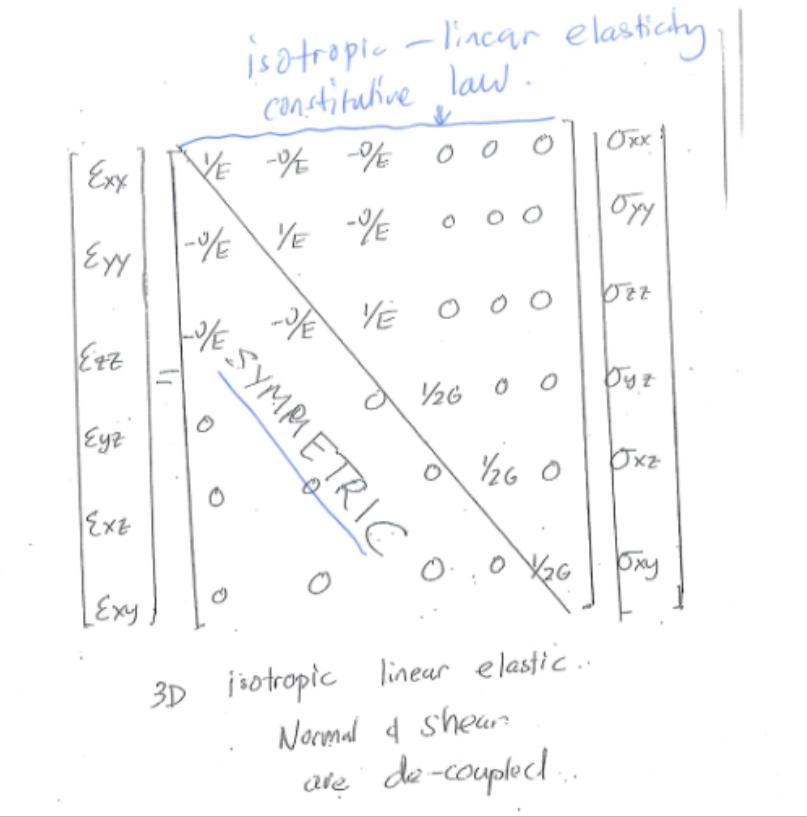
the formula: strains are related to stresses via the compliance matrix
E (Young’s Modulus): found on the main diagonal for normal components; dictates axial stretching
v (Poisson’s ratio: found on the off-diagonals for normal components; accounts for lateral contraction (hence the negative signs)
G (shear modulus): found on the main diagonal for shear components where G = E/2(1+v)
crucial behaviour: normal stresses/strains and shear stresses/strains are completely uncoupled (the upper right and lower left blocks are entirely zeros)
Be familiar with the compliance matrix for isotropic linear elastic materials. You will be given this in the formulae sheet but should know the terms and how they look in matrix form
orthotropy: material properties are different in three mutually perpendicular (orthogonal directions)
3 unique axes of symmetry: x ≠ y ≠ z
e.g. wood, cortical bone
transverse isotropy: material properties are different along one primary axis, but are identical (isotropic) in the plane perpendicular to that axis
1 unique axis, and a rotational plane of symmetry (x ≠ y, but y = z)
e.g. skeletal muscle, tendons
Using sketches/diagrams/examples, illustrate the concepts of orthotropy and transverse isotropy.
isotropic: 2 independent constants (typically Young’s Modulus E and Poisson’s Ratio v; Shear Modulus G is dependent: G = E/2(1+v)
transversely isotropic: 5 independent constant (accounts for 1 unique axial direction and 1 symmetrical plane)
orthotropic: 9 independent constants (accounts for 3 mutually perpendicular, distinct directions of symmetry)
a completely (anisotropic) material would require 21 independent constants
How many independent elastic constants are there for (1) an isotropic, (2) a transversely isotropic; (3) an orthotropic material
set up geometry and coordinates
draw FBD
define global coordinate system unless already given
list knowns and boundary conditions
write down all known stress components from applied loads or pressures
write down all known strain components or displacement boundary conditions
identify material and choose constitutive law
determine the symmetry of the material: isotropic (2 constants), transversely isotropic (5 constants), or orthotropic (9 constants)
select the correct matrix equation system
assumption: assume the material’s local coordinate axes perfectly align with your global coordinate system
solve algebraically
compute the unknown stresses and strains using the matrix rows
because normal and shear components are completely uncoupled in these materials, you can separate the math into smaller, independent sub-problems, the system will always be deterministic (equal equations and unknowns)
Know the steps of solving general linear elastic equations. (i) Draw a diagram
and define a coordinate system (unless already given); (ii) Write down all the
stresses and strains known. (iii) Decide on the material type (isotropic,
transversely isotropic or orthotropic) and choose the right constitutive law; (iv)
solve for the unknown stresses and strains. (Hint) shear and normal stresses are
uncoupled and the problem will always be deterministic.