Law and Citizens test
 Call Kai
 Learn
Learn Practice Test
 Spaced Repetition
 Match
Match Flashcards
 Knowt Play
 Podcast
1/62

There's no tags or description
Looks like no tags are added yet.
Name | Mastery | Learn | Test | Matching | Spaced | Call with Kai |
|---|
No analytics yet
Send a link to your students to track their progress
63 Terms
Rules
Regulations or guideline imposed upon the members of specific group so they work together in a peaceful manner
Laws
Formal rules that are designed to govern the way in which people behave so we can live together in one peaceful, united society. Laws apply to everyone in society. They’re purpose is to maintain order, protect people and ensure fairness.
Rules vs Laws
Rules are made by a group or organisation and only applies in that setting, while a law is made by parliament and applies to everyone in society. If you break a law the consequences are more serious than breaking a rule.
Principles of Australia’s Justice system
All individuals are equal before the law
The judiciary is Independent and impartial
Individuals have the right to a reasonable appeal
What are the 2 main types of law in Australia
Criminal Law and Civil Law
Criminal Law
A body of law that protects the community. It establishes crimes and sets sanctions for those who commit crimes, e.g. murder, theft, assault ect.
Purpose of Criminal Law
To punish wrongdoing and protect society.
Consequences of criminal law
If found guilty, a sanction may be imposed
Parties in criminal law
Prosecution (the state)
The accused
Sources of Criminal Law
Statute Law - laws made by parliament.
Common Law - developed by judges on a case-by-case basis.
Areas of criminal law
offences against the sovereign
offences against the person
public order offences
economic offences
preliminary crimes
driving offences
drug offences
Standard and burden of proof for criminal law
The accused is innocent until proven guilty (burden proof)
prosecution must prove that the accused committed the crime beyond a reasonable doubt, so they must be certain and theres no other possible outcome. (standard proof)
Summary offences
Is a less serious offences e.g. minor theft or assault, that is heard in the magistrates Court. It can result in fines or imprisonment for up to 2 years. There is a strict short limitation period that is usually 12 months. Finally trail called a hearing.
Indictable offences
Is a more serious crime e.g. murder, armed robbery, sexual assault ect,m that is heard in higher courts like the country or supreme court. It has a right to trail by a judge and a jury. It can result in heavier penalties. There is no limitation period meaning charges can be laid many years after the event.
Civil Law
Regulates disputes between individuals and groups. These are private disputes (don’t involve the state), e.g. tort law (trespass, defamation, nurisance ect), Contract, divorce, ect.
Purpose of Civil law
To remedy the situation, to resolve these conflicts and make things right for the victim
Consequences of Civil law
Compensation (usually financial) for injustices or damages.
Parties in Civil law
Plaintiff - the party who initiates/commences a civil action against another party
Defendant - the person accused of a crime
Sources of civil law
Common law - based of judges decisions
Statute law - law made by parliament
Areas of civil law
Defamation
Consumer
Trespass
Immigration
Negligence
Contracts
Nusiance
Torts
Bankruptcy
Property
Family
Employment
Tax
Resolving a civil dispute
Civil disputes are resolved through alternative dispute resolution methods such as mediation, conciliation and arbitration, or through court proceedings if ADR is unsuccessful.
Standard and burden of proof for civil law
Decisions are made on the balance of probabilities (standard of proof)
The plaintiff must prove there case (burden of proof)
Remedies in Civil Law
Court can make you pay damages to the plaintiff
Court can also order an injunction
Precedent
An earlier event, action or decision that is used as an example or guide for similar situations in the future.
Binding precedent
A legal principle from a higher court decision that lower courts must follow in similar cases in future.
Persuasive precedent
A decision that a court can consider and therefore use a source of influence but don’t have to follow. It may come from same-level court, lower courts or even courts in another country.
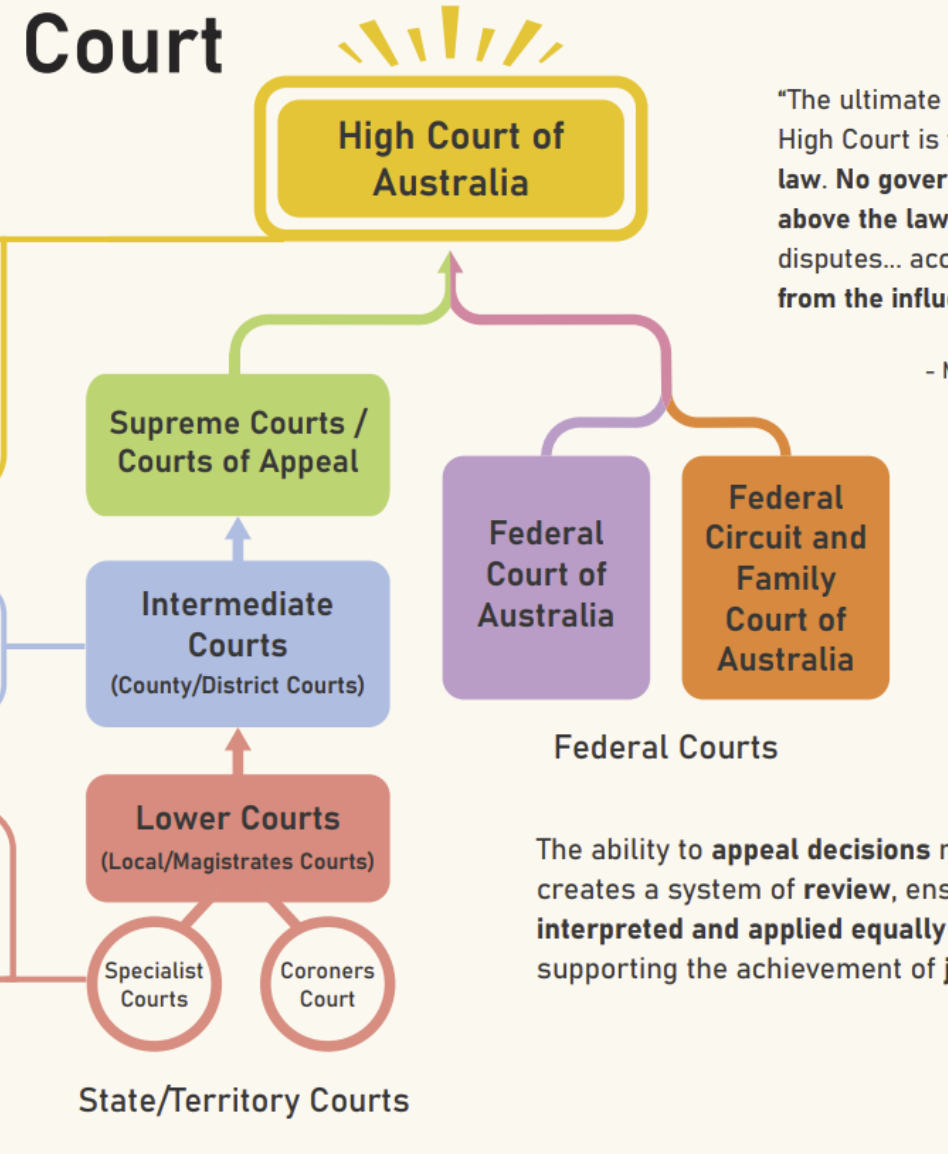
Australian court hierarchy
The ranking of courts, to organise courts and allow appeals
Jury
A group of citizens selected to decide a verdict.
Role of the jury
Listen to all the evidence
Concentrate during trail
Piece the evidence together and decide whether the accused is guilty or not
Trail by Jury
Is when a group of ordinary citizens listen to evidence in a case and decide whether the accused is guilty or not guilty.
Composition of a jury
A jury of 12 is selected in country or supreme court
Selected at random
Must be over the age of 18
Selection of jurors - why people will be unable to serve
Ineligible - Not allowed to serve on a jury at all
Disqualified - Legally barred from jury duty
Excused - Allowed to skip jury duty for a valid reason
Challenges - Lawyers can reject potential jurors
Strengths of the jury
Independent and impartial, community involvement, fairness, spreads responsibility and reflects community values.
Weaknesses of the jury
No reason for their decisions and occur behind closed doors, difficult, unduly influences, biases, may result in delays
Factors courts consider in sentencing
Current sentencing practices - usual punishment for similar crimes
Maximum penalty - highest legal punishment
Victim circumstances - harm caused to victim
Mitigating and aggravating factors
Mitigating Factors
Facts or circumstances about the offender that can lead to a less severe sentence
Acting under Duress - They were pressured or threatened into doing it.
Showing remorse - They show they feel genuinely sorry, e.g. apologies, confessing, cooperation and pleading guilty early
Aggravating Factors
Facts or circumstances about the offender or the offence that can lead to a more serve sentence
Prior offending - They’ve committed crimes before.
Nature & gravity of offence - Offending is on the high end of the scale of seriousness, use of weapons, and intentional conduct of the offender
Constitution
A set of rules and laws that explain how a countries governed, how power is divided and the right and responsibilities of government.
Australian Constitution
The written document that sets rules of how Australia is governed. it explains the powers of the federal + states governments and how laws are made.
Specific powers
Powers that are specially listen in the constitution and are given to the federal commonwealth government such as immigration, trade, ect
Residual powers
Powers not listed in the constitution meaning they remain under the state government such as education, police, ect
Referendum
A vote by Australians to decide whether the constitution should be changed. To pass majority much agree.
3 main purposed of Australian constitution
sets up government structure (how they work together)
Divides powers (federal/state)
Produces rules for law making
Relationship between high court and constitution
High court interprets the constitutions laws, decides if laws are valid and resolves conflict between federal and state
Types of Law making powers
Exclusive - federal only can make laws in these areas
Concurrent - both can make laws but if conflict federal overrides
Residual - powers not mentioned in the constitution
Express rights vs implied rights
Express- rights clearing written in the constitution e.g. freedom of religion
Implied - rights not directly written but interpreted by the high court, e.g. freedom of political communication
Sanction
A penalty imposed on a person who has breached criminal law
Statutory authority
A body or organisation that is established by parliament to make laws of its behalf e.g. local councils, australia post or vic roads
Presumption of Innocence
A person is considered innocent until proven guilty.
Trial
A formal court hearing to decide a case.
Bail
Temporary release before trial, usually with conditions.
Remedy
A remedy is the solution or outcome a court gives to fix a civil wrong.
negligence
When someone fails to take reasonable care, and that causes harm to another person.
Breach of Contract
Where one individual believes another fails to fulfil the terms of a legally binding agreement.
Defamation
A type of civil action where one party makes false statements that cause another party to lose their reputation.
Jurisdiction
The legal power to make legal decisions and judgements
Statutory interpretation
when a judge is called to resolve a dispute in which the existing legislation is unclear and needs to be interpreted.
Ratio Decidendi
The legal reasoning behind a judge’s decision. it is the binding part of the precedents.
Stare Decisis
The principle that courts should follow previous decisions in similar cases to ensure consistency in the law.
Obiter Dictum
Extra comments made by a judge that are not part of the legal reason for the decision and are not binding.
Actus Reus
The physical act of committing a crime.
Mens rea
The intention or mental element of a crime.
Beyond a reasonable doubt
The jury or judge must be certain the accused committed the crime. And theres no other possible outcome