Week #9 - Mitochondria and the Chloroplasts

0.0(0)
Studied by 0 people
call kaiCall Kai
learnLearn
examPractice Test
spaced repetitionSpaced Repetition
heart puzzleMatch
flashcardsFlashcards
GameKnowt Play
Card Sorting

1/40

encourage image

There's no tags or description

Looks like no tags are added yet.

Last updated 5:59 AM on 4/17/26
Name
Mastery
Learn
Test
Matching
Spaced
Call with Kai

No analytics yet

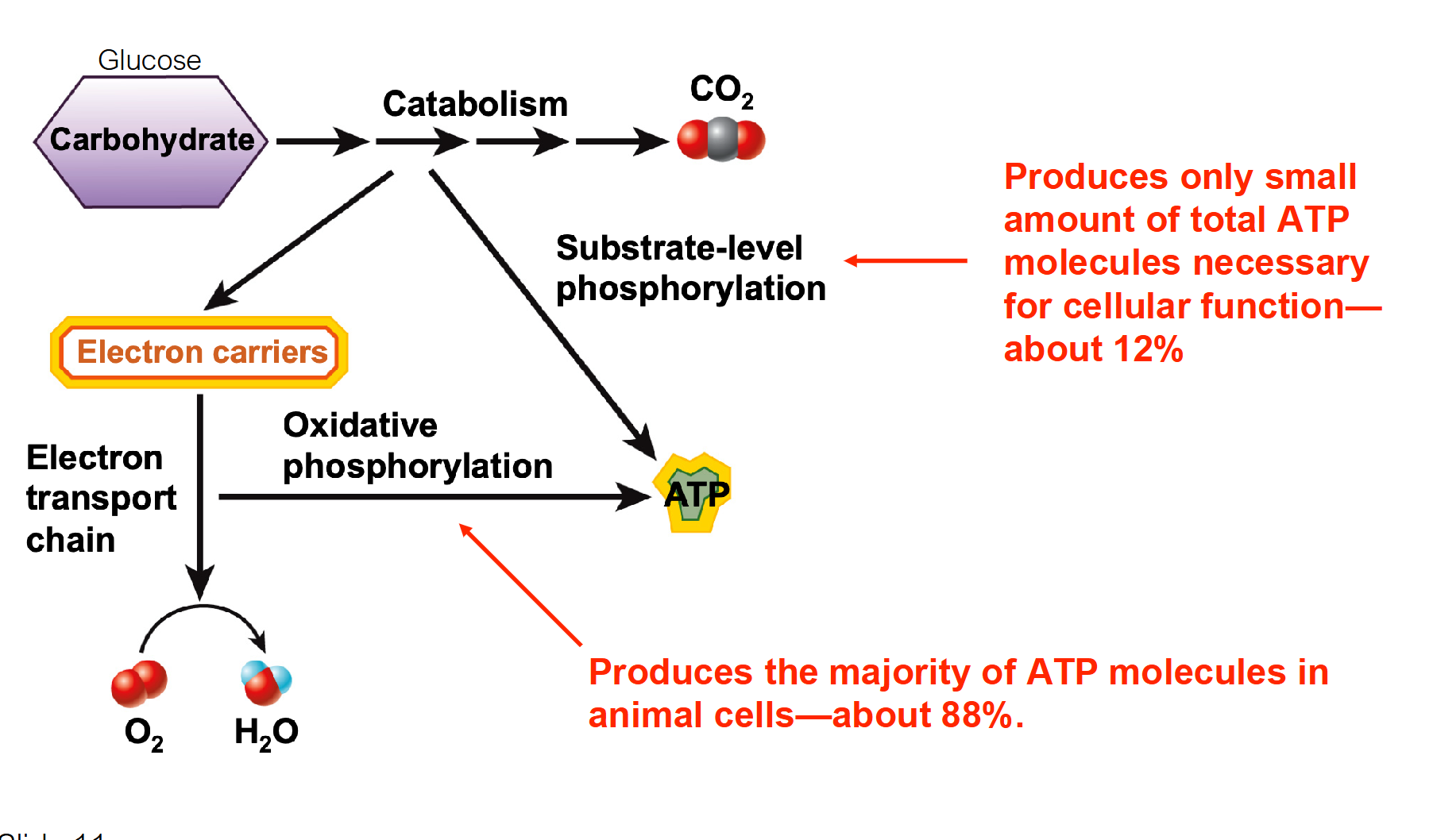
Send a link to your students to track their progress

41 Terms

1
New cards

Overview of Cell Signaling

  • All cells process information (signals) from the environment.

  • Chemical – a nutrient, waste, ion, hormone

  • Physical stimulus - light, sound or temperature

  • Signals can come from outside the organism or from other cells within the organism.

  • In multicellular organisms, signals may be transmitted over a short or a great distance.

  • To detect and respond to a signal, a cell (target) must have a specific receptor that can detect it.

  • When a cell detects a signal, it initiates a signal trans-duction pathway -- sequence of molecular events and chemical reactions -- that lead to a response to the signal

2
New cards

What are the four key characteristics of signal transduction pathways?

  • Specificity

    • Receptor proteins have very specific binding sites for chemical signal molecules (= ligands).

  • Ligand binding causes receptor protein to change shape

    • Shape change activates receptor (e.g., kinase activity)

  • Activated receptor alters function of a responder protein.

    • The signal is amplified - more than one responder molecule in cell

  • Response is executed

    • Responder activates/deactivates other cellular effectors

    • Cell activity is altered

<ul><li><p><span>Specificity</span></p><ul><li><p><span>Receptor proteins have very specific binding sites for chemical signal molecules (= ligands).</span></p></li></ul></li><li><p><span>Ligand binding causes receptor protein to change shape</span></p><ul><li><p><span>Shape change activates receptor (e.g., kinase activity)</span></p></li></ul></li><li><p><span>Activated receptor alters function of a responder protein.</span></p><ul><li><p><span>The signal is amplified - more than one responder molecule in cell</span></p></li></ul></li><li><p><span>Response is executed</span></p><ul><li><p><span>Responder activates/deactivates other cellular effectors</span></p></li><li><p><span>Cell activity is altered</span></p></li></ul></li></ul><p></p>
3
New cards

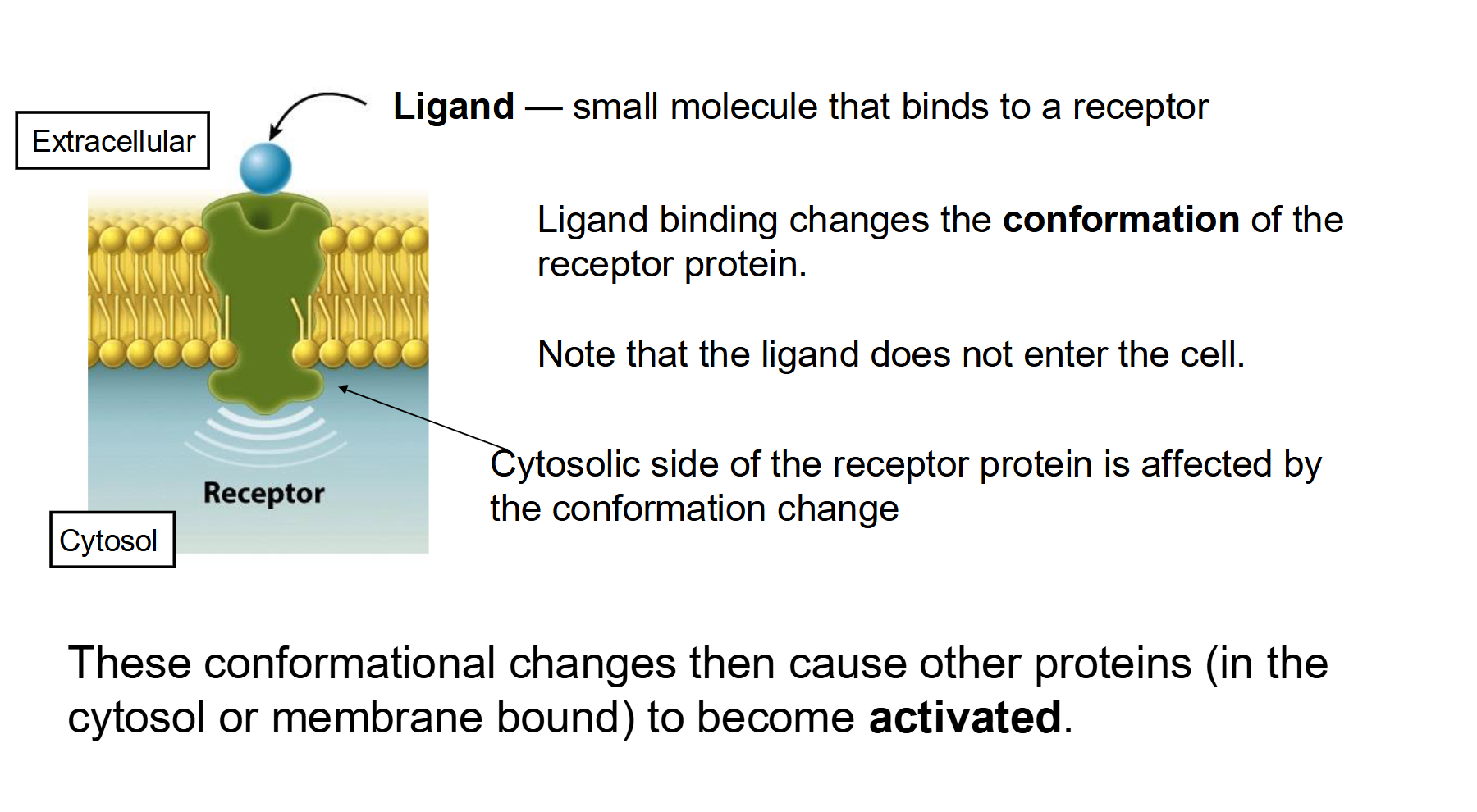
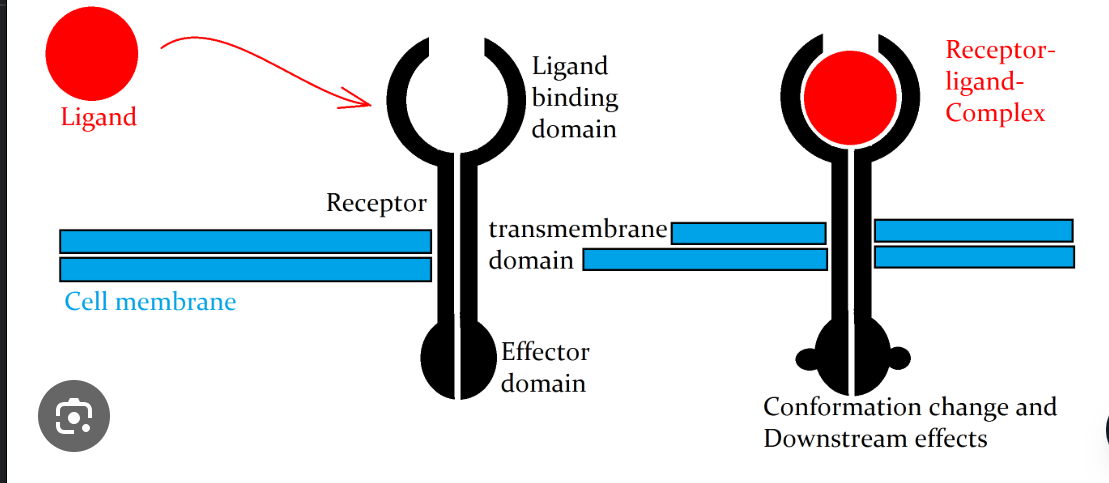
What is a ligand in the context of cell signaling, and how does it initiate a response?

A ligand is a specific signaling molecule (such as a hormone, neurotransmitter, or growth factor) that binds to a complementary receptor protein.

  • Mechanism: The binding of a ligand is highly specific (like a lock and key). When it binds to the extracellular domain of a receptor, it induces a conformational change (shape change) in the receptor.

  • Function: This shape change "activates" the receptor, allowing it to relay the signal to the interior of the cell to trigger a transduction cascade.

  • Example from notes: In glycogenolysis, Epinephrine acts as the ligand that binds to the adrenergic receptor on liver cells to start the process of glucose release.
<p>A ligand is a specific signaling molecule (such as a hormone, neurotransmitter, or growth factor) that binds to a complementary <strong>receptor</strong> protein.</p><ul><li><p><strong>Mechanism:</strong> The binding of a ligand is highly specific (like a lock and key). When it binds to the extracellular domain of a receptor, it induces a <strong>conformational change</strong> (shape change) in the receptor.</p></li><li><p><strong>Function:</strong> This shape change "activates" the receptor, allowing it to relay the signal to the interior of the cell to trigger a transduction cascade.</p></li><li><p><strong>Example from notes:</strong> In glycogenolysis, <strong>Epinephrine</strong> acts as the ligand that binds to the adrenergic receptor on liver cells to start the process of glucose release.</p></li></ul><p></p>
4
New cards

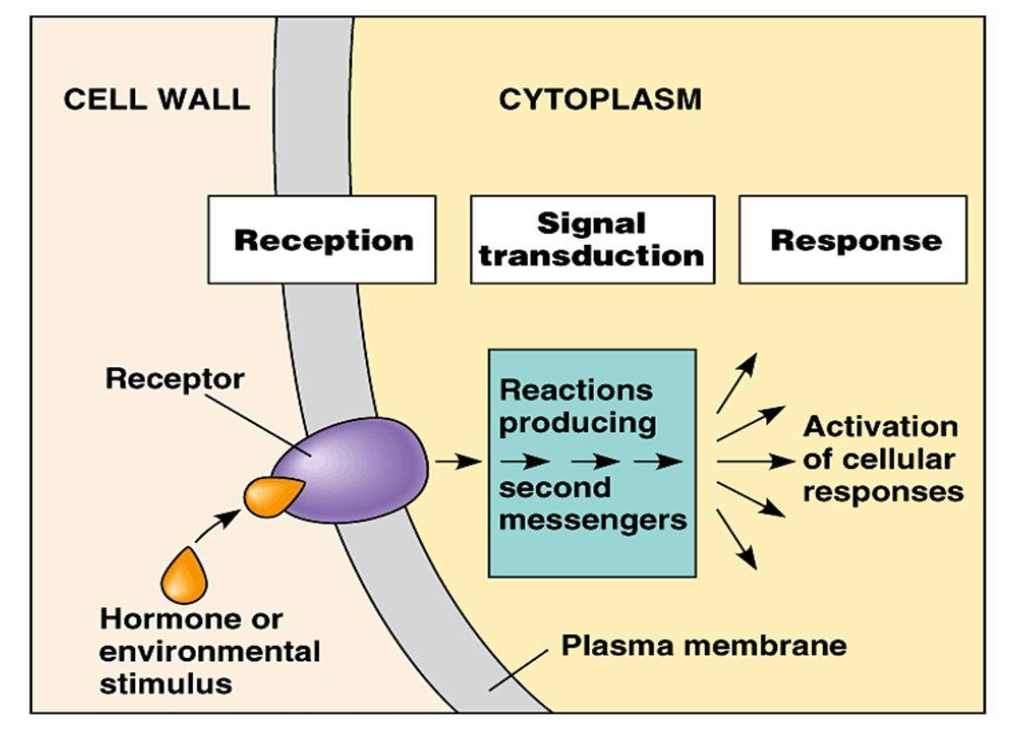
Describe the three sequential stages (and components) of a signal transduction pathway

  • Components: Signal and Receptor

  • Reception: Ligand binds to a receptor, causing a conformational change.

  • Transduction: The signal is relayed through the cell via second messengers or protein cascades (e.g., phosphorylation).

  • Response: The final cellular activity occurs (e.g., gene expression, enzyme activation, or movement).

    • Initiated by receptor

    • Transduced and amplified by other cellular molecules

    • Ultimately causes change in target cell
<ul><li><p>Components: Signal and Receptor</p></li><li><p><strong>Reception:</strong> Ligand binds to a receptor, causing a conformational change.</p></li><li><p><strong>Transduction:</strong> The signal is relayed through the cell via second messengers or protein cascades (e.g., phosphorylation).</p></li><li><p><strong>Response:</strong> The final cellular activity occurs (e.g., gene expression, enzyme activation, or movement).</p><ul><li><p>Initiated by receptor</p></li><li><p>Transduced and amplified by other cellular molecules</p></li><li><p><strong>Ultimately causes change in target cell</strong></p></li></ul></li></ul><p></p>
5
New cards

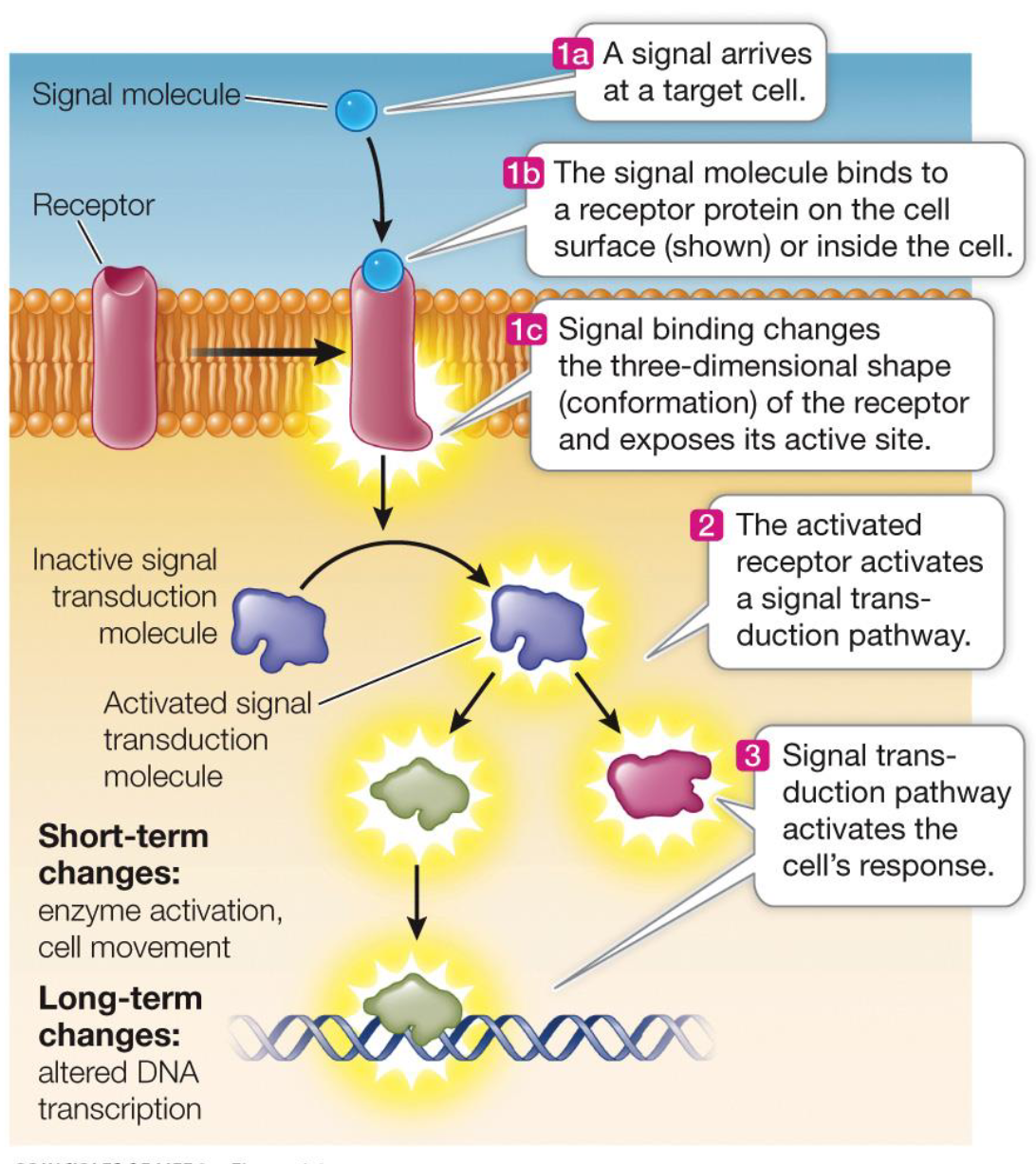
How does signal transduction utilize allosteric regulation and amplification to produce a cellular response?

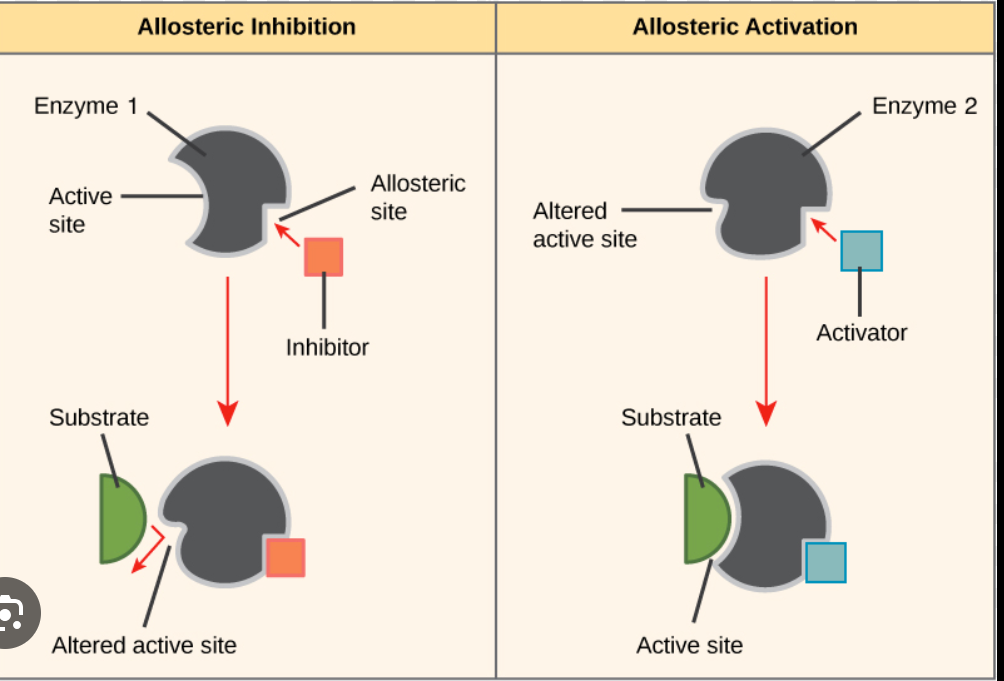
  • Allosteric regulation occurs when the binding of a molecule to a specific site on an enzyme—other than the active site—induces a conformational change that either activates or inhibits the enzyme's activity.

  • Signal transduction often involves enzymes that undergo shape changes.

  • This is frequently triggered by phosphorylation (adding a phosphate group), which acts as a molecular switch to activate or inhibit the enzyme.

  • Amplification: A single activated enzyme can catalyze many reactions. This creates a "cascade" effect where one original signal molecule results in a massive internal response.

  • Response Types:

    • Short-term: Rapid changes like opening an ion channel.

    • Long-term: Slower, lasting changes like alteration of gene expression in the nucleus.
<ul><li><p>Allosteric regulation occurs when the binding of a molecule to a specific site on an enzyme—other than the active site—induces a conformational change that either activates or inhibits the enzyme's activity.</p></li><li><p>Signal transduction often involves enzymes that undergo shape changes. </p></li><li><p>This is frequently triggered by <strong>phosphorylation</strong> (adding a phosphate group), which acts as a molecular switch to activate or inhibit the enzyme.</p></li><li><p><strong>Amplification:</strong> A single activated enzyme can catalyze many reactions. This creates a "cascade" effect where one original signal molecule results in a massive internal response.</p></li><li><p><strong>Response Types:</strong> </p><ul><li><p><strong>Short-term:</strong> Rapid changes like <strong>opening an ion channel</strong>.</p></li><li><p><strong>Long-term:</strong> Slower, lasting changes like <strong>alteration of gene expression</strong> in the nucleus.</p></li></ul></li></ul><p></p>
6
New cards

What are the primary differences between a ligand and phosphorylation in a signal transduction pathway?

  • Ligand (The Signal):

    • Role: The "First Messenger" that initiates the process.

    • Location: Usually extracellular (outside the cell).

    • Action: Binds specifically to a receptor to cause a shape change.

    • Example: Epinephrine (Adrenaline).

  • Phosphorylation (The Switch):

    • Role: A modification that acts as a "molecular switch" during transduction.

    • Location: Intracellular (inside the cytoplasm).

    • Action: A Kinase (enzyme) adds a phosphate group (PO4) to a protein, causing an allosteric change that activates or inhibits it.

    • Source: Derived from ATP.

7
New cards

Signal Transduction Cascade Using Kinases

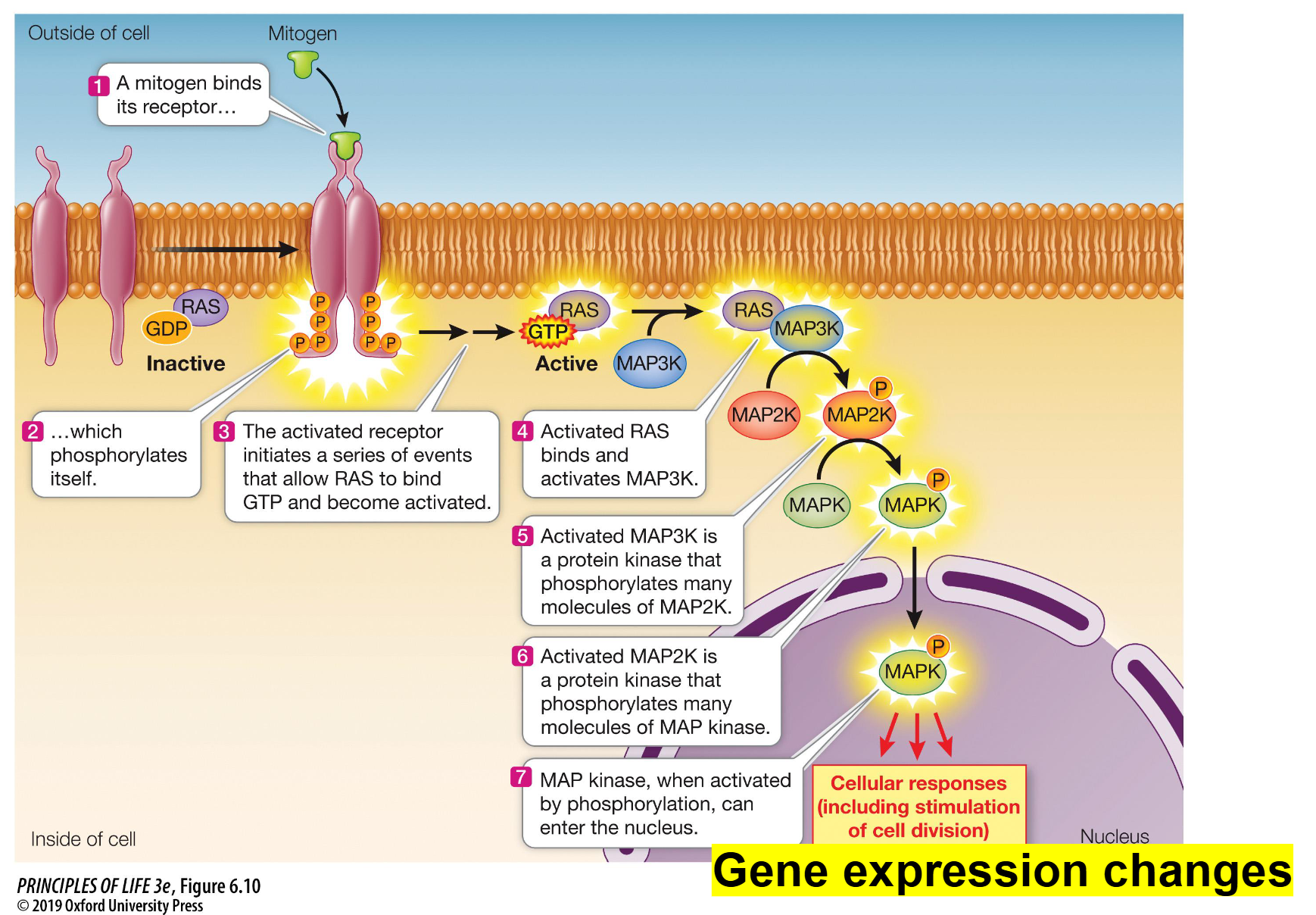
  • Reception: A mitogen (the ligand) binds to its specific receptor on the cell surface.

  • Activation: This binding causes the receptor to phosphorylate itself, which initiates a series of events that allow a protein called RAS to bind GTP and become active.

  • The Cascade (Phosphorylation): Activated RAS binds to and activates MAP3K.

    • MAP3K is a kinase that phosphorylates many molecules of MAP2K, activating them.

    • Activated MAP2K then phosphorylates many molecules of MAP kinase (MAPK).

  • The Response: Once MAPK is activated by phosphorylation, it can enter the nucleus.

  • Inside the nucleus, it triggers gene expression changes that lead to cellular responses, such as stimulating cell division
<ul><li><p><span style="line-height: 1.15;"><strong>Reception:</strong> A <strong>mitogen</strong> (the ligand) binds to its specific receptor on the cell surface</span><span>.</span></p></li><li><p><span style="line-height: 1.15;"><strong>Activation:</strong> This binding causes the receptor to <strong>phosphorylate itself</strong>, which initiates a series of events that allow a protein called <strong>RAS</strong> to bind GTP and become active</span><span>.</span></p></li><li><p><span style="line-height: 1.15;"><strong>The Cascade (Phosphorylation):</strong> Activated RAS binds to and activates <strong>MAP3K</strong></span><span>.</span></p><ul><li><p><span style="line-height: 1.15;">MAP3K is a kinase that <strong>phosphorylates</strong> many molecules of <strong>MAP2K</strong>, activating them</span><span>.</span></p></li><li><p><span style="line-height: 1.15;">Activated MAP2K then phosphorylates many molecules of <strong>MAP kinase (MAPK)</strong></span><span>.</span></p></li></ul></li><li><p><span>T</span><span style="line-height: 1.15;"><strong>he Response:</strong> Once MAPK is activated by phosphorylation, it can enter the <strong>nucleus</strong></span><span>. </span></p></li><li><p><span style="line-height: 1.15;">Inside the nucleus, it triggers <strong>gene expression changes</strong> that lead to cellular responses, such as stimulating <strong>cell division</strong></span></p></li></ul><p></p>
8
New cards

Transmembrane Proteins and Signal Transduction

  • Membrane proteins play a major role in signal transduction by converting an extracellular signal into intracellular signal(s).

  • Signal transduction allows cells to rapidly respond to events happening in their environment:

    • Grow

    • Divide

    • Survive (or not)

    • Move

    • Differentiate (i.e., time to change)

<ul><li><p><span>Membrane proteins play a major role in signal transduction by converting an extracellular signal into intracellular signal(s).</span></p></li><li><p><span>Signal transduction allows cells to rapidly respond to events happening in their environment:</span></p><ul><li><p><span>Grow</span></p></li><li><p><span>Divide</span></p></li><li><p><span>Survive (or not)</span></p></li><li><p><span>Move</span></p></li><li><p><span>Differentiate (i.e., time to change)</span></p></li></ul></li></ul><p></p>
9
New cards

Protein Kinase Receptors

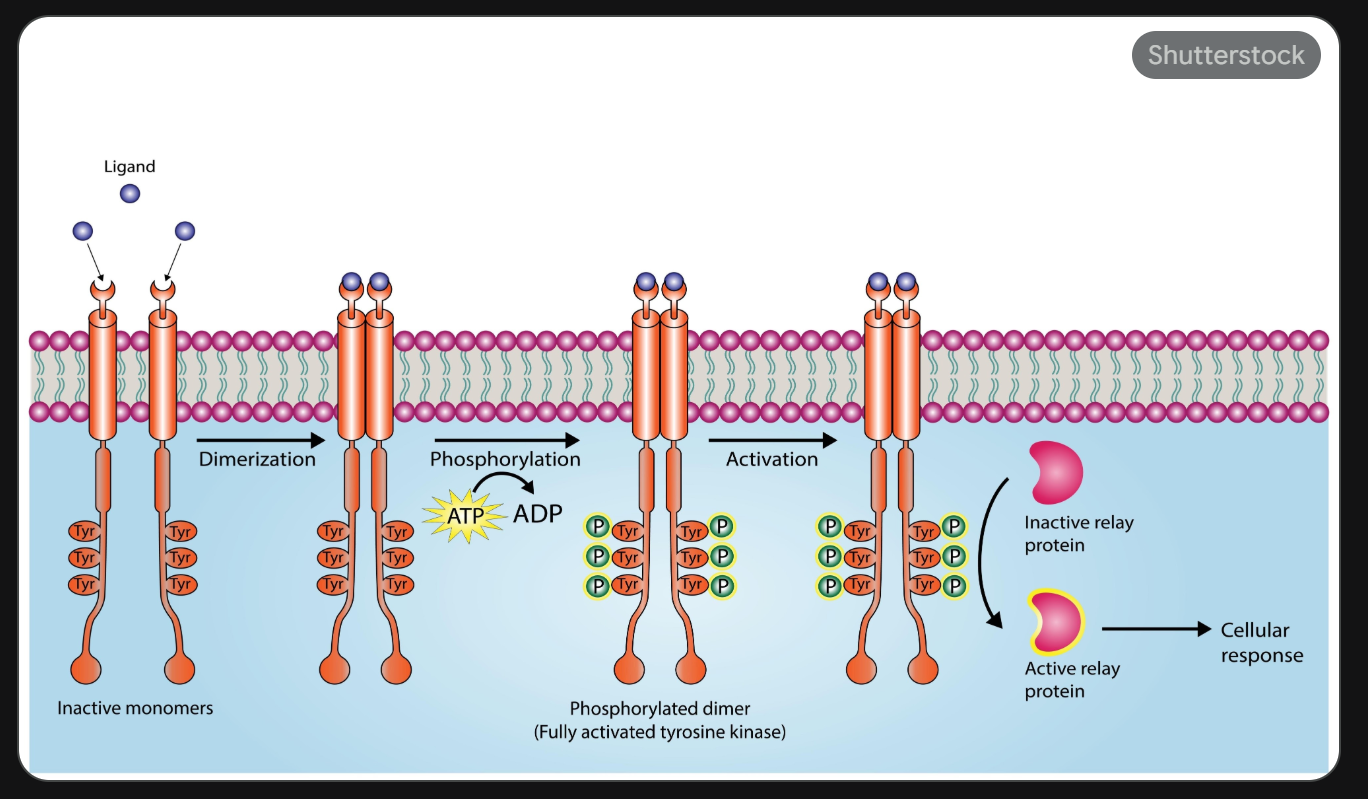
  • Ligand Binding: A signaling molecule (like insulin) binds to the extracellular portion of the receptor.

  • Dimerization/Activation: This binding causes the receptor subunits to come together or change shape.

  • Autophosphorylation: The "kinase" part of the receptor (on the inside of the cell) becomes active. It uses ATP to add phosphate groups to its own "tails."

  • Signal Propagation: These new phosphate groups act as "docking stations" for other signaling proteins inside the cell, starting the transduction cascade.

  • Ex. Mammalian insulin receptor

    • Phosphorylates itself and other insulin response substrates

    • Initiates insertion of glucose transporters into the plasma membrane
<ul><li><p><strong>Ligand Binding:</strong> A signaling molecule (like insulin) binds to the extracellular portion of the receptor.</p></li><li><p><strong>Dimerization/Activation:</strong> This binding causes the receptor subunits to come together or change shape.</p></li><li><p><strong>Autophosphorylation:</strong> The "kinase" part of the receptor (on the inside of the cell) becomes active. It uses <strong>ATP</strong> to add phosphate groups to its own "tails."</p></li><li><p><strong>Signal Propagation:</strong> These new phosphate groups act as "docking stations" for other signaling proteins inside the cell, starting the transduction cascade.</p></li><li><p>Ex.<span> </span><span>Mammalian insulin receptor</span></p><ul><li><p><span>Phosphorylates itself and other insulin response substrates</span></p></li><li><p><span>Initiates insertion of glucose transporters into the plasma membrane</span></p></li></ul></li></ul><p></p>
10
New cards

Example: The Insulin Receptor

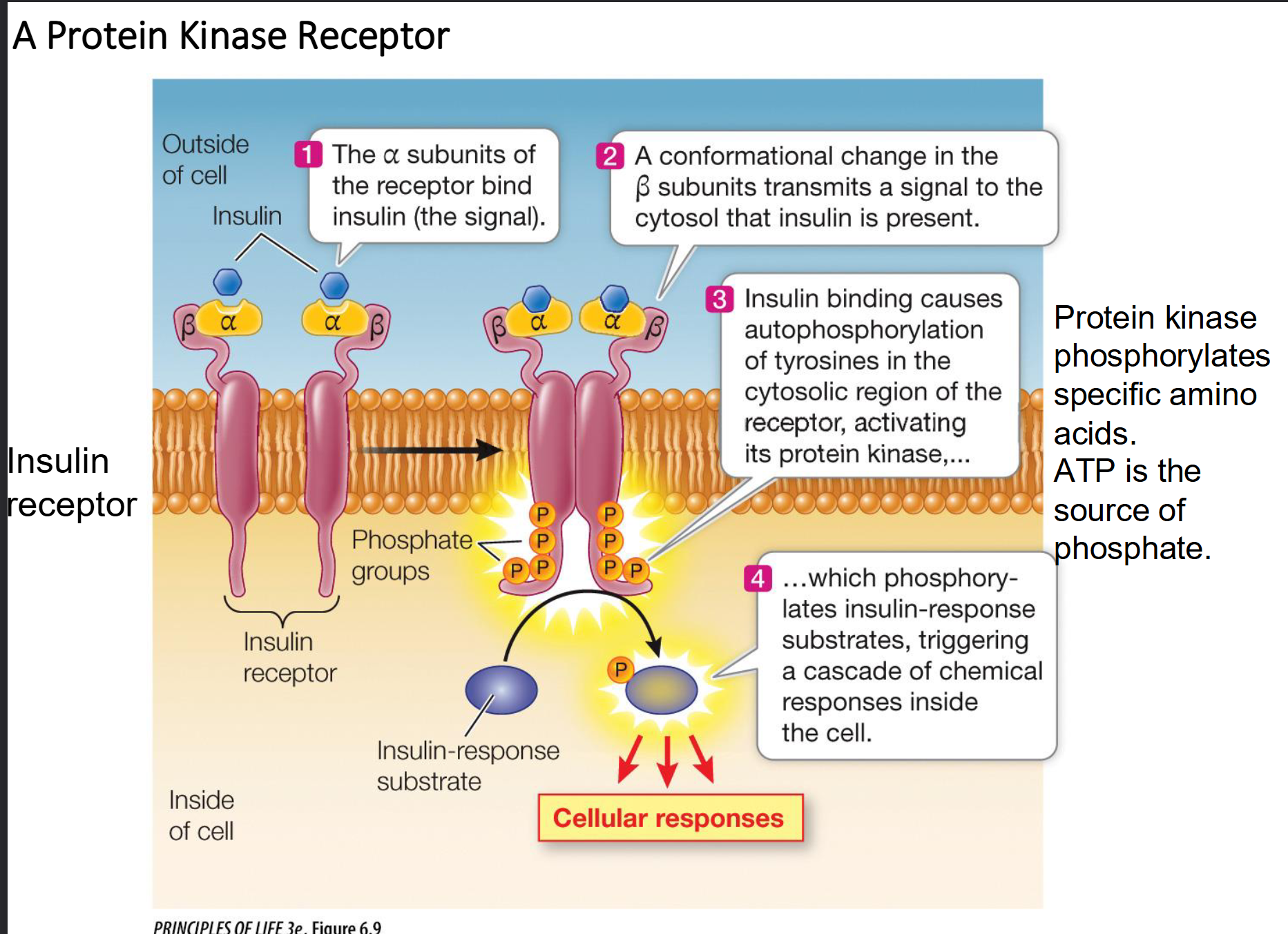
The insulin receptor is a dimer, meaning it consists of two identical halves.

  • Reception: Insulin binds to the alpha subunits (the parts outside the cell).

  • Activation: This causes a conformational change that is transmitted to the beta subunits (the parts inside the cytoplasm).

  • Transduction: The beta subunits perform autophosphorylation. This "turns on" the receptor, allowing it to phosphorylate other proteins called Insulin Response Substrates (IRS).

  • Response: These IRS proteins trigger multiple pathways, such as:

    • Moving glucose transporters to the cell membrane to let sugar in.

    • Starting glycogen synthesis (storing energy).

    • Altering gene expression for cell growth.
<p>The insulin receptor is a <strong>dimer</strong>, meaning it consists of two identical halves.</p><ul><li><p><strong>Reception:</strong> Insulin binds to the <span><strong>alpha </strong></span><strong>subunits</strong> (the parts outside the cell).</p></li><li><p><strong>Activation:</strong> This causes a conformational change that is transmitted to the <span><strong>beta </strong></span><strong>subunits</strong> (the parts inside the cytoplasm).</p></li><li><p><strong>Transduction:</strong> The <span>beta</span> subunits perform autophosphorylation. This "turns on" the receptor, allowing it to phosphorylate other proteins called <strong>Insulin Response Substrates (IRS)</strong>.</p></li><li><p><strong>Response:</strong> These IRS proteins trigger multiple pathways, such as:</p><ul><li><p>Moving glucose transporters to the cell membrane to let sugar in.</p></li><li><p>Starting glycogen synthesis (storing energy).</p></li><li><p>Altering gene expression for cell growth.</p></li></ul></li></ul><p></p>
11
New cards

The G Protein-Coupled Receptor (GPCR) Pathway

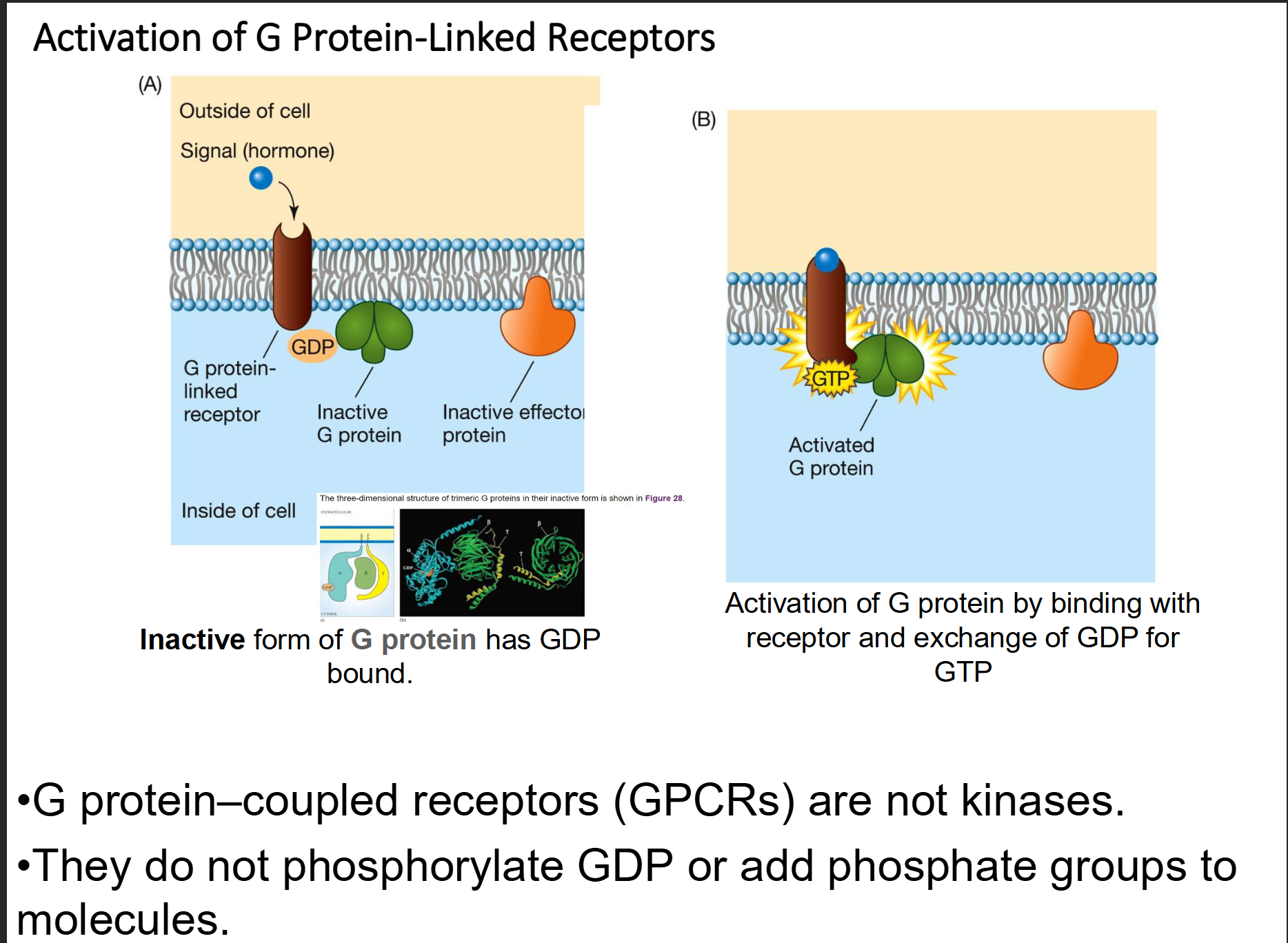
  • Reception: A ligand binds to the GPCR, causing a shape change in the receptor.

  • Activation: The receptor binds to an inactive G protein (alpha, beta, gamma subunits), causing the alpha subunit to swap GDP for GTP.

  • Dissociation: The active alpha subunit (with GTP) breaks away and moves along the membrane to activate an effector protein (like Adenyl Cyclase).

  • Second Messenger: The effector produces a second messenger (like cAMP), which triggers a downstream phosphorylation cascade and cellular response.

  • Termination: The alpha subunit eventually hydrolyzes GTP back to GDP, becomes inactive, and reunites with the beta and gamma subunits to reset the cycle.
<ul><li><p><strong>Reception:</strong> A ligand binds to the GPCR, causing a shape change in the receptor.</p></li><li><p><strong>Activation:</strong> The receptor binds to an inactive <strong>G protein</strong> (alpha, beta, gamma subunits), causing the alpha subunit to swap <strong>GDP for GTP</strong>.</p></li><li><p><strong>Dissociation:</strong> The active alpha subunit (with GTP) breaks away and moves along the membrane to activate an <strong>effector protein</strong> (like Adenyl Cyclase). </p></li><li><p><strong>Second Messenger:</strong> The effector produces a second messenger (like <strong>cAMP</strong>), which triggers a downstream phosphorylation cascade and cellular response. </p></li><li><p><strong>Termination:</strong> The alpha subunit eventually hydrolyzes <strong>GTP back to GDP</strong>, becomes inactive, and reunites with the beta and gamma subunits to reset the cycle.</p></li></ul><p></p>
12
New cards

What is a G protein, and how does it act as a molecular switch in cell signaling?

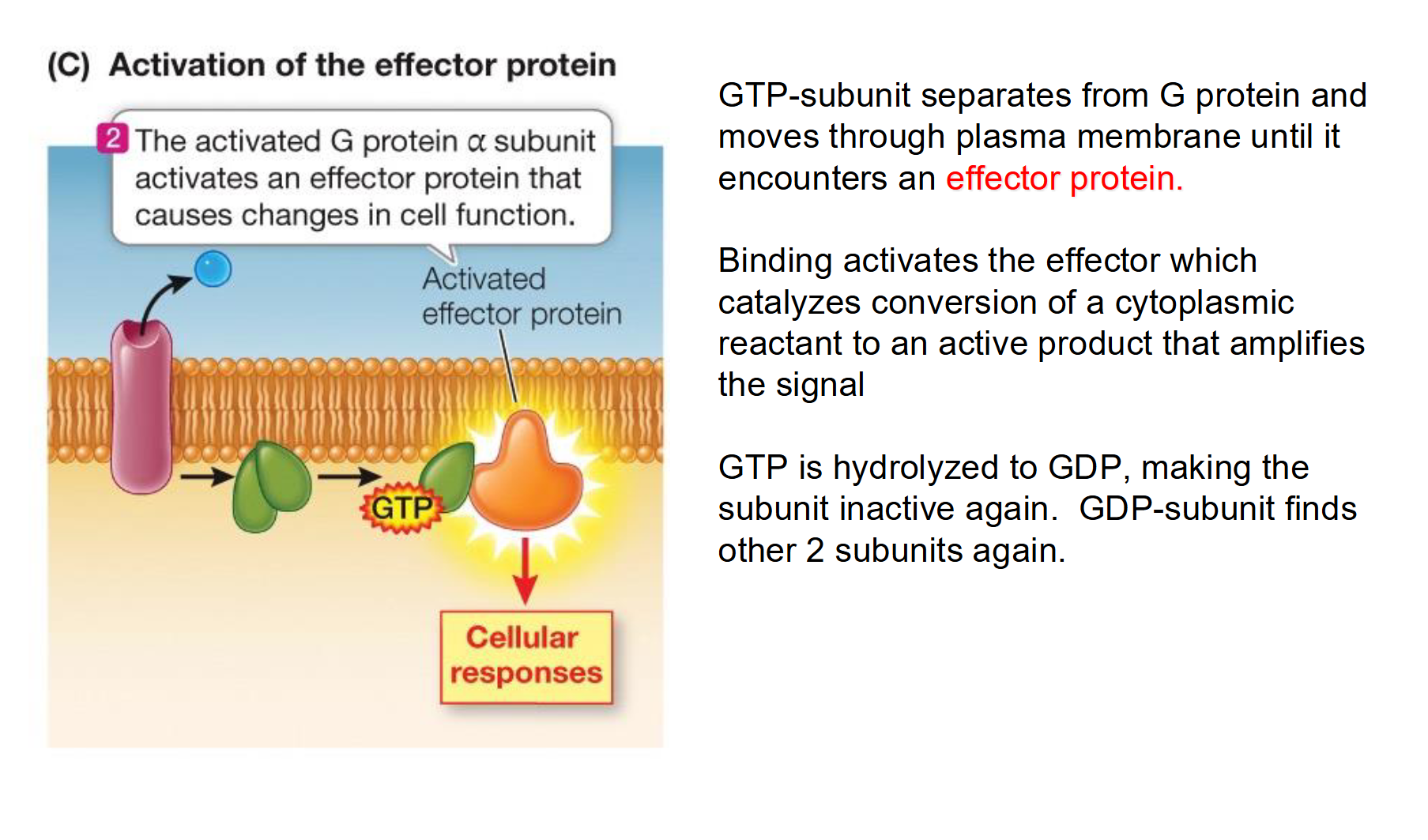
  • Structure: A heterotrimeric protein consisting of three subunits: alpha, beta, and gamma (gamma).

  • The "OFF" State: The G protein is inactive when the alpha subunit is bound to GDP.

  • The "ON" State: When a ligand binds to the receptor, the alpha subunit releases GDP and binds GTP, causing it to dissociate from the other subunits.

  • Function: Once active, the alpha subunit (bound to GTP) moves along the membrane to activate an effector (like the enzyme Adenyl Cyclase).

  • Self-Regulation: It has built-in GTPase activity, meaning it eventually hydrolyzes GTP back into GDP to turn itself "OFF."
<ul><li><p><strong>Structure:</strong> A heterotrimeric protein consisting of three subunits: <strong>alpha,</strong> <strong>beta,</strong> and <strong>gamma (gamma). </strong></p></li><li><p><strong>The "OFF" State:</strong> The G protein is inactive when the alpha subunit is bound to <strong>GDP</strong>.</p></li><li><p><strong>The "ON" State:</strong> When a ligand binds to the receptor, the alpha subunit releases GDP and binds <strong>GTP</strong>, causing it to dissociate from the other subunits.</p></li><li><p><strong>Function:</strong> Once active, the alpha subunit (bound to GTP) moves along the membrane to activate an <strong>effector</strong> (like the enzyme Adenyl Cyclase).</p></li><li><p><strong>Self-Regulation:</strong> It has built-in <strong>GTPase activity</strong>, meaning it eventually hydrolyzes GTP back into GDP to turn itself "OFF."</p></li></ul><p></p>
13
New cards

How does the G protein act as the essential link between an external hormone and the internal breakdown of glycogen?

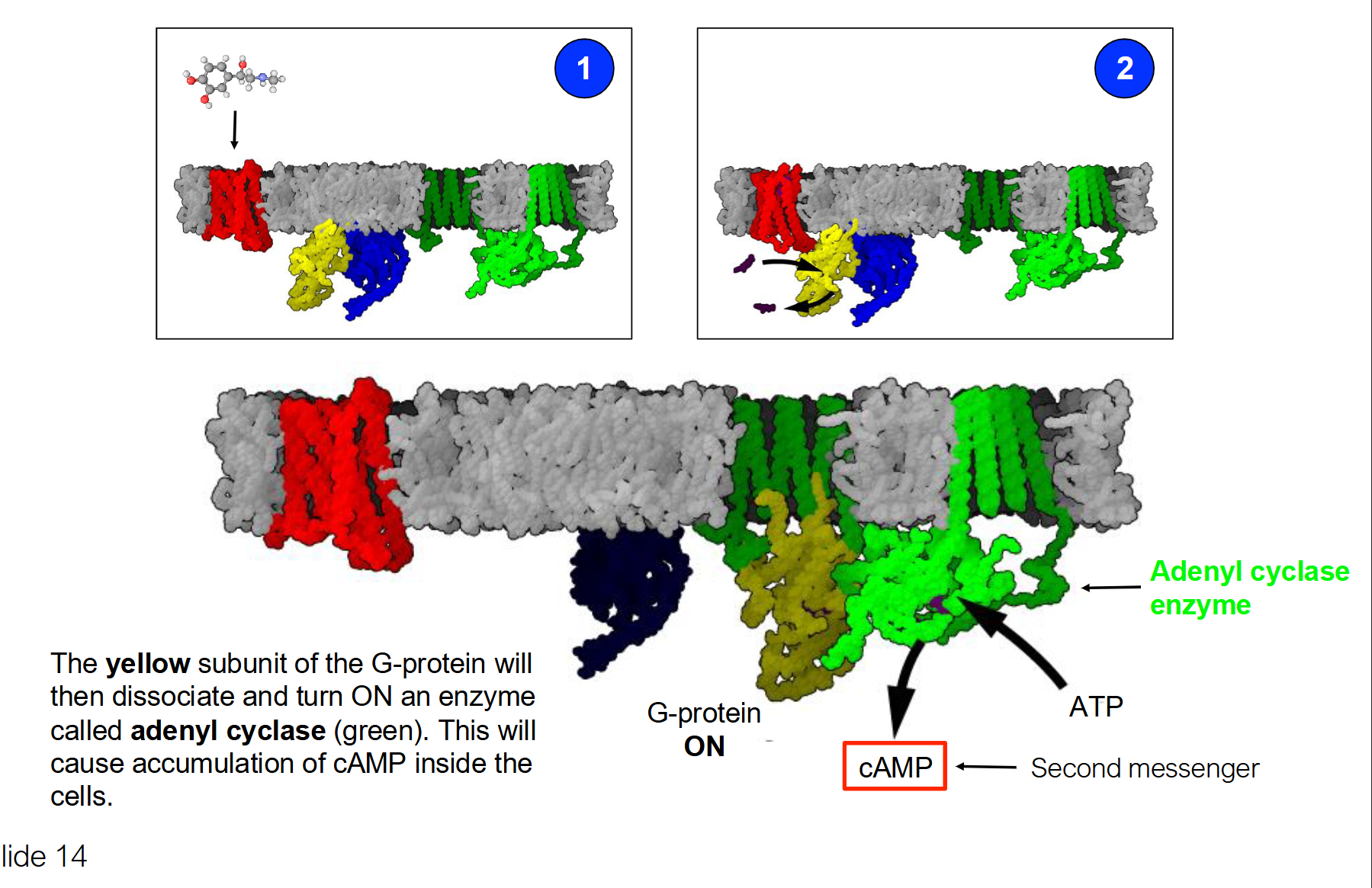
  • The Activation Step: The hormone Epinephrine (ligand) binds to a GPCR, causing the G protein to swap GDP for GTP.

  • The Relay: The active alpha subunit dissociates and activates the enzyme Adenyl Cyclase.

  • The Second Messenger: Adenyl Cyclase produces cAMP, which carries the "breakdown" signal into the cytoplasm.

  • The Result: cAMP triggers the kinase cascade (PKA → Phosphorylase Kinase → Glycogen Phosphorylase) that ultimately chops glucose units off the glycogen chain.

  • Key Concept: The G protein is the molecular switch that translates an extracellular signal into an intracellular chemical message.
<ul><li><p><strong>The Activation Step:</strong> The hormone <strong>Epinephrine</strong> (ligand) binds to a GPCR, causing the G protein to swap <strong>GDP for GTP</strong>.</p></li><li><p><strong>The Relay:</strong> The active <strong>alpha subunit</strong> dissociates and activates the enzyme <strong>Adenyl Cyclase</strong>.</p></li><li><p><strong>The Second Messenger:</strong> Adenyl Cyclase produces <strong>cAMP</strong>, which carries the "breakdown" signal into the cytoplasm.</p></li><li><p><strong>The Result:</strong> cAMP triggers the <strong>kinase cascade</strong> (PKA → Phosphorylase Kinase → Glycogen Phosphorylase) that ultimately chops glucose units off the glycogen chain.</p></li><li><p><strong>Key Concept:</strong> The G protein is the <strong>molecular switch</strong> that translates an extracellular signal into an intracellular chemical message.</p></li></ul><p></p>
14
New cards

Compare and contrast the G Protein-Coupled Receptor (GPCR) pathway and the Protein Kinase Receptor pathway (e.g., Insulin receptor)

  • Mechanism of Activation:

    • GPCR: Relies on a "relay" system. The receptor recruits a separate G protein, which swaps GDP for GTP to become active.

    • Protein Kinase: Relies on autophosphorylation. The receptor subunits come together (dimerize) and add phosphate groups to themselves.

  • The "Switch":

    • GPCR: The switch is the exchange of nucleotides (GDP/GTP).

    • Protein Kinase: The switch is the covalent addition of a phosphate group from ATP.

  • Intermediate Steps:

    • GPCR: Usually activates an effector enzyme (like Adenyl Cyclase) to produce a second messenger (like cAMP).

    • Protein Kinase: The phosphorylated receptor provides docking sites for internal signaling proteins (like IRS) to bind directly.

  • Example from Notes:

    • GPCR: Epinephrine triggering glycogen breakdown.

    • Protein Kinase: Insulin triggering glucose uptake.

15
New cards

What is the ECM?

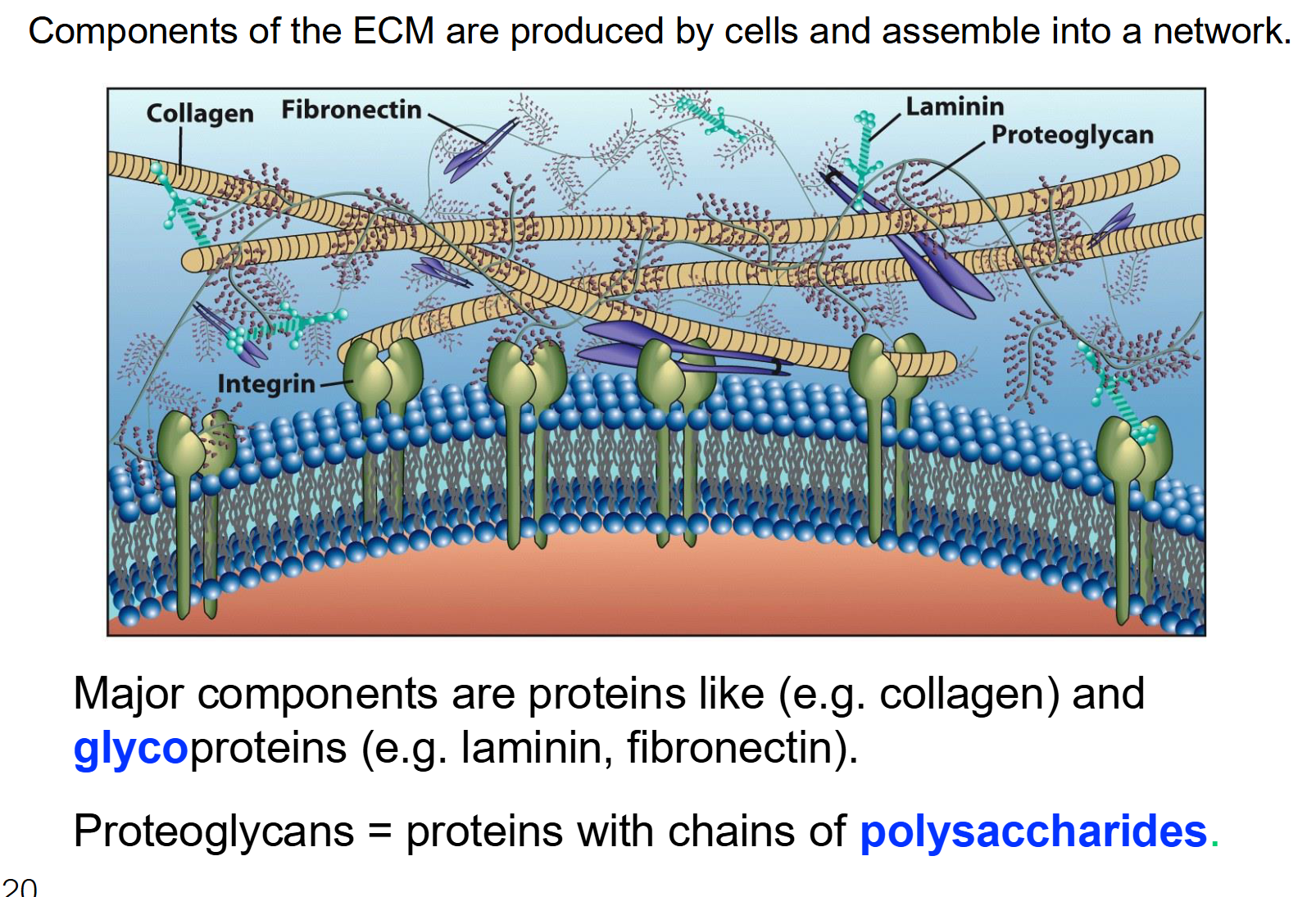
  • The ECM is an organized network of molecules (like proteins and carbohydrates) that cells produce and then "spit out" into the space around them.

  • It is a complex meshwork that connects cells into communities to form tissues like skin, bone, or muscle.

  • Key Components:

    • Fibers (like Collagen): These provide strength. Think of them as the steel cables in a bridge.

    • Glycoproteins & Proteoglycans: These are proteins with sugar chains attached. They help with hydration and trapping signaling molecules.

    • Anchor Proteins (Integrins): These are membrane proteins that physically "anchor" the inside of the cell (the cytoskeleton) to the ECM outside. This creates a continuous physical link between the cell and its environment
<ul><li><p>The ECM is an organized network of molecules (like proteins and carbohydrates) that cells produce and then "spit out" into the space around them. </p></li><li><p>It is a complex meshwork that connects cells into <strong>communities</strong> to form tissues like skin, bone, or muscle.</p></li><li><p>Key Components:</p><ul><li><p><strong>Fibers (like Collagen):</strong> These provide strength. Think of them as the steel cables in a bridge.</p></li><li><p><strong>Glycoproteins &amp; Proteoglycans:</strong> These are proteins with sugar chains attached. They help with hydration and trapping signaling molecules.</p></li><li><p><strong>Anchor Proteins (Integrins):</strong> These are membrane proteins that physically "anchor" the inside of the cell (the cytoskeleton) to the ECM outside. This creates a continuous physical link between the cell and its environment</p></li></ul></li></ul><p></p>
16
New cards

Anchor Proteins and the Extracellular Matrix (ECM)

  • They play an important role by interacting with and physically linking the cell to the components of the extracellular matrix.

  • Multicellular organisms are composed of tissues and organs consisting of communities of cells.

  • These cells work together to perform a function (e.g., skin, liver, leaves).

  • The ECM is an organized network of material produced and secreted by cells.

  • Example: The ECM is abundant in connective tissues of animals (e.g. tendons, ligaments, dermis)
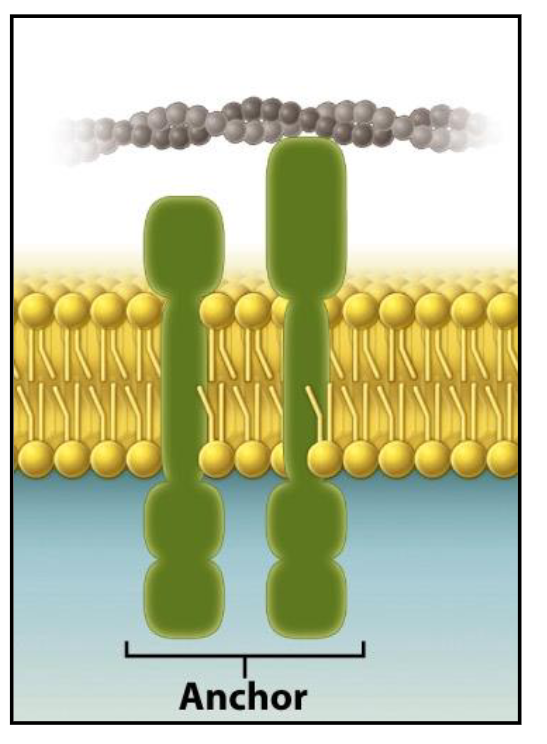
<ul><li><p>They play an important role by interacting with and physically linking the cell to the components of the extracellular matrix.</p></li><li><p>Multicellular organisms are composed of tissues and organs consisting of communities of cells.</p></li><li><p>These cells work together to perform a function (e.g., skin, liver, leaves).</p></li><li><p>The ECM is an organized network of material produced and secreted by cells.</p></li><li><p>Example: The ECM is abundant in connective tissues of animals (e.g. tendons, ligaments, dermis)</p></li></ul><p></p>
17
New cards

List the four main functions of the ECM

  • Cell adherence: It provides a surface for cells to grip onto so they don't just float away.

  • Communication between cells: When the ECM is stretched or chemically changed, it sends signals through those anchor proteins to tell the cell how to behave or grow.

  • Cell shape, mechanical support, and structural integrity: It gives tissues their shape and mechanical strength (e.g., the hardness of bone or the elasticity of skin).

  • Serving as a barrier/filtering out particles: acts as a physical sieve, controlling which nutrients or particles can reach the cell.
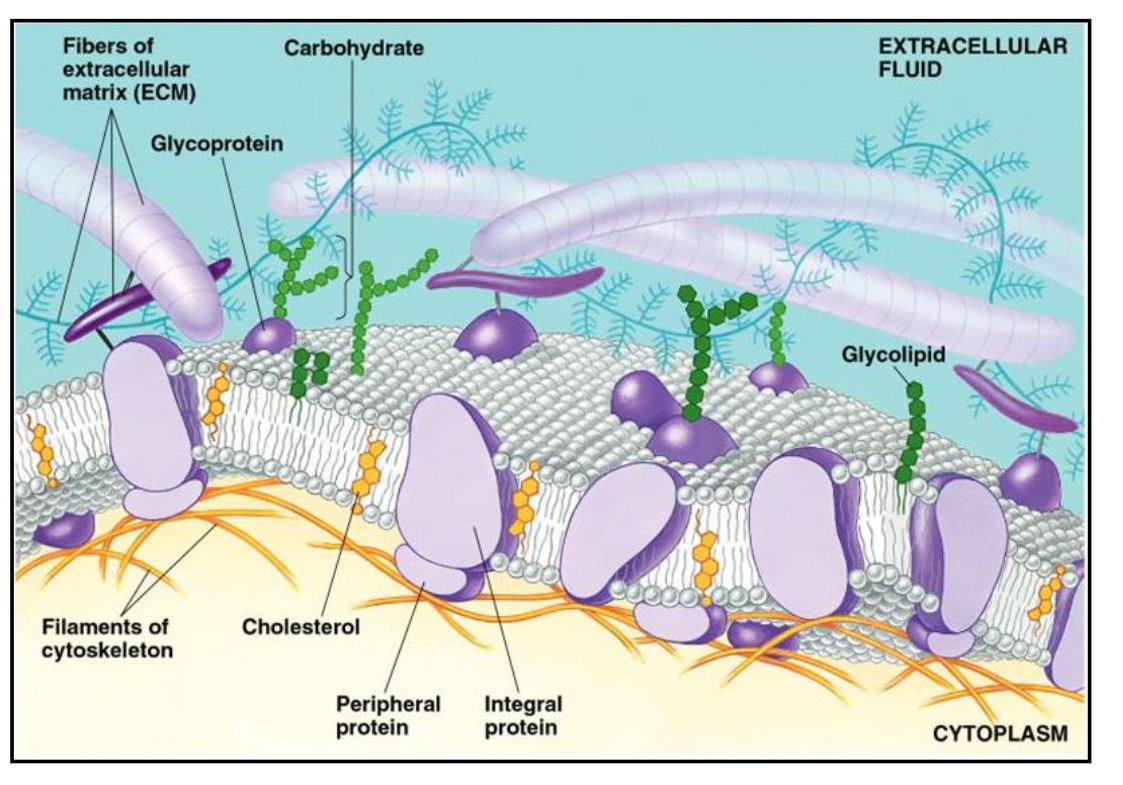
<ul><li><p>Cell adherence: It provides a surface for cells to grip onto so they don't just float away.</p></li><li><p>Communication between cells: When the ECM is stretched or chemically changed, it sends signals through those <strong>anchor proteins</strong> to tell the cell how to behave or grow.</p></li><li><p>Cell shape, mechanical support, and structural integrity: It gives tissues their shape and mechanical strength (e.g., the hardness of bone or the elasticity of skin).</p></li><li><p>Serving as a barrier/filtering out particles: acts as a physical sieve, controlling which nutrients or particles can reach the cell.</p></li></ul><p></p>
18
New cards

According to the Misrepair-accumulation theory, how does the Extracellular Matrix (ECM) contribute to the development of wrinkles?

  • The ECM of the skin is packed with two primary types of protein fibers:

    • Collagen: Provides the skin with strength and structural integrity.

    • Elastin: Provides elasticity, allowing the skin to "snap back" after being stretched.

  • Wrinkles are caused by the accumulation of incorrectly repaired (altered) collagen and elastin fibers.

  • Instead of healthy regeneration, the tissue undergoes fibrosis (thickening and scarring), which disrupts the skin's structural integrity and leads to visible folding.
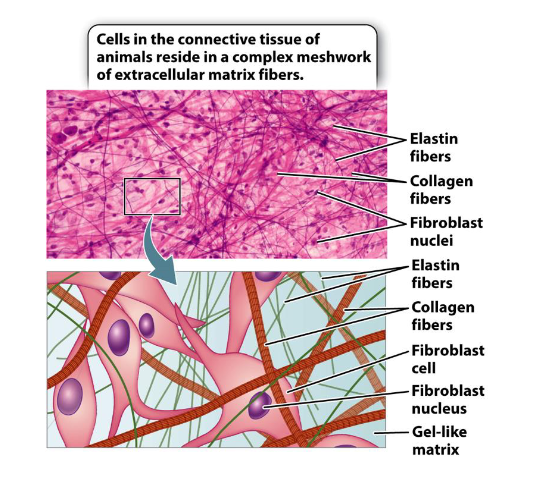
<ul><li><p>The ECM of the skin is packed with two primary types of protein fibers:</p><ul><li><p><strong>Collagen:</strong> Provides the skin with <strong>strength</strong> and structural integrity.</p></li><li><p><strong>Elastin:</strong> Provides <strong>elasticity</strong>, allowing the skin to "snap back" after being stretched.</p></li></ul></li><li><p>Wrinkles are caused by the accumulation of <strong>incorrectly repaired</strong> (altered) collagen and elastin fibers. </p></li><li><p>Instead of healthy regeneration, the tissue undergoes <strong>fibrosis</strong> (thickening and scarring), which disrupts the skin's structural integrity and leads to visible folding.</p></li></ul><p></p>
19
New cards

Compare and contrast the Extracellular Matrix (ECM) in animal cells versus plant cells. Focus on composition and primary function.

  • Identity: In plants, the ECM is the Cell Wall.

  • Composition:

    • Animals: Primarily protein-based (collagen, elastin).

    • Plants: Primarily carbohydrate-based (cellulose, hemicellulose, pectin, proteins).

  • Function:

    • Both: Provide adherence, signaling, and structural integrity.

    • Plants (Unique): Acts as a skeletal equivalent for the whole organism and provides a rigorous physical defense against pathogens and mechanical stress.
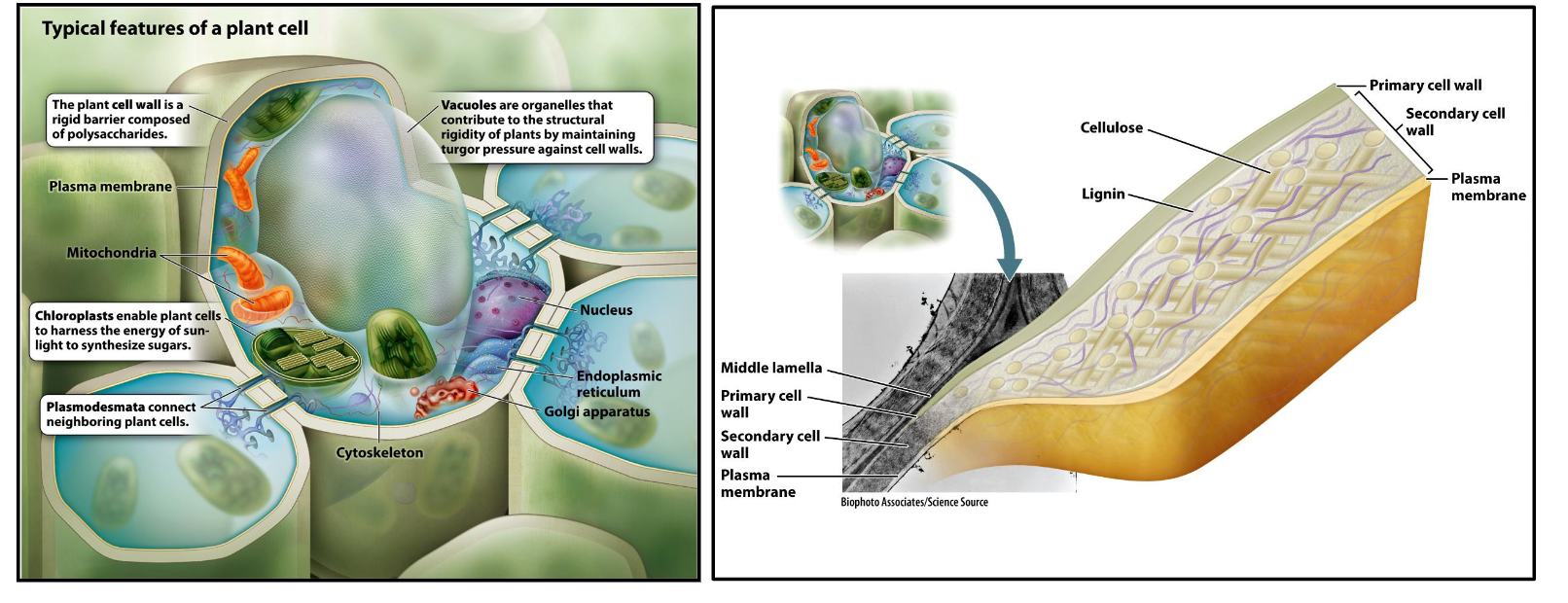
<ul><li><p><strong>Identity:</strong> In plants, the ECM is the <strong>Cell Wall</strong>.</p></li><li><p><strong>Composition:</strong> </p><ul><li><p><em>Animals:</em> Primarily protein-based (collagen, elastin).</p></li><li><p><em>Plants:</em> Primarily carbohydrate-based (<strong>cellulose</strong>, hemicellulose, pectin, proteins).</p></li></ul></li><li><p><strong>Function:</strong></p><ul><li><p><em>Both:</em> Provide adherence, signaling, and structural integrity.</p></li><li><p><em>Plants (Unique):</em> Acts as a <strong>skeletal equivalent</strong> for the whole organism and provides a rigorous physical <strong>defense</strong> against pathogens and mechanical stress.</p></li></ul></li></ul><p></p>
20
New cards

The Endosymbiotic Theory

  • Definition: An evolutionary theory stating that eukaryotic cells originated from a symbiotic relationship between different types of prokaryotes.

  • The Process: A large host cell engulfed smaller, specialized bacteria (aerobic bacteria and cyanobacteria) which eventually evolved into organelles.

  • Key Figures:

    • Konstantin Mereschkowski: First proposed the idea (1905).

    • Lynn Margulis: Advanced the theory with microbiological evidence (1967).
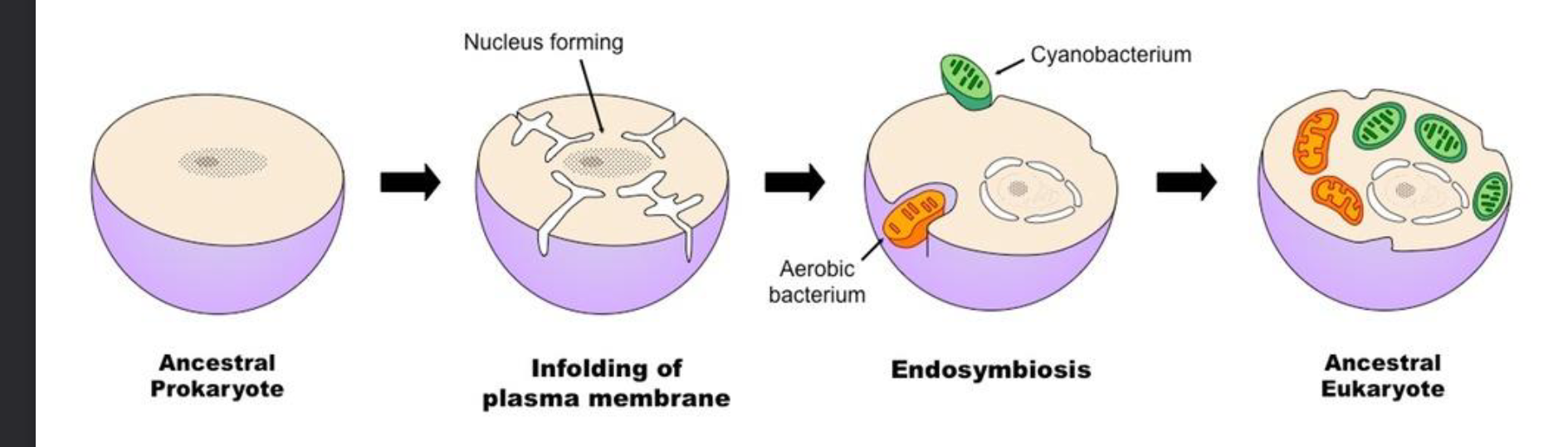
<ul><li><p><strong>Definition:</strong> An evolutionary theory stating that <strong>eukaryotic cells</strong> originated from a symbiotic relationship between different types of <strong>prokaryotes</strong>.</p></li><li><p><strong>The Process:</strong> A large host cell engulfed smaller, specialized bacteria (aerobic bacteria and cyanobacteria) which eventually evolved into organelles.</p></li><li><p><strong>Key Figures:</strong> </p><ul><li><p><strong>Konstantin Mereschkowski:</strong> First proposed the idea (1905).</p></li><li><p><strong>Lynn Margulis:</strong> Advanced the theory with microbiological evidence (1967).</p></li></ul></li></ul><p></p>
21
New cards

List two major pieces of evidence that support the Endosymbiotic Theory.

  1. Genetic Evidence: Mitochondria and chloroplasts (plastids) contain their own circular DNA, which is structurally similar to bacterial DNA.

  2. Reproduction: These organelles reproduce independently of the cell through binary fission, the same method used by bacteria.

  • Bonus: They also possess a double membrane, suggesting the inner layer is the original bacterial membrane and the outer layer is the host's vesicle.

22
New cards

Summarize Aerobic Respiration and Photosynthesis

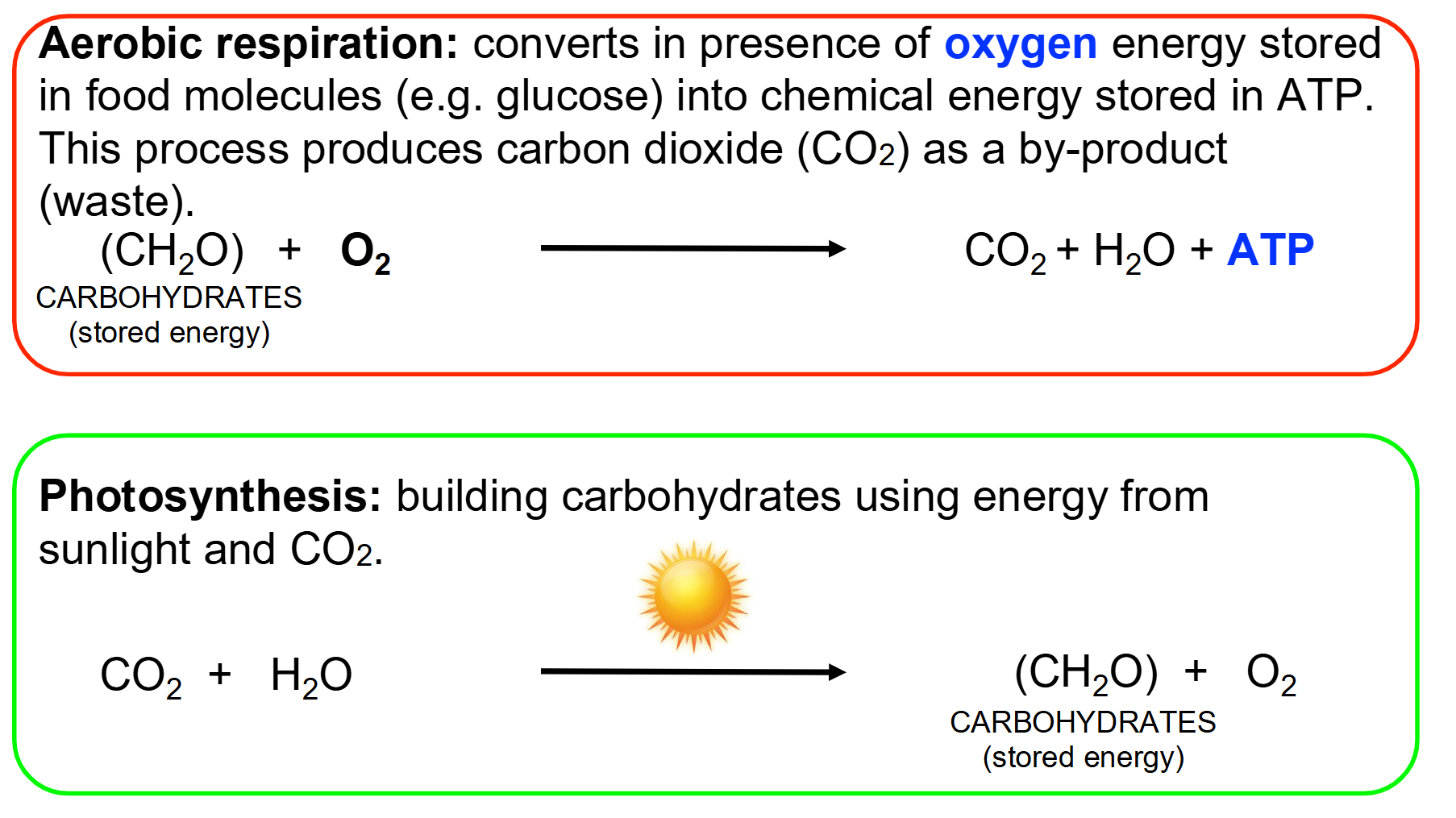
  • Aerobic Respiration:

    • Converts in presence of oxygen energy stored in food molecules (e.g. glucose) into chemical energy stored in ATP.

    • This process produces carbon dioxide (CO2) as a by-product

    • Occurs in the Mitochondria

  • Photosynthesis:

    • Building carbohydrates using energy from sunlight and CO2
<ul><li><p>Aerobic Respiration: </p><ul><li><p><span>Converts in presence of oxygen energy stored in food molecules (e.g. glucose) into chemical energy stored in ATP. </span></p></li><li><p><span>This process produces carbon dioxide (CO2) as a by-product</span></p></li><li><p><span>Occurs in the Mitochondria</span></p></li></ul></li><li><p>Photosynthesis:</p><ul><li><p><span>Building carbohydrates using energy from sunlight and CO2</span></p></li></ul></li></ul><p></p>
23
New cards

Describe the two membranes of the mitochondria

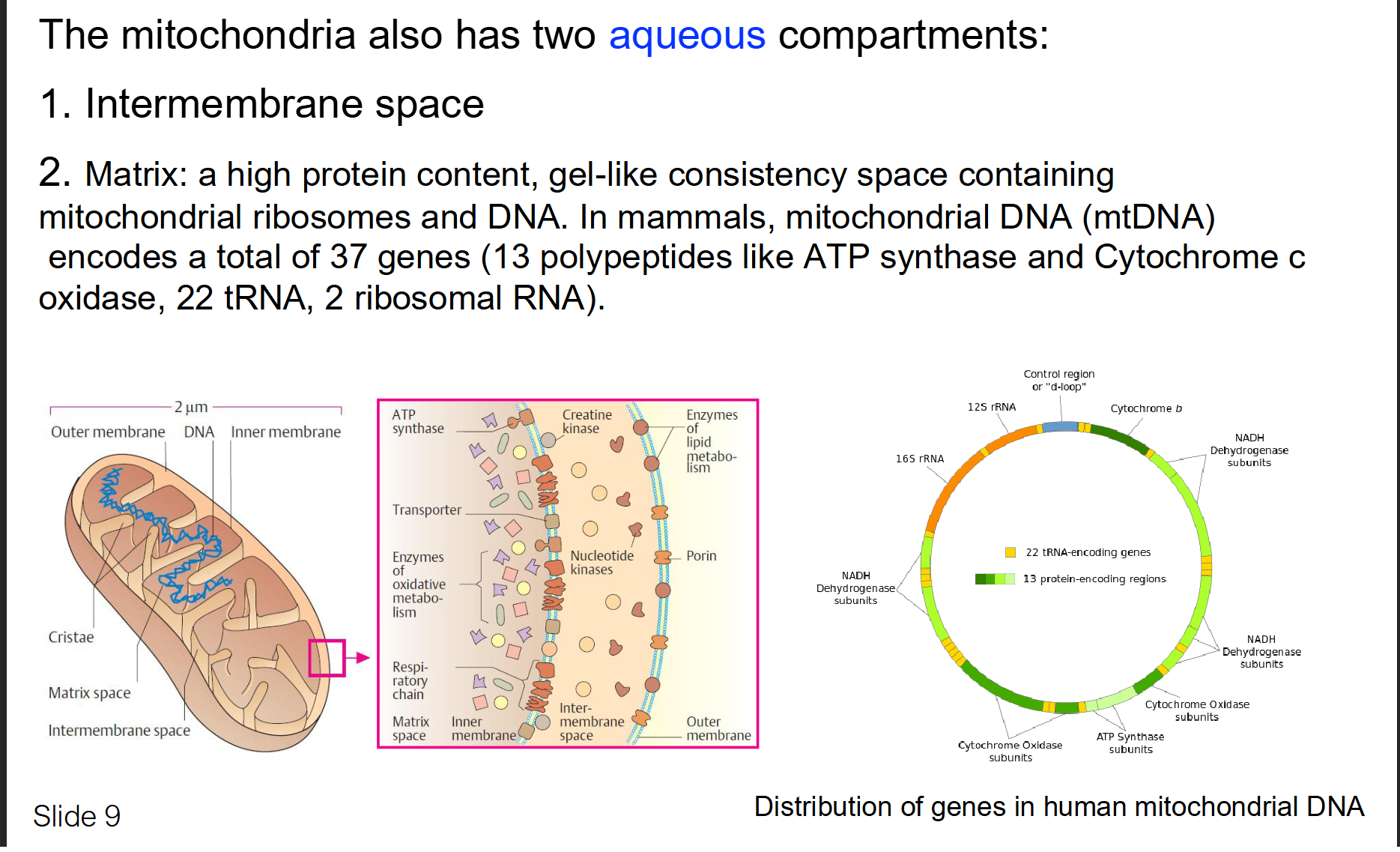
  • Outer Mitochondrial Membrane (OMM):

    • Contains porins (large channels) that make it permeable to molecules like ATP and sucrose.

    • Contains many enzymes with diverse metabolic functions. An example is monoamine oxidases that breaks down monoamines ingested from food, as well as monoamine neurotransmitters (dopamine and serotonin)

  • Inner Mitochondrial Membrane (IMM):

    • High protein to lipid ration (3:1)

    • Folded into cristae to increase surface area for energy production and contain machinery for aerobic respiration and ATP formation

    • Phospholipid called cardiolipin → a characteristic of bacterial membranes and needed for optimal function of many enzymes

  • The Matrix: The innermost gel-like space containing mtDNA and ribosomes.
<ul><li><p><strong>Outer Mitochondrial Membrane (OMM):</strong></p><ul><li><p>Contains <strong>porins</strong> (large channels) that make it permeable to molecules like ATP and sucrose.</p></li><li><p>Contains many enzymes with diverse metabolic functions. An example is monoamine oxidases that breaks down monoamines ingested from food, as well as monoamine neurotransmitters (dopamine and serotonin)</p></li></ul></li><li><p><strong>Inner Mitochondrial Membrane (IMM):</strong></p><ul><li><p>High protein to lipid ration (3:1)</p></li><li><p>Folded into <strong>cristae</strong> to increase surface area for energy production and contain machinery for aerobic respiration and ATP formation</p></li><li><p>Phospholipid called <strong>cardiolipin</strong> → a characteristic of bacterial membranes and needed for optimal function of many enzymes</p></li></ul></li><li><p><strong>The Matrix:</strong> The innermost gel-like space containing <strong>mtDNA</strong> and <strong>ribosomes</strong>.</p></li></ul><p></p>
24
New cards

What is the difference between Substrate-level phosphorylation and Oxidative phosphorylation?

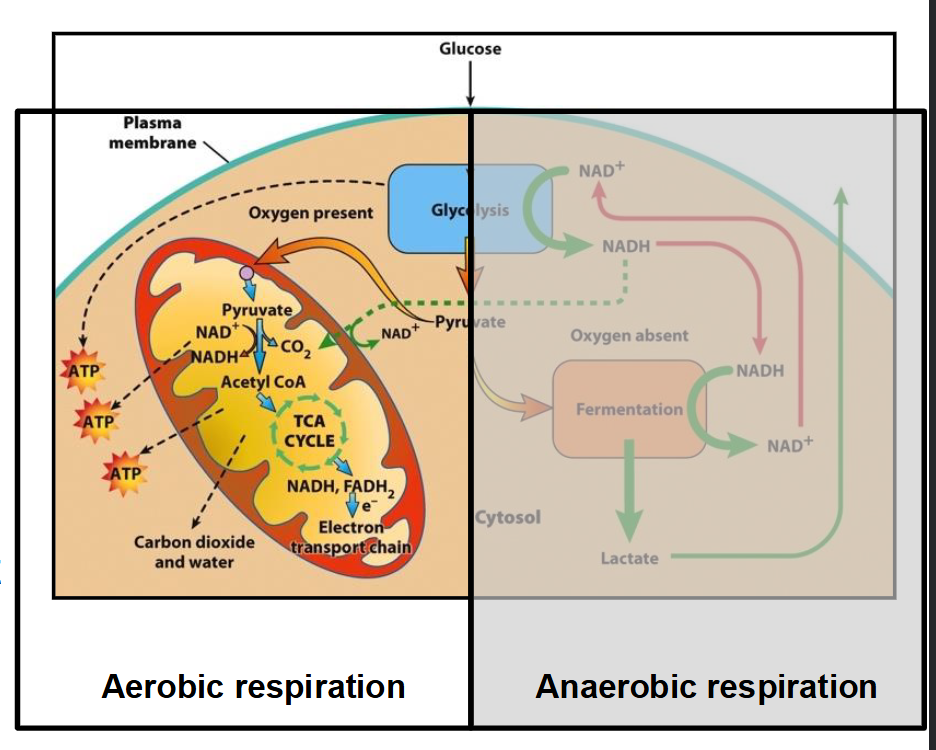
  • Cellular Respiration: Involves a series of catabolic reactions → Breaking down carbohydrates (glucose) to form ATP

  • Substrate-level phosphorylation: A direct chemical reaction (e.g., in glycolysis) that transfers a phosphate group to ADP to form ATP.

  • Oxidative phosphorylation: Uses electron carriers to create an electrochemical gradient across the inner membrane. This gradient powers ATP synthase to produce the majority of the cell's ATP.

  • Requirement: Oxidative phosphorylation requires oxygen (aerobic), whereas substrate-level can occur without it.
<ul><li><p><strong>Cellular Respiration: </strong><span>Involves a series of <strong>catabolic reactions → </strong>Breaking down carbohydrates (glucose) to form ATP</span></p></li><li><p><strong>Substrate-level phosphorylation:</strong> A direct chemical reaction (e.g., in glycolysis) that transfers a phosphate group to ADP to form ATP.</p></li><li><p><strong>Oxidative phosphorylation:</strong> Uses <strong>electron carriers</strong> to create an <strong>electrochemical gradient</strong> across the inner membrane. This gradient powers <strong>ATP synthase</strong> to produce the majority of the cell's ATP.</p></li><li><p><strong>Requirement:</strong> Oxidative phosphorylation requires <strong>oxygen</strong> (aerobic), whereas substrate-level can occur without it.</p></li></ul><p></p>
25
New cards

Does SLP or OP produce more ATP?

Oxidative Phosphorylation produces a lot more!
<p>Oxidative Phosphorylation produces a lot more!</p>
26
New cards

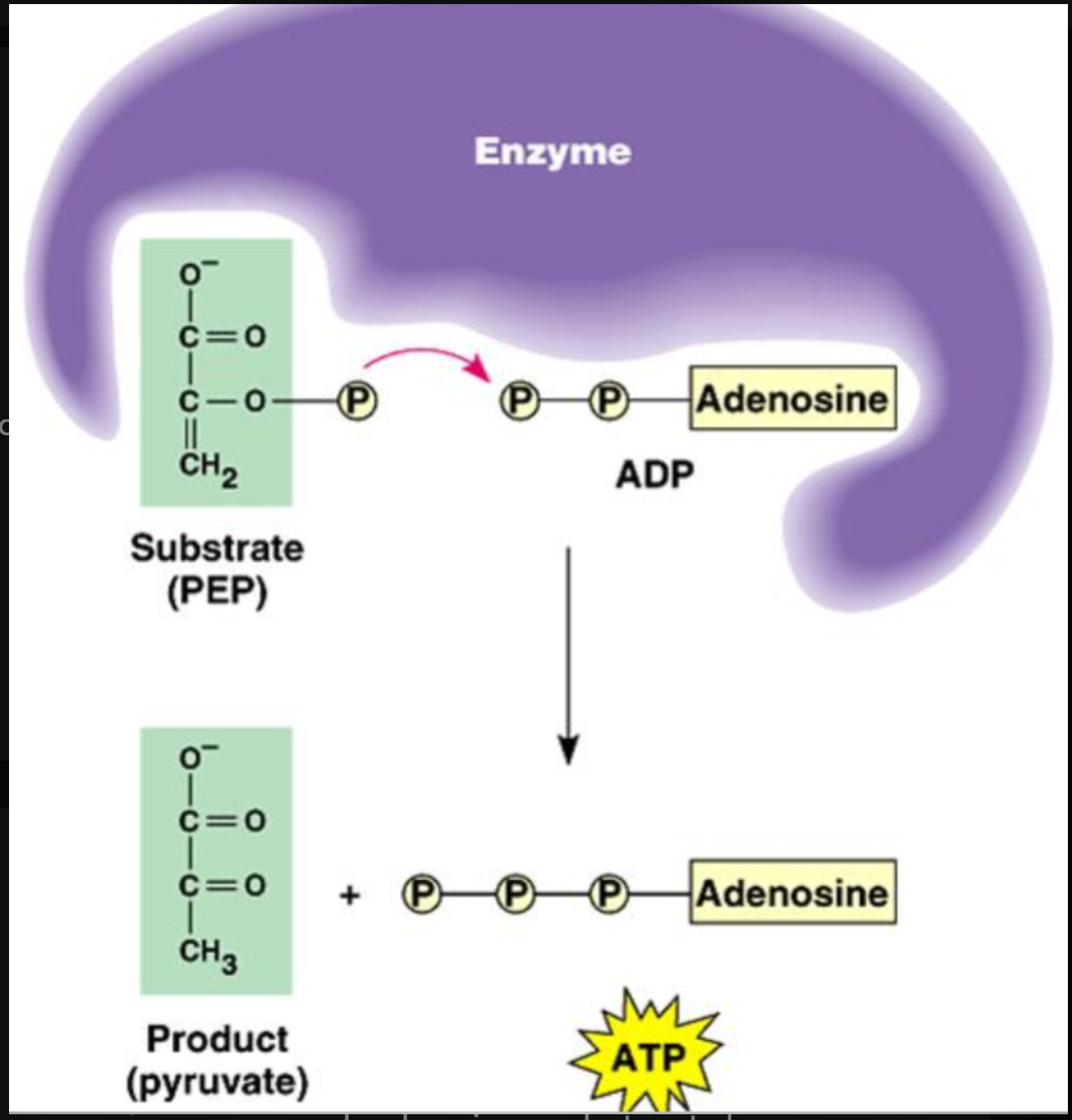
Substrate Level Phosphorylation Overview

  • In this process, a phosphate group is physically moved from a high-energy "donor" molecule (the substrate) directly onto ADP (adenosine diphosphate) to create ATP.

  • Components:

    • ADP: The "empty battery" waiting to be charged.

    • Phosphorylated Substrate: A metabolic intermediate molecule that is holding onto a phosphate group.

    • NAD+ and FAD: Electron carriers that are reduced

  • Glycolysis: Happens in the cytosol. For every molecule of glucose, the cell nets 2 ATP through substrate-level phosphorylation.

  • The TCA (Krebs) Cycle: Happens in the mitochondrial matrix. This cycle produces 1 ATP (or GTP) per turn via this method.
<ul><li><p>In this process, a <strong>phosphate group</strong> is physically moved from a high-energy "donor" molecule (the substrate) directly onto <strong>ADP</strong> (adenosine diphosphate) to create <strong>ATP</strong>.</p></li><li><p>Components:</p><ul><li><p><strong>ADP:</strong> The "empty battery" waiting to be charged.</p></li><li><p><strong>Phosphorylated Substrate:</strong> A metabolic intermediate molecule that is holding onto a phosphate group.</p></li><li><p><strong>NAD+ and FAD: </strong>Electron carriers that are reduced</p></li></ul></li></ul><ul><li><p><strong>Glycolysis:</strong> Happens in the <strong>cytosol</strong>. For every molecule of glucose, the cell nets 2 ATP through substrate-level phosphorylation.</p></li><li><p><strong>The TCA (Krebs) Cycle:</strong> Happens in the <strong>mitochondrial matrix</strong>. This cycle produces 1 ATP (or GTP) per turn via this method.</p></li></ul><p></p>
27
New cards

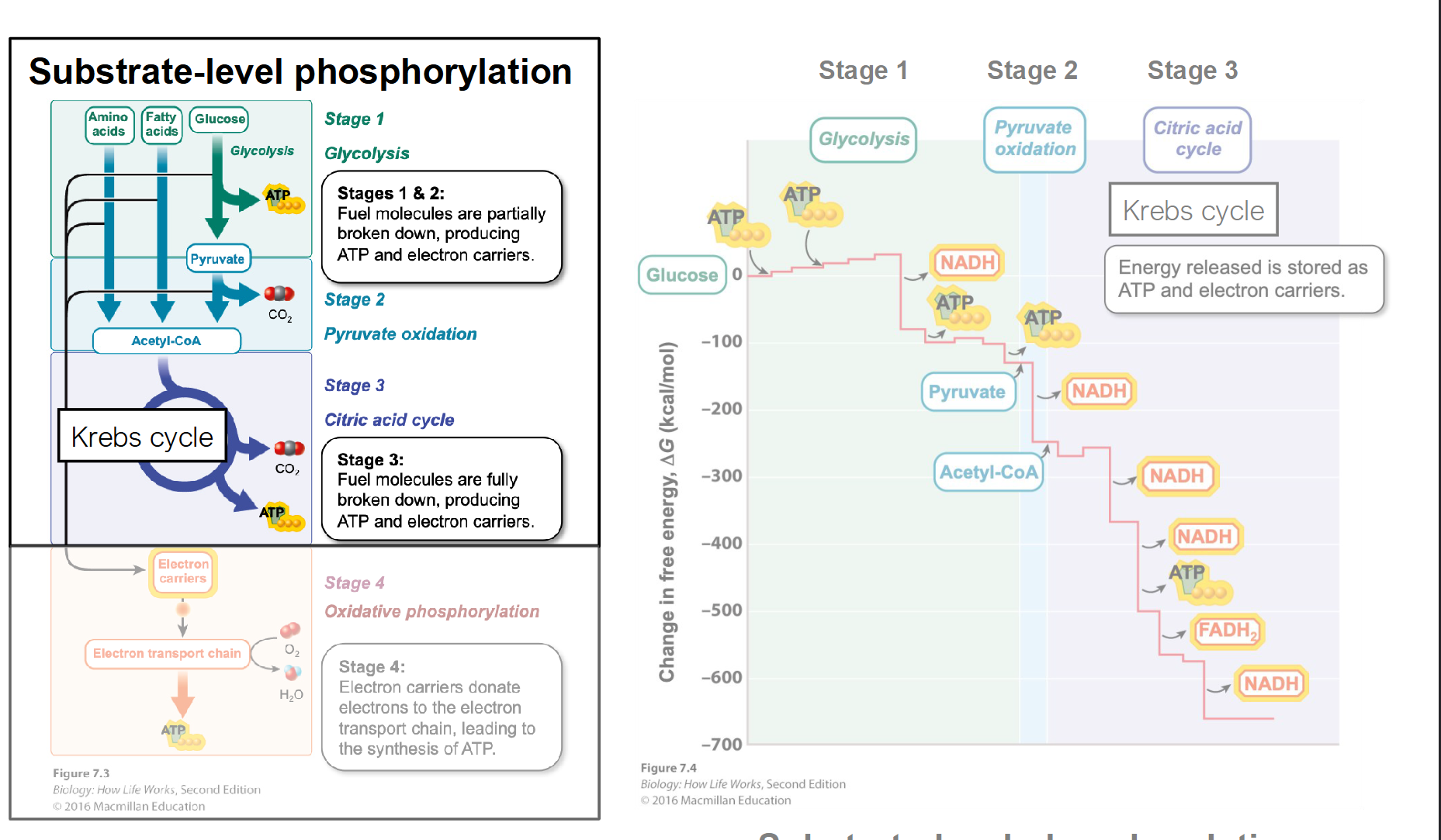
Glycolysis

  • Starts with glucose (6C sugar) and produces two 3C pyruvate (pyruvic acid) molecules 

  • Occurs in cytoplasm 

  • Anaerobic process: Does not require oxygen 

  • 2 NAD+ → 2 NADH that enter ETC

  • Net Profit of 2 ATP (4 Produced in total, but 2 were invested to break glucose down)

  • The overall goal of glycolysis is to break down glucose into smaller pyruvate molecules, producing a small amount of ATP and NADH for energy use.
<ul><li><p>Starts with glucose (6C sugar) and produces two 3C pyruvate (pyruvic acid) molecules&nbsp;</p></li><li><p>Occurs in cytoplasm&nbsp;</p></li><li><p><strong>Anaerobic process</strong>: Does not require oxygen&nbsp;</p></li><li><p>2 NAD+ → 2 NADH that enter ETC</p></li><li><p>Net Profit of 2 ATP (4 Produced in total, but 2 were invested to break glucose down)</p></li><li><p><span>The overall goal of glycolysis is to break down glucose into smaller pyruvate molecules, producing a small amount of ATP and NADH for energy use.</span></p></li></ul><p></p>
28
New cards

Pyruvate Oxidation

  • Following glycolysis, two pyruvate molecules are transported through the two mitochondrial membranes into the matrix 

  • The main purpose of pyruvate oxidation is to convert pyruvate (from glycolysis) into acetyl-CoA, which can then enter the Krebs cycle (Citric Acid Cycle) for further energy extraction.

  • This process also generates NADH and releases carbon dioxide (CO₂).

<ul><li><p>Following glycolysis, two pyruvate molecules are transported through the two mitochondrial membranes into the <strong>matrix&nbsp;</strong></p></li><li><p>The main purpose of pyruvate oxidation is to convert <strong>pyruvate</strong> (from glycolysis) into <strong>acetyl-CoA</strong>, which can then enter the <strong>Krebs cycle</strong> (Citric Acid Cycle) for further energy extraction.</p></li><li><p>This process also generates NADH and releases carbon dioxide (CO₂).</p></li></ul><p></p>
29
New cards

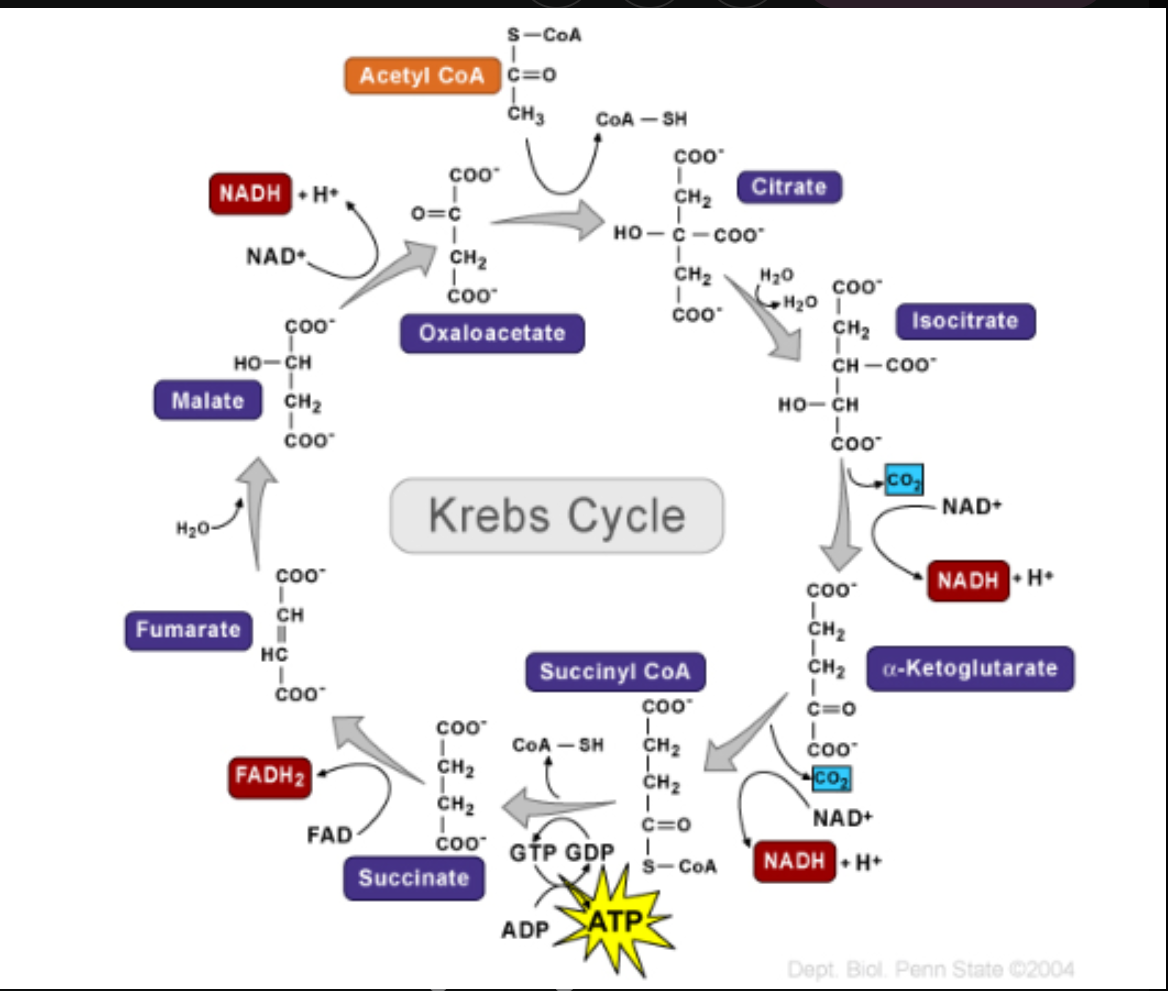
The Citric Acid Cycle

  • A.K.A Kreb’s Cycle 

  • Result in oxidation of acetyl group to CO2 

  • Completes the conversion of all carbon atoms originally in glucose to CO2 

  • Synthesizes ATP, NADH and FADH2

  • Its main purpose is to fully oxidize the acetyl group from acetyl-CoA into carbon dioxide (CO₂) and capture high-energy electrons in the form of NADH and FADH₂ for use in the electron transport chain.

  • The cycle also generates a small amount of ATP (or GTP).
<ul><li><p>A.K.A Kreb’s Cycle&nbsp;</p></li><li><p>Result in oxidation of acetyl group to CO2&nbsp;</p></li><li><p>Completes the conversion of all carbon atoms originally in glucose to CO2&nbsp;</p></li><li><p>Synthesizes ATP, NADH and FADH2</p></li><li><p>Its main purpose is to fully oxidize the acetyl group from <strong>acetyl-CoA</strong> into <strong>carbon dioxide (CO₂)</strong> and capture high-energy electrons in the form of <strong>NADH</strong> and <strong>FADH₂</strong> for use in the <strong>electron transport chain</strong>.</p></li><li><p>The cycle also generates a small amount of ATP (or GTP).</p></li></ul><p></p>
30
New cards

The Electron Carriers

  • Coenzymes acting as electron carriers can exist either as:

  • Oxidized—can accept electrons

  • Reduced—can donate electrons when returning to their oxidized state

  • Nicotinamide adenine dinucleotide

    • Oxidized = NAD+

    • Reduced = NADH

  • Flavin adenine dinucleotide

    • Oxidized = FAD

    • Reduced = FADH2

  • Oxidation of NADH and FADH2 allows electrons and energy to be transferred
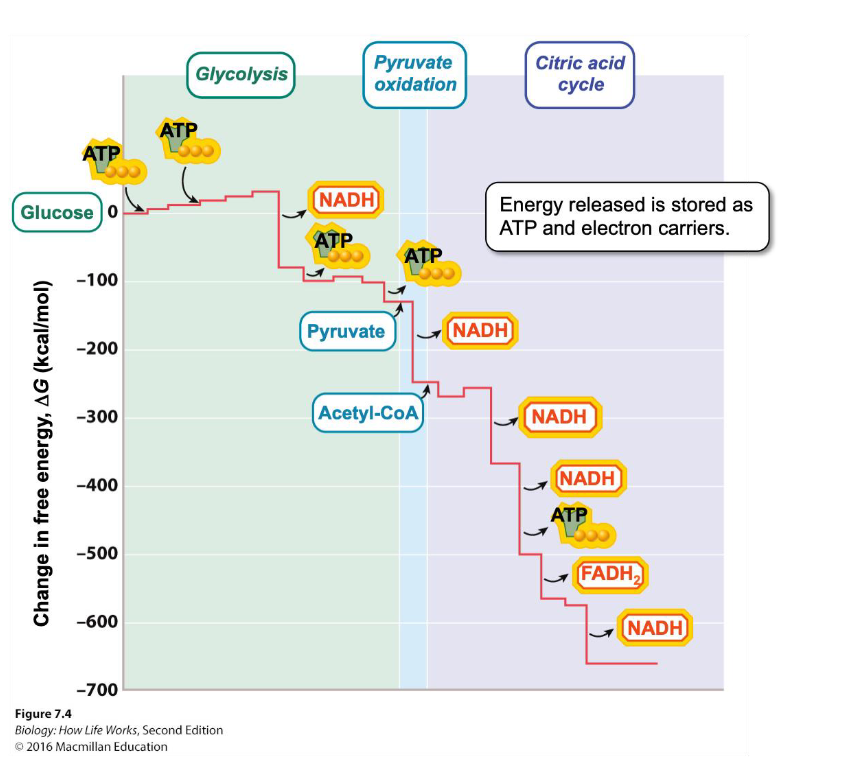
<ul><li><p><span>Coenzymes acting as electron carriers can exist either as:</span></p></li><li><p><span>Oxidized—can accept electrons</span></p></li><li><p><span>Reduced—can donate electrons when returning to their oxidized state</span></p></li><li><p><span>Nicotinamide adenine dinucleotide</span></p><ul><li><p><span>Oxidized = NAD+</span></p></li><li><p><span>Reduced = NADH</span></p></li></ul></li><li><p><span>Flavin adenine dinucleotide</span></p><ul><li><p><span>Oxidized = FAD</span></p></li><li><p><span>Reduced = FADH2</span></p></li></ul></li><li><p><span>Oxidation of NADH and FADH2 allows electrons and energy to be transferred</span></p></li></ul><p></p>
31
New cards

The ETC

  • Delivery: Electron carriers (NADH and FADH₂) from Glycolysis and the TCA cycle arrive and "dump" their high-energy electrons into the chain.

  • The Chain Reaction: As these electrons move from one complex to the next, they lose energy.

  • The Proton Pump: This lost energy isn't wasted. Complexes I, III, and IV use it as fuel to pump Hydrogen ions (H+) from the Matrix into the Intermembrane Space.

  • The Final Destination: At the very end of the chain, Oxygen acts as the final electron acceptor. It grabs the "spent" electrons and some H+ ions to form Water (H2O). This is why you need to breathe!
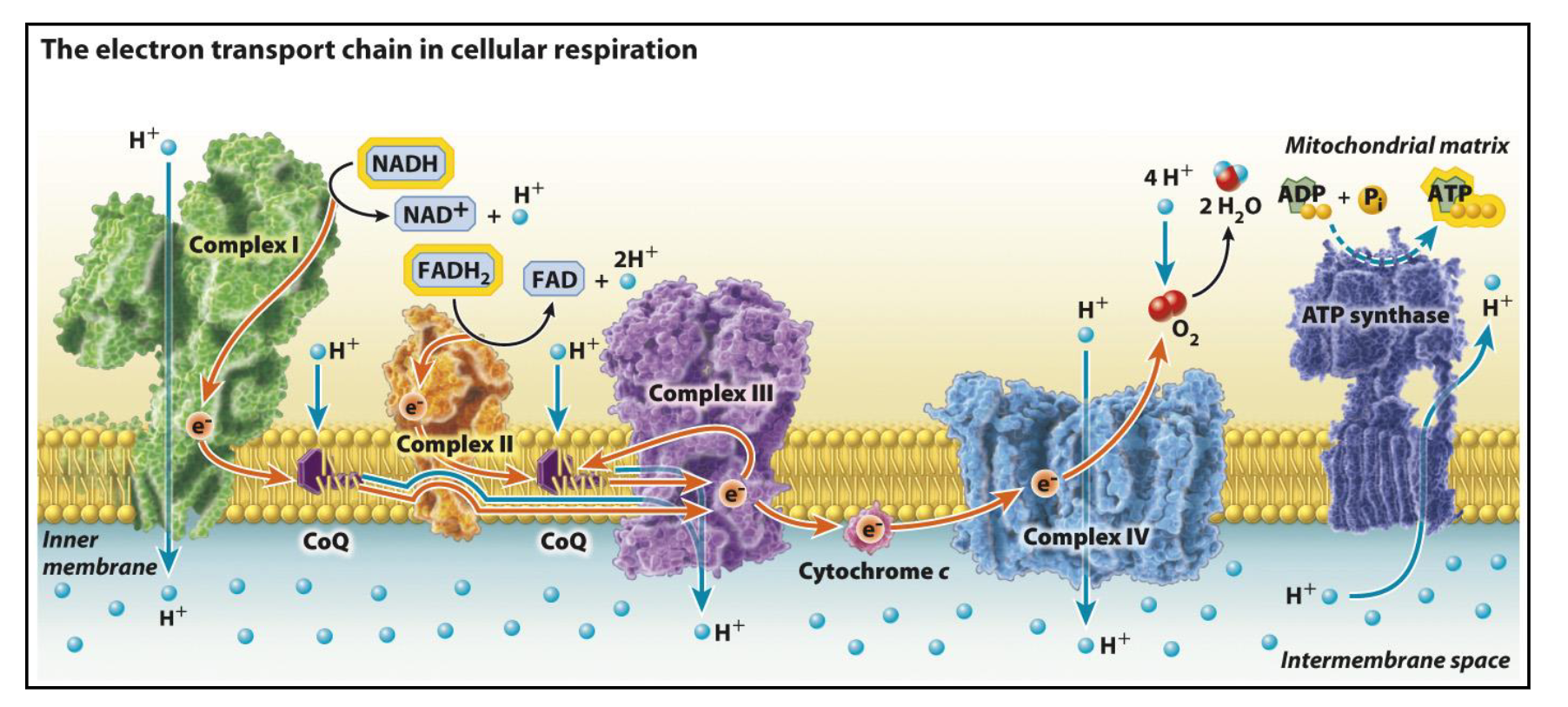
<ul><li><p><strong>Delivery:</strong> Electron carriers (<strong>NADH</strong> and <strong>FADH₂</strong>) from Glycolysis and the TCA cycle arrive and "dump" their high-energy electrons into the chain.</p></li><li><p><strong>The Chain Reaction:</strong> As these electrons move from one complex to the next, they lose energy.</p></li><li><p><strong>The Proton Pump:</strong> This lost energy isn't wasted. Complexes I, III, and IV use it as fuel to pump <strong>Hydrogen ions (</strong><span><strong>H+</strong></span><strong>)</strong> from the <strong>Matrix</strong> into the <strong>Intermembrane Space</strong>.</p></li><li><p><strong>The Final Destination:</strong> At the very end of the chain, <strong>Oxygen</strong> acts as the final electron acceptor. It grabs the "spent" electrons and some <span>H+ </span>ions to form <strong>Water (</strong><span><strong>H2O</strong></span><strong>)</strong>. This is why you need to breathe!</p></li></ul><p></p>
32
New cards

The Electrochemical Gradient and Chemiosmosis: The ATP Factory

  • Because the ETC is constantly pumping H+ ions into the narrow intermembrane space, that area becomes highly concentrated with positive charges.

  • This creates a proton-motive force.

  • The ions desperately want to diffuse back into the matrix (where the concentration is lower), but they cannot pass through the phospholipid bilayer because they are charged.

  • Since the H+ ions are trapped, they have only one "doorway" back into the matrix: a specialized protein called ATP Synthase.

    • The Turbine: As H+ ions flow through ATP synthase, they cause the protein to spin like a water wheel or a turbine.

    • The Payoff: This mechanical spinning energy is used to capture an inorganic phosphate and attach it to ADP, creating ATP.
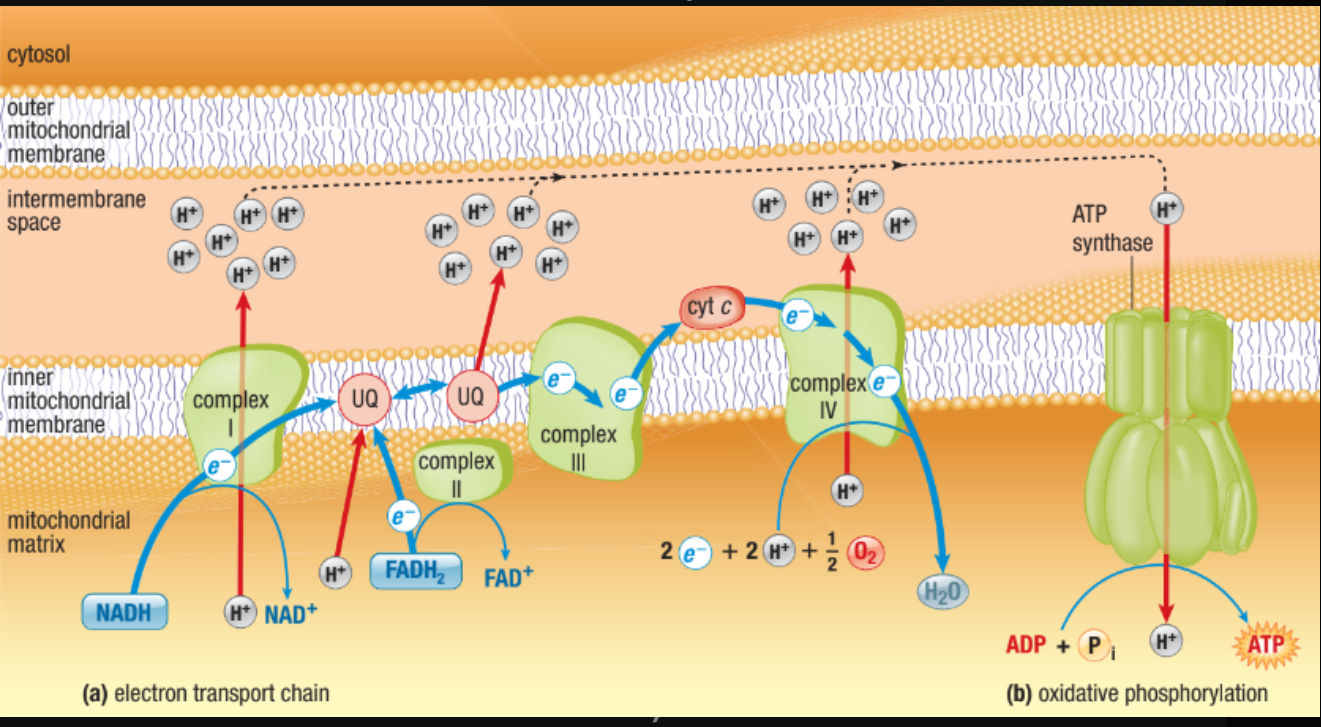
<ul><li><p>Because the ETC is constantly pumping H+ ions into the narrow intermembrane space, that area becomes highly concentrated with positive charges.</p></li><li><p>This creates a <strong>proton-motive force</strong>.</p></li><li><p>The ions desperately want to diffuse back into the matrix (where the concentration is lower), but they cannot pass through the phospholipid bilayer because they are charged.</p></li><li><p>Since the H+ ions are trapped, they have only one "doorway" back into the matrix: a specialized protein called <strong>ATP Synthase</strong>.</p><ul><li><p><strong>The Turbine:</strong> As H+ ions flow through ATP synthase, they cause the protein to spin like a water wheel or a turbine.</p></li><li><p><strong>The Payoff:</strong> This mechanical spinning energy is used to capture an inorganic phosphate and attach it to <strong>ADP</strong>, creating <strong>ATP</strong>.</p></li></ul></li></ul><p></p>
33
New cards

What is the role of Oxygen and the Proton Gradient in oxidative phosphorylation?

  • Oxygen: Acts as the final electron acceptor at the end of the ETC. It combines with electrons and H+ to form water (H2O). Without it, the chain backs up and stops.

    • One of the most electronegative elements 

  • Proton Gradient: Energy from passing electrons is used to pump H+ ions into the intermembrane space.

  • ATP Synthesis: The high concentration of H+ creates a "pressure" (proton-motive force) that flows through ATP Synthase, spinning it like a turbine to manufacture ATP.
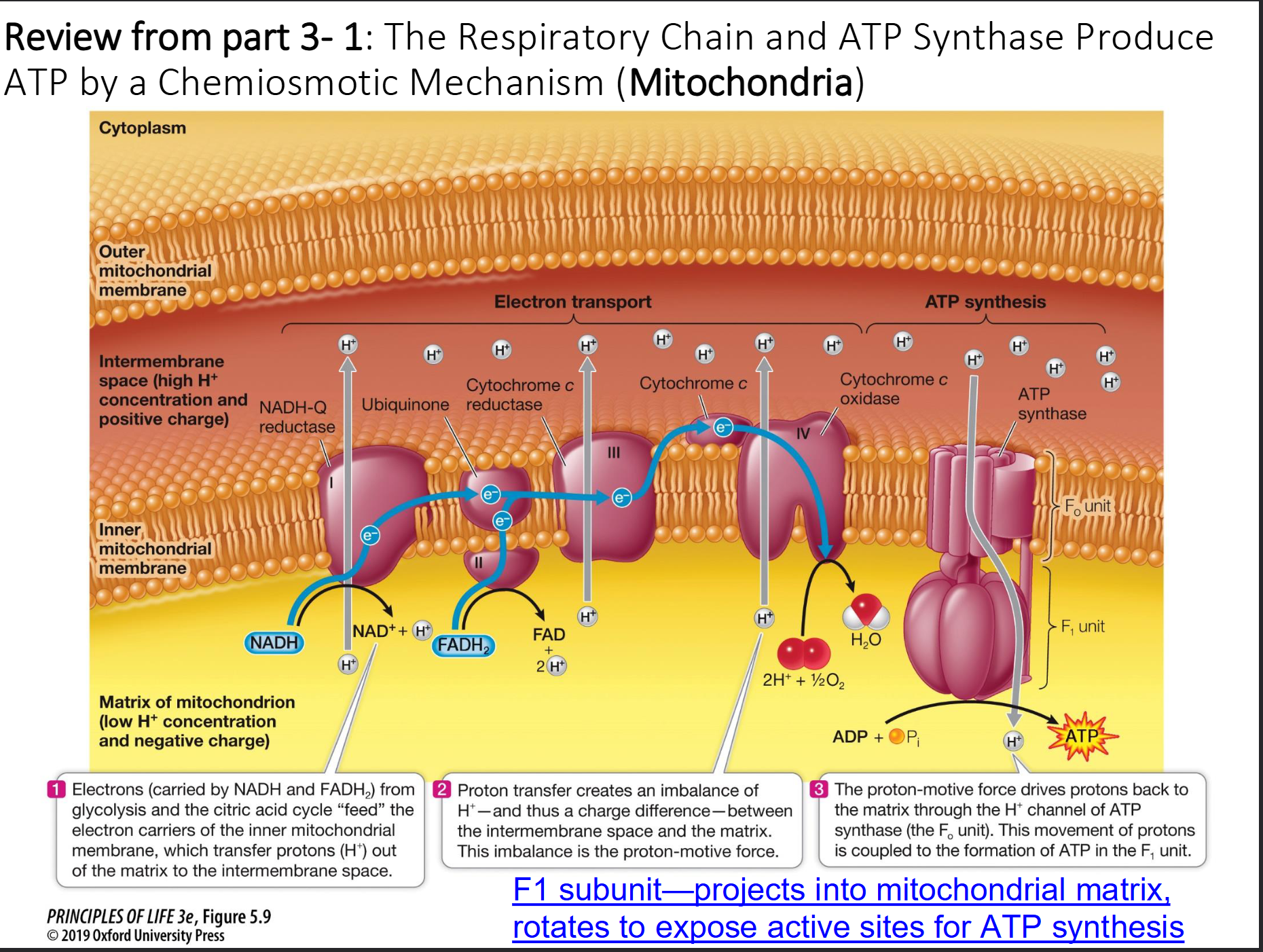
<ul><li><p><strong>Oxygen:</strong> Acts as the <strong>final electron acceptor</strong> at the end of the ETC. It combines with electrons and H+ to form <strong>water (H2O)</strong>. Without it, the chain backs up and stops.</p><ul><li><p><span>One of the most electronegative elements&nbsp;</span></p></li></ul></li><li><p><strong>Proton Gradient:</strong> Energy from passing electrons is used to pump H+ ions into the <strong>intermembrane space</strong>.</p></li><li><p><strong>ATP Synthesis:</strong> The high concentration of H+ creates a "pressure" (proton-motive force) that flows through <strong>ATP Synthase</strong>, spinning it like a turbine to manufacture ATP.</p></li></ul><p></p>
34
New cards

NADH and FADH2

  • NADH

    • Passes electrons to NADH dehydrogenase (1st protein complex) 

    • NADH oxidation pumps 3 protons and are responsible for producing 3ATP

  • FADH2

    • Passes electrons to complex II

    • FADH2 oxidation pumps 2 protons and are responsible for producing 2ATP

35
New cards

Photosynthesis and its two stages

  • Photosynthesis: Building carbohydrates (CH2O) using energy from sunlight and CO2.

  • CH2O is then used as a starting point for making other molecules or synthesizing ATP through cellular respiration (mitochondria)

#1 Light Dependent Reactions: 

  • Directly associated with the absorption of light 

#2 Light Independent Reactions: 

  • A.K.A Calvin Cycle

  • DO NOT require light but need products of light dependent reactions 
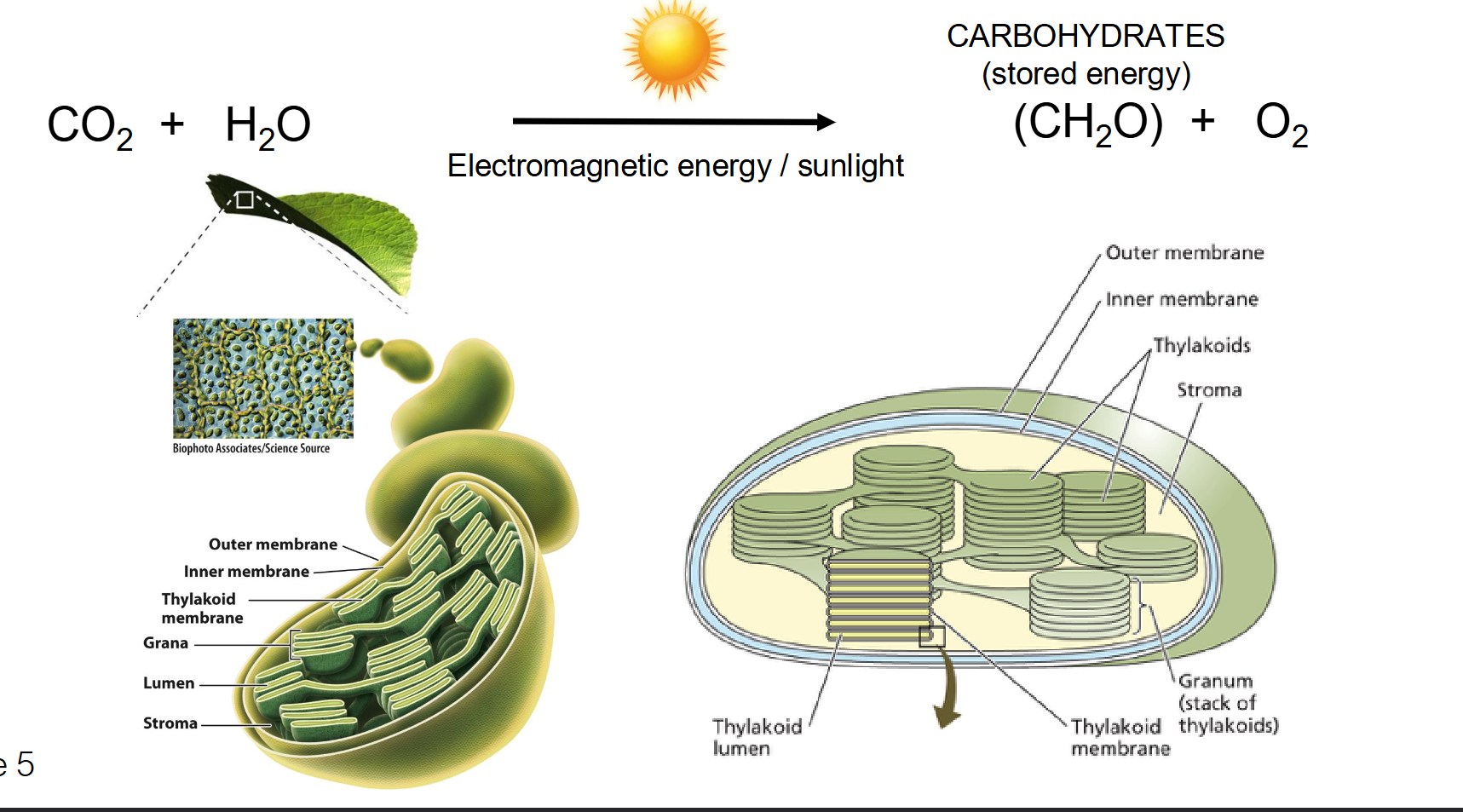
<ul><li><p><span><strong>Photosynthesis:</strong> Building carbohydrates (CH2O) using energy from sunlight and CO2. </span></p></li><li><p><span>CH2O is then used as a starting point for making other molecules or synthesizing ATP through cellular respiration (mitochondria)</span></p></li></ul><p><span><strong>#1 Light Dependent Reactions:&nbsp;</strong></span></p><ul><li><p><span>Directly associated with the absorption of light&nbsp;</span></p></li></ul><p><span><strong>#2 Light Independent Reactions:&nbsp;</strong></span></p><ul><li><p><span>A.K.A Calvin Cycle</span></p></li><li><p><span>DO NOT require light but need products of light dependent reactions&nbsp;</span></p></li></ul><p></p>
36
New cards

Light Dependent Reactions

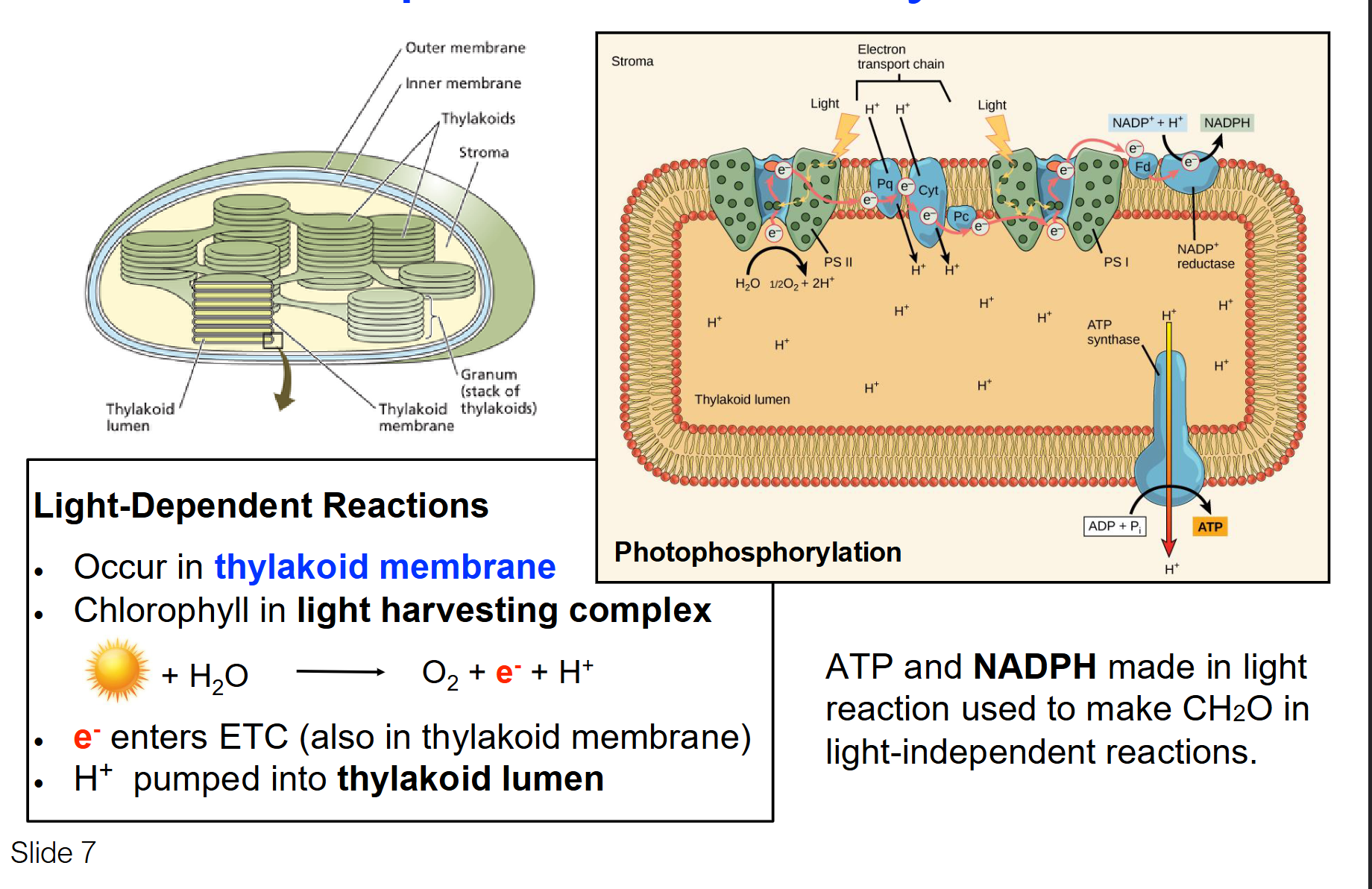
  • Light energy is captured by pigment molecules (chlorophyll)

  • Used to make ATP and NADPH (Nicotinamide adenine dinucleotide phosphate) 

  • A water molecule is split and an ETC transfers electrons to NADP+, establishing a proton gradient to make ATP 

  • These products are used in the Calvin cycle to synthesize glucose

  • Oxygen is produced as a waste product and is released
<ul><li><p>Light energy is captured by pigment molecules&nbsp;(chlorophyll)</p></li><li><p>Used to make ATP and NAD<strong>P</strong>H (Nicotinamide adenine dinucleotide phosphate)&nbsp;</p></li><li><p>A water molecule is split and an ETC transfers electrons to NADP+, establishing a proton gradient to make ATP&nbsp;</p></li><li><p>These products are used in the Calvin cycle to synthesize glucose</p></li><li><p>Oxygen is produced as a waste product and is released</p></li></ul><p></p>
37
New cards

What are the key steps in the light dependent reaction?

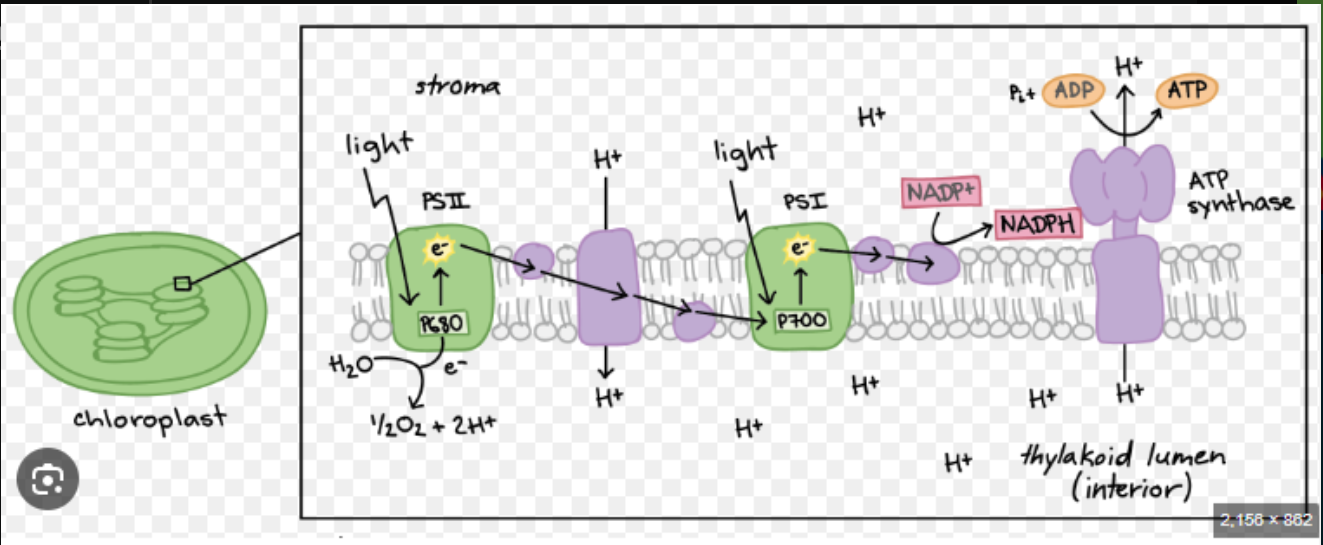
  1. Absorption of Light: Chlorophyll and other pigments in the photosystem II absorb light energy, which excites electrons to a higher energy level.

  2. Splitting of Water: This excited state triggers the splitting of water molecules into oxygen, protons (H⁺), and electrons. Oxygen is released as a byproduct.

  3. Electron Transport Chain (ETC): The excited electrons travel through the ETC, losing energy as they go, which is used to pump protons across the thylakoid membrane, creating a proton gradient.

  4. ATP Synthesis: As protons flow back across the membrane through ATP synthase (due to the gradient), ATP is generated from ADP and inorganic phosphate.

  5. Formation of NADPH: Electrons reach photosystem I, get re-energized by light, and are then transferred to NADP⁺ to form NADPH.
<ol><li><p><strong>Absorption of Light</strong>: Chlorophyll and other pigments in the photosystem II absorb light energy, which excites electrons to a higher energy level.</p></li><li><p><strong>Splitting of Water</strong>: This excited state triggers the splitting of water molecules into oxygen, protons (H⁺), and electrons. Oxygen is released as a byproduct.</p></li><li><p><strong>Electron Transport Chain (ETC)</strong>: The excited electrons travel through the ETC, losing energy as they go, which is used to pump protons across the thylakoid membrane, creating a proton gradient.</p></li><li><p><strong>ATP Synthesis</strong>: As protons flow back across the membrane through ATP synthase (due to the gradient), ATP is generated from ADP and inorganic phosphate.</p></li><li><p><strong>Formation of NADPH</strong>: Electrons reach photosystem I, get re-energized by light, and are then transferred to NADP⁺ to form NADPH.</p></li></ol><p></p>
38
New cards

Summary of Light Dependent Reaction

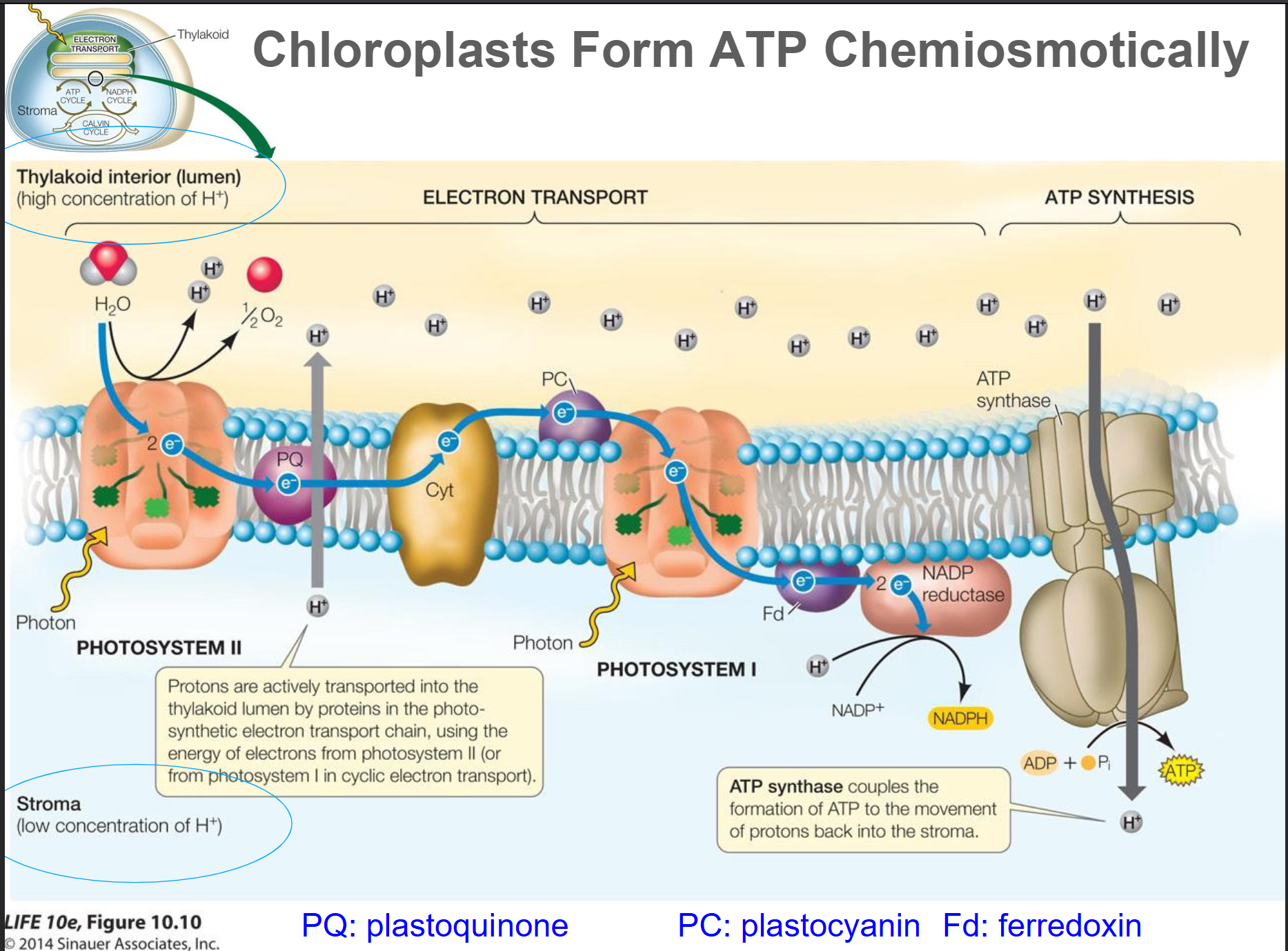
  • The Path: Electrons start at Photosystem II (PSII), move through an electron transport chain to Photosystem I (PSI), and finally end up at NADP⁺.

  • Photolysis: To replace the electrons leaving PSII, water molecules are split (H2O → 2H+ + ½ O2 + 2e-. This is why plants release oxygen.

  • Products: It produces both ATP (via a proton gradient) and NADPH (the final electron catcher).

  • Purpose: Provides the exact "ingredients" (ATP and NADPH) needed for the Calvin Cycle to build sugar.
<ul><li><p><strong>The Path:</strong> Electrons start at <strong>Photosystem II (PSII)</strong>, move through an electron transport chain to <strong>Photosystem I (PSI)</strong>, and finally end up at <strong>NADP⁺</strong>.</p></li><li><p><strong>Photolysis:</strong> To replace the electrons leaving PSII, water molecules are split (<span>H2O → 2H+ + ½ O2 + 2e-</span>. This is why plants release <strong>oxygen</strong>.</p></li><li><p><strong>Products:</strong> It produces both <strong>ATP</strong> (via a proton gradient) and <strong>NADPH</strong> (the final electron catcher).</p></li><li><p><strong>Purpose:</strong> Provides the exact "ingredients" (ATP and NADPH) needed for the Calvin Cycle to build sugar.</p></li></ul><p></p>
39
New cards

Summarize the light independent reaction (Calvin Cycle)

  • CO2 Fixation

    • Electrons in NADPH and the ATP’s used to convert CO2 into organic compounds/carbohydrates (CH2O) 

    • First into 3-carbon compounds which are further processed to make glucose 

    • Take place in the stroma of chloroplasts and do not require light directly.
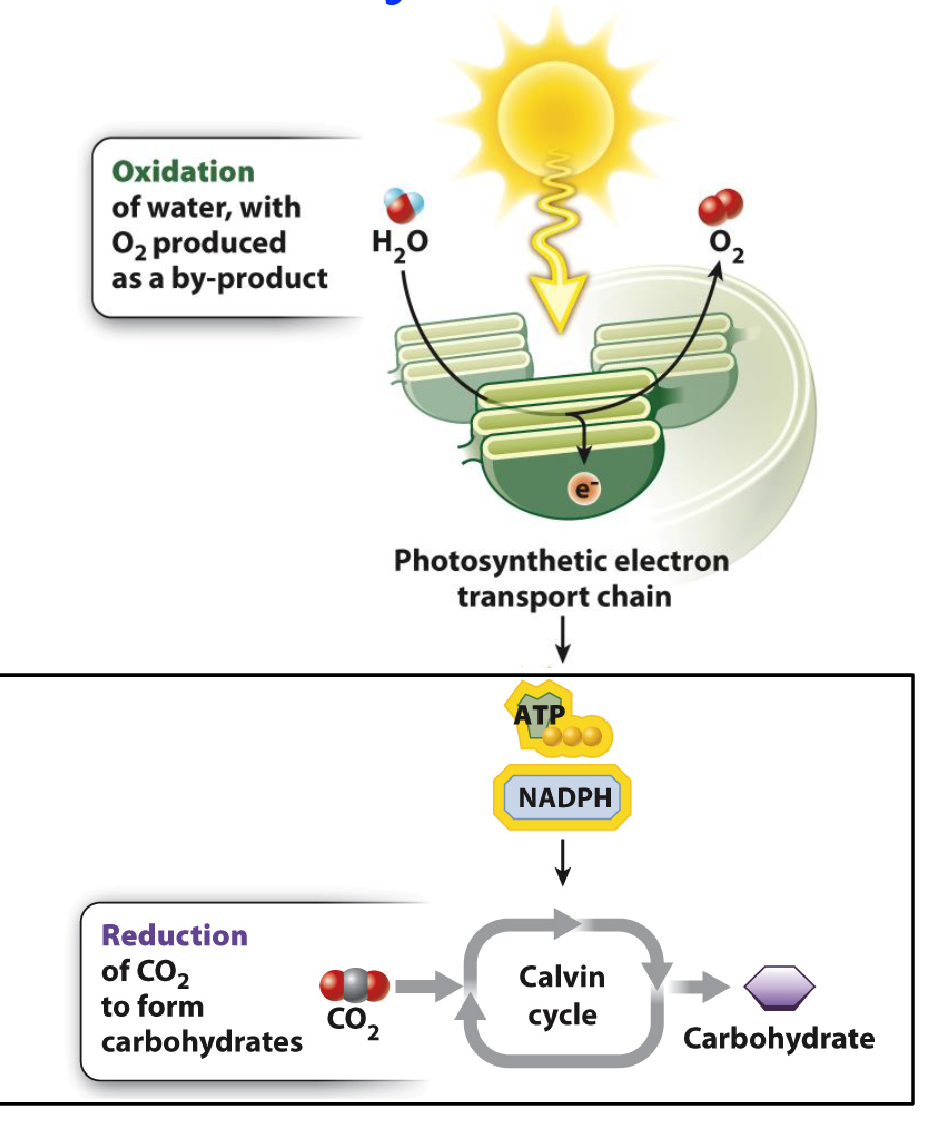
<ul><li><p><span>CO2 Fixation</span></p><ul><li><p><span>Electrons in NADPH and the ATP’s used to convert CO2 into organic compounds/carbohydrates (CH2O)&nbsp;</span></p></li><li><p><span>First into 3-carbon compounds which are further processed to make glucose&nbsp;</span></p></li><li><p>Take place in the <strong>stroma</strong> of chloroplasts and do not require light directly.</p></li></ul></li></ul><p></p>
40
New cards

Compare the location, energy source, and final electron acceptor for the ETC in plants (Photosynthesis) vs. animals (Cellular Respiration).

Feature

Animal ETC (Mitochondria)

Plant ETC (Chloroplast)

Organelle Location

Inner Mitochondrial Membrane (IMM)

Thylakoid Membrane

Primary Energy Source

Chemical energy from Glucose (via NADH/FADH₂)

Light energy from Photons

Final Electron Acceptor

Oxygen (O2) (forming water)

NADP⁺ (forming NADPH)

Proton Pumping Direction

Matrix Intermembrane Space

Stroma Thylakoid Lumen

By-product

Water (H2O)

Oxygen (O2)

41
New cards

Where do the electrons originally come from for the Mitochondrial ETC versus the Chloroplast ETC?

  • Animals (Mitochondria): Electrons are stripped from organic food molecules (like Glucose) during Glycolysis and the TCA cycle.

  • Plants (Chloroplasts): Electrons are stripped from Water (H2O) through a process called photolysis in Photosystem II.

  • Key Distinction: Animals use oxygen to take electrons away at the end; plants create oxygen by taking electrons from water at the beginning.