Greek Religion OCR A Level Classical Civilisation
 Call Kai
 Learn
Learn Practice Test
 Spaced Repetition
 Match
Match Flashcards
 Knowt Play
1/239

There's no tags or description
Looks like no tags are added yet.
Name | Mastery | Learn | Test | Matching | Spaced | Call with Kai |
|---|
No analytics yet
Send a link to your students to track their progress
240 Terms
Polytheism
Belief in many gods
12 Olympian Gods
Zeus, Poseidon, Hades, Hera, Ares, Athena, Apollo, Aphrodite, Hermes, Artemis, Hephaestus, either Hestia or Dionysus. Believed to live on Mount Olympus.
Other major deities
Hades- not Olympian because he lives in the underworld. Persephone sometimes included due to her role in Eleusinian mysteries.
Homer
8th/7th century BC, Epic poet credited with writing down the Iliad and the Odyssey
Hesiod
c. 700 BC, Epic poet who composed Works and Days (tells farmers how to live a good life) and Theogony (god's origins and family tree)
Homeric Hymns
Hymns written in the style of Homer (not actually Homer) to the gods
Aetiology
Cause or reason for something
Panathenaic Amphora prescribed source
333-332BC, black figure, three athletes running on the back. Given as a prize for the Panathenaic games. Shows her large figure (head going up the neck), active goddess, poised, armed.
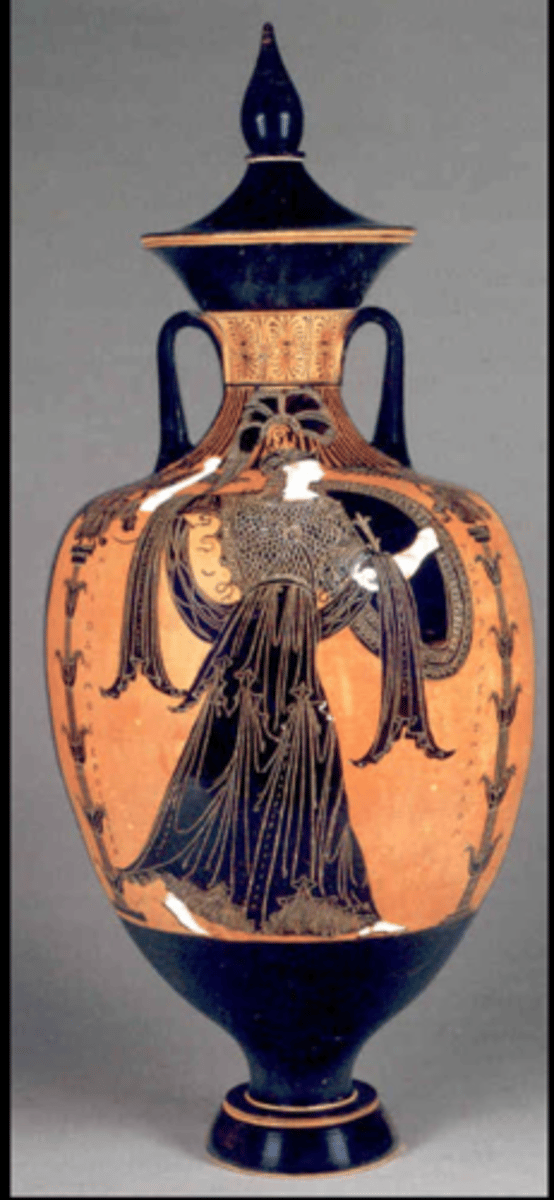
Athena's birth in Homeric Hymns quote
"It was craft-filled Zeus who gave birth / From his sacred head to her already in armour of war... / Quickly she leapt from his deathless head to stand / Before Zeus who bears the aigis."
Works and Days wine quote
"Never pour gleaming wine to Zeus in the morning with unwashed hands, or to the other immortals, for then they pay no heed, and spit out your prayers."
Athena's deceit of Hector in the Iliad quote
"Oh for sure now the gods have called me to my death! I thought the hero Deiphobos was with me: but he is inside the wall, and Athene has tricked me. So now vile death is close on me, not far now any longer, and there is no escape."
Anthropomorphism
Human characteristics- they appear similar to humans both physically and emotionally (they have different whims and grudges), but they are also distinctly not human in various ways such as size, power and immortality
Euripides' Bacchae Dionysus quote
"I have exchanged my mortal form for a divine one."
Poseidon's interests vs Athena's in the Odyssey
Poseidon hates Odysseus because he attacked his son so causes a storm at sea to attack him, but Athena protects Odysseus because she is his patron
Works and Days Zeus' power quote
"For easily he makes strong, and easily he oppresses the strong, easily he diminishes the conspicuous one and magnifies the inconspicuous, and easily he makes the crooked straight and withers the proud -- Zeus who thunders on high, who dwells in the highest mountains... There is no way to evade the purpose of Zeus."
Iliad Gods' immortality quote
"The lord god's immortal hair streamed forward from his deathless head, and he shook the heights of Olympus."
Euripides' Hippolytus immortality quote
"It is not lawful for me to look upon the dead or defile my sight with the last breath of the dying."
Death in Greek Tragedy
There is only one character who dies on stage out of the 32 surviving Greek Tragedies (Sophocles' Ajax) because theatre was sacred to Dionysus -- he should not be tarnished with death
Do ut des
Latin phrase meaning "I give so that you may give"
Works and Days how to honour the gods quote
"Appease the immortal gods with libations and burnt offerings, both when you go to bed and when the holy light returns, so that they may have a gracious heart and spirit towards you, and you may buy other men's land and not have someone else buy yours"
Votive offerings
a dedication to a god by an individual as part of a vow made between mortal and deity
Modern scholar Jon Mikalson quote
The relationship was that of honour rather than love, like the honour that "a subject owes his king"
Works and Days Zeus giving justice quote
"If a man is willing to say what he knows to be just, wide-seeing Zeus gives prosperity... For those who occupy themselves with violence and wickedness and brutal deeds, Kronos' son, wide-seeing Zeus, marks out retribution..."
Epithet
an adjective or descriptive phrase expressing a quality/characteristic of the person or thing mentioned
Agora
the marketplace in ancient Greece
Phratry
"brotherhood," male kinship group in Athens
Some of Zeus' epithets
Agoraios, of the agora; Phatrios, of the phratry; Philios, household and individual wellbeing; Herkeios, of the fence/courtyard: meaning protector of families
Oracle
a person or agency thought to be a source of knowledge or advice via prophectic power derived from the gods; people would often ask which god to pray to
Heroisation
the process by which a living person becomes a hero/is made a hero
Hero cults
Worshipped heroes. Hero defined as a person who lived and died in either myth or real life, so there is a distinction between gods and heroes. Heroes had to achieve something unusual in their lifetime.
Heracles
A widespread and popular hero who is the exception to the rule as he was worshipped as both a hero and god. Asclepius also has similar worship.
Panhellenic
all Greeks
Demeter and Kore
The story of Demeter and Persephone of which multiple things are based around, such as the Thesmophoria
Eleusinian Mysteries
Mystery cult based around Demeter and Kore that it was looked down upon and even became illegal to tell the secrets of
Mystery cult
Secret initiation, you can't tell the secret
Epopteia
Revelation of the secret at the end of the Eleusinian Mysteries
Rules of the Eleusinian Mysteries
1. Anyone could join, man/woman, free/slave, etc you just have to know how to speak Greek and not have done a serious crime like murder.
2. Pay a contribution to be initiated
3. You can't tell the secrets ESPECIALLY the revelation part
Alcibiades
Athenian leader accused of mocking the secrets with the uninitiated and he was punished with the death penalty
Homeric Hymn to Demeter
Source for Eleusis; "share" of something special after death, "awe of the gods prevents any speaking out"
Christian sources
Such as Tertullian, they mocked and defamed the mysteries to differentiate themselves from "pagan" beliefs and also because Eleusis promised similar things to Christianity
Aristophanes' Frogs
Humorous approach, they are singing etc happily in the underworld even though the underworld is usually depicted negatively
Telesterion
Hall of initiation for mystery religion in the Sanctuary of Demeter at Eleusis, building at site dates back to 900BC, no windows, dimly lit, rock cut stands
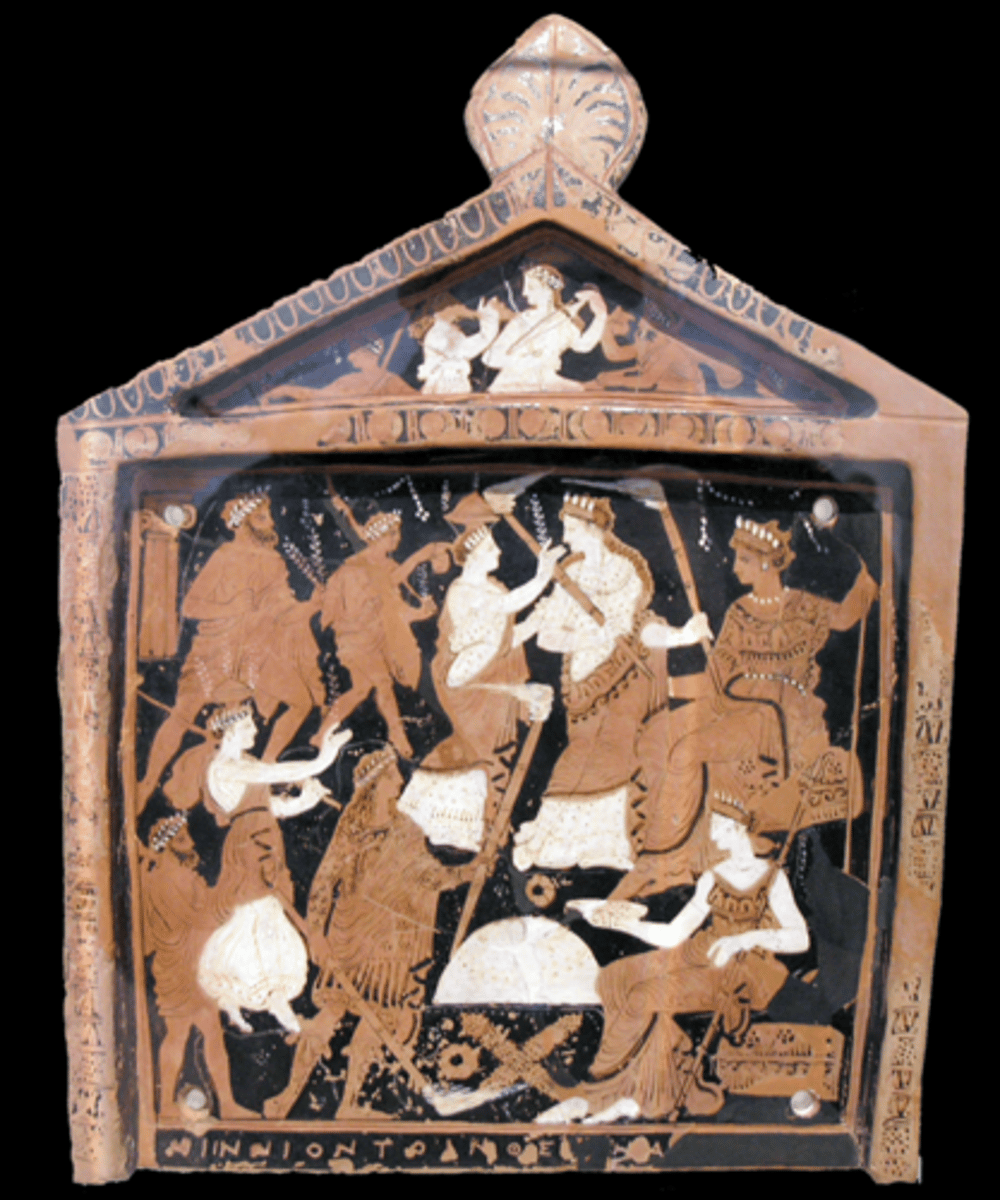
Ninnion Tablet
Depiction of the cult of Eleusis, from left to right: initiates led by the god Iacchus are approaching the seated Demeter and Persephone
Lesser Mysteries
Took part in spring, preparatory event for the Great Mysteries
Mystagogue
already initiated person who is also able to initiate others
Myst
in the process/wishing to be initiated
Archon Basileus
Most important government official for all things sacred in Athens
Kykeon
Special brew said to have had psychotropic effects
Hierophant
Leading priest at Eleusinian Mysteries, always from Eumolpidae family
Great Mysteries
Day 1- assemble in Agora
Day 2- bathe in sea including animal sacrifice in the sea as purification
3 day rest
Day 5- start 15 mile journey to Eleusis
After they would be initiated at Eleusis, drink kykeon, focus on personal revelation, final is the viewing of the epoptai
Asclepius in Homer (Iliad)
Human physician instructed by Chiron who heals the most wounded Greeks
Other Asclepius versions
Son of Apollo and varying mortal woman
Athenian Plague
Around 420BC, they erected an Asclepion afterwards
Thucydides
Historian, source of information about the Athenian plague
Asclepion
Healing temple dedicated to Asclepius
Epidaurus
Location of the an important Asclepion where pilgrims would go from all over Greece to be healed, leaving inscriptions as thanks
Cos
Location of the Asclepion which was a famous school for physicians
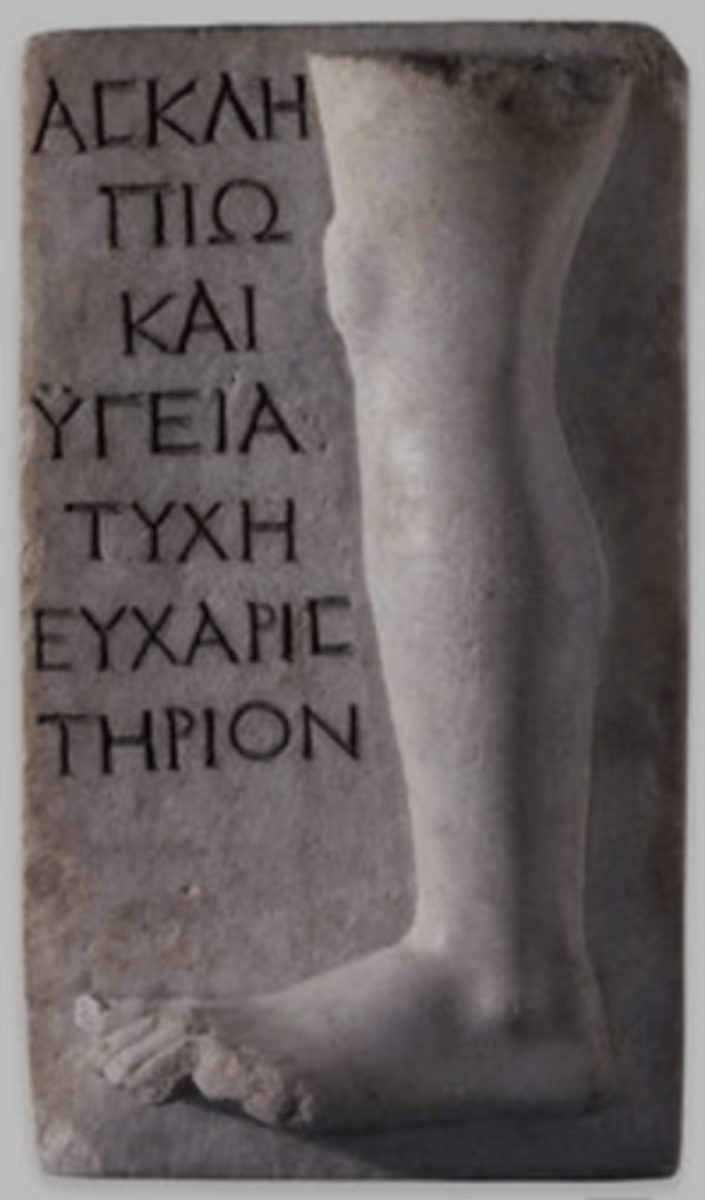
Prescribed source for Asclepius
1st century AD; Votive of a leg thanking Asclepius and Hygeia, island of Melos, by someone called Tyche
Incubation
Sleeping in the shrines of Asclepius
Visit to Asclepion
Bathe, incubation, dream of the god is interpreted by priest or cured instantly, physicians give treatment based on what priest said if necessary
Snakes
Kept in the Asclepion, supposedly having healing abilities
Miracle proved diety
Votives thanking Asclepius for medical miracles legitimising the cult
Oropos
Asclepion with temple, theatre, bath buildings and a fountain house
Dodona
The ancient oracle of Zeus, where messages were supposedly delivered by a sacred oak, either leaves rustling or doves in the tree (according to Homer, Odyssey and Herodotus and Hesiod fragments)
Lead tablet
The questions were carved into these, often yes or no questions or which god should I pray to
Polis
Ancient Greek city-state
Kyrios
Male head of house- did most of household religion
Oikos
Household/family
Zeus Ktesios
Protector of property and wealth. Household god represented with vase filled with seeds, water, oil in the storeroom
Zeus Herkeios
Protected the fence/outside enclosure of the house. A statue stood in the courtyard to ward off evil
Apollo Agyeios
Protected the house at the main door, represented by either a statuette, a small pillar or a statue of Heracles
The Hearth
Central hearth of each household dedicated to Hestia. New members of the family (babies, brides, slaves) welcomed by walking around the fire showered with dried fruit and nuts
The Herm
Rectangular pillar with Hermes' head at the top and a phallus lower on the pillar, halfway marker on roads and protective symbol outside house
Offerings to the dead
Kyrios offers garlands and libations of milk and honey at the family tombs once a year
Apatouris
3 day festival where son is welcomed into his father's phratry
Aristophanes Lysistrata role of women
Lysistrata was an Arrephoros, Grinder, at Brauron, a basket-bearer as a child. Role of women in religion seems to be mostly outside the home
Arrephoros
Secret ritual to Athena Polias where they take a basket of items they didn't know from the temple of Athena to the sanctuary of Aphrodite and brought something back
Brauronia
Girls would dress up as bears at the festival of Artemis at Brauron (nearby to Athens)
Thesmophoria
Women-only festival to Demeter and Kore
Rites of the dead
Women expected to tend to the body and do the proper rites when someone died
Erchia sacrifice calendar
A deme of Athens, Erchia, had a sacrifice calendar with 25 sacrifices a year, 6 of which were various epithets of Apollo. 2000-3000 residents
Proerosia
Pre-ploughing festival, Erchia, as it was a countryside deme would celebrate festivals like this in honour of Demeter.
Prytaneion
State dining room in the agora, contained a polis hearth as a reflection of the home hearth
Eleusinion
Athenian building to correspond to Eleusis, on the slopes of the Acropolis
Main panhellenic sanctuaries
Delphi, Pythian Apollo; Olympia, Olympian Zeus; Nemea, Nemean Poseidon; Isthmus, Isthmian Poseidon
Priests and Priestesses
Carry out rites related to their cult such as libations and taking care of the sanctuary, often served a god of their own gender but there are exceptions such as the Pythia
Archon
Athenian magistrate
Archon basileus
Main religious official of the Athenian state
Scapegoat ritual
Household servants representing evils such as famine or disease are driven out while the archon basileus shouts "out with Famine and in with Wealth and Health" (or the kyrios on a smaller scale household setting)
Eponymous archon
Gave his name to the year; had authority over civic festivals
City Dionysia
The Greek civic festival in honor of the god Dionysus where dramatic competitions took place including premieres of Aristophanes' and Euripides' works
Polemarch/war archon
In charge of cults related to military affairs such as Artemis Agrotera who they made sacrifices to on the battlefield
Epimeletai
Overseers of religious festivals such as the Eleusinian mysteries
Miasma
Religious impiety or pollution which causes disease
How you can get miasma
Giving birth, miscarriage; Entering the house of a woman who just gave birth; Physically dirty; Not honouring the gods properly; Disrespecting burial laws; Disrespecting right to asylum; Sex; Attending a funeral, near a dead body; Murder
How to purify
Dirty: sprinkle water
Birth: not enter sanctuary for a few days
Murder: can't attend worship until go through purification
Plutarch impiety law source
In 433 a law was passed to publicly prosecute "those who did not believe in the gods"
Herodotus Pythia Lydia consultation source
Croesus, king of Lydia, asked the Pythia if he should wage war against the Persians
Pythia wooden walls
Themistocles interpreted the Pythia's advice to trust the wooden walls as boats and won the battle against the Persians in 480
Herodotus Spartans omens source
Pausanias and his Spartans refused to advance attacking the Persians until the sacrificial omens were favourable