#6 - ENEV 384 Engineering Material - Metals
 Call Kai
 Learn
Learn Practice Test
 Spaced Repetition
 Match
Match Flashcards
 Knowt Play
1/42

Earn XP
Description and Tags
Comprehensive practice flashcards covering the atomic structure, crystalline defects, alloys, manufacturing processes, and mechanical properties of metals and steel based on the ENEV 384 lecture transcript.
Name | Mastery | Learn | Test | Matching | Spaced | Call with Kai |
|---|
No analytics yet
Send a link to your students to track their progress
43 Terms
Metallic bond
A bond where atoms share electrons that exist in an unconfined state, moving freely in an electron cloud without disturbing the lattice structure.
Toughness
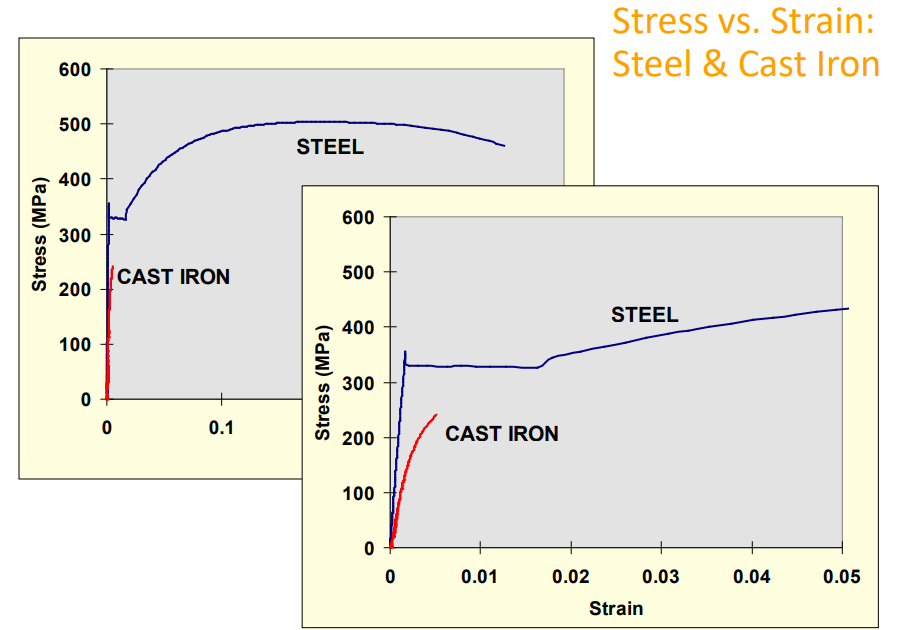
The ability of a material to absorb energy, which is proportional to the area under the stress-strain curve.
Unit cell
The smallest part of the crystal structure that retains all the properties of the crystal.
Coordination number
The number of nearest neighbors an atom can have, determined by the ratio of atom diameters.
Crystal Lattice Structure
A 3-D geometric repeating pattern of atoms throughout a structure.
Grain Structure
A collection of unit cells that form into lattice structures as multiple nuclei develop during the cooling of molten metal.
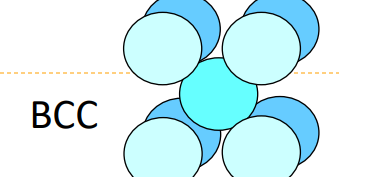
Body centered cubic (BCC)
A lattice structure with atoms at each corner and one in the center; examples include Cr, Na, and α-iron at temperatures below 912∘C. 9 atoms
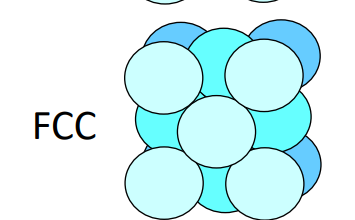
Face center cubic (FCC)
A close-packed lattice structure with atoms at each corner and at the center of each face; examples include Al, Cu, and γ-iron between 912∘C and 1400∘C. 14 atoms
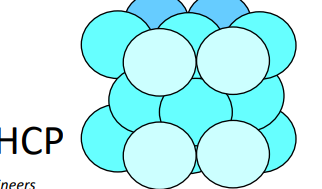
Hexagonal close pack (HCP)
A lattice structure with atoms at each corner, the center of the top and bottom faces, and the center plane, totaling 17 atoms.
Atomic Packing Factor (APF)
The measure of density of packing calculated as the volume of atoms in a unit cell divided by the volume of the unit cell.
Polymorphism
When two or more distinct types of crystal structures exist for the same composition; also referred to as allotropes in metals literature.
Austenite
The FCC form of Fe-C solution that exists at temperatures above 912∘C and can dissolve higher proportions of carbon than Ferrite.
Ferrite
The low temperature BCC form of iron with small amounts of carbon that is ductile and can dissolve significant amounts of Cr, Si, W, and Mo.
Dislocations
Imperfections in the stacking of atomic planes that produce high-energy sites and allow small stresses to move material step-by-step.
Point defects
Structural defects in crystalline materials including vacancies, self-interstitials, and impurity atoms (interstitial or substitutional).
Substitutional solution
An alloy formed when impurity atoms (solute) are approximately the same size as the parent atoms and replace them in the lattice.
Interstitial solid solution
An alloy where the alloying atoms fit into the holes, or interstices, in the parent metal lattice.
Grain boundaries
Transition zones between crystals where atomic packing directions do not align, characterized by high energy and less efficient packing.
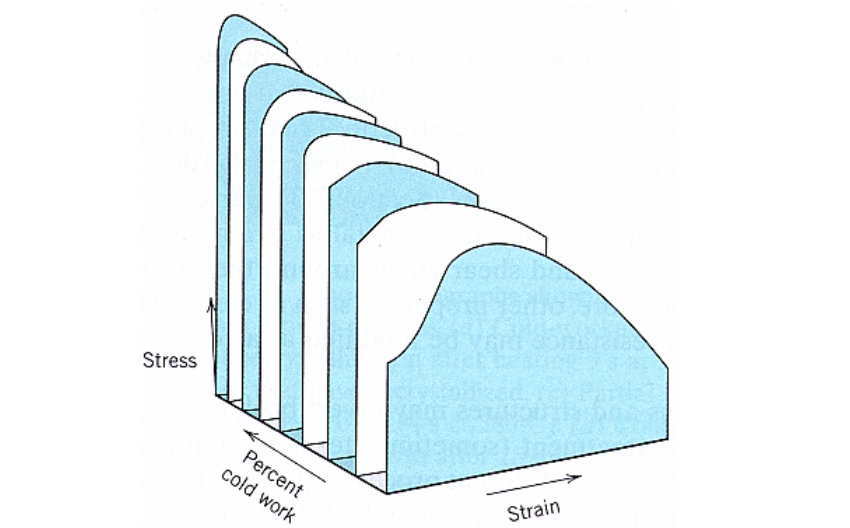
Strain hardening
The process of making a metal stronger and more brittle by straining it beyond the yield point, causing dislocations to interfere with each other.
Brittle fracture
A fracture with little or no plastic deformation, where cracks propagate at the speed of sound from small flaws.
Ductile fracture
A fracture characterized by large deformations, necking, and a typical cup/cone failure surface.
Cleavage
A mechanism of fracture where the surface is flat and perpendicular to the applied stress, common in brittle materials.
Pig iron
Molten iron produced in a blast furnace containing approximately 4%C, 1%Mn, and 1%Si.
Wrought iron
A ductile, high purity iron with long fibrous slag inclusions that is anisotropic and ideal for cold-working.
Cast iron
Iron with high carbon content (up to 5%) and graphite inclusions, possessing high compressive strength but low tensile strength.
Billet
A semi-finished length of metal that has a round or square cross-section.
Slab
A length of metal that is rectangular in cross-section.
Bloom
A porous mass of iron and slag produced by a bloomery furnace.
Cementite
A hard and brittle iron carbide compound with the specific formula Fe3C.
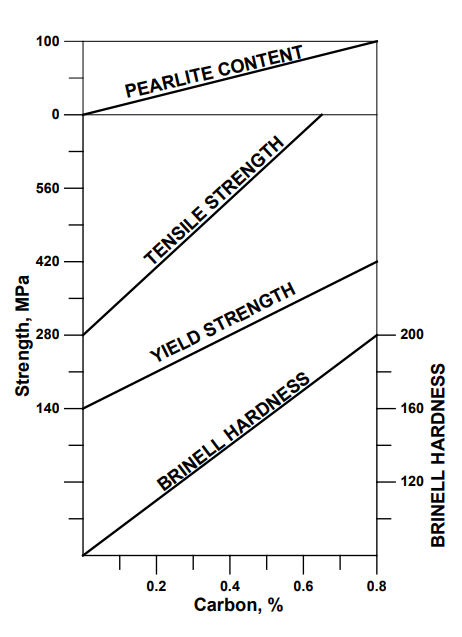
Pearlite
A lamellar mixture of alternating layers of Ferrite (88wt%) and Cementite (12wt%).
Brinell scale
A scale characterizing the indentation hardness of materials through the penetration of a loaded indenter.
Normalizing
A slow, continuous cooling process that produces equilibrium structures such as Pearlite, Cementite, and Ferrite.
Quenching
A fast cooling process that produces non-equilibrium, frozen structures like Martensite and Bainite.
Martensite
A non-equilibrium frozen structure produced in steel through the quenching process.
Re-crystallization temperature
The temperature at which re-crystallization of grains is spontaneous, usually 0.3 to 0.6 of the absolute melting temperature.
Cold-working
A strain-hardening process occurring below the re-crystallization temperature that increases yield and tensile strength while decreasing ductility.
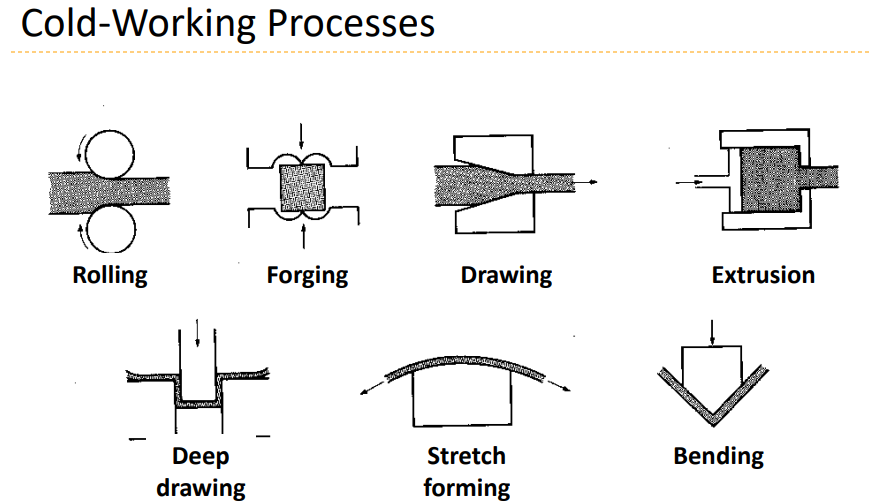
Hot-working
Plastic deformation of metal above the re-crystallization temperature that eliminates pores and cavities without appreciably changing mechanical properties.
Anisotropy
The characteristic of a material having different mechanical properties in different directions, such as being weaker across the grain.
Yield point
The point on a stress-strain curve where dislocations are released, marking the end of purely elastic deformation.
Carbon equivalent (CE)
An index determining the weldability of rebar, calculated as: CE=%C+6%Mn+40%Cu+20%Ni+10%Cr−50%Mo−10%V.
Dependence of Properties on Carbon %
Effect of Cold Work on Tensile Stress-Strain Curve
Stress vs. Strain: Steel & Cast Iron