A Primer in Behavioral Economics
 Call Kai
 Learn
Learn Practice Test
 Spaced Repetition
 Match
Match Flashcards
 Knowt Play
1/103

There's no tags or description
Looks like no tags are added yet.
Name | Mastery | Learn | Test | Matching | Spaced | Call with Kai |
|---|
No analytics yet
Send a link to your students to track their progress
104 Terms
Behavioral Economics
The attempt to increase the explanatory and predictive power of economics by providing more psychologically plausible foundations.
Descriptive Theories
Theories that describe how people actually make decisions.
Normative Theories
Theories that describe how people should make decisions.
Rational-Choice Theories
Theories that define what it means to make rational choices.
Laboratory experiments
Involve real choices, real money, and real subjects (students)
Field experiments
Randomly assigning participants to test or control group and observe
Process measures
Combine restos with brain scans and other data to provide a model
System 1
Fast, automatic, intuitive thinking requiring little effort.
System 2
Slow, deliberate, analytical thinking requiring conscious effort.
Cognitive Reflection Test (CRT)
Test designed to measure the tendency to override an intuitive but incorrect response and engage in reflection.
Weak Preference (≽)
Relationship meaning "at least as good as."
Strong Preference (≻)
Relationship meaning "strictly better than."
Indifference (∼)
Relationship meaning two alternatives are equally preferred.
Completeness
A property of rational preferences where any two alternatives can be compared.
Transitivity
A property of rational preferences where if x is preferred to y and y to z, then x is preferred to z.
Rational Preference
A preference relation that is complete and transitive.
Properties of indifference
Reflexivity, symmetry and transivity
Properties of strong preference
Transitivity, anti-symmetry, irreflexivity
Reflexivity
The property that every alternative is indifferent to itself.
Symmetry
The property that if x is indifferent to y, then y is indifferent to x.
Anti-symmetry
The property that if x is strictly preferred to y, then y cannot be strictly preferred to x.
Irreflexivity
The property that no alternative is strictly preferred to itself.
Utility
A numerical representation of preference.
Utility Function
A function assigning numbers to alternatives such that higher values represent preferred outcomes.
Explicit Cost
The direct monetary cost of obtaining something.
Opportunity Cost
The value of the best alternative forgone when making a choice.
Economic Profit
Benefit of a choice minus its opportunity cost.
Rational Choice
A choice whose utility is at least as great as its opportunity cost.
Sunk Cost
A cost that has already been incurred and cannot be recovered.
Sunk-Cost Fallacy
The mistake of allowing unrecoverable past costs to influence current decisions.
Menu Dependence
The phenomenon where preferences are influenced by the available set of options.
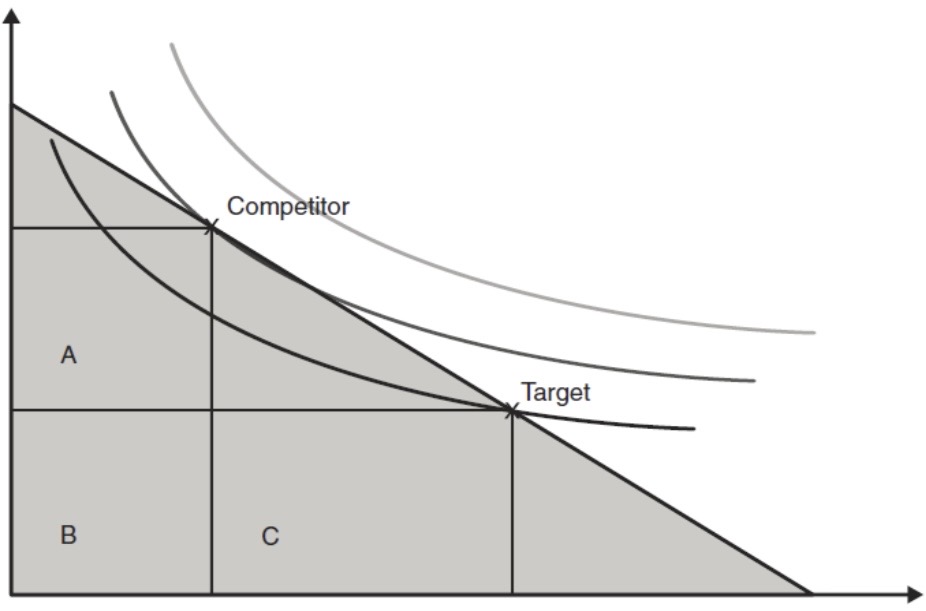
Decoy Effect
The tendency for preferences to change when an inferior option is introduced.
Before the introduction of the decoy effect
After the introduction of the decoy effect
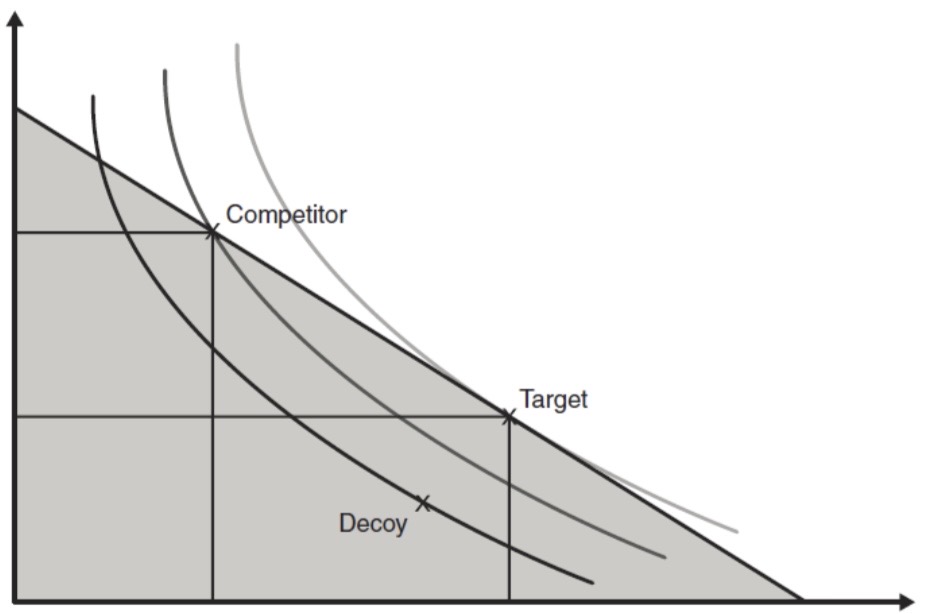
Asymmetrically Dominated Option
An option dominated by the target alternative but not by the competitor.
Reason-Based Choice
Choosing an option because it provides a justification for the decision.
Bandwagon Effect
The tendency to do something because many other people are doing it.
Endowment Effect
The tendency to value something more once it is owned.
Loss Aversion
The tendency for losses to have a greater psychological impact than equivalent gains.
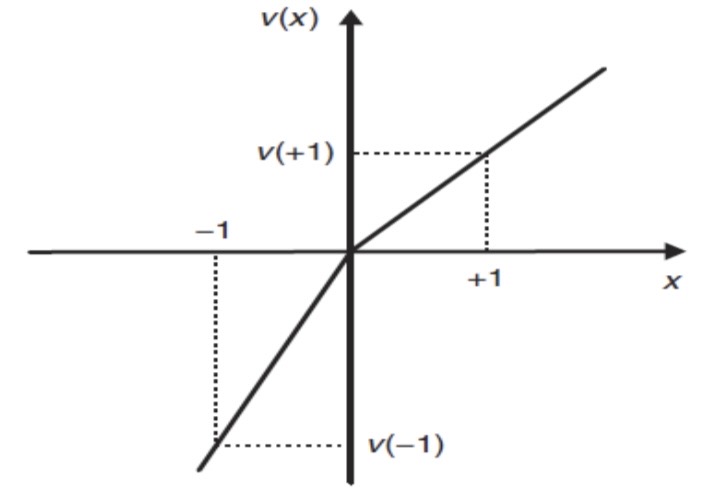
Without loss aversion
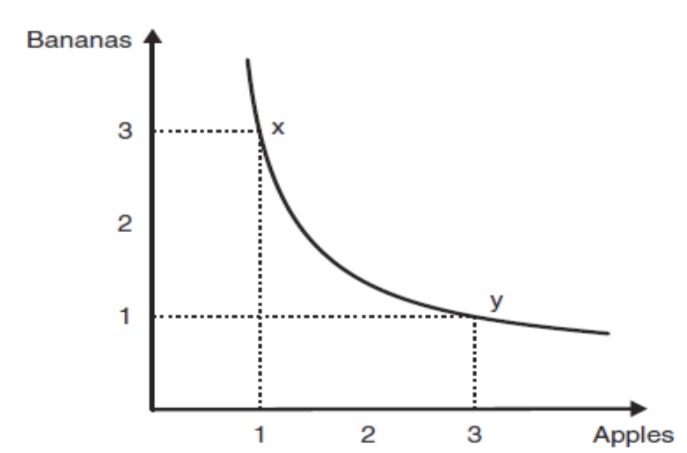
With loss aversion
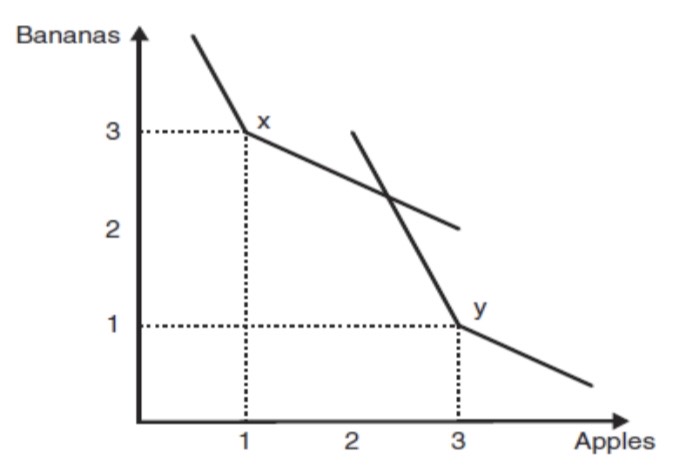
Reference Point
The benchmark against which gains and losses are evaluated.
Anchoring
The tendency to rely heavily on an initial value when making judgments.
Anchor
The initial value or reference used in estimation and decision making.
Independence
Two events are independent if one does not affect the probability of the other.
Gambler's Fallacy
The mistaken belief that independent random events influence one another.
Law of Small Numbers
The mistaken belief that small samples closely resemble the populations from which they are drawn.
Conjunction Fallacy
The error of judging a conjunction of events as more probable than a single event.
Disjunction Fallacy
The error of judging a broader category as less probable than one of its subsets.
Confirmation Bias
The tendency to interpret information in ways that confirm existing beliefs.
Availability
The ease with which information comes to mind.
Availability Heuristic
The tendency to judge probability based on how easily examples can be recalled.
Framing Effect
The tendency for decisions to change depending on how information is presented.
Gain Frame
A presentation emphasizing positive outcomes.
Loss Frame
A presentation emphasizing negative outcomes.
Integrating Outcomes
Evaluating multiple gains and losses as a single net outcome.
Segregating Outcomes
Evaluating each gain and loss separately.
Cancellation
Combining a small loss with a large gain into a single outcome.
Silver Lining
Separating a small gain from a larger loss to make the gain more noticeable.
Allais Problem
A decision problem demonstrating violations of expected utility theory.
Sure-Thing Principle
The principle that choices should not be affected by outcomes that are common to all options.
Certainty Effect
The tendency to overweight outcomes that are certain.
Ellsberg Paradox
A paradox showing people's preference for known risks over ambiguous risks.
Regret aversion
Individuals know they might regret the risky choice over the sure thing
Ambiguity Aversion
The tendency to avoid options with unknown probabilities.
Probability Weighting Function
A function describing how people subjectively distort probabilities.
Prospect Theory
A theory stating that people evaluate outcomes relative to a reference point and weight probabilities nonlinearly.
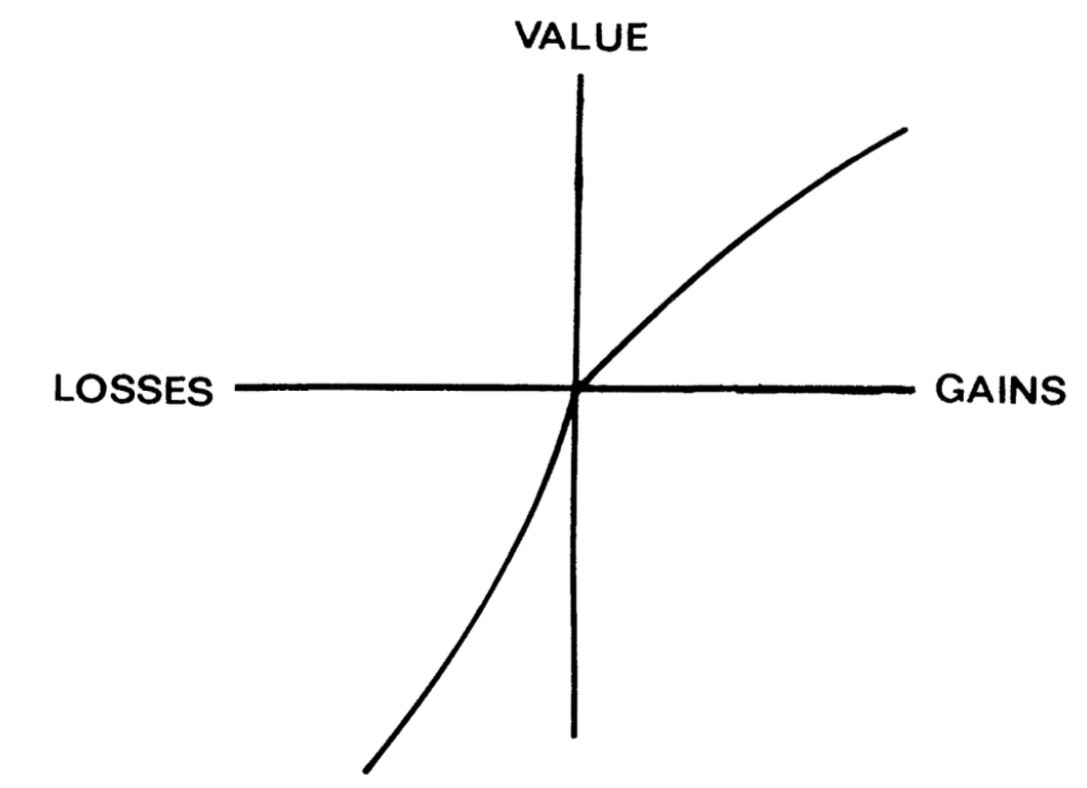
Value Function
In prospect theory, a function defined over gains and losses relative to a reference point.
Concave for Gains
A characteristic implying diminishing sensitivity to gains.
Convex for Losses
A characteristic implying diminishing sensitivity to losses.
Game Theory
The study of strategic interactions among decision makers.
Game
A decision problem where outcomes depend on the actions of multiple players.
Strategy
A complete plan of action specifying what a player will do in every circumstance.
Payoff
The outcome or reward associated with a particular strategy combination.
Payoff Matrix
A table showing payoffs for all possible combinations of strategies.
Nash Equilibrium
A strategy profile where each player's strategy is a best response to others.
Nash's Theorem
The theorem stating that every finite game has at least one Nash equilibrium.
Pure Coordination Game
A game in which players have perfectly aligned interests.
Battle of the Sexes
An impure coordination game where players prefer different coordinated outcomes.
Zero-Sum Game
A game in which one player's gain is exactly another player's loss.
Prisoner's Dilemma
A game where individually rational actions lead to a collectively worse outcome.
Pareto Dominance
One outcome is better for at least one person and no worse for anyone else.
Pareto Optimality
A situation where no one can be made better off without making someone else worse off.
Cheap Talk
Non-binding communication between players.
Backward Induction
A method for solving sequential games by reasoning from the end backward.
Trembling-Hand-Perfect Equilibrium
A Nash equilibrium robust to small probabilities of mistakes.
Sequential Game
A game in which players move one after another.
Subgame
A portion of a larger game that itself constitutes a game.
Subgame-Perfect Equilibrium
A strategy profile that is a Nash equilibrium in every subgame.
Ultimatum Game
A game where one player proposes a division of resources and the other can accept or reject it.
Dictator Game
A game where one player unilaterally decides how to divide resources.
Trust Game
A game where one player sends resources that are multiplied and another decides how much to return.
Public Goods Game
A game involving voluntary contributions to a shared resource.
Beauty Contest Game
A game where players choose numbers aiming to be closest to a fraction of the average choice.
Social Preferences
Preferences that depend on both one's own outcome and others' outcomes.
Altruistic Preferences
Preferences where a person's utility increases with another person's welfare.
Envious Preferences
Preferences where a person's utility decreases when others do better.
Rawlsian Preferences
Preferences focused on maximizing the welfare of the worst-off individual.