Geometry Review and Vocab
 Call Kai
 Learn
Learn Practice Test
 Spaced Repetition
 Match
Match Flashcards
 Knowt Play
1/147

There's no tags or description
Looks like no tags are added yet.
Name | Mastery | Learn | Test | Matching | Spaced | Call with Kai |
|---|
No analytics yet
Send a link to your students to track their progress
148 Terms
Acute angle
An angle that measures less than 90 degrees
Acute triangle
A triangle whose angles all measure less than 90 degrees
Addition property of equality
If you add the same number to both sides of an equation, the two sides stay equal
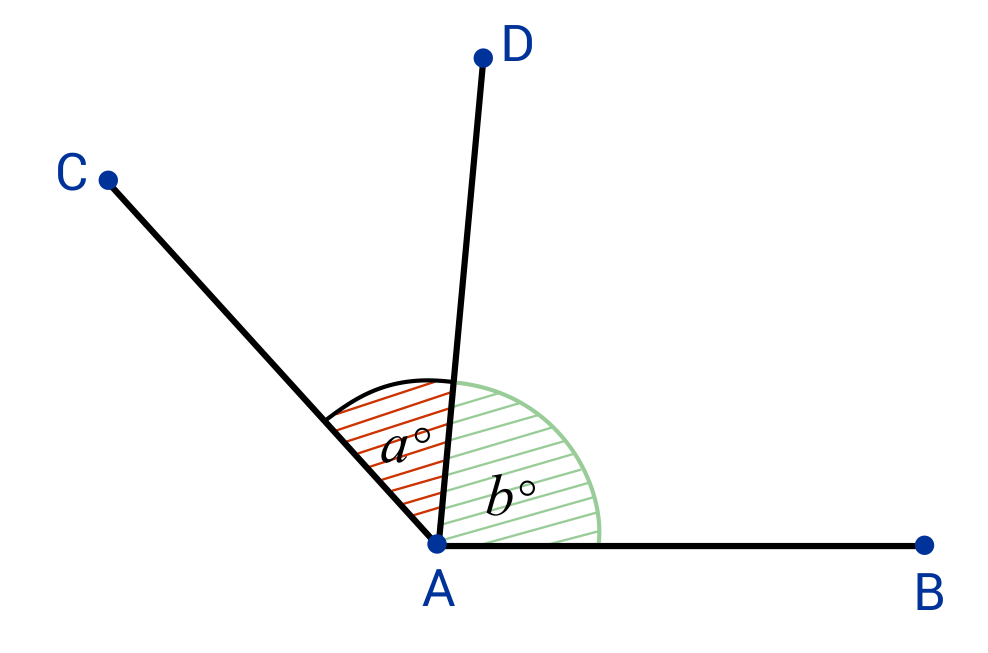
Adjacent angles
Two angles that share a common vertex and one common side without overlapping
All of my children are bringing in peanut butter cookies
Altitude
Line segment from a vertex, perpendicular to the opposite side
Altitude rule
altitude/segment = hypotenuse/altitude
Altitude-hypotenuse theorem
In a right triangle, the altitude drawn to the hypotenuse creates two smaller right triangles similar to each other and to the original
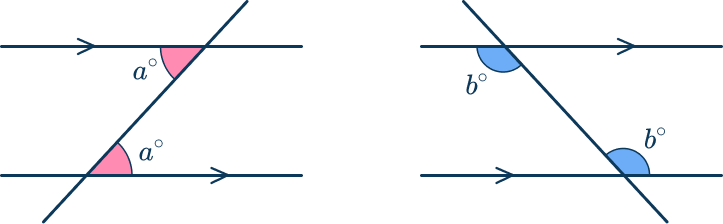
Alternate interior angles
Angles formed on opposite sides of a transversal
Alternate interior angles theorem
When lines are parallel, alternate interior angles are congruent
Angle bisector
A ray that divides an angle into two congruent angles
Angle - angle similarity
If two angles of one triangle are congruent to two angles in another triangle, then the two triangles are similar
AAS Congruence
In two triangles, if two of their angles and their non-included side are congruent, then they are congruent
ASA Congruence
In two triangles, if two of their angles and their included side are congruent, then the triangles are congruent
Angles outside of circles
The external angle is half the measure of the large arc minus the measure of the smaller arc
Isosceles triangle apex rule
If two sides are equal, the two base angles are equal
Area
The amount of space inside a 2D shape, measured in square units
Area of a circle
A= Pi r² ( radius squared )
Area of a parallelogram
A=Bh
Area of a trapezoid
A=.5(B1 + B2)h
Area of a triangle
A = .5bh
Area of similar figures
A1/A2 = K squared, where k is the ratio of corresponding side lengths
Centroid
Point where a triangle's three medians intersect, "center of gravity”
Central angle
Angle whose vertex is at the center of the circle, is congruent to its intercepted arc
Chord
Line segment whose endpoints both lie on the circle
Circumcenter
Point where the perpendicular bisectors of a triangle's sides intersect, center of the circumscribed circle, equidistant from all vertices of the triangle
Colinear points
Points that lie on the same line
Common tangents
Lines that touch two circles at only one point
Complimentary angles
Two angles whose measures add up to 90 degrees
Composition
2 or more transformations in order, read right to left
Congruent chords theorem
If two chords are congruent, they are both equidistant from the center
Congruent complements theorem
If two angles are complements of the same or congruent angles, then those angles are congruent
Congruent supplements theorem
If two angles are supplements of the same or congruent angles, then those angles are congruent
Same side interior angles theorem
If lines are parallel, same side interior angles are supplementary
Converse of isosceles triangle theorem
If two angles of a triangle are congruent, then the sides opposite those angles are congruent
Converse of the alternate interior angle theorem
If alternate interior angles are congruent, then lines are parallel
Converse of same side interior angles theorem
If same side interior angles are supplementary, then lines are parallel
Converse of corresponding angles theorem
If corresponding angles are congruent, lines are parallel
Coplanar
Points, lines, or figures that lie on the same plane
CPCTC
Corresponding parts of congruent triangles are congruent
Corresponding angles theorem
If lines are parallel, corresponding angles are congruent
Cross section
Cuts parallel to base = same shape as base, cuts perpendicular to base = shape of solid
Density
d = m/V
Diameter
Line segment that passes through the center of the circle and has both endpoints on the circumference
Dilation
Transformation enlarging or reducing a figure by a scale factor, produces a similar figure, D
Direct isometry
Rigid transformation that preserves distance and orientation
Division property of equality
If you divide both sides of an equation by the same number, both sides remain equal
Equilateral triangle
A triangle where all 3 sides are congruent and all 3 angles are congruent ( each 60 degrees )
Exterior angle theorem
The exterior angle of a triangle is equal to the sum of the two opposite inside angles
Exterior angles
Angles formed outside a polygon when one side is extended
Exterior of an angle
An angle and its exterior are linear pairs
Chord-chord angle
Angle measure =.5( arc1 + arc2 )
General form of a circle
Not factored version
Glide reflection
Transformation that combines a slide and a reflection across a line
How to identify a base
HL Congruence
If two right triangles have a congruent hypotenuse and one corresponding leg congruent, then the triangles are congruent
Incenter
Point where all three angle bisectors meet, center of the inscribed circle, equidistant from all three sides of the triangle
Inscribed angle
An angle with its vertex on the circumference, its measure is half the measure of the intercepted arc
Inscribed quadrilaterals
Four-sided figure whose vertices lie on a circle, and opposite angles are supplementary
Intersecting chords
When two chords intersect inside a circle, the products of their segments are equal
Isometric
Transformation that preserves distance and shape
Isosceles triangle
Triangle with two congruent sides, angles opposite those sides are congruent
Isosceles triangle theorem
In an isosceles triangle, the angles opposite the two congruent sides are congruent
Isosceles trapezoid
Trapezoid with one pair of parallel sides, non-parallel sides are congruent, base angles are congruent
Kite
Has two pairs of adjacent congruent sides, perpendicular diagonals, one diagonal bisects the other, one pair of opposite angles congruent
Lateral area
Sum of all the areas of all the side faces of a 3D solid not including the base(s)
Leg rule
Leg/hypotenuse = hypotenuse segment/leg
Line symmetry
When a figure can be folded along a line so both sides match exactly
Lines perpendicular to a transversal theorem
If two perpendicular parallel lines are cut by a transversal that is perpendicular to one of them, it is also perpendicular to the other
Major arc
Arc whose measure is greater than 180 degrees
Median
Line segment from a vertex to the midpoint of the opposite side
Midpoint
Point on a line segment that divides it into two equal parts
Midpoint formula
Midpoint= (X1 + X2)/2 , (Y1 + Y2)/2
Minor arc
An arc whose measure is less than 180 degrees
Multiplication property of equality
If you multiply both sides of an equation by the same number, the equation stays equal
Net
2D flat pattern that can be folded to form a 3D solid
Obtuse angle
An angle whose measure is greater than 90 degrees
Obtuse triangle
A triangle with one obtuse angle
Opposite isometry
Transformation that preserves shape and distance but changes orientation
Orthocenter
The point where the three altitudes of a triangle intersect
Parallel chords
Stay the same distance apart, create equal arcs
Parallel lines
Lines that never intersect and stay the same distance apart
Parallelogram
Quadrilateral equal with both pairs of opposite sides parallel and congruent, opposite angles are equal, consecutive angles are supplementary, diagonals bisect each other
Partition property
When a segment is divided into parts, the sum of its parts equals the whole
Perimeter
Total distance around a shape
Perimeter of similar figures
1:1 ratio proportional by scale factor
Perpendicular lines
Two lines that intersect to form a 90 degree angle
Plane
A flat, two-dimensional surface that extends forever in all directions
Point of concurrency
The point where three or more lines, segments, or rays intersect
Point symmetry
When a figure looks the same after a 180° rotation about a point
Properties of transformations
They preserve shape size, angle measure, and distance
Proportional parts with parallel lines
When parallel lines are cut by a transversal, the segments they create are proportional
Pythagorean theorem
a² + b² = c²
Pythagorean theorem - classifying acute
a² + b² > c²
Pythagorean theorem- classifying obtuse
'a² + b² < c²
Pythagorean theorem - classifying right
a² + b² = c²
Radius - chord theorem
A radius ( or diameter ) perpendicular to a chord bisects the chord and its intercepted arc
Rectangle
A quadrilateral whose opposite sides are parallel and congruent, diagonals are congruent and bisect each other, cell four angles are right angles
Reflection in x-axis
( x, y ) → ( x, -y )
Reflection in y-axis
( x, y ) → ( -x, y )