Geoscience EXAM Chapter 1
 Call Kai
 Learn
Learn Practice Test
 Spaced Repetition
 Match
Match Flashcards
 Knowt Play
1/22

There's no tags or description
Looks like no tags are added yet.
Name | Mastery | Learn | Test | Matching | Spaced | Call with Kai |
|---|
No analytics yet
Send a link to your students to track their progress
23 Terms
1. In the context of science, how would you classify the following statement? Dinosaurs become extinct because a large asteroid collided with Earth.
A. Theory
B. Hypothesis
C. Observation
B. Hypothesis
Pluto was discovered in 1930, becoming the 9th planet in the solar system. As telescopes improved, other Sun-orbiting objects were discovered. Some of those were even larger than Pluto. By 2005, it was becoming apparent that many more objects would soon be discovered and that the number of planets in the Solar System could swell to as many as 50. After much debate, scientists in the International Astronomical Union (IAU) concluded that Pluto and the other similar celestial bodies orbiting the Sun should be classified as "dwarf" planets. Since a "planet" must clear the space surrounding its orbit, our Solar system now has 8 planets.
2. Why weren't the other Pluto-like objects discovered earlier?
A. Scientific explanations are tentative.
B. Science is based on empirical observations.
C. Scientific explanations make predictions.
D. Science is limited by technology.
3. Pluto still exists, so how do you explain that we now officially only have 8 planets in our solar system?
A. Scientific explanations are tentative.
B. Science is based on empirical observations.
C. Scientific explanations make predictions.
D. Science is limited by technology.
4. Why are scientists expected to publish the data they use to make discoveries?
A. Scientific explanations are tentative.
B. Science is based on empirical observations.
C. Scientific explanations make predictions.
D. Science is limited by technology.
5. Which of the earth-system scientist's roles is best illustrated by this paragraph?
A. Alerting the public of natural hazards
B. Use of earth resources
C. Health of the environment
D. Informing society
D. Science is limited by technology
A. Scientific explanations are tentative
B. Science is based on empirical observations
D. Informing Society
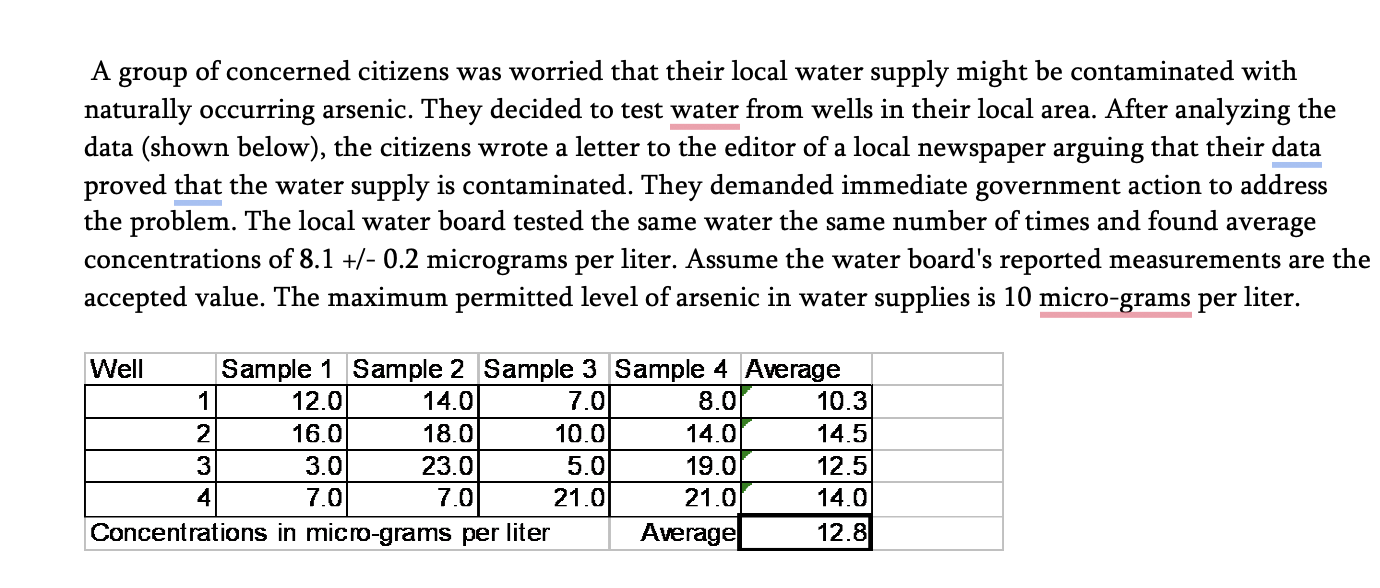
6. Which statement below best describes the data reported by the concerned citizens?
A. Their data are accurate, but not precise.
B. Their data are precise, but not accurate.
C. Their data are not accurate or precise.
D. Their data are accurate and precise.
7. The citizens decide to retest the water and obtain 11.4+ /-0.2 micrograms per liter and again argue for action. Which statement below best describes the new data reported by the concerned citizens?
A. Their data are accurate, but not precise.
B. Their data are precise, but not accurate.
C. Their data are not accurate or precise.
D. Their data are accurate and precise.
8. Which of the earth-system scientist's roles is best illustrated by this paragraph?
A. Alerting the public of natural hazards
B. Use of earth resources
C. Health of the environment
D. Informing society
C. Their data are not accurate or precise
B. Their data are precise but not accurate
C. Health of the environment
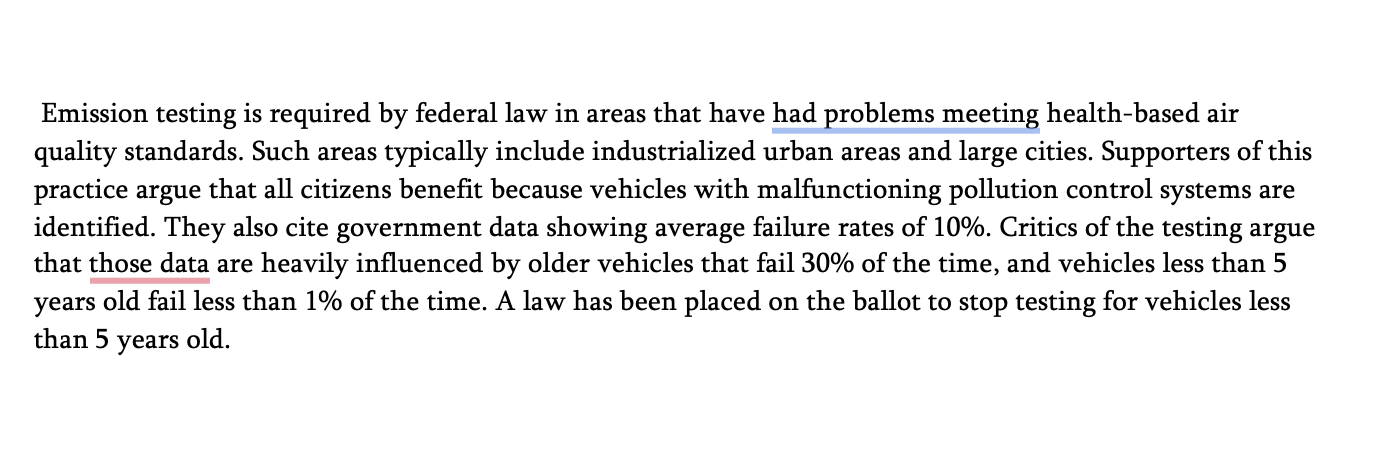
9. Suppose the law passed. What is likely to happen to air quality in those areas where testing is required?
A. Air quality should improve a lot.
B. Air quality should decline a lot.
C. There should be little change to air quality.
10. Which special interest group is most likely to oppose passage of the law?
A. An organization representing respiratory therapists
B. An organization representing new car dealerships
C. An organization representing auto repair professionals
11. Which part of the earth system is most directly affected by passage of the law?
A. Geosphere
B. Hydrosphere
C. Atmosphere
D. Biosphere
12. Which of the earth-system scientist's roles is best illustrated by this paragraph?
A. Alerting public of natural hazards
B. Use of earth resources
C. Health of the environment
D. Informing society
C. There should be little change to air quality
C. An organization representing auto repair professionals
C. Atmosphere
D. Informing society
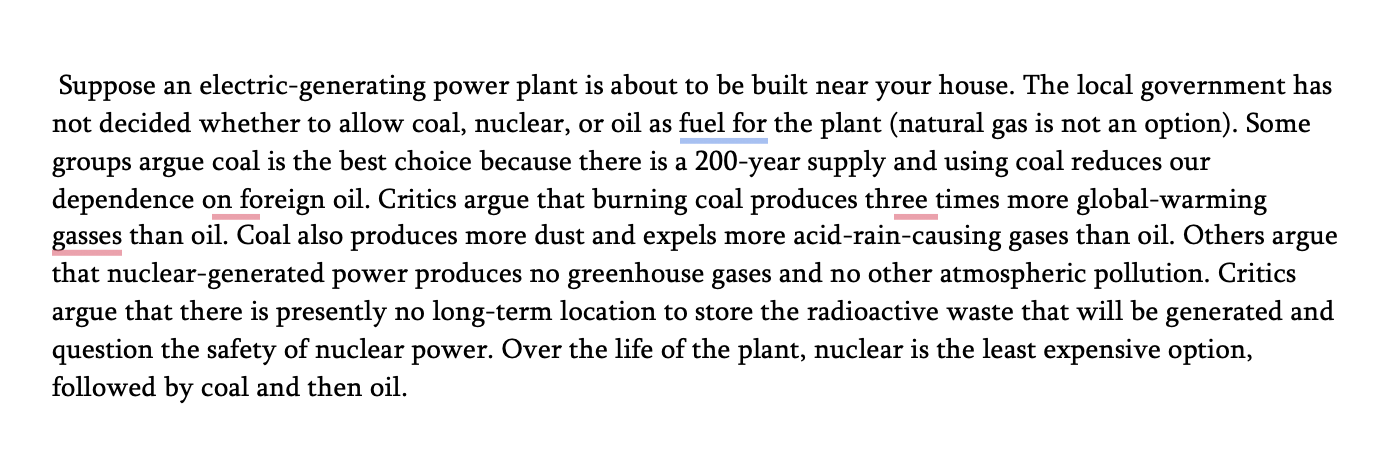
13. Place the fuel options in order from highest impact on global warming to least impact.
A. Nuclear, oil, coal
B. Oil, coal, nuclear
C. Coal, nuclear, oil
D. Coal, oil, nuclear
14. Which option is likely to have the least impact on the biosphere where you live?
A. Coal
B. Nuclear
C. Oil
15. Which of the earth-system scientist's roles is best illustrated by this paragraph?
A. Alerting public of natural hazards
B. Use of earth resources
C. Health of the environment
D. Informing society
D. Coal, Oil, Nuclear
B. Nuclear
B. Use of earth resources
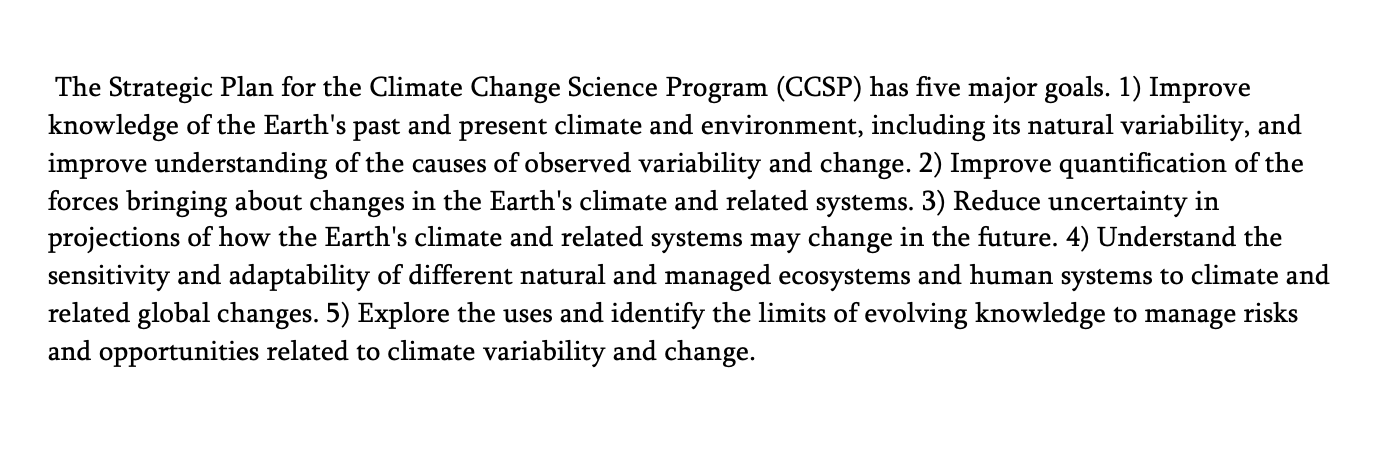
16. What hypothesis underlies these goals?
A. Climate has changed in the past.
B. Climate will change in the future.
C. Climate will stay about the same.
17. How are these goals consistent with the characteristics of good science?
A. They rely on scientific opinions.
B. They rely on accepted theories.
C. They rely on empirical evidence.
B. Climate will change in the future
C. They rely on empirical evidence
18. Which component of the earth system relates to the solid earth?
A. Hydrosphere
B. Biosphere
C. Geosphere
D. Atmosphere
E. Exosphere
C. Geosphere
19. Which part of the earth system includes plants and animals?
A. Atmosphere
B. Biosphere
C. Hydrosphere
D. Solid earth
B. Biosphere
20. Which part of the earth system includes ice on Antarctica?
A. Atmosphere
B. Biosphere
C. Hydrosphere
D. Solid earth
C. Hydrosphere
21. What caused the 2001 explosion to occur in Hutchinson, Kansas?
A. Natural gas leak in a private home
B. Natural gas storage facility leak
C. Leak from a natural gas well
B. Natural gas storage facility leak
22. What distinguishes science from non-science?
A. Science is based on empirical observations.
B. Science is based on unchanging facts.
C. Science is based solely on experiments.
A. Science is based on empirical observations
23. A hypothesis can be improved or rejected based on which of the following?
A. New data
B. New observations
C. Experiments
D. Any of the choices are correct.
D. Any of the choices are correct
24. Which of the following is a characteristic of empirical observations?
A. They can be measured by others.
B. They are observations that will not change.
C. They represent ethical interpretations.
A. They can be measured by others
25. Which hypothesis listed below is an example of "bad science"?
A. Earthquakes in the central U.S. are caused by tidal forces.
B. The globe is warming due to human actions.
C. A large asteroid collision with Earth caused the extinction of the dinosaurs.
A. Earthquakes in the central U.S. are caused by tidal forces
26. What distinguishes a natural hazard from a natural phenomenon?
A. There is no difference because they both deal with the Earth system.
B. Natural phenomenon is associated with populated areas; natural hazards occur anywhere.
C. Natural hazards are associated with populated areas; natural phenomenon occur anywhere
C. Natural hazards are associated with populated areas; natural phenomenon occur anywhere
27. Which of the following natural hazards are we most likely to try to prevent?
A. Floods
B. Tornados
C. Hurricanes
D. Volcanic Eruptions
A. Floods
Why weren't the other Pluto-like objects discovered earlier?
A. Scientific explanations are tentative. B. Science is based on empirical observations.
C. Scientific explanations make predictions. D. Science is limited by technology.
D. Science is limited by technology.
Three of the four choices listed below are aspects of the scientific method. Select the exception.
A. observation B. hypothesis C. experimentation D. philosophy
D. philosophy
Kathie studied the geology of several Hawaiian volcanoes and used her data to predict the potential dangers from the eruption of similar volcanoes on the Galapagos Islands. What type of reasoning did she apply?
A. Inductive reasoning B. Deductive reasoning
A. Inductive reasoning
Which is the best description of a scientific study?
A. A scientific study allows you to be able to explain something so that you are able to touch it and see it. In science you have to see it for it to be true.
B. A scientific study involves making clear, unbiased observations. The opinions and personal feelings or beliefs of the scientist have no effect on the outcome.
C. A scientific study involves making hypotheses, collecting data, and performing experiments or testing claims, to reach a conclusion supported by evidence.
D. A scientific study uses mathematics to do calculations and generate graphs that can be used to closely examine facts.
C. A scientific study involves making hypotheses, collecting data, and performing experiments or testing claims, to reach a conclusion supported by evidence.
Is evacuation of a city in advance of a hurricane an example of prevention or adjustment?
Adjustment
List these cosmic features in order of size, beginning with the largest.
A. universe, galaxy, star, planet
Which of the following statements is most accurate?
Stars are approximately the same age as their orbiting planets.