Computer Memory (Internal)
 Call Kai
 Learn
Learn Practice Test
 Spaced Repetition
 Match
Match Flashcards
 Knowt Play
1/70

Earn XP
Description and Tags
Computer Organization and Architecture
Name | Mastery | Learn | Test | Matching | Spaced | Call with Kai |
|---|
No analytics yet
Send a link to your students to track their progress
71 Terms
Key Characteristics of Computer Memory Systems
L - internal & external
C - # of words and bytes
UoT - word or block
AM - sequential, direct, random, associative
P - access time, cycle time, transfer rate
PT - semiconductor, magnetic, optical, magneto-optical
PC - volatile/nonvolatile, erasable/nonerasable
O - memory modules
Location
Capacity
Unit of Transfer
Access Method
Performance
Physical Type
Physical Characteristics
Organization
Relationship between the length in bits A of an address and the number N of addressable units is
2A = N
Information decays naturally or is lost when electrical power is switched off
Volatile Memory
No electrical power is needed to retain information
Nonvolatile Memory
Cache is another form of
Internal memory
the natural unit of memory organization
Word Size
is usually governed by data bus width: 8 bits, 64 bits, 128 bits, 256 bits, etc.
Unit of Transfer
Memory is organized into units of data called records
Sequential access
Involves a shared read-write mechanism
Direct access
Each addressable location in memory has a unique, physically wired-in addressing mechanism
Random access
A word is retrieved based on a portion of its contents rather than its address
Associative
What are the three performance parameters used?
Access Time, Memory Cycle Time, Transfer Rate
refers to electronic data storage devices that use semiconductor technology to store digital data (RAM)
Semiconductor memory
magnetized media
Magnetic-surface memory
class of data storage systems that use light to read or write data to an underlying optical media
Optical memory
This memory cannot be altered, except by destroying the storage unit
Nonerasable memory
physical arrangement of bits to form words
Organization
faster access time
greater cost per bit
greater capacity
smaller cost per bit & slower access time
tendency of a processor to access the same set of memory locations repetitively over a short period of time
Locality of Reference (Principle of Locality)
the reuse of specific data and/or resources within a relatively small time duration
temporal locality
the use of data elements within relatively close storage locations
spatial locality
occurs when data elements are arranged and accessed linearly, such as traversing the elemtns in a one-dimensional array
sequential locality
also referred to as secondary memory or auxiliary memory
External, nonvolatile memory
a portion of main memory can be used as a buffer to hold data temporarily that is to be read out to disk
Disk cache
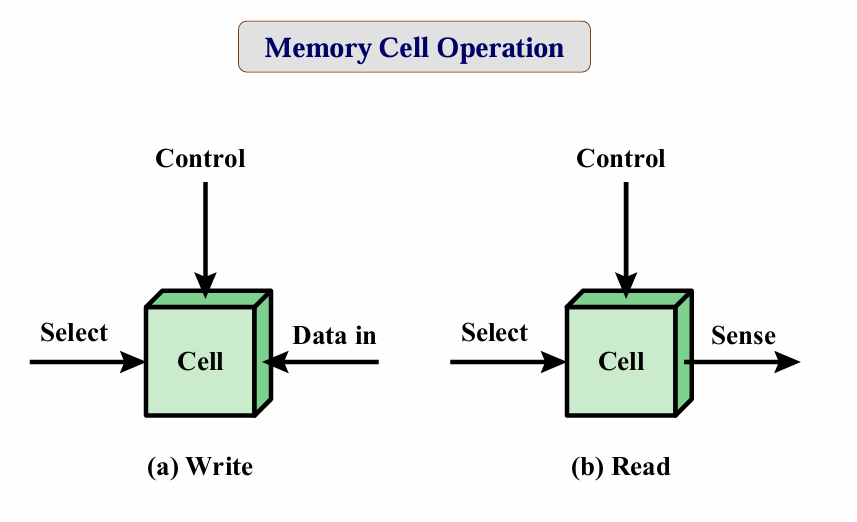
Draw an illustration of a Memory Cell Operation
Write: ← Data in
Read: → Sense
RAM
Random-Access Memory
ROM
Read-Only Memory
PROM
Programmable Read-Only Memory
EPROM
Erasable Programmable Read-Only Memory
EEPROM
Electrically Erasable Programmable Read-Only Memory
SRAM
Static Random-Access Memory
DRAM
Dynamic Random-Access Memory
made with cells that store data as charge on capacitors
DRAM
it is activated when the bit value from this cell is to be read or written
Address line
when does the transistor turns on and the charge stored on the capacitor is fed out onto a bit line and to a sense amplifier.
When the address line is selected
digital device that uses the same logic elements used in the processor
SRAM
Contains a permanent pattern of data that cannot be changed or added to
Read-Only Memory (ROM)
Intermediate between EPROM and EEPROM in both cost and functionality
Flash Memory
Composed of a collection of DRAM chips
Interleaved memory
Simplest of the error-correcting codes.
devised by Richard Hamming at Bell Laboratories
Hamming Code
Used both for internal memory and external memory applications
Flash memory
A very high-speed semiconductor memory which can speed up CPU
Cache Memory
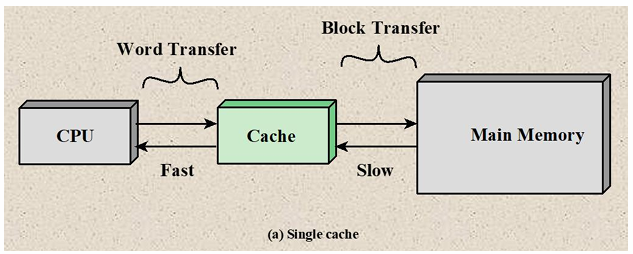
Draw an illustration of a single cache
CPU, Cache, Main Memory
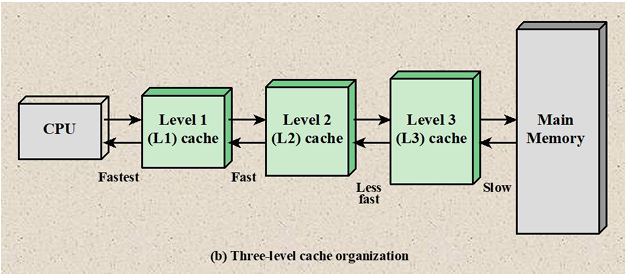
Draw an illustration of a three-level cache organization
CPU, L1 cache, L2 cache, L3 cache, Main memory
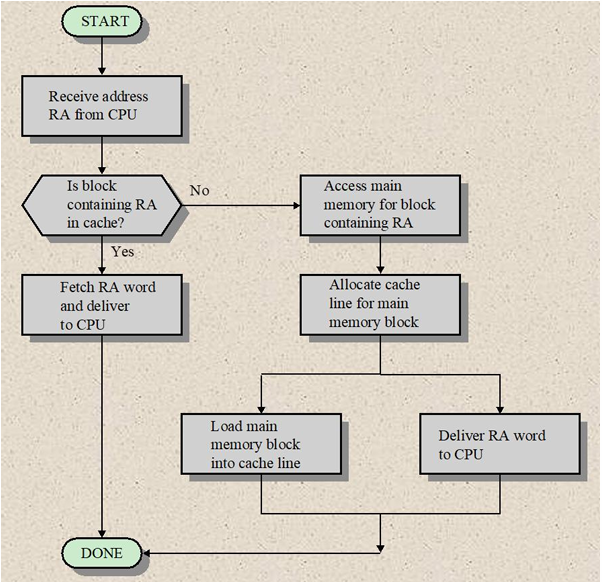
if the request corresponds to an element that is currently residing in the cache, it is called?
a cache hit
if the request corresponds to an element that is not currently in the cache, it is called?
cache miss
Flowchart of a Cache Read Operation
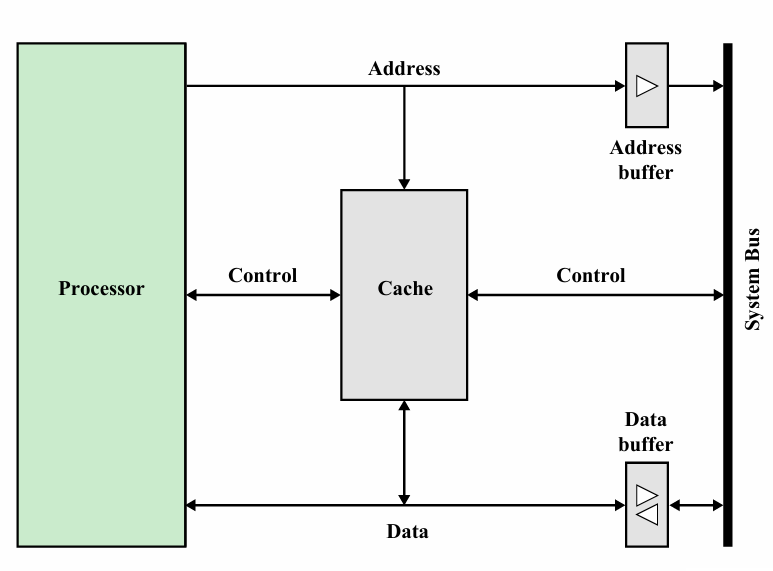
Typical Cache Organization
Elements of Cache Design:
CA - logical, physical
CS -
MF - direct, associative, set associative
RA - LRU, FIFO, LFU, Random
WP - write through, write back
LS -
NoC - single or two level, unified or split
Cache Address
Cache Size
Mapping Function
Replacement Algorithm
Write Policy
Line Size
Number of Caches
also known as virtual cache, stores data using virtual addresses
logical cache
stores data using main memory physical addresses
physical cache
One of the three techniques in mapping function.
The simplest technique, maps each block of main memory into only one possible cache line
Direct
One of the three techniques in mapping function.
Permits each main memory block to be loaded into any line of the cache
Associative
One of the three techniques in mapping function.
A compromise that exhibits the strengths of both the direct and associative approaches while reducing their disadvantages.
Set Associative
originally proposed as an approach to reduce the conflict misses of direct mapped caches without affecting its fast access time
Victim cache
It is where a main memory block can be placed in any available line of cache or cache block
Associative Mapping
uniquely identifies the block of memory while residing in the cache
tag field
identifies the element within the block that is requested by the processor
word field
interprets the address issued by the processor by dividing it into two fields
MMU
Replacement algorithm where it replaces that block in the set that has been in the cache longest with no reference to it
Least Recently Used (LRU)
Replacement algorithm where it replaces that block in the set that has been in the cache longest
First-In-First-Out(FIFO)
Replacement algorithm where it replaces that block in the set that has experience the fewest references
Least Frequently Used (LFU)
Replacement algorithm where it picks a line at random from among the candidate lines
Random
the main disadvantage of this technique is that it generates substantial memory traffic and may create a bottleneck
Write through
Portions of main memory are invalid and hence accesses by I/O modules can be allowed only through the cache
Write back
designated as level 1 cache
Internal cache
designated as level 2 cache
External cache
complicates all of the design issues related to caches, including size, replacement algorithm, and write policy
use of multilevel caches
advantages of what type of cache?
Higher hit rateBalances load of instruction and data fetches automatically
Only one cache needs to be designed and implemented
unified cache
advantages of what type of cache?
Eliminates cache contention between instruction fetch/decode unit and execution unit
important in pipelining
split cache