Memory
 Call Kai
 Learn
Learn Practice Test
 Spaced Repetition
 Match
Match Flashcards
 Knowt Play
1/62

There's no tags or description
Looks like no tags are added yet.
Name | Mastery | Learn | Test | Matching | Spaced | Call with Kai |
|---|
No analytics yet
Send a link to your students to track their progress
63 Terms
Information processing
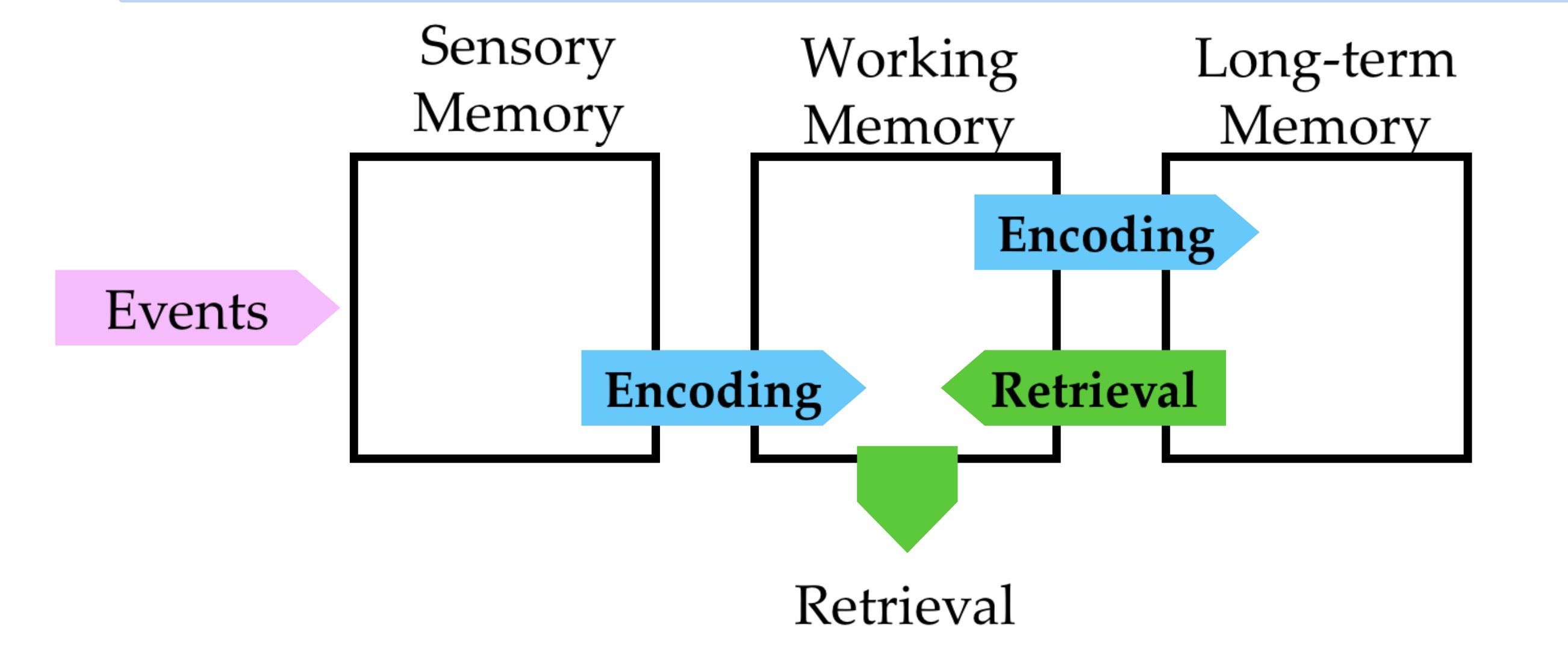
The Atkinson-Schiffrin (1968) 3-stage model of memory includes
A) sensory memory
B) short-term memory
C) long-term memory
Unconscious Processing Image
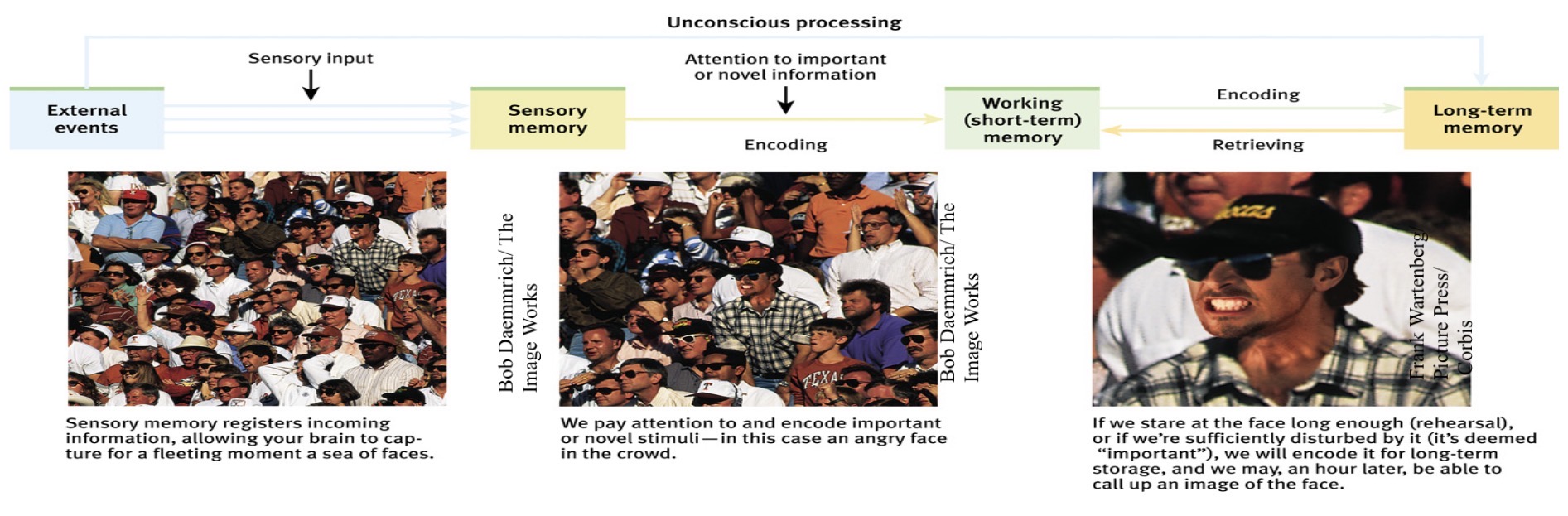
Studying Memory: Information Processing Models
Encoding: getting information in
How we code
What we code
Storage: retaining information
Retrieval: getting information out
Modifications to the Three-Stage Model
Some information skips the first two stages and enters long-term memory automatically.
Since we cannot focus on all the sensory information received, we select information that is important to us and actively process it into our working memory.
Encoding: Getting Information In (How We Encode)
Some information (route to your school) is automatically processed.
However, new or unusual information (friend’s new cell-phone number) requires attention and effort.
Automatic Processing
We process an enormous amount of information effortlessly, such as the following:
Space:
Time:
Frequency:
Space:
While reading a textbook, you automatically encode the place of a picture on a page.
Time:
We unintentionally note the events that take place in a day.
Frequency:
You effortlessly keep track of things that happen to you.
Effortful Processing
Committing novel information to memory requires effort just like learning a concept from a textbook. Such processing leads to durable and accessible memories.
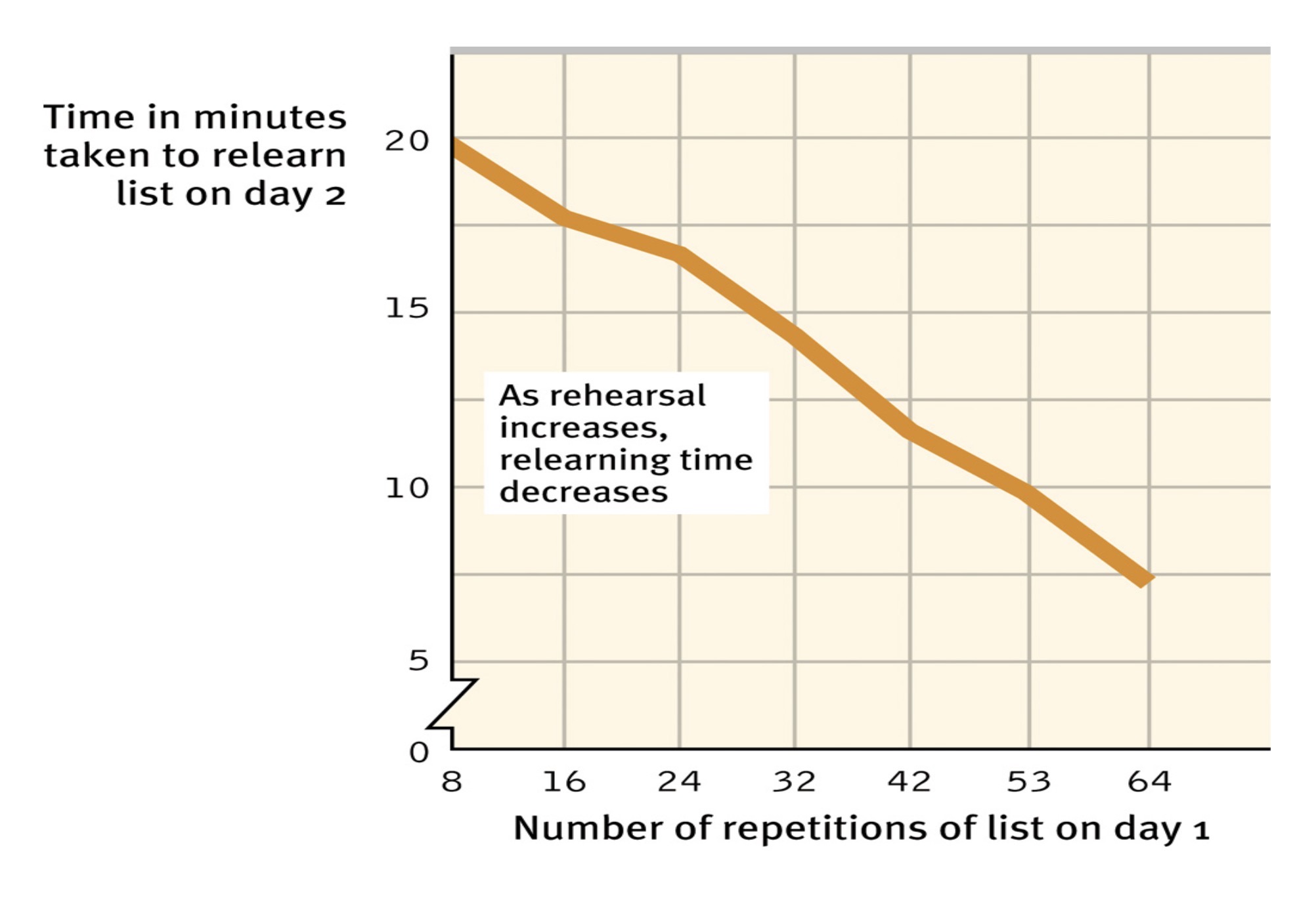
Rehearsal
Effortful learning usually requires rehearsal or conscious repetition.
Ebbinghaus studied rehearsal by using nonsense syllables: TUV YOF GEK XOZ
The more times the nonsense syllables were practiced on Day 1, the fewer repetitions were required to remember them on Day 2.
What We Encode
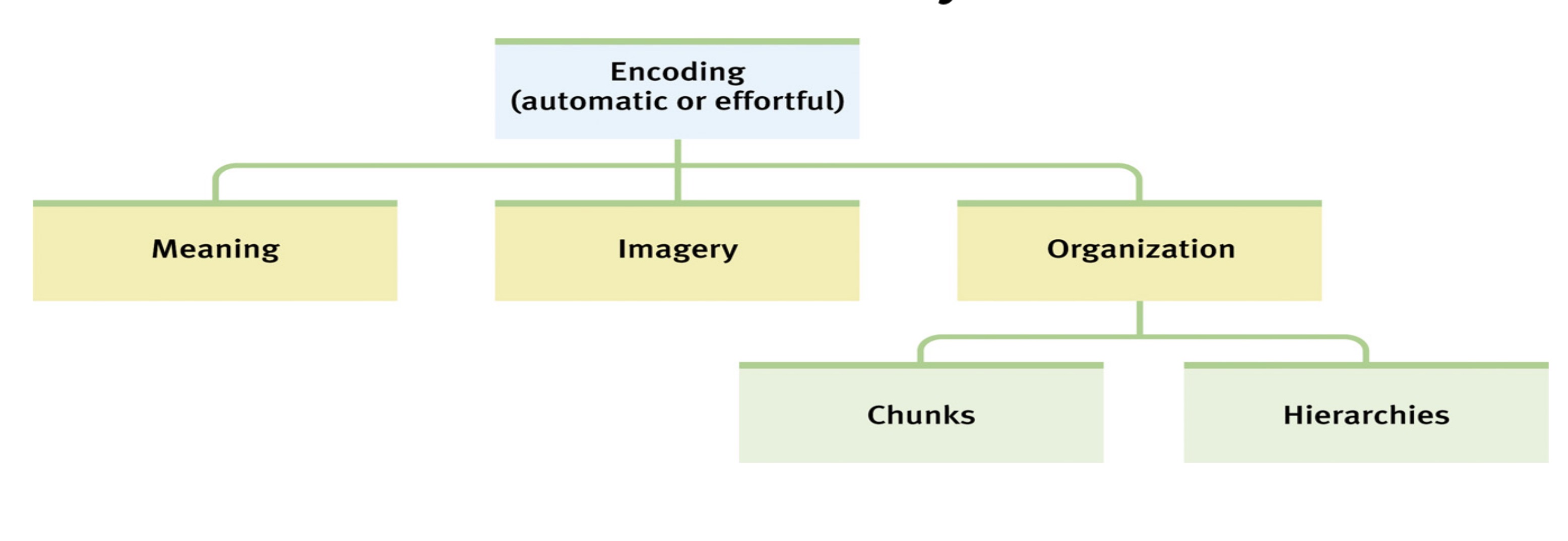
Encoding by meaning
Encoding by images
Encoding by organization
Encoding Meaning
Processing the meaning of verbal information by associating it with what we already know or imagine. Encoding meaning (semantic encoding) results in better recognition later than visual or acoustic encoding.
Visual Encoding
Mental pictures (imagery) are a powerful aid to effortful processing, especially when combined with semantic encoding.
Showing adverse effects of tanning and smoking in a picture may be more powerful than simply talking about it.
Mnemonics
Imagery is at the heart of many memory aids. Mnemonic techniques use vivid imagery and organizational devices in aiding memory.
Organizing Information for Encoding
Break down complex information into broad concepts and further subdivide them into categories and subcategories.
Chunking
Hierarchies
Chunking
Organizing items into a familiar, manageable unit. Try to remember the numbers below.
1-7-7-6-1-4-9-2-1-8-1-2-1-9-4-1
If you are well versed with American history, chunk the numbers together and see if you can recall them better. 1776 1492 1812 1941.
Acronyms are another way of chunking information to remember it.
Ex: HOMES = Huron, Ontario, Michigan, Erie, Superior; ROY G. BIV = Red, Orange, Yellow, Green, Blue, Indigo, Violet
Peg-Word System
“One is a bun, two is a shoe, three is a tree, four is a door, five is a hive, six is sticks, seven is heaven, eight is a gate, nine is swine, ten is a hen.”
Hierarchy
Complex information broken down into broad concepts and further subdivided into categories and subcategories.
Encoding Summarized in a Hierarchy
Memory Effects
Spacing Effect:
Serial Position Effect:
Spacing Effect:
We retain information better when we rehearse over time.
Serial Position Effect:
When your recall is better for first and last items on a list, but poor for middle items.
Storage: Retaining Information
Storage is at the heart of memory. Three stores of memory are shown below:
Sensory Memories
The duration of sensory memory varies for the different senses.
Iconic (eye): 0.5 sec long
Echoing (ear): 3-4 sec long
Hepatic (hands): <1 sec long
Working Memory
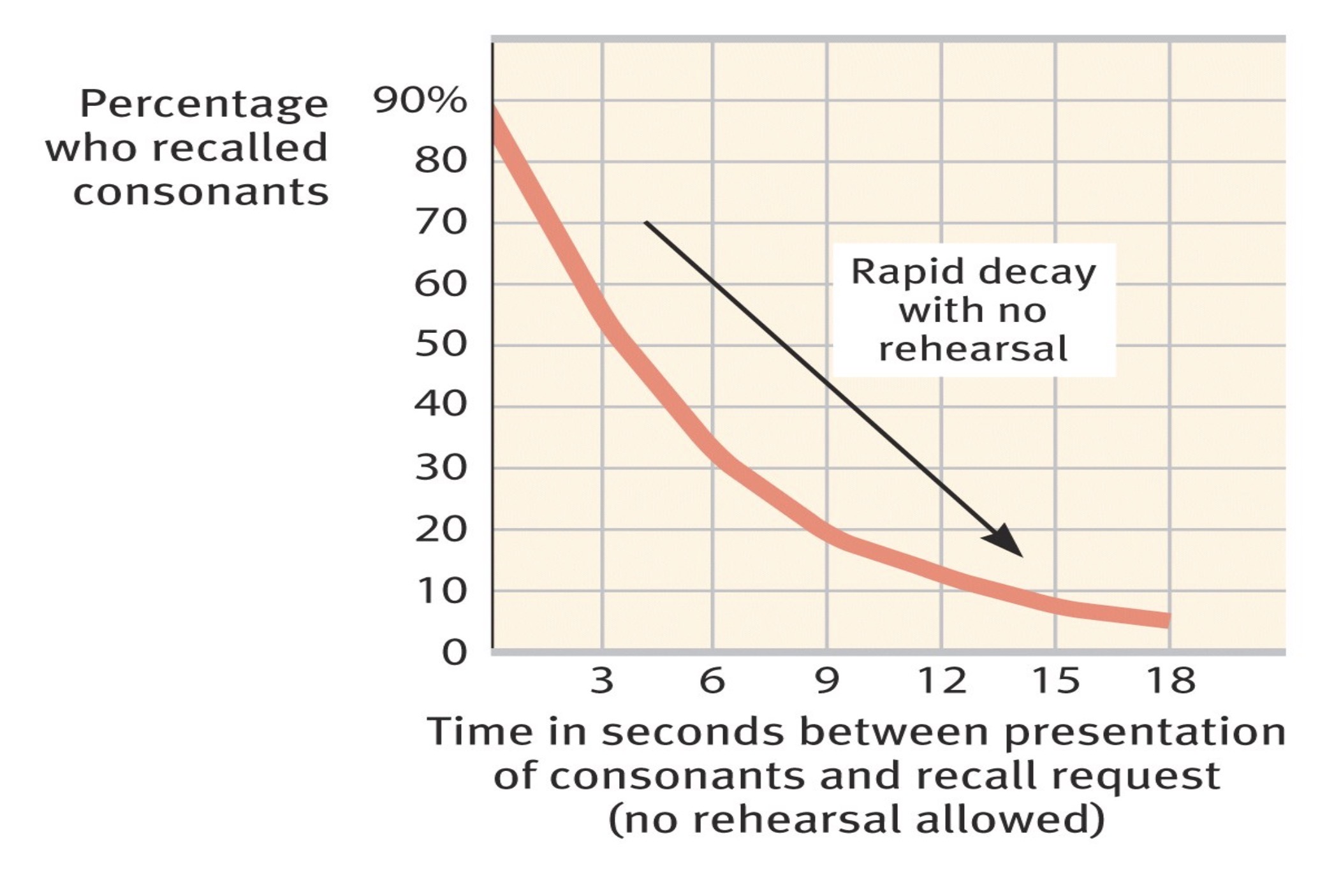
Working memory, the new name for short-term memory, has a limited capacity (7±2) and a short duration (20 seconds).
Sir George Hamilton observed that he could accurately remember up to 7 beans thrown on the floor. If there were more beans, he guessed.
Capacity
The Magical Number Seven, Plus or Minus Two: Some Limits on Our Capacity for Processing Information (1956).
You should be able to recall 7±2 letters.
Working emery duration
Types of memories
explicit (declarative)
implicit (procedural)
Explicit Memory
refers to facts and experiences that one can consciously know and declare.
With conscious recall
Processed in hippocampus
Facts- general knowledge
Personally experienced events
Implicit Memory
involves learning an action while the individual does not know or declare what she knows.
Without conscious recall Processed
Processed, in part, by cerebellum
Skills - motor and cognitive
Classical and operant conditions effects
Long-Term Memory
Essentially unlimited capacity store.
The Clark’s nutcracker can locate 6,000 caches of buried pine seeds during winter and spring.
Types of Long-Term Memory
Episodic
Semantic
Procedural
Episodic
memories of personally experienced events.
Semantic
memories of general factual knowledge.
Procedural
memories that relate to skills or habits.
Stress Hormones & Memory
Heightened emotions (stress-related or otherwise) make for stronger memories.
Flashbulb memories
Flashbulb memories
are clear memories of emotionally significant moments or events
Hippocampus
a neural center in the limbic system that processes explicit memories.
Anterograde Amnesia
After losing his hippocampus in surgery, patient Henry M. (HM) remembered everything before the operation but cannot make new memories.
Retrograde Amnesia
An inability to retrieve information from one’s past.
Implicit Memory With Henry M.
HM is unable to make new memories that are declarative (explicit), but he can form new memories that are procedural (implicit).
HM learned the Tower of Hanoi (game) after his surgery. Each time he plays it, he is unable to remember the fact that he has already played the game.
Retrieval Cues
Memories are held in storage by a web of associations.
These associations are like anchors that help retrieve memory.
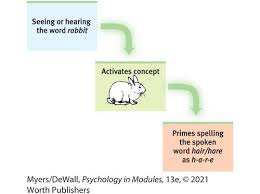
Priming
To retrieve a specific memory from the web of associations, you must first activate one of the strands that leads to it.
Context Effects
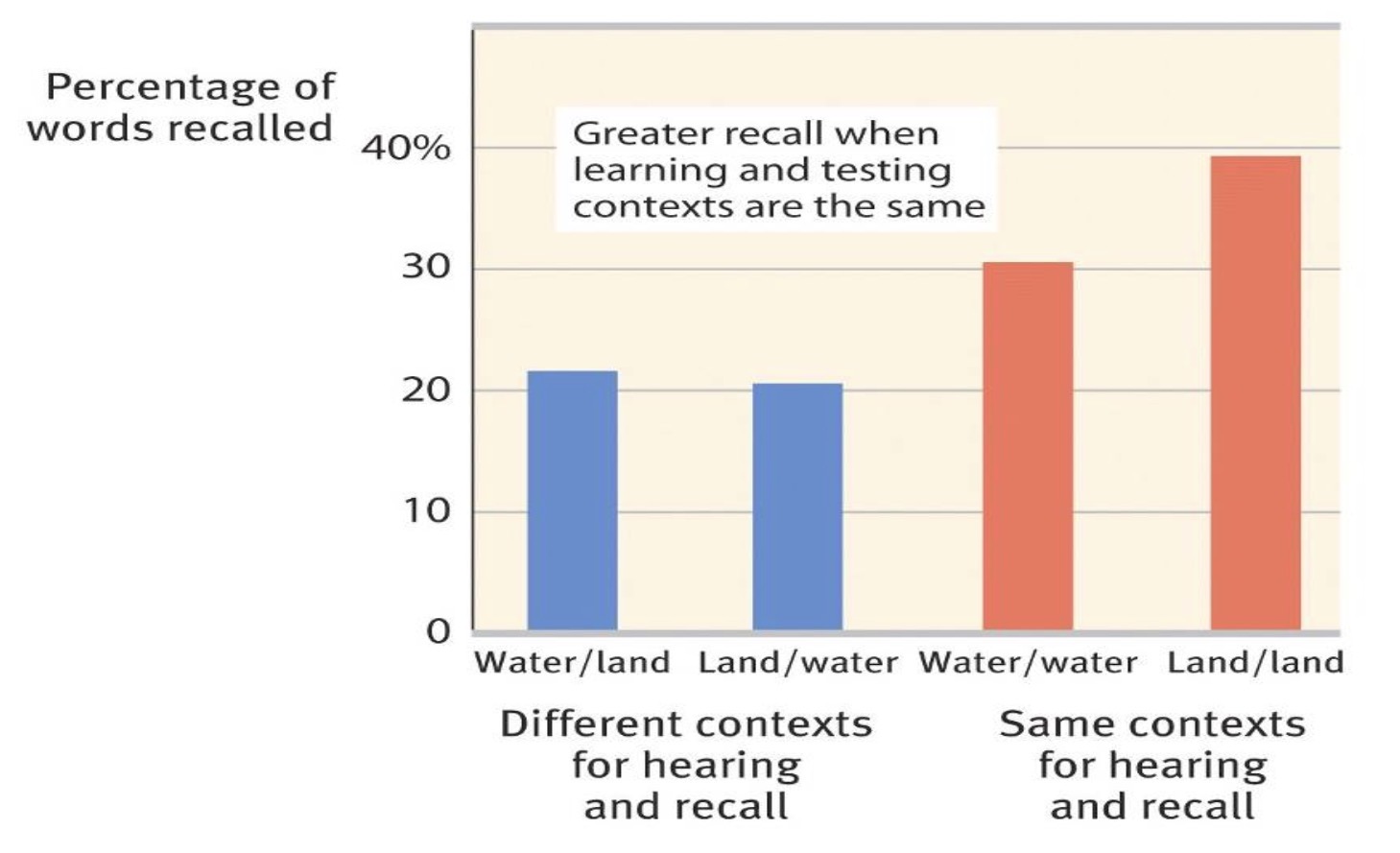
Scuba divers recall more words underwater if they learned the list underwater, while they recall more words on land if they learned that list on land (Godden & Baddeley, 1975).
Déjà Vu
means “I've experienced this before.” Cues from the current situation may unconsciously trigger retrieval of an earlier similar experience.
Moods and Memories
We usually recall experiences that are consistent with our current mood (state-dependent memory). Emotions, or moods, serve as retrieval cues. Our memories are mood-congruent.
Forgetting
An inability to retrieve information due to poor encoding, storage, or retrieval.
Encoding Failure
We cannot remember what we do not encode.

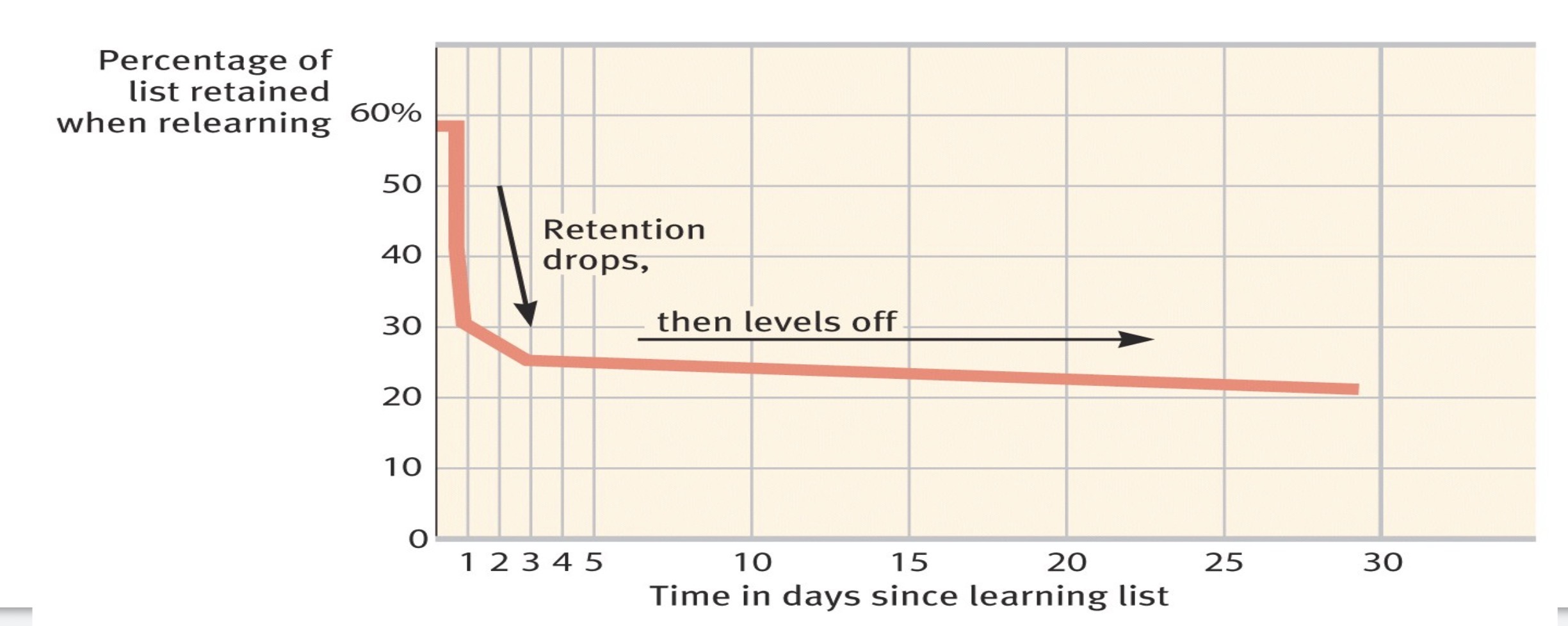
Storage Decay
Poor durability of stored memories leads to their decay. Ebbinghaus showed this with his forgetting curve.
Retrieval Failure
Although the information is retained in the memory store, it cannot be accessed.

Tip-of-the-tongue (TOT)
is a retrieval failure phenomenon. Given a cue (What makes blood cells red?) the subject says the word begins with an H(hemoglobin).
Proactive Interference
Learning of new information may be hindered by information already learned.
Retroactive Interference
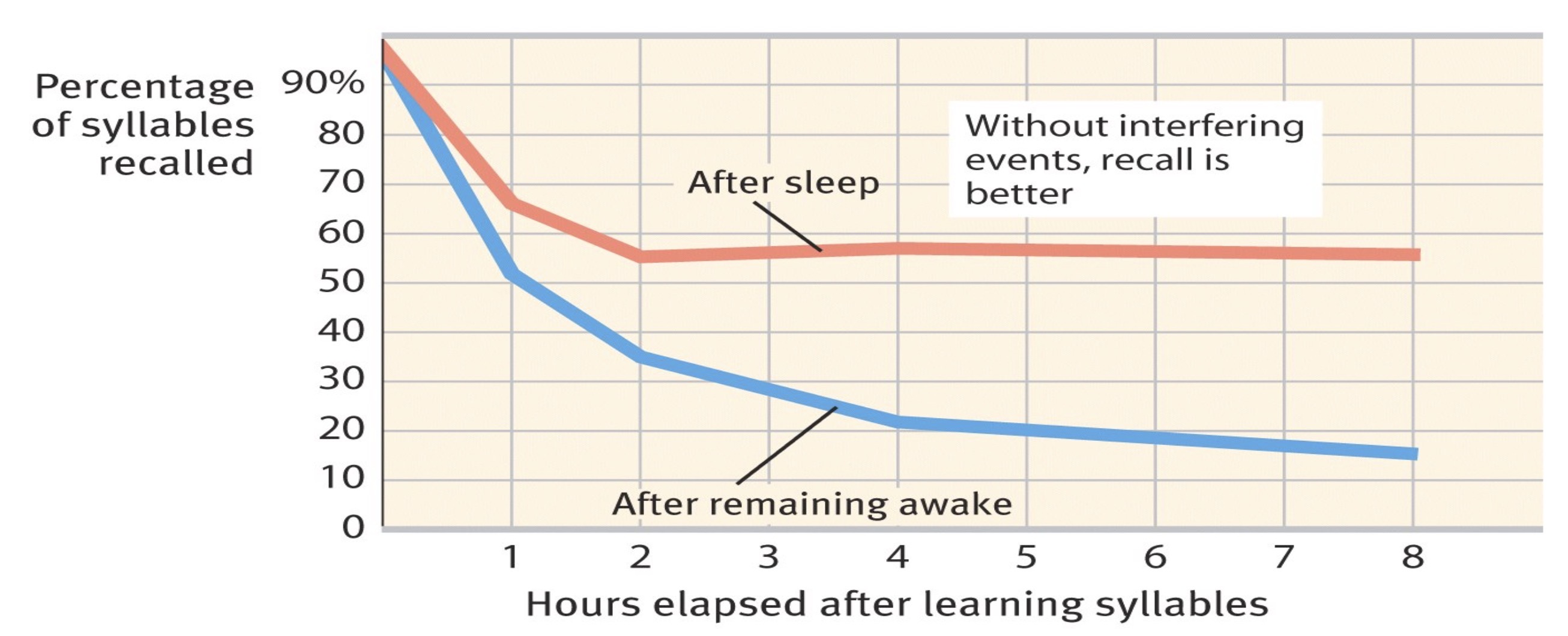
Learning of the new information hinders the retrieval of the previously learned information. Sleep prevents retroactive interference. Therefore, it leads to better recall.
Motivated Forgetting
People unknowingly revise their memories.
Repression:
A defense mechanism that banishes anxiety-arousing thoughts, feelings, and memories from consciousness.
Why do we forget?
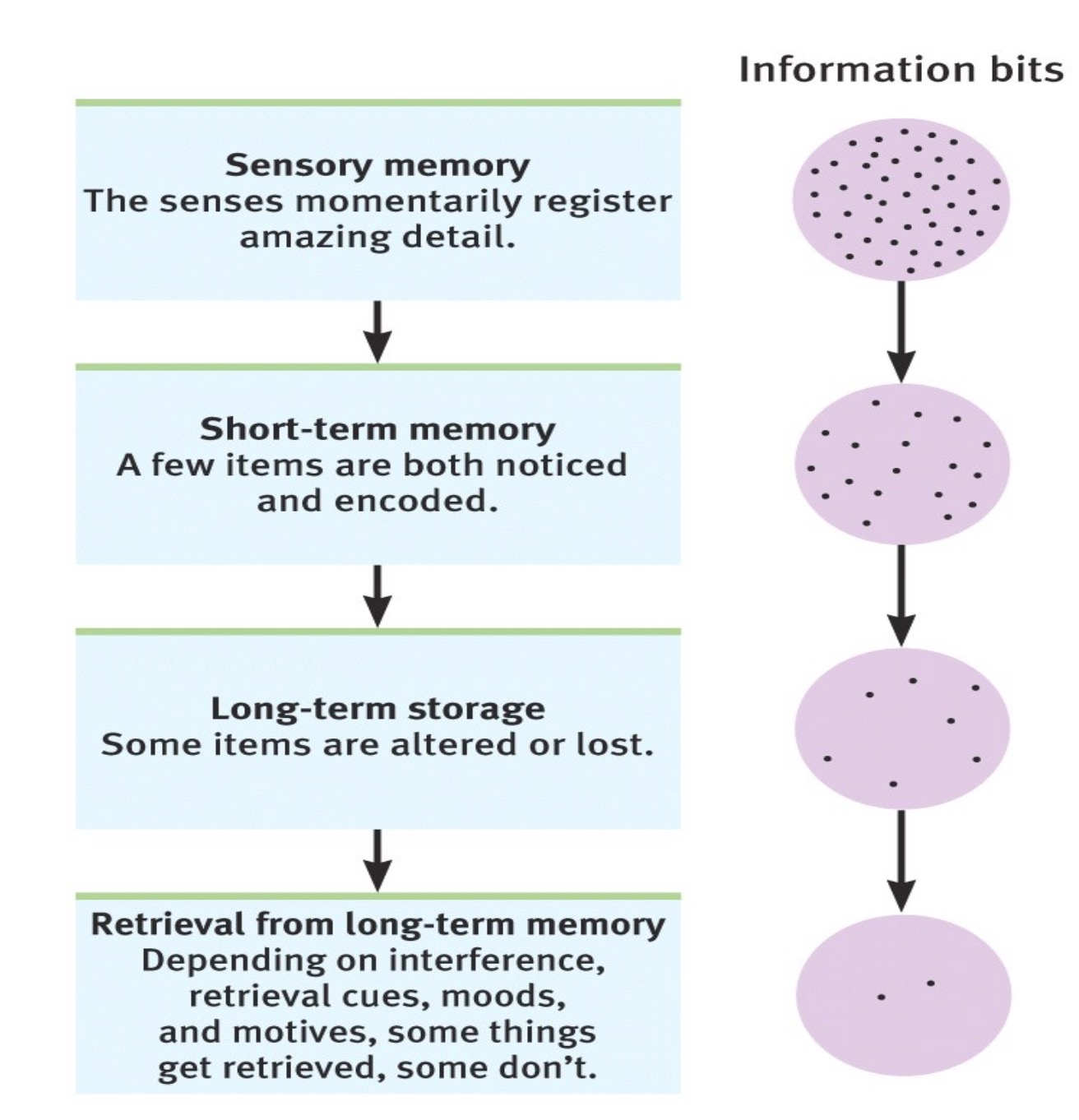
Forgetting can occur at any memory stage. We filter, alter, or lose much information during these stages.
Misinformation and Imagination Effects
Eyewitnesses reconstruct their memories when questioned about the event.
Memory Construction (Car situation)
A week later they were asked: Was there any broken glass? Group B (smashed into) reported more broken glass than Group A (hit).
Misinformation
Group A: How fast were the cars going when they hit each other?
Group B: How fast were the cars going when they smashed into each other?
Source Amnesia:
Attributing an event to the wrong source that we experienced, heard, read, or imagined (misattribution).
Constructed Memories
Loftus’ research shows that if false memories (lost at the mall or drowned in a lake) are implanted in individuals, they construct (fabricate) their memories.
Improving Memory
Study repeatedly to boost long-term recall.
Spend more time rehearsing or actively thinking about the material.
Make material personally meaningful.
Use mnemonic devices:
associate with peg words — something already stored
make up a story
chunk — acronyms
Activate retrieval cues — mentally recreate the situation and mood.
Recall events while they are fresh — before you encounter misinformation.
Minimize interference:
Test your own knowledge.
Rehearse and then determine what you do not yet know.