3.4.6 Biodiversity within a community
 Call Kai
 Learn
Learn Practice Test
 Spaced Repetition
 Match
Match Flashcards
 Knowt Play
1/10

There's no tags or description
Looks like no tags are added yet.
Name | Mastery | Learn | Test | Matching | Spaced | Call with Kai |
|---|
No analytics yet
Send a link to your students to track their progress
11 Terms
Define biodiversity. (2 marks)
- The variety of living organisms, including species, genetic, and ecosystem diversity.
- Can relate to habitats ranging from small local areas to the whole Earth.
Define a community and species richness. (2 marks)
- A community is all populations of different species living in the same area.
- Species richness is a measure of the number of different species in a community.
Describe what an index of diversity does. (2 marks)
Shows the relationship between the number of species in a community and the number of individuals in each species.
Explain why index of diversity is more useful than species richness. (2 marks)
- Takes into account the number of individuals in each species.
- Considers that some species may be present in small or high numbers.
State the formula for index of diversity. (2 marks)
where N is the total number of organisms of all species and n is the total number of organisms of each species.
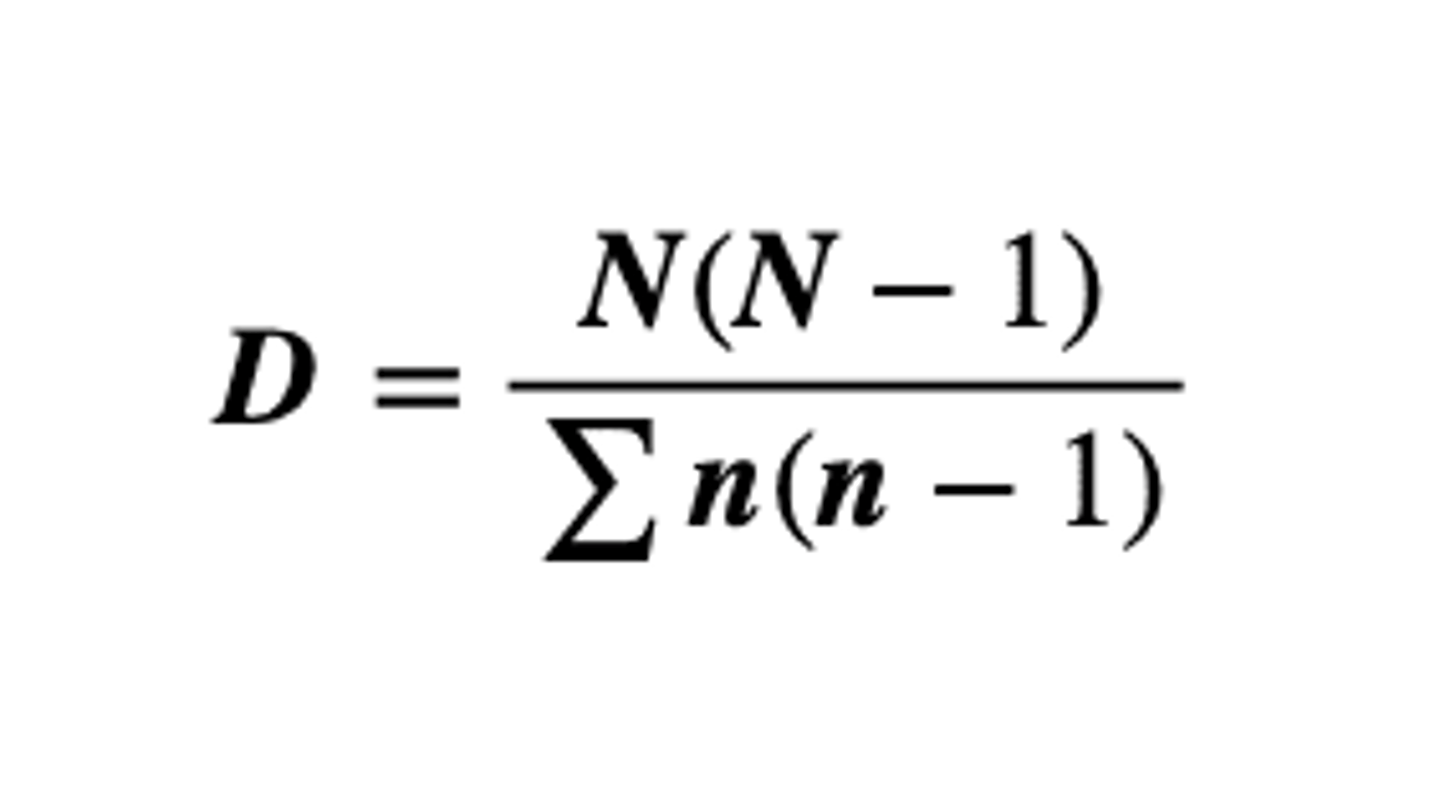
Describe the steps involved in calculating an index of diversity. (5 marks)
- Calculate the total number of organisms (N) if not given.
- Multiply N by (N - 1).
- For each species, multiply the number of organisms (n) by (n - 1).
- Add all values of n(n - 1) to get Σn(n - 1).
- Divide N(N - 1) by Σn(n - 1).
Describe how index of diversity values can be interpreted. (2 marks)
- A high value means many species are present and species are evenly represented.
- A low value means the habitat is dominated by one or a few species.
Explain how some farming techniques reduce biodiversity. (4 marks)
- Removal of woodland and hedgerows reduces variety of plant species, so there are fewer habitats and niches and less variety of food sources.
- Monoculture reduces the variety of plant species and therefore habitats and niches.
- Use of herbicides to kill weeds reduces plant diversity and food sources.
- Use of pesticides to kill pests reduces predator populations.
Explain the balance between conservation and farming. (3 marks)
- Conservation is required to increase biodiversity.
- When implemented on farms, yields can be reduced, lowering profit or income for farmers.
- Financial incentives or grants are offered to offset losses.
State examples of how biodiversity can be increased in areas of agriculture. (4 marks)
- Reintroducing field margins and hedgerows.
- Reducing the use of pesticides.
- Growing different crops in the same area.
- Using crop rotation with nitrogen-fixing crops instead of fertilisers.
Still learning (10)
You've begun learning these terms. Keep up the good work!