Chapter 4: Imperfections in the Atomic & Ionic Arrangements
 Call Kai
 Learn
Learn Practice Test
 Spaced Repetition
 Match
Match Flashcards
 Knowt Play
1/88

There's no tags or description
Looks like no tags are added yet.
Name | Mastery | Learn | Test | Matching | Spaced | Call with Kai |
|---|
No analytics yet
Send a link to your students to track their progress
89 Terms
Are defects useful?
Yes, because they can strengthen the material (strength, ductility, corrosion behaviour, conductivity)
How are defects created in the crystal lattice?
Through temperature, alloying, deformation, processing
Describe impurities
unwanted, present form raw materials or processing
Describe dopants/alloying elements
deliberately added, for beneficial effect on properties or processing
Why do we study imperfections?
Controlling defects means controlling material behaviour
Optimize performance
What are the 3 types of defects?
Point defects
Line defects
Surface defects
Describe point defects
localized imperfection that disrupts the perfect crystal structure
affects a region involving several atoms/ions
dimensions of an atom
single lattice point defects
interstitial point defects
What are the types of point defects?
Vacancy (a)
Interstitial (b)
Substitutional (c) *note there is small and large
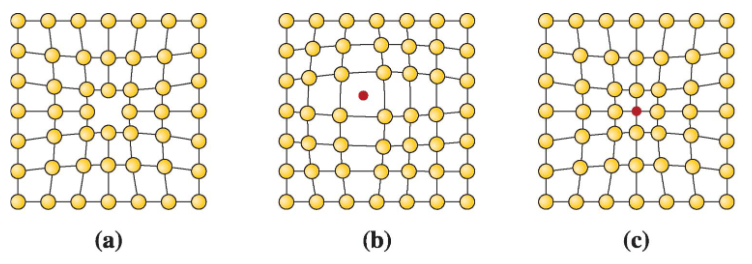
How are vacancies produced?
produced when an atom or an ion is missing from its normal site in the crustal structure
How is the concentration of a vacancy determined? What is the relationship in the formula?
As T increases, the exponent is less negative, so the fraction of vacancy increases (higher thermal energy introduces more motion)
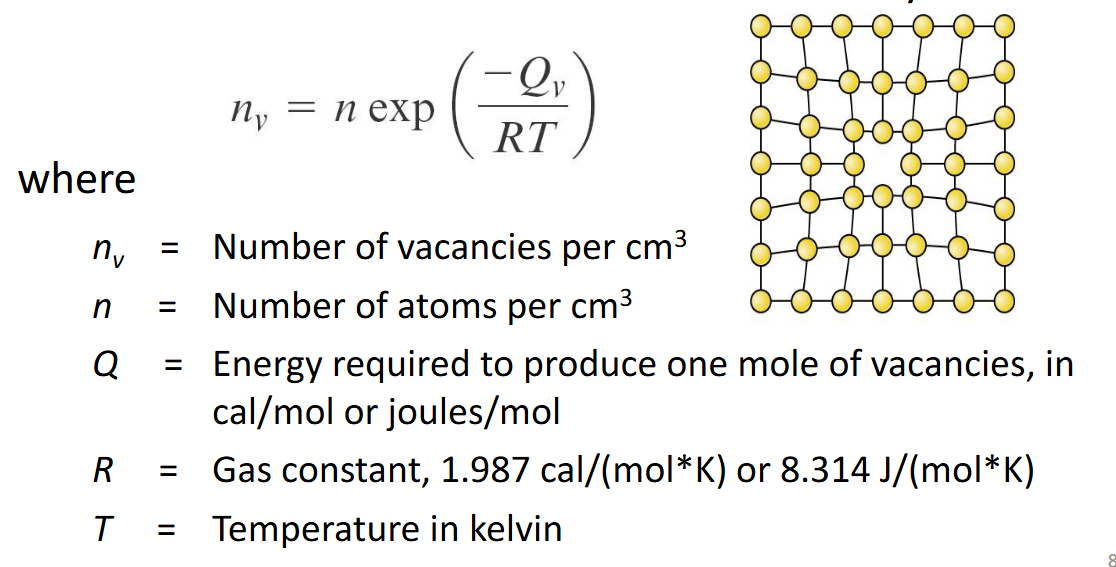
What determines the activation energy for a material (Qv)?
bond strength
crystal structure
material type
atomic packing
What are interstitial atoms?
atoms which are smaller than the host atom and fit into the interstitial sites
usually somewhat larger than the interstitial position and push the surrounding atoms out a bit creating a much larger volume of distorted lattice around it
What is a substitutional defect?
one atom/ion is replaced by a different type of atom/ion
ex. silicon is replaced with phosphorous or boron in the lattice
Which directions are easier or harder to deform?
find out answer**
Describe line defects
dimensions of a row of atoms
edge and screw dislocations → main example
dislocations motion
role of dislocations on deformation
Why are dislocations important?
Without dislocations, metals would be much harder to deform permanently
Describe surface defects
dimensions of a plane of atoms
grain boundaries (GBs)
What are grain boundaries?
Regions where crystals with different orientations meet
borders between grains where atoms are not properly spaced
What is the Frenkel defect?
vacancy-interstitial pair formed when an atom jumps from a normal position to an interstitial site (occurs in materials with ionic, metallic, covalent bonds)
What is the Schottky defect?
“stoichiometric” vacancy combinations in ionic materials (required to preserve charge neutrality)
Calculate the number of vacancies in copper at room temperature (25ºC). What will be
the temperature needed to produce 1000 times more than the equilibrium
concentration at room temperature? Assume 20 kCal / mole of vacancies is the energy
for formation, and Cu is FCC with 0.361 nm lattice parameter.
Answers: 1.85 × 10¹⁴ vacancies/m3 & 375K
What is an interstitial defect?
extra atom/ion inserted into the crystal at a normally unoccupied position
Does the number of interstitials vary with the temperature, in the same manner as vacancies?
Temperature does not create additional interstitial atoms in the same direct way that it creates vacancies.
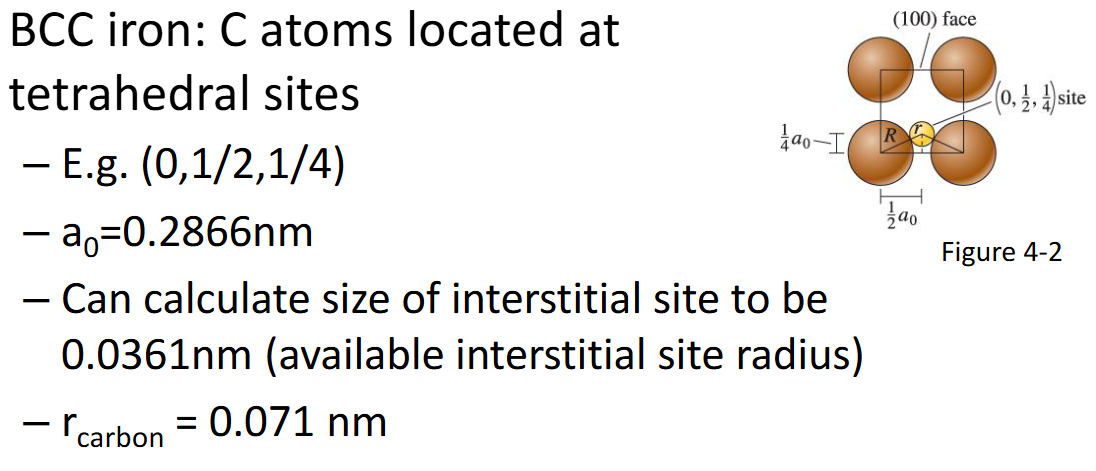
Which iron lattice (BCC or FCC) is distorted to a larger extent by accepting interstitial carbon? *Note iron is a special case
radius of interstitial sites for BCC < the radius of interstitial sites for FCC < the radius of interstitial carbon
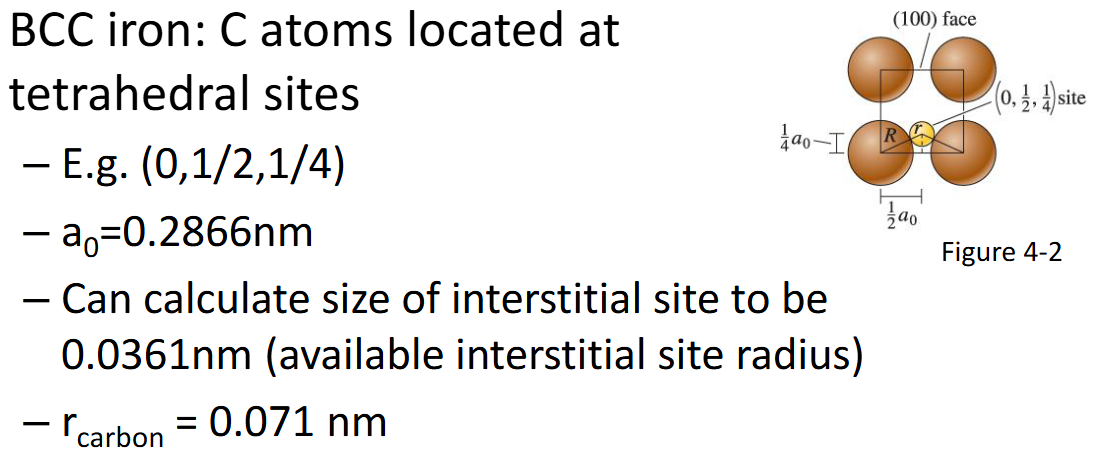
What structure do you think would accept more interstitial carbon?
FCC because it has larger interstitial sites
Will a defect atom occupy a substitutional or interstitial site?
Depends on:
size and valence of guest atoms
size and valence of host atoms that make up the lattice
size of interstitial sites
Interstitial → usually when the guest atom is much smaller than host atom (ex. C for iron)
Substitutional → guest atom is similar size to host atom
Atoms with similar bonding behaviour and valence are more likely to mix well
Large difference in valence can make substitution harder (reduced solubility)
Describe solid solutions
when one type of atom (a solute) is dissolved into a crystal lattice of another element (a solvent), then a solid solution can be either substitutional or interstitial.
substitutional → solute atom replaces solvent lattice sites
interstitial → small atoms goes in the spaces between the atoms in the lattice
Layers of atoms tend to __________________ along certain crystallographic planes.
slide past each other
Plastic deformation in metals occurs…
mainly by shear
What happens when the shear stress is high enough?
Atomic planes slip relative to each other
What creates a shear components along an inclined plane?
Applied tensile force
Dislocation motion
slip/glide
atomic planes sliding past each other
What happens when dislocations align?
Dislocations will be annihilated
What are the three types of dislocations?
Edge
Screw
Mixed
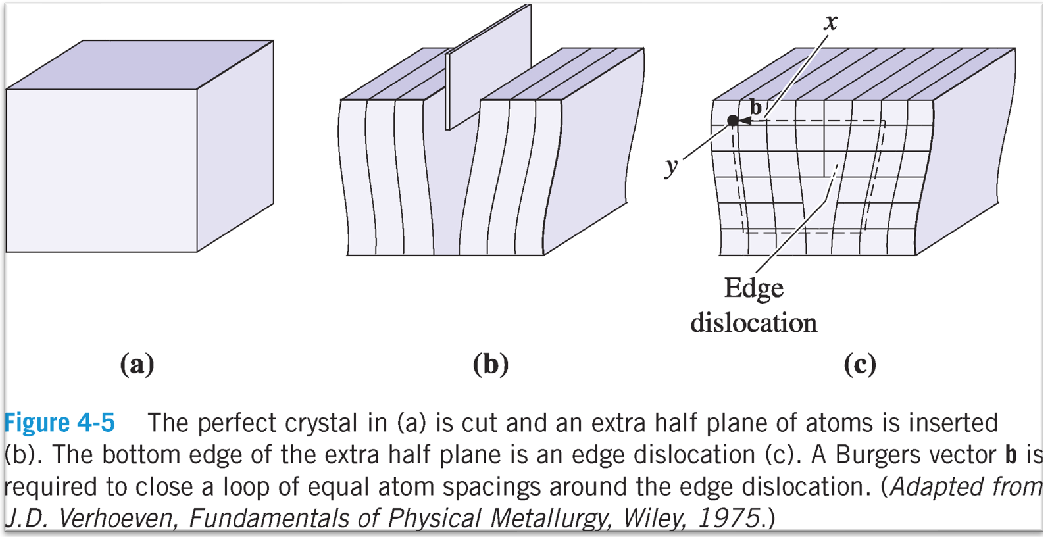
How is an edge dislocation caused?
by an extra half-pane of atoms inside the crystal
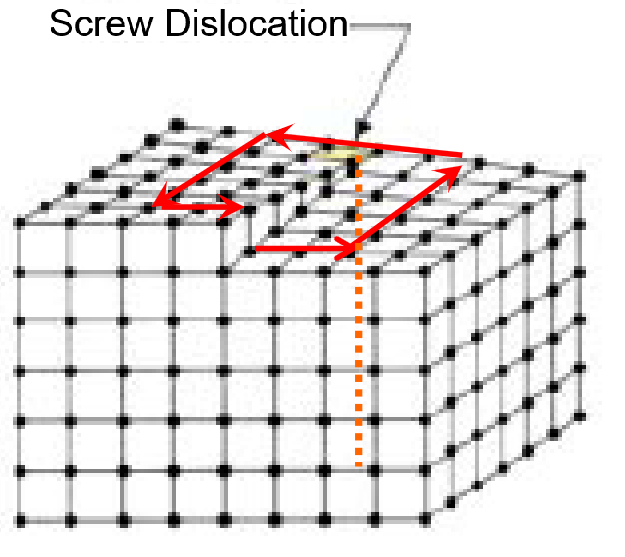
How is a screw dislocation caused?
by a spiral-like shear displacement of atomic planes
when part of a crystal is sheared by about one atomic spacing relative to the other part
How is a mixed dislocation caused?
combo of edge and screw
most real dislocations are mixed because dislocation lines are usually curved, not perfectly straight
Burgers vector
tells us the size and direction of the lattice mismatch caused by the extra half-plane of atoms
shows the magnitude and direction of the permanent atomic displacement
to determine the Burger’s vector direction you must trace the burger’s circuit clockwise around the dislocation
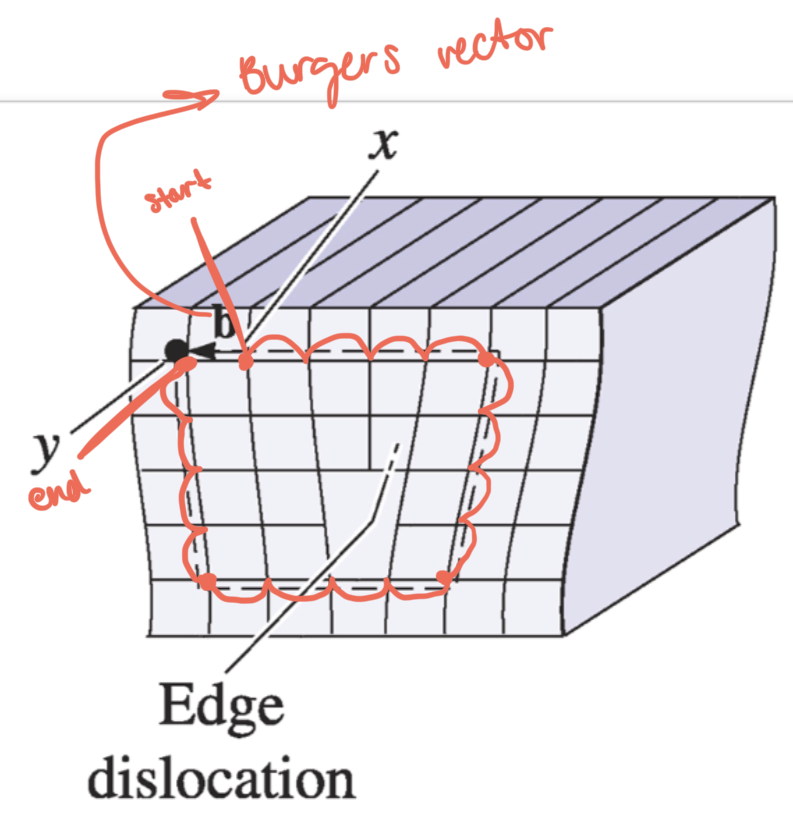
How to determine the Burgers vector?
start at top left of dislocation (x)
count equal # of steps in all directions (loop around 1 in clockwise direction)
when we arrive at the end point (y), the vector is drawn
from start point to end point
What is the dislocation line?
the edge of the extra plane of atoms
For an edge dislocation, the Burgers vector is:
perpendicular to the dislocation line
parallel to the slip direction
usually about one atomic spacing in magnitude
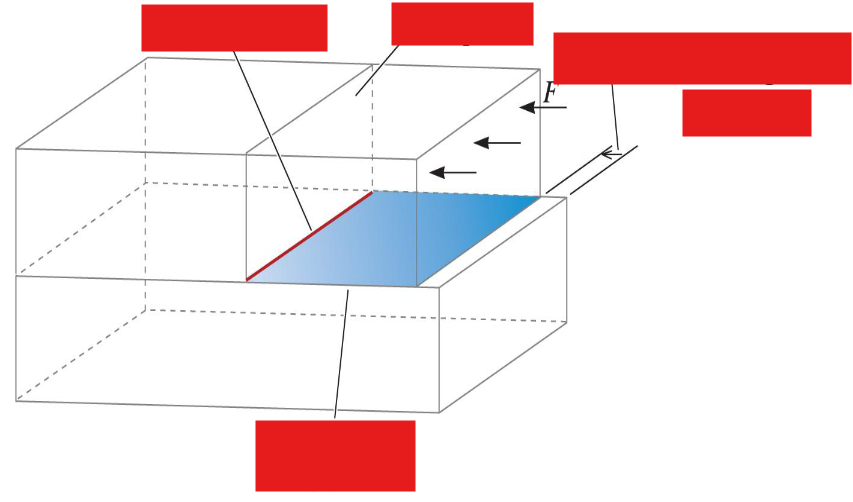
Label the diagram
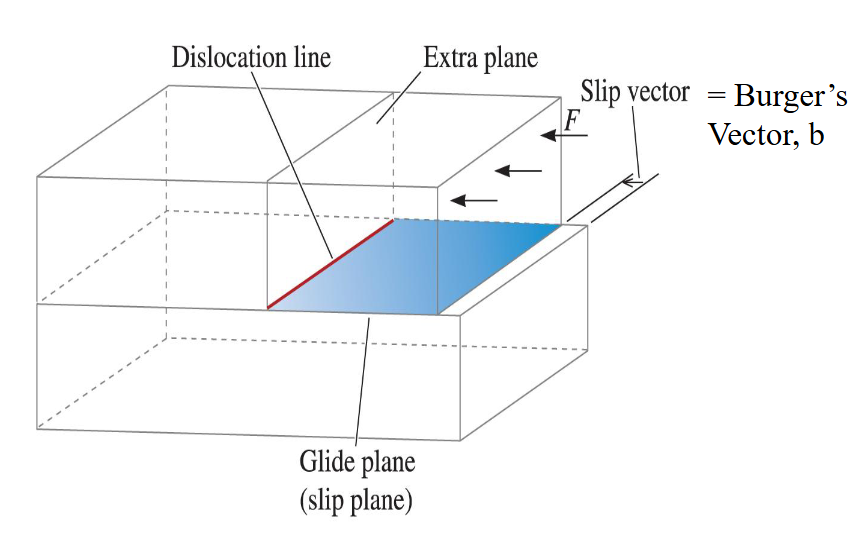
Slip plane
The plane along which the dislocation moves
Slip direction
the direction in which atoms shift during slip
For a screw dislocation, the Burgers vector is:
parallel to the dislocation line
parallel to shear stress
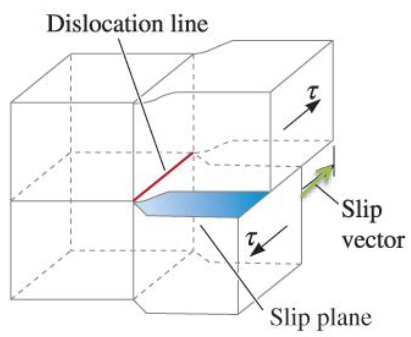
In an edge dislocation, the dislocation line moves __________ to the Burger’s vector
parallel
In a screw dislocation, the dislocation line moves ______________ to the Burgers vector
perpendicular
How can we predict when/where plastic deformation will occur?
When materials experience…*unfinished
When might we want slip to occur?
Manufacturing
When might we not want slip to occur?
Service/loading
When is slip most likely to occur?
along directions with high linear density
between planes with high planar density and large interplanar spacing
High linear density & high planar density
Easy for bonds to be broken and reformed
Large interplanar spacing
Bonding not as strong
What do slips in metals explain?
They explain why strength is much less than the value predicted from the metallic bond
provide ductility to metal
can be controlled by interfering with movement of dislocations
Interstitial atoms
strain field or lattice distortion around them
reduce the strain if they are in the larger interstice at the bottom of the extra half plane
Substitutional atom
produce less strain if they associate themselves with a dislocation
What happens when a dislocation comes in contact with an interstitial atom?
Addition stress is required to move them forward ***need to double check
What is the end result of interstitial and substitutional atoms?
Both interstitial and substitutional will inhibit the mobility of dislocations, and result in an increase in strength
Elastic deformation
reversible deformation
bonds between atoms are stretched but not broken
return to their equilibrium position when load is removed
Plastic deformation
permanent deformation
cause by dislocations moving through metal
anything that impedes dislocation mobility strengthens the metal at the expense of ductility
Why are FCC materials so formable and ductile?
Both slip directions and planes are close packed
Why are BCC materials more brittle?
Even though they have 4x more slip systems than FCC, none of the planes are as closely-packed *direction are closely-packed
What is Peierls-Nabarro used for?
Calculate the amount of shear stress needed to overcome resistance (required to cause dislocation)
What is the Peierls-Nabarro equation?
τ = c exp [-kd/b]
τ = shear stress
d = interplanar slip plane spacing
c and k are material constants
shear stress is lowest when b is smallest
slip always occurs in the closest packed directions of crystals
Schmid’s Law equation
τr = σ cosλ cosϕ
What is Schmid’s Law?
Slip in a crystalline material begins when the resolved shear stress on a slip system reaches the critical resolved shear stress.
Critical Resolved Shear Stress
shear stress required for slip to occur
slip occurs when the applied stress produces a resolved shear stress
if CRSS is high then a high applied stress is needed to cause deformation
What is τmax?
τmax = σ yield / 2
Grain
portion of the material within which the arrangement of the atoms is nearly identical
What happens at a material’s surface?
The crystal ends abruptly resulting in improper coordination numbers and bonding
Atoms on the surface are not in their equilibrium (low energy and configuration)
True or False: Compared to grain interiors, GBs are high energy regions,
True
What does a higher ASTM grain size number mean?
more grains in the same area, so the grains are smaller
What do smaller grains mean?
more boundaries
more shear stress required to continue deformation
increase in strength and ductility
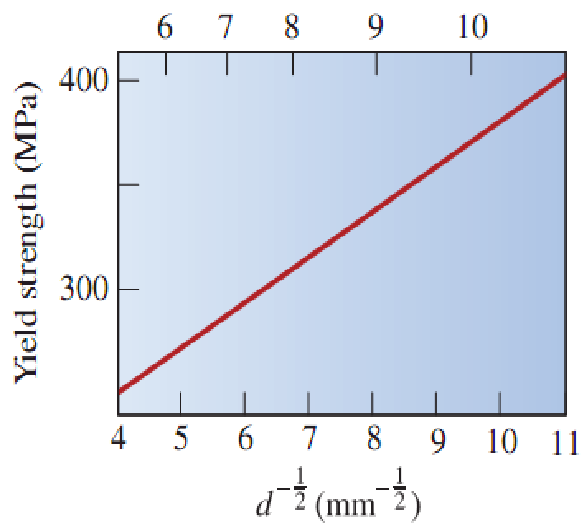
What is the Hall-Petch equation?
The effect of grain size on the yield strength of steel at room temperature
σy = σo + Kd-1/2
σy : yield strength
σo : inherent strength of crystal lattice
K : Hall-Petch strengthening constant (locking parameter)
d : average grain diameter
Average linear intercept length equation
l = (total length of all test lines) / (total number of GBs intercepted)
How do material properties change in the Heat Affected Zone (HAZ)?
recrystallization or annealing
overaging (precipitation hardened materials
Low angle boundaries
An array of dislocations that produces a small misorientation (<15°) between the adjoining crystals
How is a tilt boundary formed?
by an array of edge dislocations
How is a twist boundary formed?
by an array of screw dislocations
True or False: Small grain boundaries have much higher energy than large angle grain boundaries
False
Twin boundary
plane across which there is a special mirror image mis-orientation of the crystal structure, cause by shear force
when exposed to shear the lattice can sometimes deform by forming a mirror lattice (a twin)
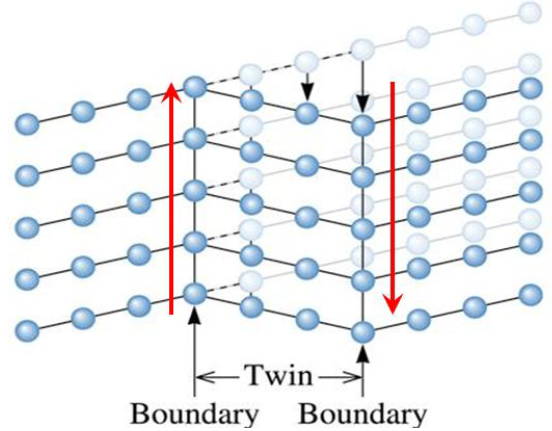
What does it mean when you see striped grains with straight edges?
Likely to be twins
Strain hardening
deforming a material to increase dislocation density and make it stronger
What does dislocation density mean?
stronger material
Grain-size strengthening
reduce grain size to increase strength
Precipitation strengthening
added atoms come together and form small particles inside the matrix
Do solid solutions form a separate particle/phase?
No
Are the particles in precipitation strengthening a different phase from the matrix?
Yes