One-dimensional flow through soils [Lecture 13]
 Call Kai
 Learn
Learn Practice Test
 Spaced Repetition
 Match
Match Flashcards
 Knowt Play
1/17

There's no tags or description
Looks like no tags are added yet.
Name | Mastery | Learn | Test | Matching | Spaced | Call with Kai |
|---|
No analytics yet
Send a link to your students to track their progress
18 Terms
Filter design
earth embankment dam for water storage (w eroded sandy layer)
sandy layer is permeable → water drains out safely instead of under the dam
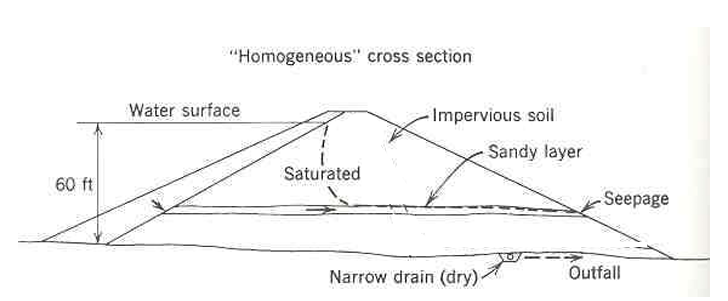
Internal erosion (piping)
Soil particles moved freely to an escape exit leading to structure degradation/collapse
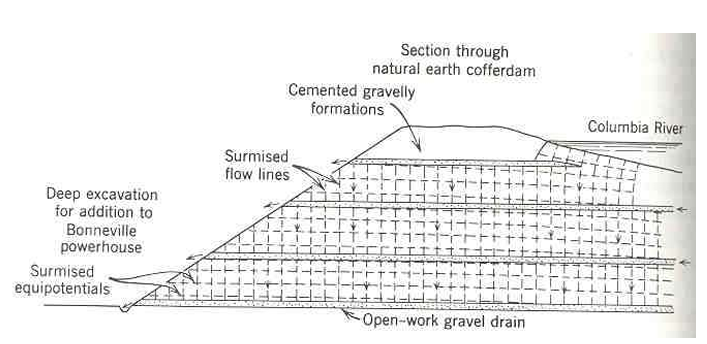
Slope stability (drains)
natural earth cofferdam slope stabilised with built-in drainage layers
changes in environmental conditions may alter the degree of saturation and strength of soil
Design of road drainage systems
proper drainage systems collect and transport water to safer locations within the structure
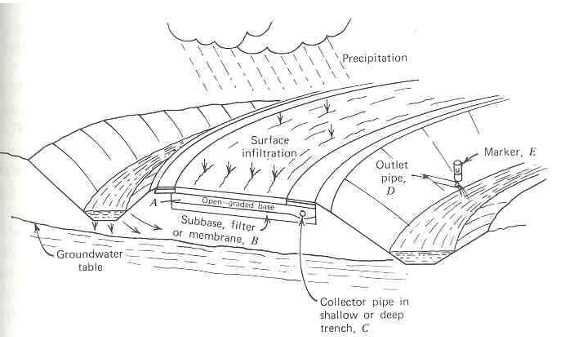
Pavement degradation
poor drainage can cause pumping/water bleeding leading to structure degradation
Flow around a sheet pile (homogeneous soil)
downwards flow → positive effect on effective stress (increases)
upwards flow → negative effect on effective stress (reduces)
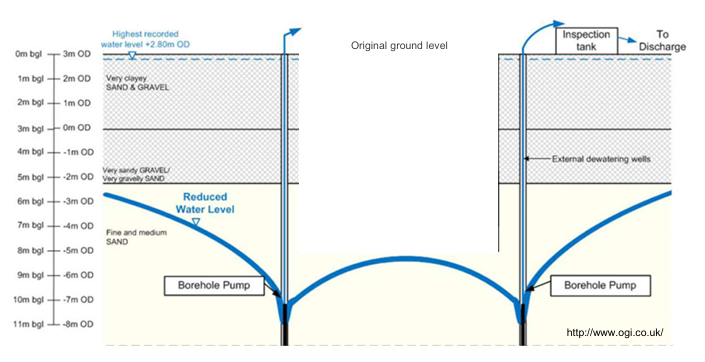
Dewatering systems
sheet piles susceptible to floods
place two borehole pumps + external dewatering wells
1D flow of water through soil
water flows from zones of high mechanical energy to zones of low mechanical energy (per unit mass/weight)
Bernoulli’s theorem:
Total head h
Elevation head hz = z (with reference to datum)
Pressure head = hp = u/𝝲w (height of column in piezometer)
Velocity head (negligible for soils)
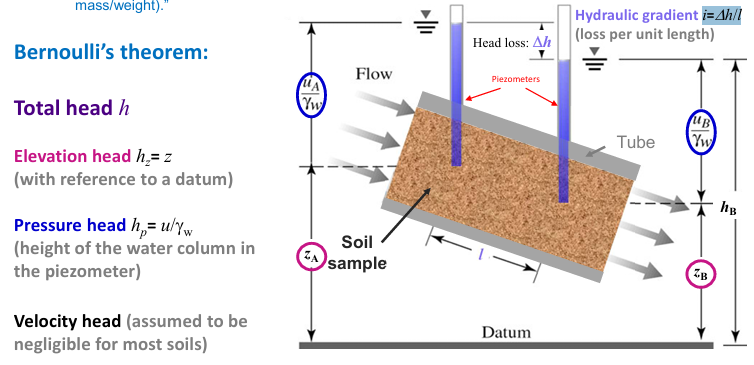
Hydraulic gradient
i=Δh/l (loss per unit length)

Example downward seepage
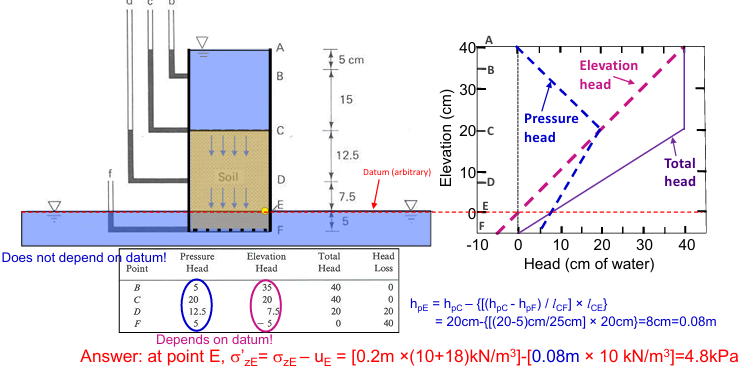
Static liquefaction σ’=0
σ’=z𝝲’-iz𝝲w=0
icr=𝝲’/𝝲w
~ 1 for most soils (since 𝝲’ ~ 9 to 10kN/m3)
Discharge & seepage velocities
q=v*A=vs*Av [L3/T]
q = flow rate
v = discharge velocity (average velocity)
vs = seepage velocity
A=Av+As
![<p>q=v*A=v<sub>s</sub>*A<sub>v</sub> [L<sup>3</sup>/T]</p><p>q = flow rate</p><p>v = discharge velocity (average velocity)</p><p>v<sub>s</sub> = seepage velocity</p><p></p><p>A=A<sub>v</sub>+A<sub>s</sub></p>](https://assets.knowt.com/user-attachments/1be3ea21-8d00-481c-9001-4e5b7237e5a5.png)
Darcy’s law
v proportional to k*i
for most soils:
k*i=q/A=Q/(tA)=k*Δh/l
k = hydraulic conductivity (or coefficient or permeability)
Q = flow volume [L3] (for mass conservation Qin=Qout)
![<p>v proportional to k*i</p><p></p><p>for most soils:</p><p>k*i=q/A=Q/(tA)=k*<span style="background-color: transparent;">Δ</span>h/l</p><p></p><p>k = hydraulic conductivity (or coefficient or permeability)</p><p>Q = flow volume [L<sup>3</sup>] (for mass conservation Q<sub>in</sub>=Q<sub>out</sub>)</p>](https://assets.knowt.com/user-attachments/4ccbf434-a428-45b3-a124-4baaa78c4aca.png)
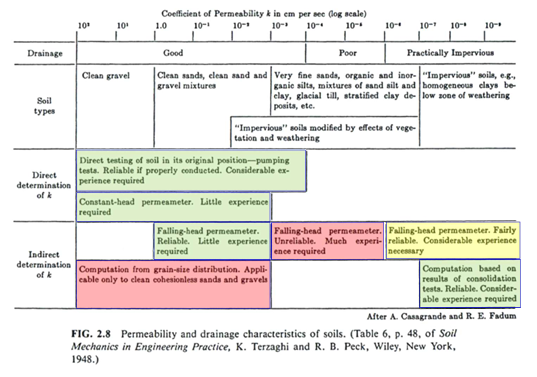
Permeability
soil property that varies significantly
(range of 10 billion times)
Permeability lab evaluation
a) Constant-head test (coarse-grained soils)
b) Falling-head test (fine-grained soils)
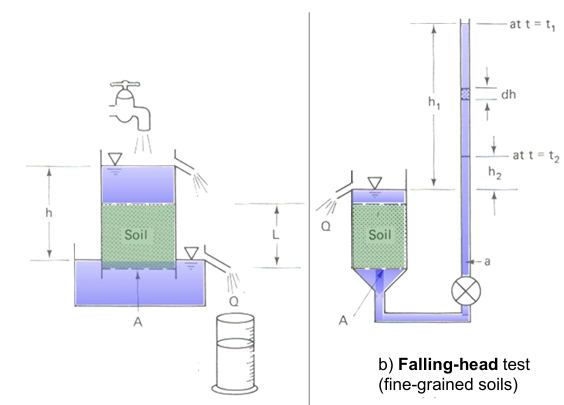
Constant head test
k = hydraulic conductivity [L/T]
Q = flow volume or outflow [L3]
t = test duration [T]
h = constant head [L], (=Dh)
A = specimen area [L ]
L = specimen length [L]
![<p>k = hydraulic conductivity [L/T]</p><p>Q = flow volume or outflow [L<sup>3</sup>]</p><p>t = test duration [T]</p><p>h = constant head [L], (=Dh) </p><p>A = specimen area [L ] </p><p>L = specimen length [L]</p>](https://assets.knowt.com/user-attachments/0e1b27f5-1ba3-4fb3-a47d-338ceb3b697b.png)
Falling-head test
k = 2.303*(aL)/(At)*log10*(h1/h2)
k = hydraulic conductivity [L/T]
t = test duration [T], (=t1-t2)
A = specimen area [L2]
a = standpipe area [L2]
L = specimen length [L]
![<p>k = 2.303*(aL)/(At)*log<sub>10</sub>*(h<sub>1</sub>/h<sub>2</sub>)</p><p>k = hydraulic conductivity [L/T] </p><p>t = test duration [T], (=t1-t2)</p><p>A = specimen area [L<sup>2</sup>]</p><p>a = standpipe area [L<sup>2</sup>]</p><p>L = specimen length [L]</p>](https://assets.knowt.com/user-attachments/ca775e8b-b0f1-4b78-8367-a2eee6f3dd25.png)
Permeability preliminary assessment only