L6a Social and emotional brain 1
 Call Kai
 Learn
Learn Practice Test
 Spaced Repetition
 Match
Match Flashcards
 Knowt Play
1/56

There's no tags or description
Looks like no tags are added yet.
Name | Mastery | Learn | Test | Matching | Spaced | Call with Kai |
|---|
No analytics yet
Send a link to your students to track their progress
57 Terms
What is the social intelligence hypothesis, according to Dunbar and Shultz
the idea that aspects of social life have been the primary force shaping intelligent behaviour
What has the brain evolved to deal with – referred to as computational demand – according to the social brain hypothesis
complex information of the social word
Define feeding ecology
how a species obtains and uses food in its natural environment
What do differences in feeding ecology create
different cognitive demands
What is the ecological intelligence hypothesis, according to Rosati
the idea that cognitive abilities evolved partly to solve ecological problems e.g. finding and exploiting food resources
What can variables related to feeding ecology (e.g. diet quality, foraging complexity) predict in the body
neurobiological traits
Explain the difference in what the social intelligence hypothesis vs ecological intelligence hypothesis attributes brain evolution to
social complexity vs feeding complexity
What method did Isik et al use to investigate processing speed of social interaction perception when ppts watched images (of either non-social or social interaction)
EEG/MEG decoding
What were the two tasks in Isik et al following ppts watching two images
judging whether two actors were of the same/different gender and whether the image contained a social interaction
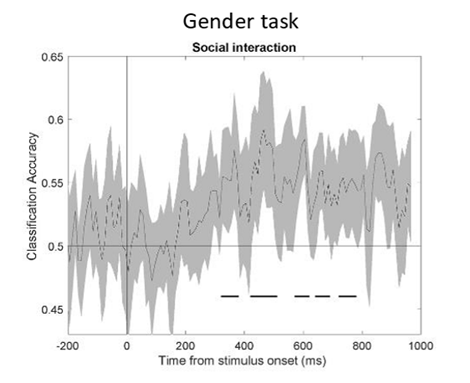
This was the speed of encoding for gender task (around 350ms), how did the time change for the social interaction task
time did not really differ, encoding for social interaction information occurred also 200-400ms after stimulus onset
This response time is considered fast or slow
relatively slow
What does the relatively slow speed of social interaction perception suggest about the underlying neural processes
suggests it is not a simple feedforward process and likely relies on information from multiple brain areas
What was the behavioural response time in the social interaction task (in ms)
600ms
What 4 pieces of social information does the face convey
others’ emotional states, attention/intentions (eye gaze), membership in social categories (e.g. gender), disposition (e.g. trustworthiness)
What 4 social cues does eye gaze provide
distinguishes between emotions, establishes dyadic communication, orient attention to critical objects, gives clues about intention
Recall to last weeks lecture, what two brain areas are involved in eye-gaze detection (clues: FFA and STS)
fusiform face area and superior temporal suclus
What task activates the FFA vs the STS, according to Hoffman and Haxby
face identity task vs eye gaze detection task
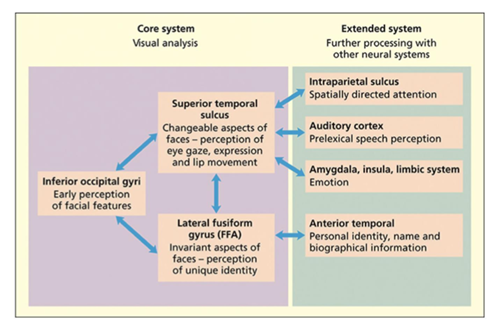
What does Haxby et al’s model attempt to explain (we looked at this in a previous lecture)
face processing and recognition
In the model, what does the STS process vs the FFA
changeable aspects of faces vs invariant aspects of faces (unique facial identity)
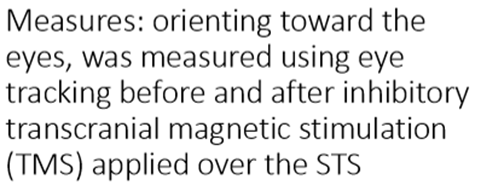
Study 1 by Saitovitch et al applied inhibitory TMS over the right STS, what was the impact on eye gaze and/or attention
led participants to look less to the eye region
What does this suggest about the role of STS
helps guide attention to the eyes, not only eye-gaze detector
It is assumed that STS detects eye-gaze, this could be simply any eye movements – Pelphrey et al aimed to test whether mutual and averted gaze evoke the same level of STS neural activity, what were the findings
mutual gaze evoked greater right-lateralised STS activity
What does this suggest and reinforce about STS assumptions
involved in the visual analysis of SOCIAL information conveyed by eye-gaze, not simply detecting eye movements
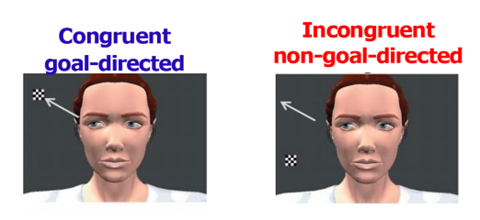
Pelphrey et al following up Study 2 with Study 3 which was interested in whether the context in which the eye movement occurs matters – tested congruent goal-directed vs incongruent non-goal-directed gaze shifts, which elicited greater activity and what does this show about the STS
incongruent, showing the STS is sensitive to violations of expected social behaviour
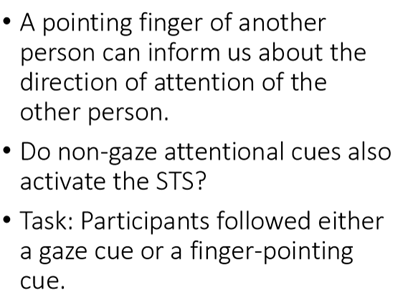
Study 4 by Materna et al – what were the results of STS activity in response to the two conditions
similar STS activity in both conditions

Complete the summaries of the previous studies
guide attention, visual analysis, eye-gaze, violations of expected, directional, pointing
Considering these summaries, is STS specialised for eye-gaze
no, not specific for the eyes or face
Pelphrey et al wanted to extend findings of congruent vs incongruent gaze shifts to goal-directed actions – ppts watched an animated character making movements either toward (congruent) or away from a dial (incongruent), which condition evoked greater STS activity
incongruent
What does this demonstrate about STS sensitivity
sensitive to violations of expected or goal-direct behaviour
This is different to gaze shift findings – what does this mean about STS function
ability to differentiate violation between predicted and actual behaviour
In previous lectures, we have seen that the STS is more active for biological motion compared to scrambled biological motion – Isik et al wanted to test whether STS preferentially engaged in perceiving social interactions vs independent actions (point-light figures), what were the results
STS responded more strongly to social interactions
What did Isik et al fand when using animated shapes (rather than human figures)
STS showed greater responses to socially interacting shapes compared to shapes moving in an inanimate manner
What do these findings tell us about what drives STS activity
perceived social interaction itself, not merely presence of human bodies/biological motion
From all these studies, what can we conclude about what STS role actually is
social meaning processor for dynamic cues
What 6 social information has the STS been evidenced to process (some we have identified, some not)
eye gaze direction, facial movements, biological motion, body actions, vocal cues, audio visual integration
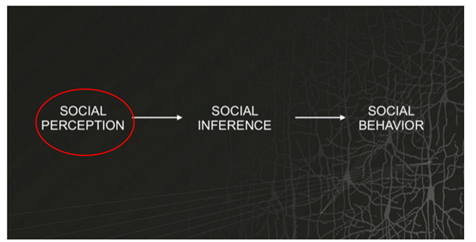
What is then questioned about what input is required at this stage
purely relies on visual information or input from higher-level brain regions too
According to McMahon and Isik, how are seemingly high-level aspects of social interactions extracted
largely by visual processes
And what do they suggest to be one of the goals of the visual system
recognising social interactions
What are social primitives
basic visual features used to detect social interactions
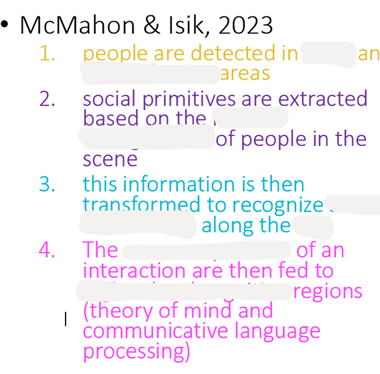
Complete the steps of social interaction perception
body, face-selective, relative configuration, social interactions, STS, core components, higher-level cognitive
What is the third visual pathway proposed by Pitcher and Ungerleirder (3 areas)
pathway projecting from early visual cortex, via motion-selective areas, into the STS
What does the STS compute in this pathway
actions of moving faces and bodies
What is the third visual pathway specialised for
dynamic aspects of social perception
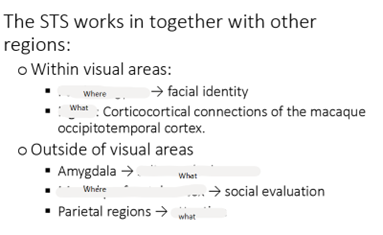
STS is seen as part of a network hub rather than a lone operator, fill the gaps
fusiform gyrus, figure, salience/relevance, medial prefrontal cortex, attention
What are two neuroscience methods used with infants
fMRI and fNIRS
What does fNRIS measure (similar to fMRI)
concentration changes of oxyHb and deoxyHb focally
Infants are drawn to faces with mor elements in the upper half or lower half
upper
What brain activity may reflect distinctively social processes early in infancy
cortical face-selective responses
What is the main mode of establishing communicative context between humans
mutual gaze
Through a looking time study in newborns, what is their visual acuity and what gaze did infants prefer
poor, direct gaze over averted gaze
Through an EEG study, what was their visual acuity and what processing of direct gaze did they find
high, enhanced neural processing
Using fNIRS, what changes in oxyHb concentration did Grossman et al find when infants watched dynamic scenarios in two gaze conditions
increases in oxyHb for mutual compared to averted gaze
What do these findings suggest about cortical areas in the infant brain and what it corresponds with
mutual gaze activates these area which correspond to adult STS regions
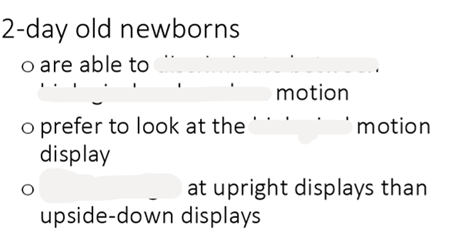
Fill the gaps of Simion et al findings on newborn preference for biological motion
discriminate between biological and random, biological, looked longer
Using fNIRS, what did Lisboa et al find about concentration levels in STS in response to coherent PLW vs scrambled PLW
increase concentration in STS for coherent PLW but no activations for scrambled motion
What does this suggest about the specialisation of STS in infants (specify age)
functionally speciflaised in biological motion configurations at 7-8 months of age
What is the overall developmental trajectory of STS social specialisation
face processing then indirect evidence for STS involvement in eye-gaze and biological motion, specialisation of STS for complex social signals emerges gradually during development