Financial Management

0.0(0)
Studied by 0 people
call kaiCall Kai
learnLearn
examPractice Test
spaced repetitionSpaced Repetition
heart puzzleMatch
flashcardsFlashcards
GameKnowt Play
Card Sorting

1/108

encourage image

There's no tags or description

Looks like no tags are added yet.

Last updated 1:49 PM on 4/27/26
Name
Mastery
Learn
Test
Matching
Spaced
Call with Kai

No analytics yet

Send a link to your students to track their progress

109 Terms

1
New cards

WORKSHOP 1

WORKSHOP 1

2
New cards
What is the primary objective of capital budgeting methods in corporate finance?
To analyze forecasted cash flows and make informed investment decisions.
3
New cards
List the five major investment decision rules discussed in Workshop 1.
"Net Present Value (NPV), Internal Rate of Return (IRR), Profitability Index (PI), Payback Period (PP), and Average Accounting Return (AAR)."
4
New cards
"According to the NPV rule, when is shareholder value maximized?"
Shareholder value is maximized when projects with a positive NPV are accepted.
5
New cards
How is an 'independent' project defined in capital budgeting?
A project where the decision to accept or reject has no effect on other projects.
6
New cards
"In capital budgeting, what is the definition of 'mutually exclusive' projects?"
Projects that cannot both be undertaken at the same time.
7
New cards
What is the decision rule for a set of independent projects regarding NPV?
Accept all projects that have an NPV exceeding zero.
8
New cards
"When choosing between mutually exclusive projects, which one should be selected based on the NPV rule?"
The project with the highest positive NPV.
9
New cards

Formula: What is the general mathematical formula for Net Present Value (NPV)?
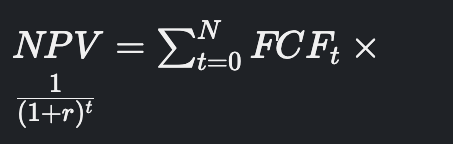
<p></p>
10
New cards
What is the first general rule for applying the NPV method regarding the type of data discounted?
Discount cash flows rather than accounting profits.
11
New cards
"According to the second general rule of NPV, managers should only focus on _____ cash flows."
Incremental
12
New cards
How should 'sunk costs' be handled when calculating incremental cash flows for a project?
Sunk costs should be ignored as they cannot be recovered regardless of the investment decision.
13
New cards
Name two types of non-cash values that must be remembered when calculating incremental cash flows.
Opportunity costs and salvage value.
14
New cards

What is net trade credit, how do you find each?

Recievables - Payables

Say receivables are on average 30 days and payables on average 50 days

do 30/365 x revenue for recievables and 50/365 x COGS - remembet to use your new incremental values

15
New cards

What is NWC formula

Cash + Inventoryies + net trade credit

16
New cards
What is the consistent treatment for inflation when discounting nominal cash flows?
Nominal cash flows must be discounted at a nominal discount rate.
17
New cards
What is the consistent treatment for inflation when discounting real cash flows?
Real cash flows must be discounted at a real discount rate.
18
New cards
What does the fourth general rule of NPV suggest regarding investment and financing decisions?
"They should be treated separately, assuming all cash flows belong to shareholders regardless of financing."
19
New cards
Which mandatory deduction is required by the fifth general rule of NPV when forecasting cash flows?
Taxes must be deducted.
20
New cards
Term: Unlevered firm.
A firm that is financed with 100% equity and 0% debt.
21
New cards

Formula: How is Unlevered Net Income calculated using EBIT and the tax rate ($tc$)?

Its just deducting the tax as a multiplier < 1

<p>Its just deducting the tax as a multiplier &lt; 1</p><p></p>
22
New cards

"In the context of financial forecasting, what does EBIT stand for?"

Earnings Before Interest and Tax. (OPERATING PROFIT)

23
New cards

"Formula: What is the formula for EBIT using revenue, costs, and depreciation?"

<p></p>
24
New cards
Definition: Incremental earnings.
The amount by which a firm's earnings are expected to change as a result of an investment decision.
25
New cards

Formula: What is the comprehensive formula for Free Cash Flow (FCF)?
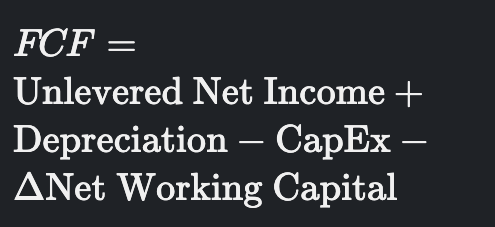
<p></p>
26
New cards
Why is depreciation added back to Unlevered Net Income when calculating Free Cash Flow?
Depreciation is a non-cash expense that was subtracted to calculate earnings but does not involve an actual cash outflow.
27
New cards
When should Capital Expenditures (CapEx) be recorded in a Free Cash Flow forecast?
In the period the physical cash outflow occurs to purchase the asset.
28
New cards
Provide two examples of why a project might require an investment in Net Working Capital (NWC).
To maintain a minimum cash balance or to hold inventory for product requirements.
29
New cards
Why is the opportunity cost of research relevant to an investment decision even if no cash changes hands?
"It represents a potential negative cash outflow, such as the removal of a tax benefit."
30
New cards
True or False: The tax implications of positive differences in asset values at the end of a project should be ignored in salvage value calculations.
False.
31
New cards
Give an example of a negative within-firm externality.
Cannibalization of sales from an existing product line by a new project.
32
New cards
Definition: Internal Rate of Return (IRR).
The discount rate at which the Net Present Value (NPV) of a project's cash flows equals zero.
33
New cards
What is the standard decision rule when using the Internal Rate of Return (IRR)?
Accept the project if the IRR is greater than the firm's cost of capital.
34
New cards

State two 'pros' of using the Internal Rate of Return (IRR) method.

It incorporates the time value of money and

is easy to understand and communicate.

35
New cards
Describe the 'multiple IRR' problem.
"A situation occurring when cash flows change signs more than once, leading to more than one discount rate that results in a zero NPV."
36
New cards
"Under what condition is NPV an increasing function of the discount rate, potentially making the IRR rule inapplicable?"
When the benefits of an investment occur before the costs (delayed investment).
37
New cards
Name two problems specific to using IRR for mutually exclusive investments.
The timing problem and the scaling problem.
38
New cards
Definition: Crossover Rate.
The discount rate at which the NPVs of two different projects are equal.
39
New cards
What is the first step in calculating the crossover rate between two projects?
Calculate the differences between the cash flows of the two projects for each period.
40
New cards

Formula: What is the formula for the Profitability Index (PI)? AND min acceptance criteria

Accept if PI > 1

<p>Accept if PI &gt; 1</p>
41
New cards
In what specific scenario is the Profitability Index most useful?
When the firm's investment funds are limited (capital rationing).
42
New cards
Term: Soft Rationing.
Limits on available investment funds imposed by a firm's own management.
43
New cards
Term: Hard Rationing.
Limits on investment funds imposed by the external capital market's inability to provide funds.
44
New cards

Definition: Payback Period (PP). Decision Rule?

The amount of time required for the cumulative cash flows of a project to equal the initial investment cost.

Accept the project if the payback period is within a desired or specified time frame.

45
New cards

State three pitfalls of the standard Payback Period rule.

"It ignores the time value of money,

ignores cash flows after the payback period,

does not compare addition to shareholder value amongst projects

46
New cards
Definition: Discounted Payback Period (DPP).
The amount of time it takes to recover the initial investment after accounting for the time value of money.
47
New cards

Formula: What is the general formula for the Accounting Rate of Return (ARR)?

<p></p>
48
New cards
What is the minimum acceptance criterion for the Accounting Rate of Return (ARR)?
Accept the project if the ARR is greater than or equal to the targeted return.
49
New cards
Why is the Accounting Rate of Return (ARR) rarely used by financial managers?
It relies on accounting and tax figures rather than market values or actual cash flows.
50
New cards
How can the 'average book assets' component of ARR be calculated across the life of a project?
By taking the average of the opening and closing book values of assets across the project life.
51
New cards
Which investment appraisal method is described as the 'single best criterion' to be used alone?
Net Present Value (NPV).
52
New cards

WORKSHOP 2

WORKSHOP 2

53
New cards

WORKSHOP 3

WORKSHOP 3

54
New cards
Definition: Sensitivity Analysis.
An analysis that varies one input assumption at a time while holding others constant to see the effect on NPV or IRR.
55
New cards
Definition: Scenario Analysis.
An analysis that examines what happens to a project's NPV when a logical set of multiple variables are forecast incorrectly.
56
New cards
Definition: Financial Break-Even Analysis.
Finding the level of output or quantity sold that results in a Net Present Value (NPV) of exactly zero.
57
New cards
What is the 'contribution margin' in the context of break-even analysis?
The difference between the selling price per unit and the variable cost per unit.
58
New cards
Term: Capital Rationing.
A situation where a limit is set on the total amount of funds available for new investments.
59
New cards
"On a corporate balance sheet, which side represents the 'Investment Decision'?"
The assets side (existing assets and growth assets).
60
New cards
"On a corporate balance sheet, which side represents the 'Financing Decision'?"
The liabilities and equity side (debt and equity).
61
New cards
Definition: Pecking Order Theory.
"A theory suggesting that firms prefer internal financing first, followed by debt, and external equity as a last resort."
62
New cards
Why might the IRR rule lead to a different decision than the NPV rule in mutually exclusive projects with different scales?
"IRR measures percentage return which may favor smaller, high-return projects, while NPV measures absolute value added to the firm."
63
New cards
How does the 'timing problem' affect the IRR for mutually exclusive projects?
Differences in the timing of cash flows can cause the IRR to favor a project that generates less total wealth than an alternative.
64
New cards
What is the purpose of performing a 'Break-Even Analysis' in capital budgeting?
To determine the minimum level of sales or maximum cost allowable for a project to remain viable (NPV $\ge$ 0).
65
New cards
"When evaluating mutually exclusive projects with different lives, which method simplifies the comparison?"
The Equivalent Annual Cost (EAC) method.
66
New cards

WORKSHOP 4

WORKSHOP 4

67
New cards
"In the context of Pecking Order Theory, why do managers care about how their actions are interpreted by outsiders?"
External financing can signal information about the firm's health or future prospects to the market.
68
New cards
Cloze: Depreciation is a non-cash expense and is _____ in calculating Free Cash Flow.
Excluded (or added back)
69
New cards
What is the 'nominal' vs 'real' rule for NPV consistency?
Never mix real and nominal cash flows; match the flow type with the corresponding discount rate type.
70
New cards
Term: Incremental Cash Flow.
The difference between a firm's future cash flows with a project and those without the project.
71
New cards
"In the balance sheet view of corporate finance, which side represents the 'Investment Decision'?"
The Assets side.
72
New cards
"In the context of corporate finance, which side of the balance sheet represents the 'Financing Decision'?"
The Liabilities and Equity side.
73
New cards
Asset Type: Assets in Place
"Definition: Existing investments that generate cash flows today, including fixed and working capital assets."
74
New cards
Asset Type: Growth Assets
Definition: The expected value that will be created by future investment opportunities.
75
New cards
Term: Debt Financing
Definition: Raising capital by borrowing funds that must be repaid in the future.
76
New cards
Term: Equity Financing
Definition: Raising capital by selling shares of ownership in the firm.
77
New cards
"In terms of cash flow priority, debt is considered a(n) _____ claim."
Fixed
78
New cards
"In terms of cash flow priority, equity is considered a(n) _____ claim."
Residual
79
New cards
Which form of corporate financing offers the advantage of tax deductibility on payments?
Debt Financing (Interest is tax deductible).
80
New cards
Contrast the management role of debt holders versus equity holders.
"Debt holders have little to no role in management, while equity holders have a significant role."
81
New cards
What is the typical maturity characteristic of equity capital?
Infinite (Perpetual lives).
82
New cards
What is the typical maturity characteristic of debt capital?
Fixed maturity.
83
New cards
How does the priority of equity compare to debt during financial trouble?
"Equity has low priority, while debt has high priority."
84
New cards
What defines a 'Zero-coupon' or 'pure-discount' bond?
A bond that makes no periodic interest payments and is sold at a deep discount from face value.
85
New cards
Term: Eurobond
Definition: A bond issued in a currency different from the currency of the country where it is issued.
86
New cards
Term: Convertible bond
Definition: A bond that can be exchanged for a predetermined number of shares of the issuer's common stock.
87
New cards
Term: Callable bond
Definition: A bond that the issuer has the right to pay off or redeem before its scheduled maturity date.
88
New cards
What is the difference between secured debt and unsecured debt?
"Secured debt is backed by collateral, while unsecured debt (debentures) is not."
89
New cards
Why is the lower cost of debt relative to equity considered an 'illusion'?
"As debt increases, risk increases for equity holders, who then demand a higher rate of return."
90
New cards
How does debt financing add discipline to corporate managers?
The requirement to make regular interest and principal payments prevents the wasteful use of cash.
91
New cards
List three primary costs associated with debt financing.
"Bankruptcy costs, agency costs, and loss of future flexibility."
92
New cards
How does Preferred Stock differ from Common Stock regarding bankruptcy?
Preferred stock gets priority in the payment of dividends and the distribution of assets.
93
New cards
"In the context of convertible bonds, what is 'conversion value' (parity value)?"
The value of the bond if it were converted into shares at the current market price.
94
New cards
Formula: Market conversion price of a convertible bond

<p></p>
95
New cards
Formula: Market conversion premium per share

<p></p>
96
New cards
What does the Market conversion premium ratio represent?
The market conversion premium per share expressed as a percentage of the current market price of the shares.
97
New cards
Formula: Debt to Capital Ratio

<p></p>
98
New cards
What components are included in 'Debt' for the Debt to Capital Ratio?
"All interest-bearing liabilities, both short-term and long-term."
99
New cards
Formula: Interest Coverage Ratio (ICR)

<p></p>
100
New cards
What is the primary purpose of calculating the Interest Coverage Ratio?
To determine how easily a firm can pay interest on its outstanding debt using its earnings.