Unit 3.2 Investigating Cellular Respiration
 Call Kai
 Learn
Learn Practice Test
 Spaced Repetition
 Match
Match Flashcards
 Knowt Play
1/53

There's no tags or description
Looks like no tags are added yet.
Name | Mastery | Learn | Test | Matching | Spaced | Call with Kai |
|---|
No analytics yet
Send a link to your students to track their progress
54 Terms
What is cellular respiration?
Process where food is turned into useable energy for the cell
What is the chemical equation for aerobic cellular respiration?
C6H12O6 + 6O2 → 6H20 + 6CO2 + ATP energy
What are the 4 stages of aerobic cellular respiration?
Glycolysis
Pyruvate oxidation
Krebs cycle
Electron Transport Chain/Chemiosmosis
Energy-carrying coenzymes/enzymes/specialized structures within the mitochondria do what for aerobic cellular respiration?
They incrementally extract the energy of the electrons as they move towards oxygen
Is aerobic cellular respiration anabolic or catabolic? Endothermic or exothermic?
Catabolic and exothermic
In every reaction, aerobic cellular respiration generates free energy (as ATP) along with, as always,-
the loss of energy as waste heat
Do the electrons stripped from glucose have a little energy or a lot of energy?
Have a LOT of potential energy
During the aerobic cellular respiration process, what 2 ways do electrons lose some energy?
To work the proton pumps
As heat (disorder)
What are the 2 main players involved in aerobic cellular respiration?
Mitochondrion
Enzyme/coenzymes
Where does aerobic cellular respiration start and where does it end?
Starts in the cytoplasm and ends in the mitochondrion
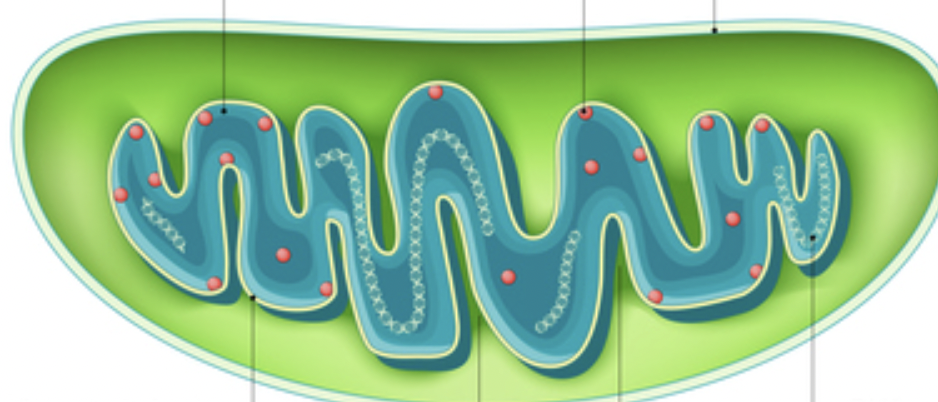
Label the parts of the mitochondrion from top left
Matrix, ribosome, outer membrane, DNA, crista, inner membrane
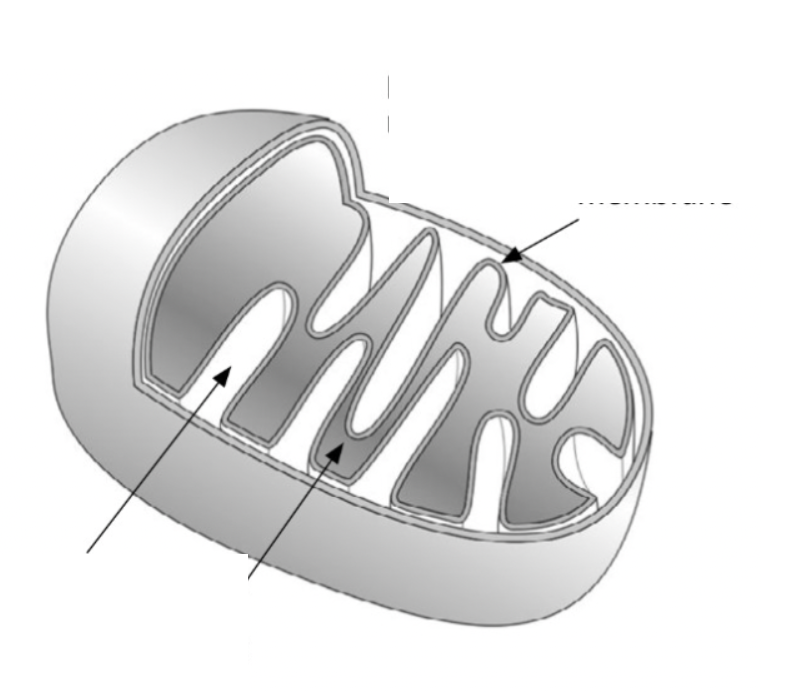
Label the part of the mitochondrion from the top
External membrane, internal membrane, matrix, cristae
What 2 places do most reactions occur in the mitochondrion?
Matrix
Internal membrane
Recall- what are enzymes?
Protein catalysts that speed up chemical reactions without themselves being used up
What is the function of a coenzyme? Are they a protein like enzymes?
Non-protein. Necessary for the proper functioning of an enzyme
What are 2 coenzymes of note here?
NADH and FADH2
What is the main source of energy for cellular respiration?
Glucose
What 2 reasons does glucose work so fast?
Quickly absorbed into the bloodstream once ingested
Cells are permeable to glucose (by insulin)
Once glucose gets into the cytoplasm, what happens?
It’s processed for its free energy to do immediate cellular work- harvested as ATP
Where does Stage 1 Glycolysis take place?
In the cytoplasm
What is the main purpose of Stage 1 Glycolysis?
To prepare the energy-rich glucose molecule for the extraction of the energy stored in its bonds
What does it mean that the outcome of glycolysis is net 2 ATP?
Some energy, 2 ATP, needs to be used to first destabilize that glucose molecule. The outcome of glycolysis is 4 ATP and 2 NADH but because we used 2 already, we take about 2 from the end result
Does Stage 1 Glycolysis need oxygen?
No. This stage is anaerobic
What 3 products comes out of Stage 1 Glycolysis?
Two 3-Carbon pyruvate molecules
2 NADH
2 ATP (4 made but we used 2 at the beginning so net 2)
What is CoA?
Coenzyme A
Where does Stage 2 Pyruvate Oxidation occur?
In the mitochondrial matrix
Stage 2 Pyruvate Oxidation makes how many ATP?
NONE (only prepares for next steps; “transitional period”)
Before Stage 2 Pyruvate Oxidation can happen, what do the two pyruvates molecules have to do?
Stage 1 happens in the cytoplasm. Now, both pyruvates must be actively transported across the outer mitochondrial membrane, through the intermembrane space, and the inner mitochondrial membrane before finally reaching the mitochondrial matrix
What 4 products have we made during Stage 2 Pyruvate Oxidation?
2 CO2
2 Acetyl-CoA
2 NADH
2 H+
What happens during the very last step of Stage 3 Krebs Cycle?
Last step resets the cycle
Where does Stage 3 Krebs Cycle occur?
In the mitochondrial matrix
Each step in Stage 3 Krebs Cycle does what for future steps?
Prepares for the harvesting of energy in successive steps.
Enzymes in Stage 3 Krebs Cycle turn 2 Acetyl-CoA molecules into what 8 things?
Citrate → isocitrate → alpha-ketoglutarate → succinyl-CoA → succinate → fumarate → malate → oxaloacetate
What is important about oxaloacetate?
It begins the cycle as a reactant and is regenerated as a product during the last reactions in the cycle to reset it
During Stage 3 Krebs Cycle, energy is removed from the transformed Acetyl-CoA molecules as what 3 things?
ATP
NADH
FADH2
Where does Stage 4 Electron Transport Chain (ETC) and Chemiosmosis occur?
In the cristae of the mitochondrial matrix, the inner membrane, and the intermembrane space
In simplest terms, what happens during Stage 4 ETC and Chemiosmosis?
Electrons harvested from the oxidation of glucose move from electron donors (NADH, FADH2) to an electron acceptor (oxygen) via ETC. ETC is made up of molecules (cytochrome complexes) that release some energy from the electrons at each step in the chain. Energy powers 3 proton pumps that push H+ ions out across the mitochondrial matrix membrane into the intermembrane space. Resulting transmembrane proton gradient is used to make ATP by chemiosmosis
What is a simple way to describe all 4 stages of cellular respiration?
Energy in C-H bonds of glucose → energy carriers → transported/harvested along the ETC → pump protons into the matrix → generate PMF → form ATP
ATP generation depends on the constant maintenance of what?
H+ reservoir in the intermembrane space
Why is it called aerobic cellular respiration?
Electrons will only keep moving through the ETC if oxygen is present to accept them at the end of the process
What is the main goal of the ETC and Chemiosmosis?
To harvest energy from the carrier molecules produced in the first three stages of cellular respiration
At the end of all stages of cellular respiration, what is the net ATP yield?
32 ATP
Are there alternative metabolic pathways? For who? Why?
Yes. Fats and other lipids get used up for energy when glucose isn’t available
What is beta-oxidation?
Aerobic breakdown (catabolism) of fats
How do proteins provide energy for cellular respiration?
Proteins are broken down into amino acids which are “deaminated” to produce energy-rich molecules. Amino groups are removed during deamination. Because of their unique functional groups, once deaminated they form products that can feed into Glycolysis or the Krebs Cycle
Deamination can create what toxic substance? How is it removed?
Urea; filtered by the kidneys and excreted via urine
What happens is anaerobic cellular respiration?
First set of electrons oxidized from glucose reduce NAD+ to NADH. Cells do not have limitless supplies of NAD+ available to undergo reduction reactions to gain electrons. Until NADH can offload their electrons to an acceptor they become unavailable for further electron removal
What happens in anaerobic cellular respiration when oxygen isn’t available? What have organisms learned to do to cope?
Another electron acceptor must be used; or organisms have had to evolve different mechanisms
What is lactic acid fermentation in muscle cells after strenuous exercise?
O2 will be used faster than glucose can be metabolized. Will shift temporarily to produce lactic acid. Protons and electrons that were removed from glucose during glycolysis attach back onto pyruvate thus creating lactic acid
How do muscle cramps form? How can they be reduced?
From lactic acid; increasing oxygen will reduce cramps and restart aerobic cellular respiration
Is cellular respiration efficient?
No
If 1 Glucose has 3012kJ of energy, 1 ATP has 30kJ, and cellular respiration makes 32 ATP, how much energy is lost as heat? What is the percentage?
Lose 2052kJ of energy lost as heat; use only 32% of Glucose’s available energy
Is the efficiency of aerobic cellular respiration better than anaerobic?
Yes! 32% vs only 2%
Where are two places where we lose efficiency?
Some H+ leaks out of the proton reservoir and makes it’s way back into the matrix thus avoiding making ATP
Some energy from the proton pumps does other things not ATP related