Psych Exam: 4/23
 Call Kai
 Learn
Learn Practice Test
 Spaced Repetition
 Match
Match Flashcards
 Knowt Play
1/35

There's no tags or description
Looks like no tags are added yet.
Name | Mastery | Learn | Test | Matching | Spaced | Call with Kai |
|---|
No analytics yet
Send a link to your students to track their progress
36 Terms
Divergent Thinking
expanding the number of possible problem solutions; creative thinking that diverges in different directions
Convergent Thinking
narrowing the available problem solutions to determine the single best solution
representativeness heuristic
judging the likelihood of events in terms of how well they seem to represent, or match, particular prototypes, lead us to ignore other relevant information
availability heuristic
judging the likelihood of events based on their availability in memory, we presume such events are common
framing
the way an issue is posed; how an issue is framed can significantly affect decisions and judgments
nudge
framing choices in a way that encourages people to make beneficial decisions
priming
the activation, often unconsciously, of particular associations in memory
visuospatial sketchpad
a memory component that briefly holds information about objects' appearance and location in space
heuristic
a simple thinking strategy - a mental shortcut - that often allows us to make judgments and solve problems efficiently; speedier but also more error-prone than an algorithm
gestalt
an organized whole, pieces of information become meaningful wholes
figure-ground
the organization of the visual field into objects (the figures) that stand out from their surroundings (the ground)
grouping
the perceptual tendency to organize stimuli into coherent groups
assimilation
taking in new information into our already existing schemas, no change to the person's current interpretation of reality
ex: might call an animal a dog first
accommodation
changing existing schemas when we gain new information, may develop as a result of the changes, a person's perception of reality is adjusted
ex: incorporate knowledge to the existing schema
state-dependent memory
when people are better able to recall information when they are in the same physical or emotional state as when the memory was formed
ex: drinking coffee while studying for exam, perform better when drinking coffee
mood-congruent memory
our current mood can influence the type of memories we recall, ex: recall other positive memories when happy
multi-store model
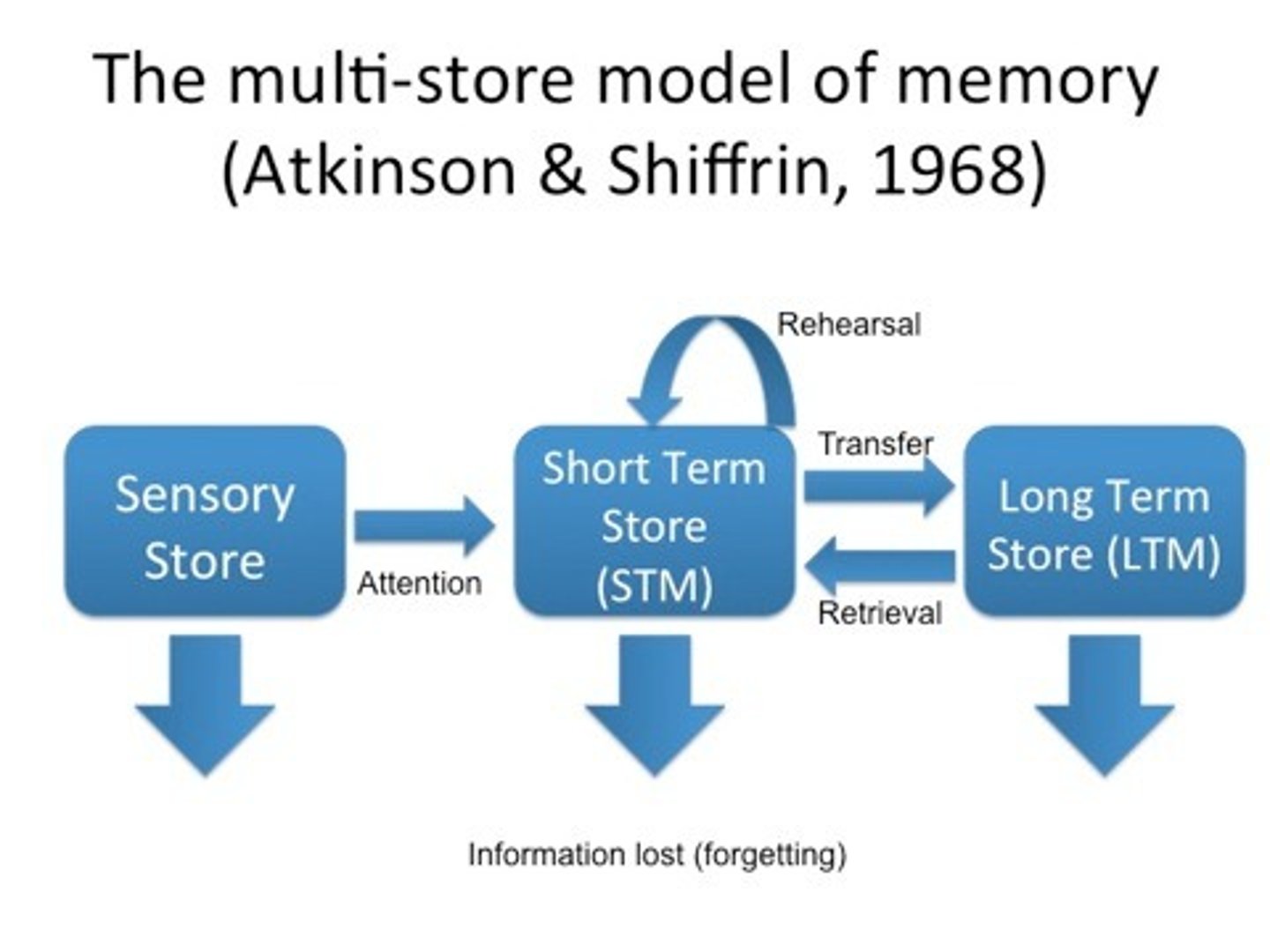
information-processing model
encode -> store -> retrieve
effortful processing
requires attention and conscious effort to encode memories, facts/experiences
automatic processing
unconscious encoding of incidental information (space, time, frequency, and of familiar or well learned information), produces implicit memories
misinformation effect
occurs when a memory has been corrupted by misleading information
source amnesia
faulty memory for how, when, or where information was learned or imagines (as when misattributing information to a wrong source)
enconding
the process of getting information into the memory system, by extracting meaning
storage
the process of retaining encoded information over time
retrieval
the process of getting information out of memory storage
memory
the persistence of learning over time through the encoding, storage, and retrieval of information
inattentional blindness
failing to see visible objects when our attention is directed elsewhere
change blindness
failing to notice changes in the environment, a form of inattentional blindness
perceptual constancy
perceiving objects as unchanging even as illumination and retinal images change
binocular cue
a depth cue, such as retinal disparity that depends on the use of two eyes
retinal disparity
a binocular cue for perceiving depth
convergence
a cue to nearby objects' distance, enabled by the brain combining retinal images
grouping
the perceptual tendency to organize stimuli into coherent groups
proximity
grouping nearby figures together
continuity
perceiving smooth, continuous patterns, rather than discontinuous ones
closure
filling in gaps to create a whole object