Chapter 6 + Interlude
 Call Kai
 Learn
Learn Practice Test
 Spaced Repetition
 Match
Match Flashcards
 Knowt Play
1/90

There's no tags or description
Looks like no tags are added yet.
Name | Mastery | Learn | Test | Matching | Spaced | Call with Kai |
|---|
No analytics yet
Send a link to your students to track their progress
91 Terms
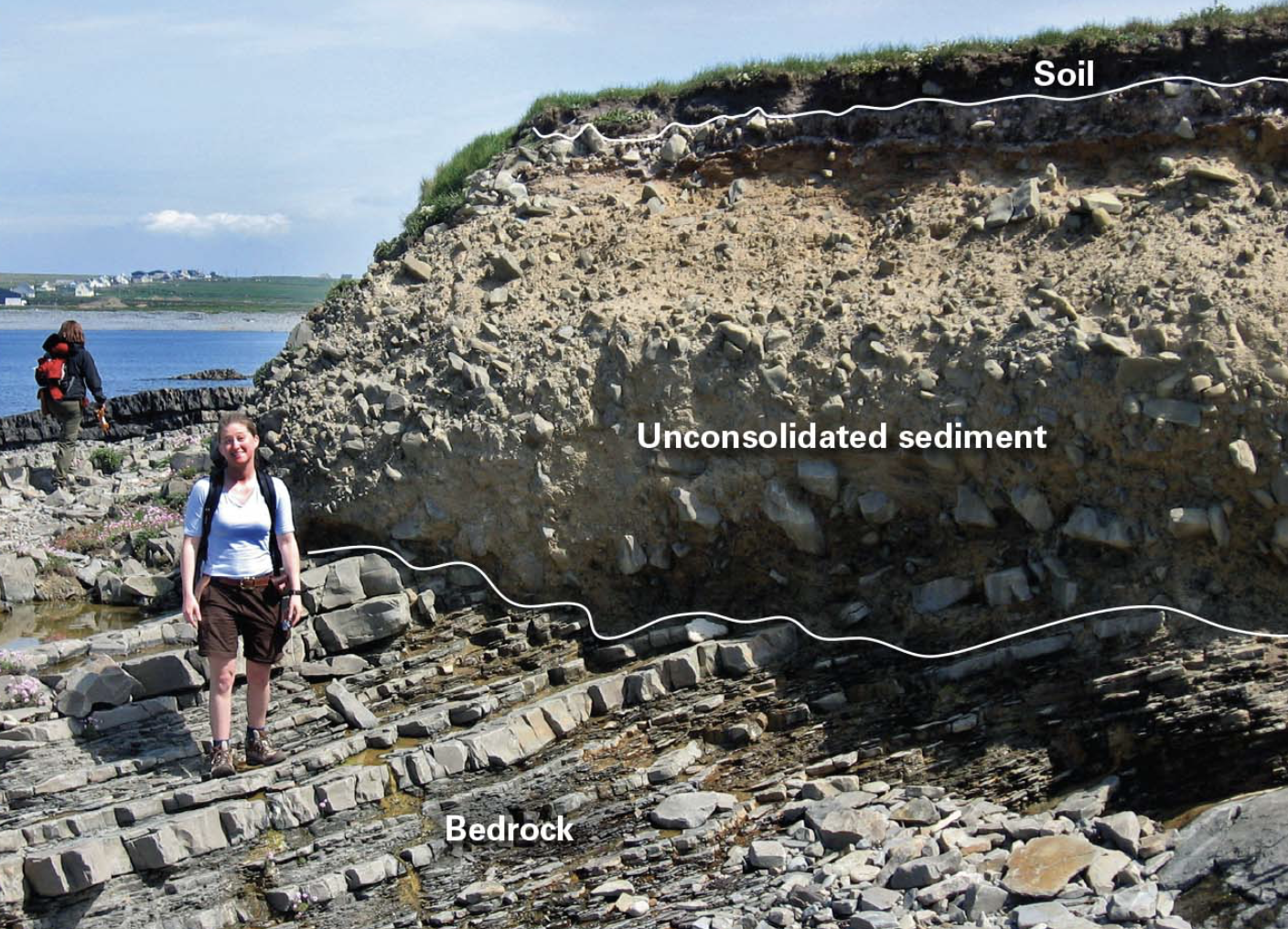
Sediment:
an accumulation of loose mineral grains, such as boulders, pebbles, sand, silt, or mud, that are not cemented together
materials came from weathering of pre-existing rock
form a veneer, or cover, over bedrock
some sediments transform into soil
Weathering:
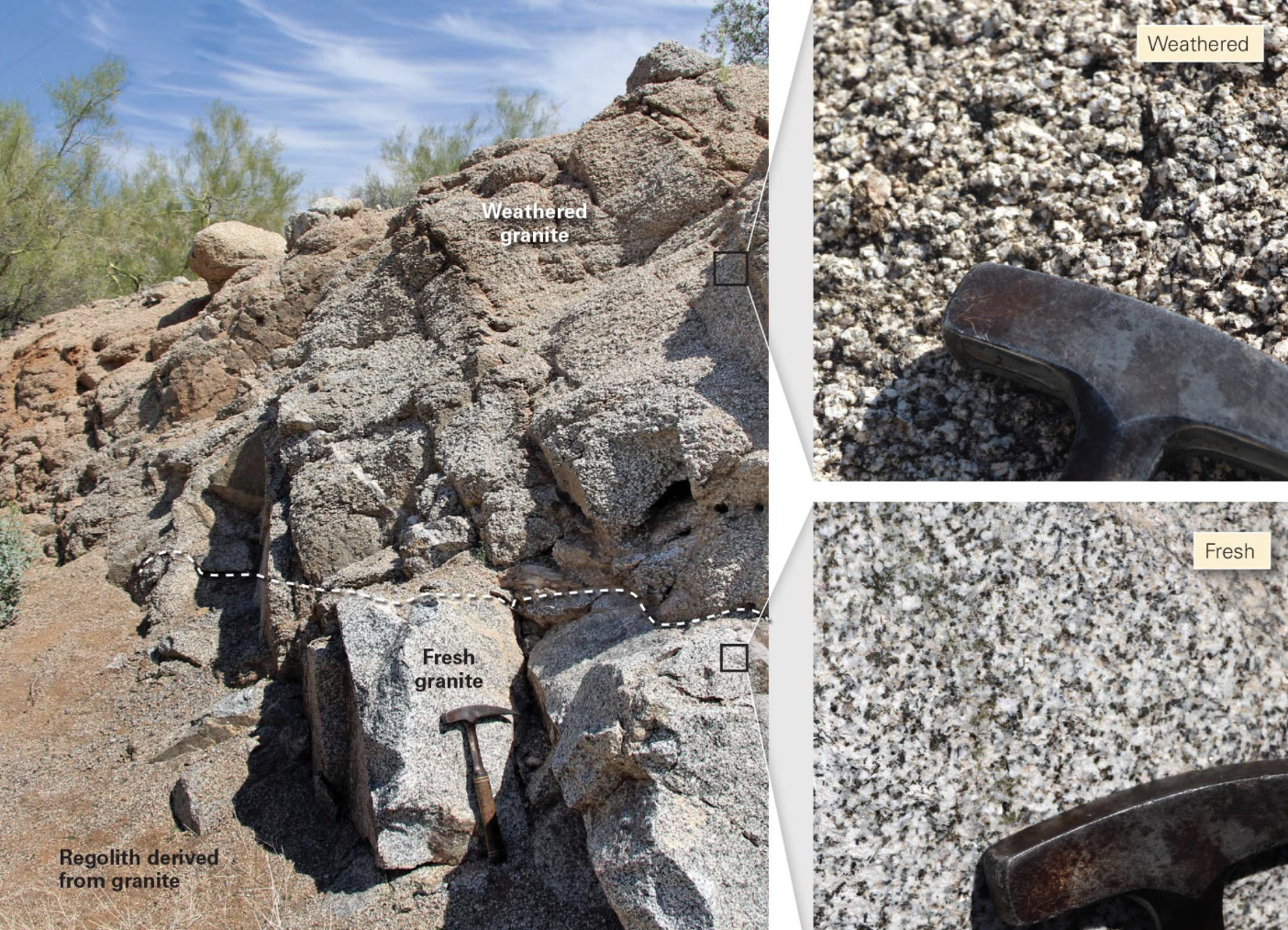
processes that break up and corrode solid rock, eventually transforming it into sediment and can also produces ions that dissolve in surface water and groundwater
may look discolored, or rough, compared with unweathered or fresh rock
Physical weathering:
also called mechanical weathering, breaks intact rock into unconnected grains or chunks known as clasts, which come in a range of sizes
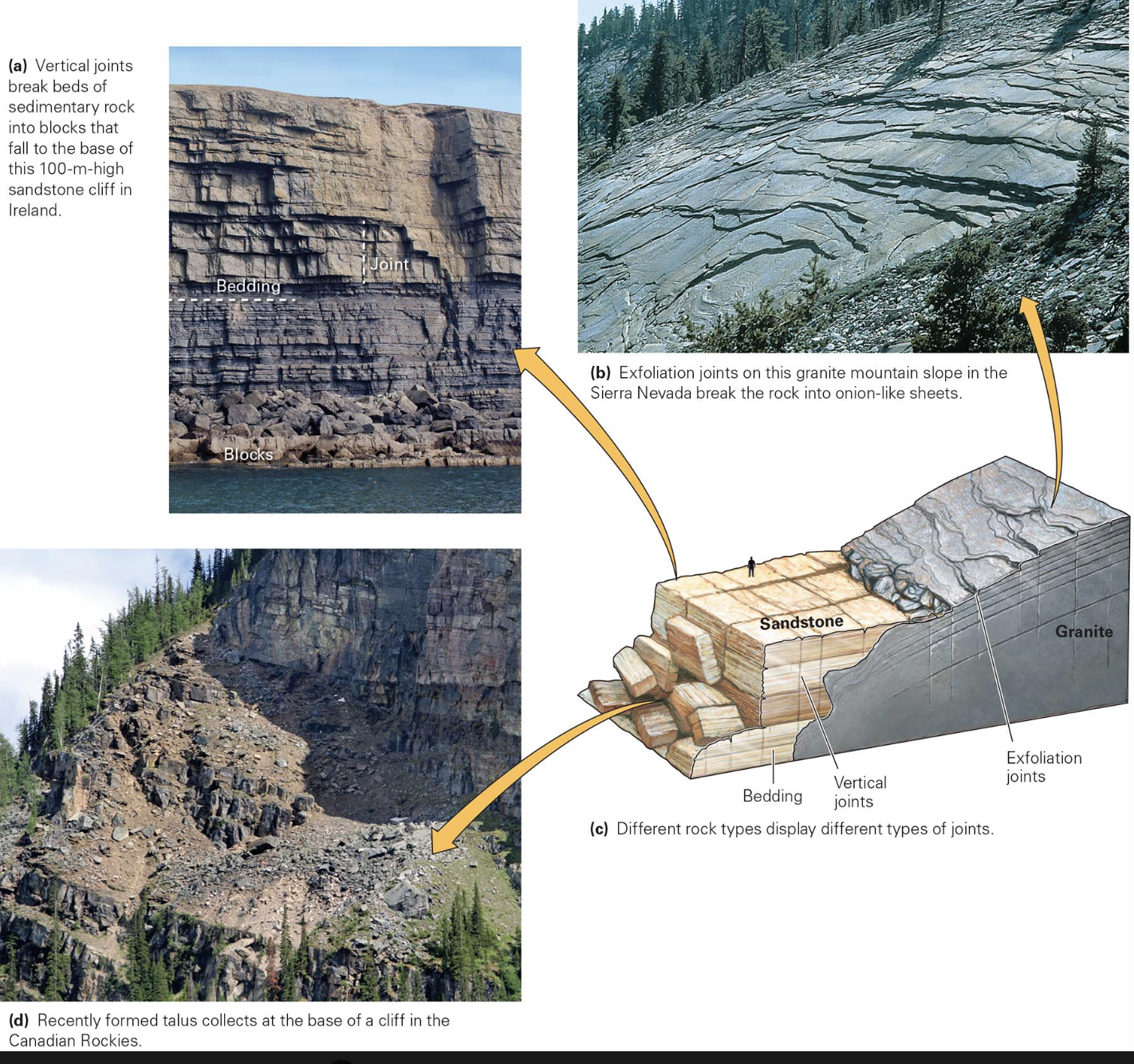
jointing
frost, salt, and root wedging
thermal expansion
animal attack
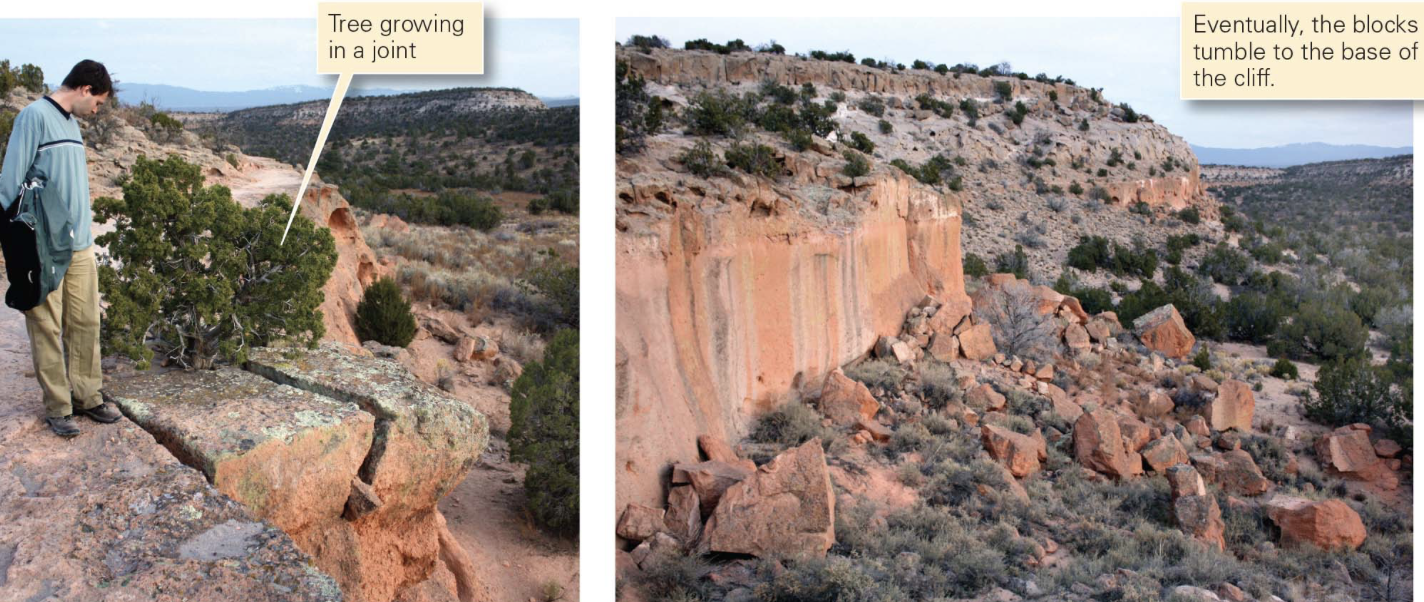
How does jointing contribute to physical weathering?
jointing effectively breaks bedrock into many separate blocks, which, when exposed on a slope, eventually tumble downslope, fragmenting into smaller pieces as they fall and the resulting chunks may collect in an apron of talus, the rock rubble at the base of a slope, or may be carried away by rivers or glaciers at the base of a cliff
Frost wedging:
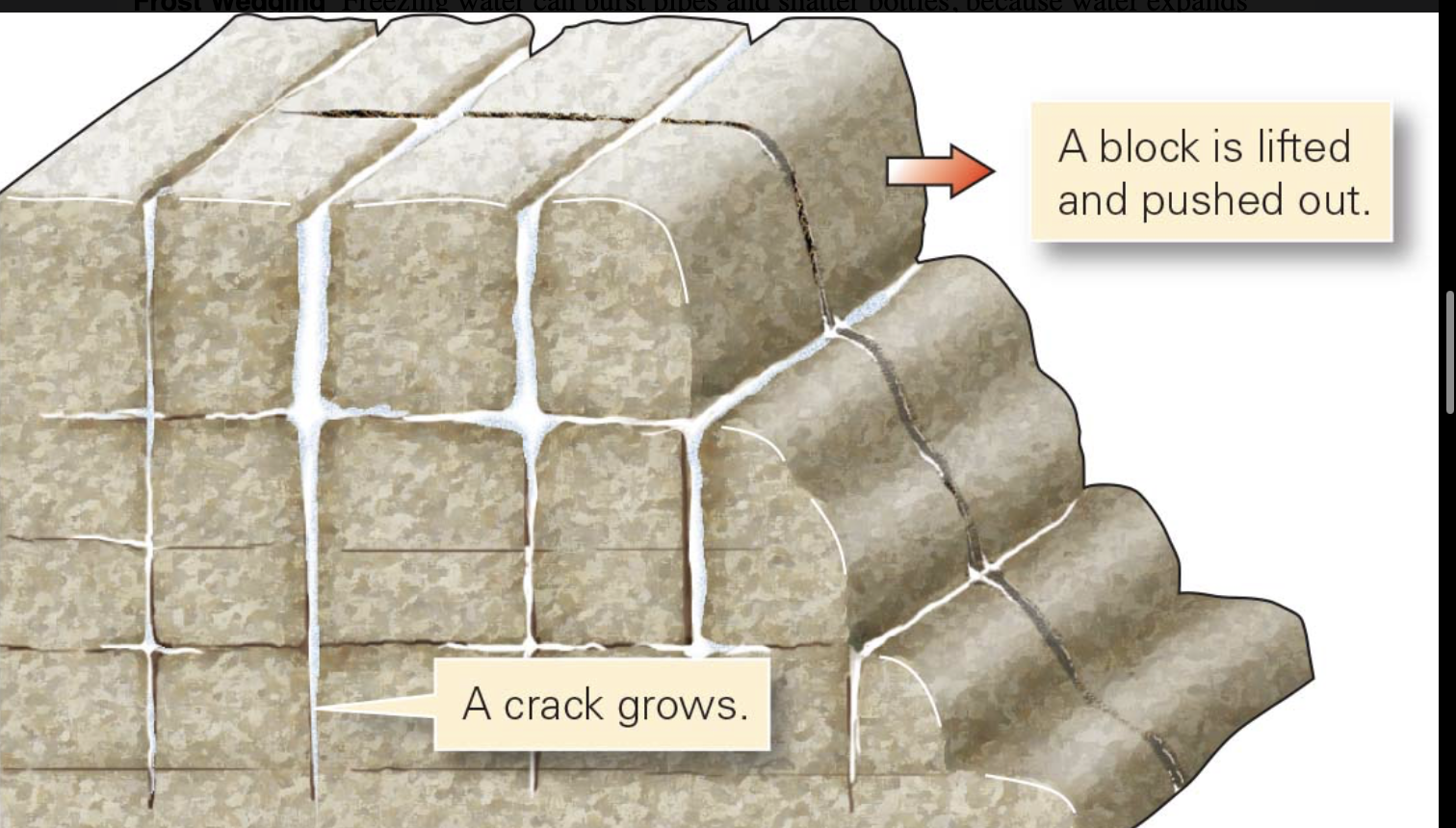
form of mechanical weathering where water seeps into cracks in rocks, freezes, and expands because water expands by about 9% when it turns to ice
continuous freeze-thaw cycle acts like a wedge, eventually shattering the rock into smaller pieces
Salt wedging:
dissolved salt in groundwater precipitates in open pore spaces in rocks, forming crystals that push apart the surrounding grains by weakening rock so that when exposed to wind and rain, the rock disintegrates into separate grains
same phenomenon happens along the seacoast, where salt spray percolates into rock and then dries
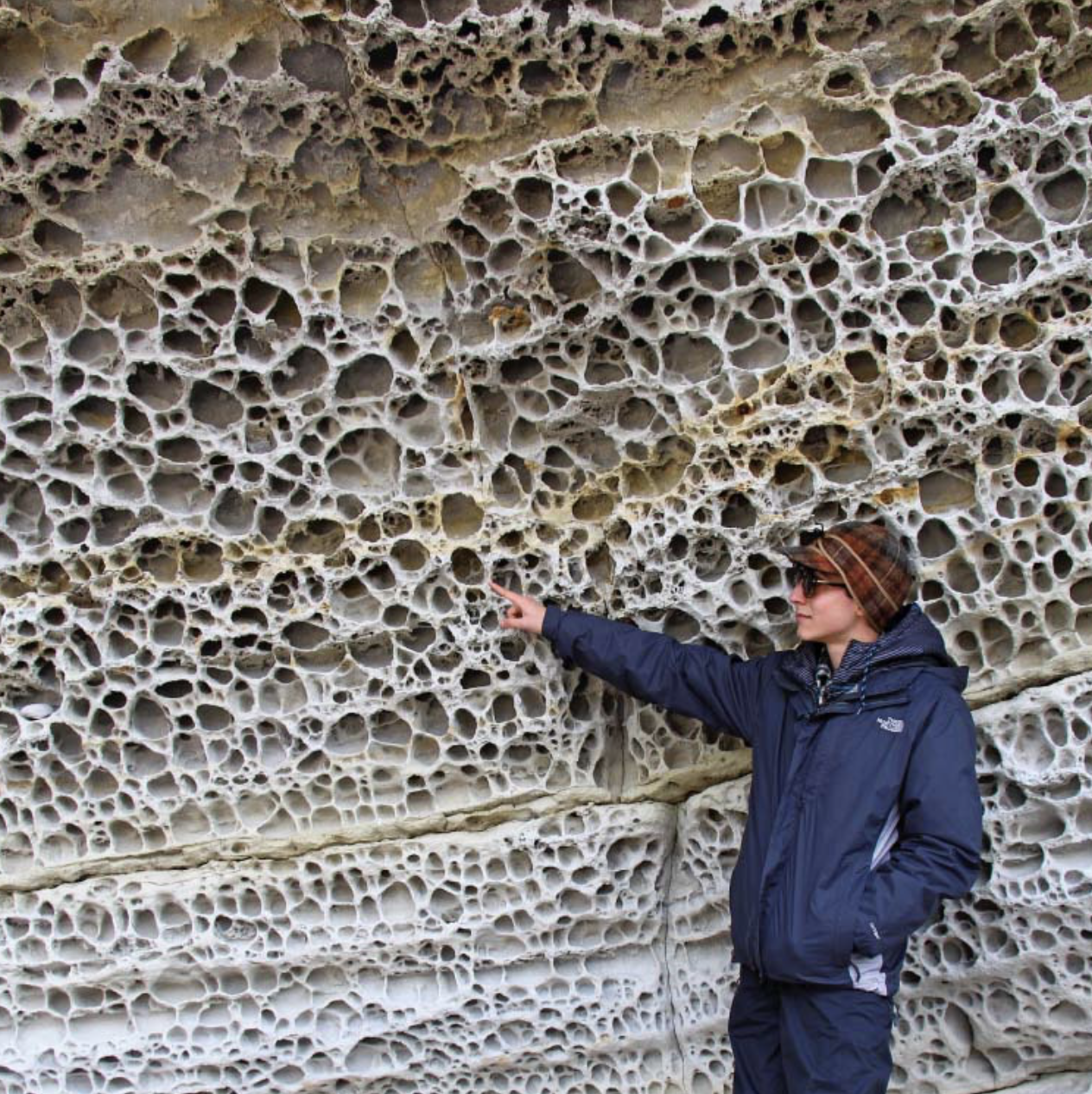
Root wedging:
form of biotic, mechanical weathering where plant and tree roots grow into tiny cracks and fissures in rocks or concrete where as the roots expand and thicken in their search for water and nutrients, they exert immense pressure, wedging the rock apart and causing it to break
Chemical weathering:
refers to the many chemical reactions that alter or destroy minerals when rock comes in contact with water solutions or air; not all at the same pace
dissolution
hydrolysis → many into clay
oxidation → iron-bearing rocks to “rust”
hydration → causes swelling and weakens rock
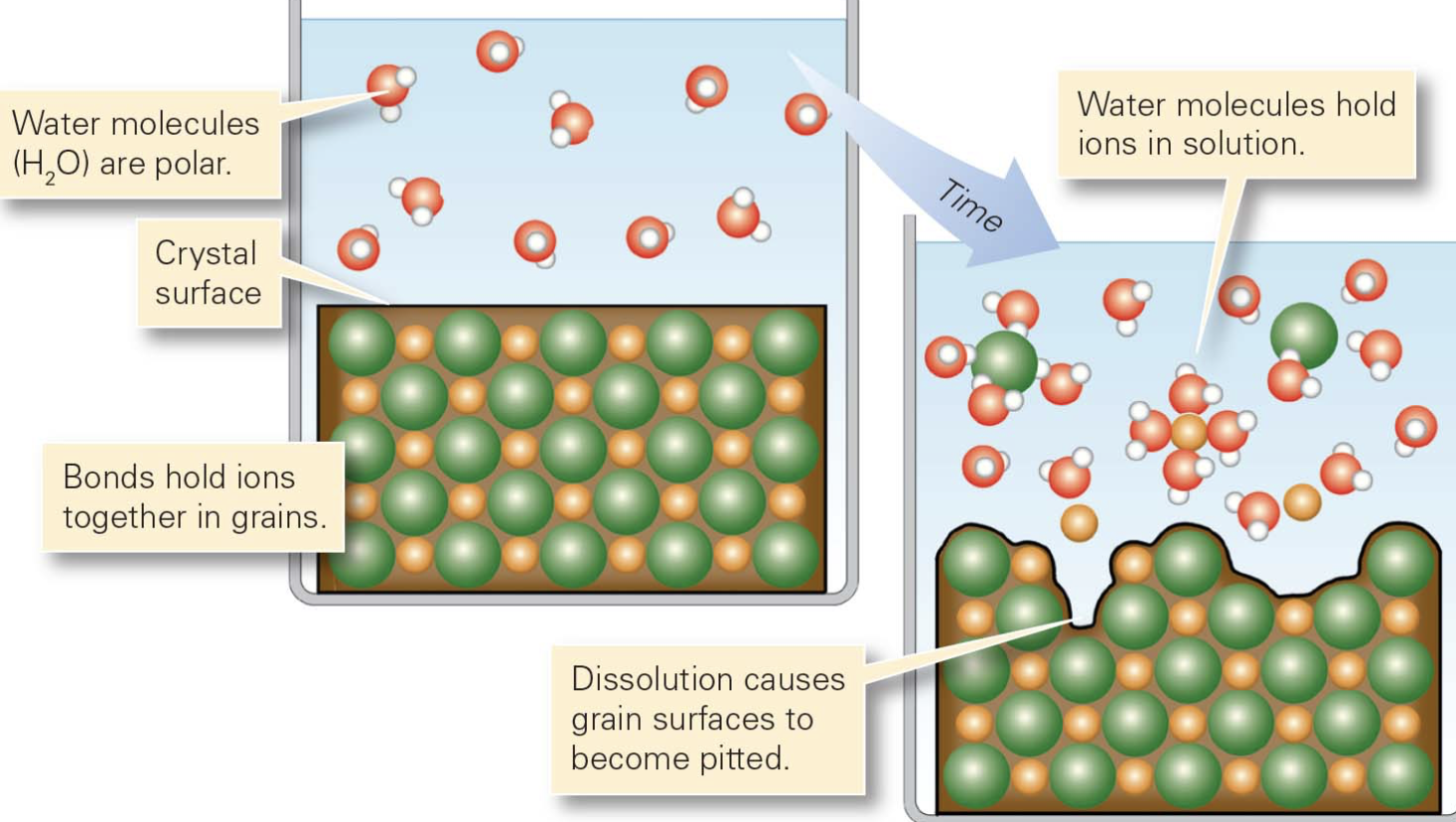
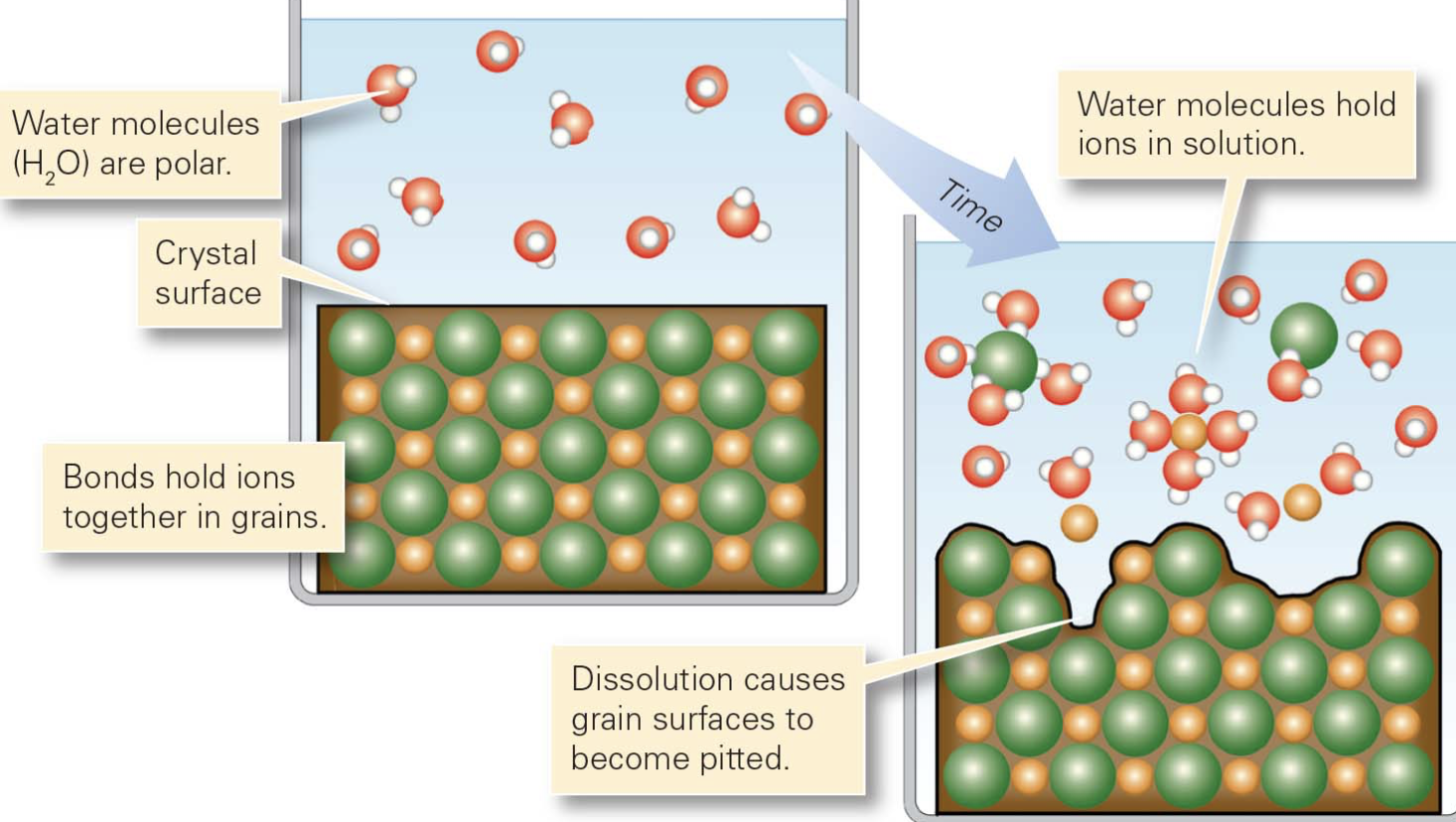
Dissolution:
water serves as a solvent, so when it flows over or through rock, it slowly dissolves minerals where it affects primarily salts and carbonate minerals, but even silicate minerals can dissolve slightly
How do physical and chemical weathering work together?
chemical-weathering reactions take place at a material’s surface and as a result, the overall rate at which chemical weathering occurs depends on the ratio of surface area to volume where the greater the surface area, the faster the volume of the whole material can chemically weather
when jointing (physical weathering) breaks a large block of rock into smaller pieces, the surface area increases, so chemical weathering happens faster
physical weathering speeds up chemical weathering and vice versa
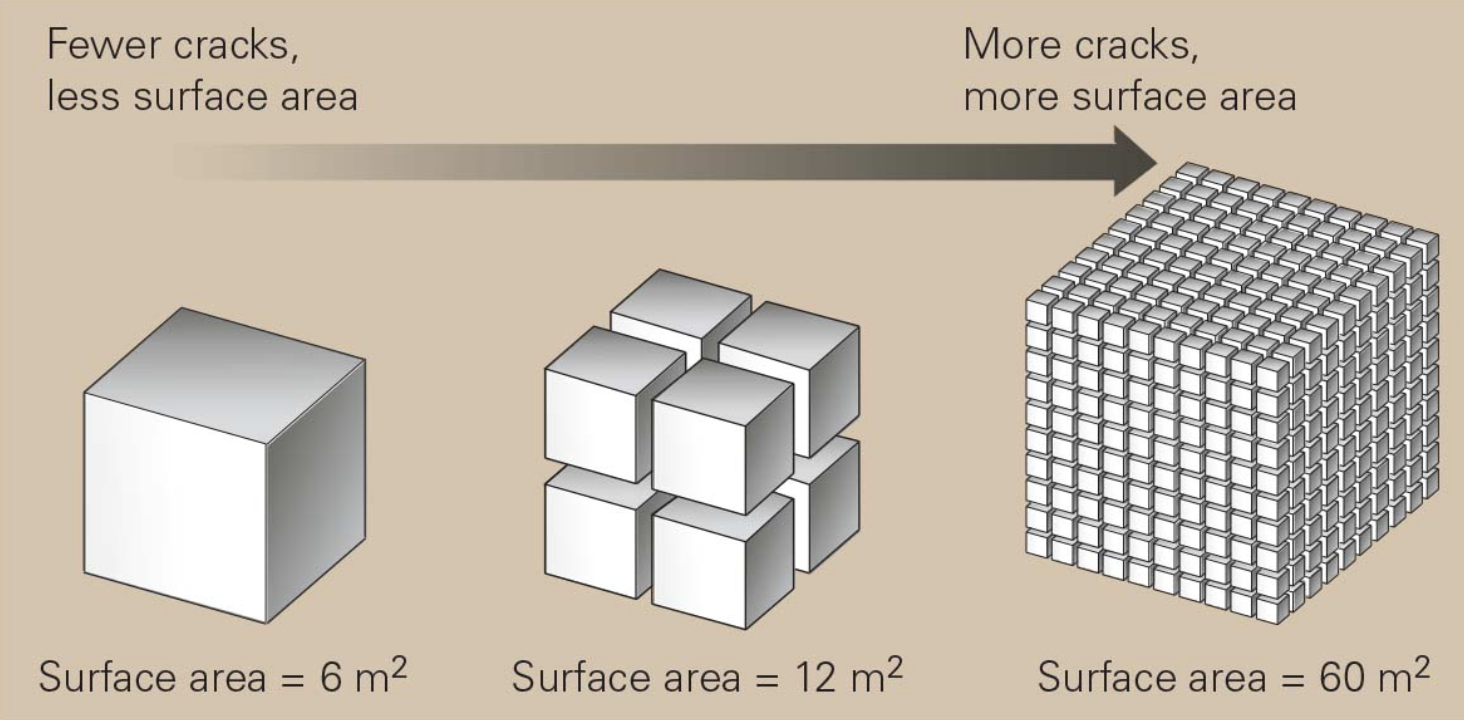
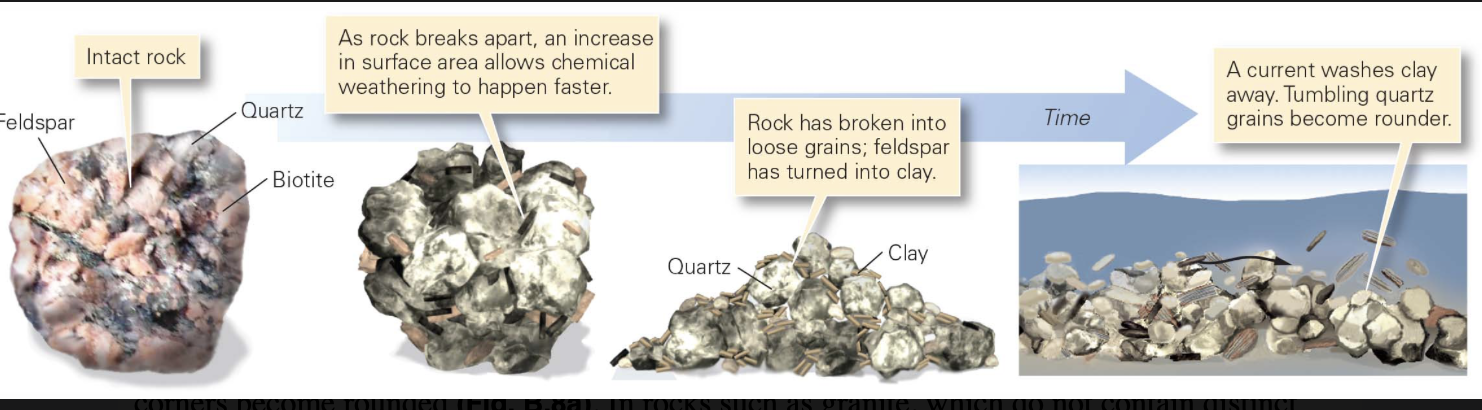
How does chemical weathering speed up physical weathering?
chemical weathering speeds up physical weathering by dissolving away grains or cements that hold a rock together, by transforming hard minerals (such as feldspar) into soft minerals (such as clay), and by causing minerals to absorb water and expand
phenomena make rock weaker, so it can disintegrate more easily
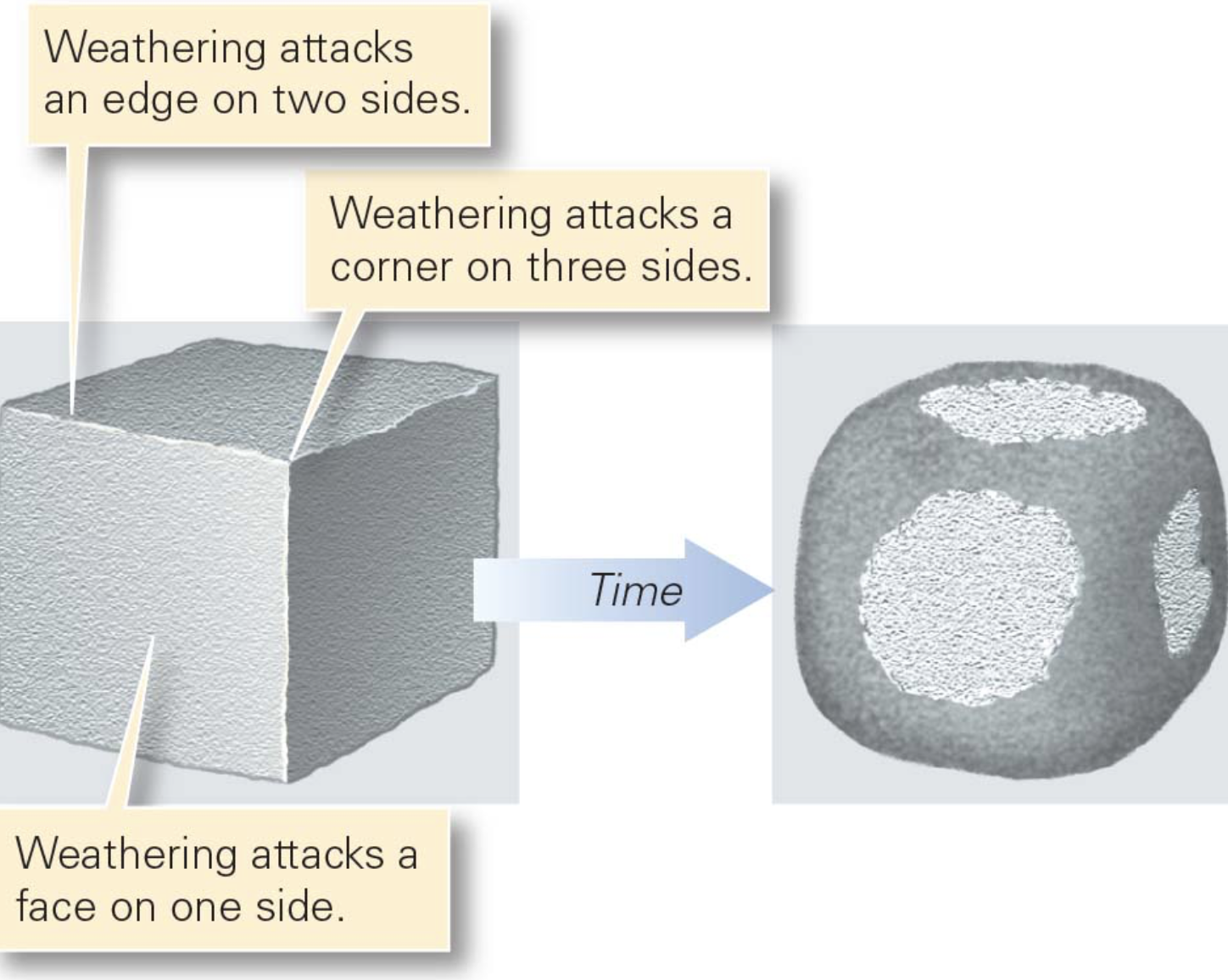
Where does weather happen at a faster rate?
happens faster at edges, and even faster at the corners of broken blocks because weathering attacks a flat face from only one direction, an edge from two directions, and a corner from three directions → over time, edges of blocks become blunt and corners become rounded
Sedimentary rock:
a type of rock that forms at or near the surface of the Earth either by
cementing together of fragments broken off pre-existing rock
physical + chemical weathering
precipitation of mineral crystals out of water solutions
growth of mounds of shells
accumulation and subsequent alteration of organic matter
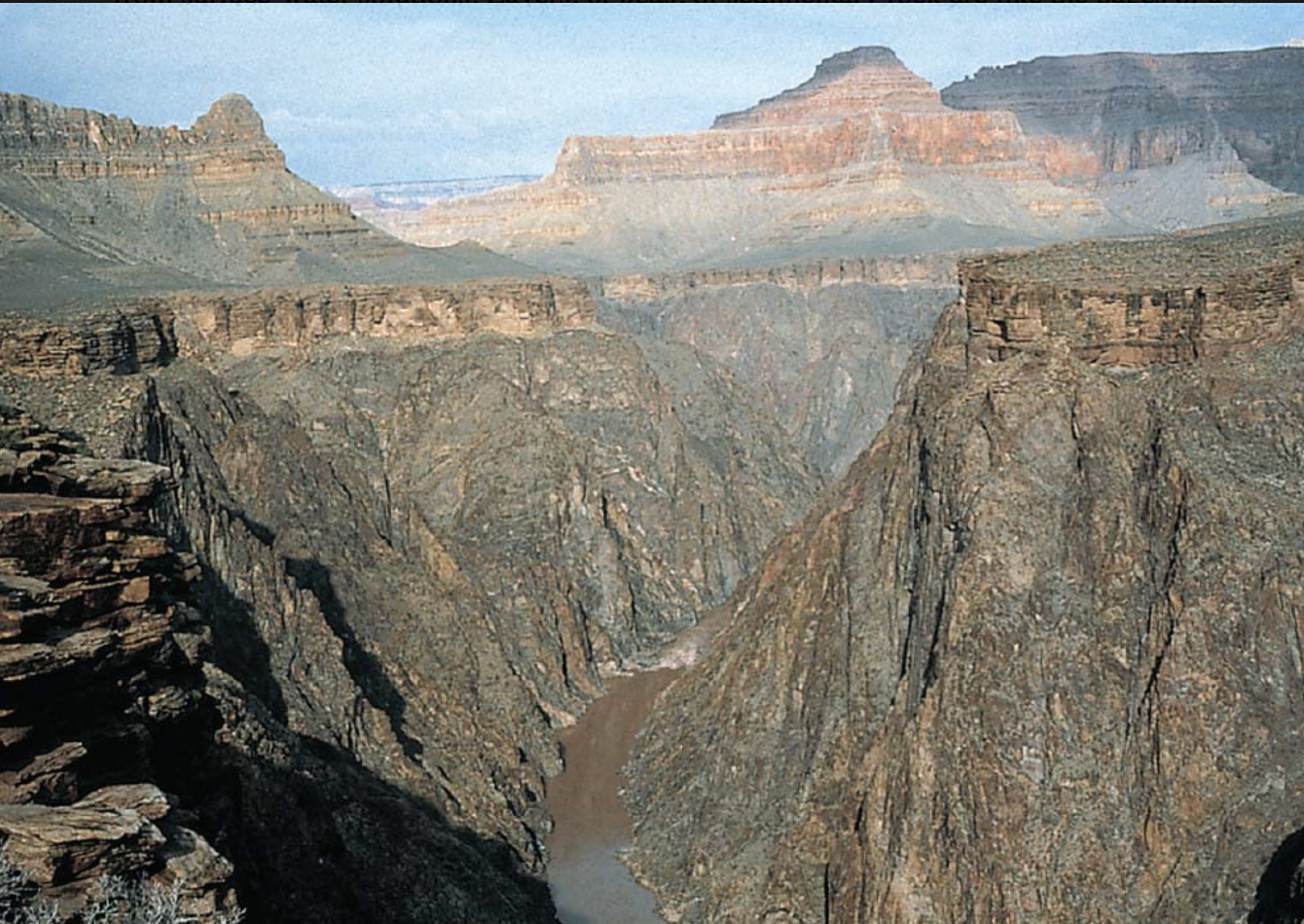
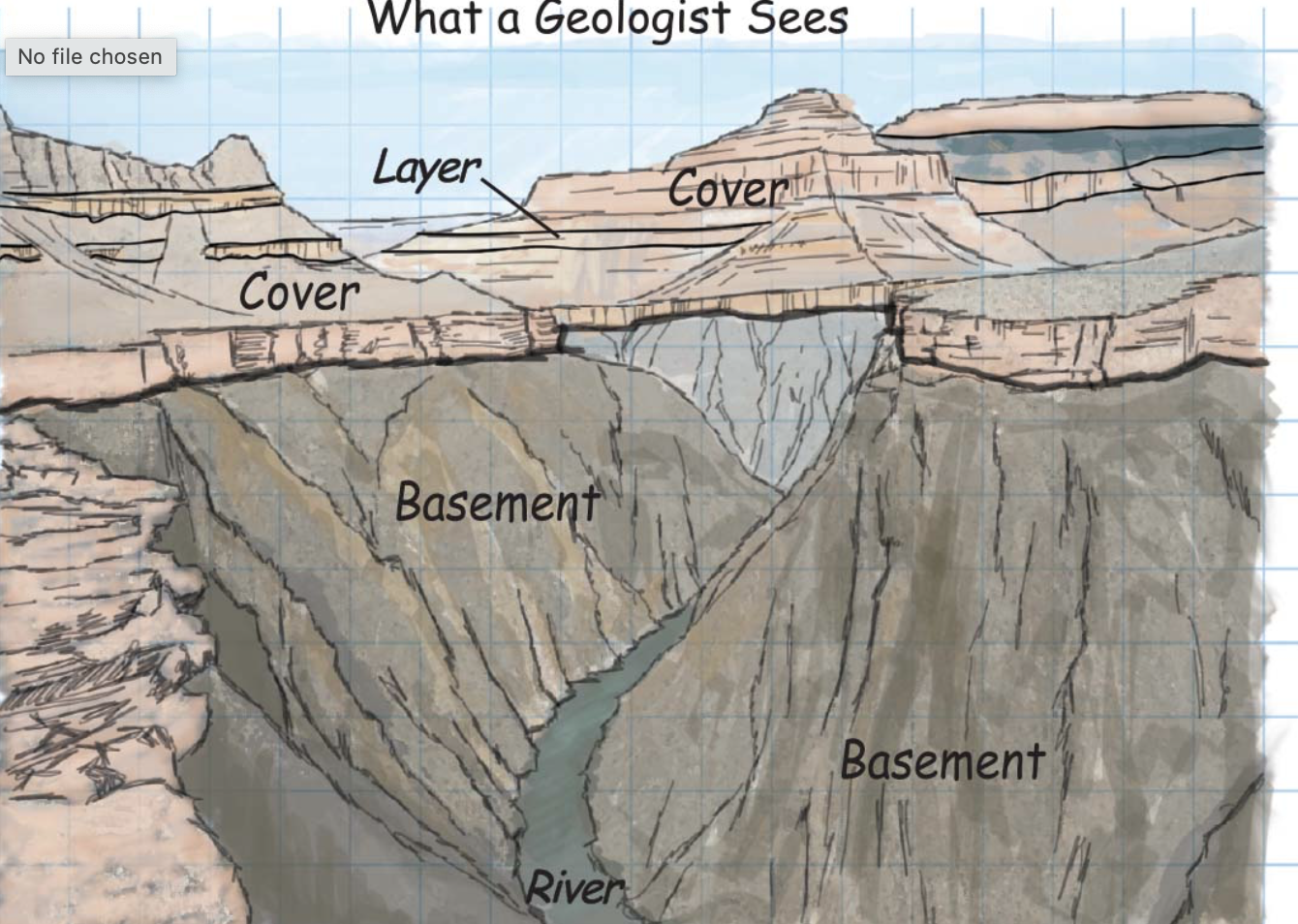
Layers, or beds, of sedimentary rock are like the pages of a book, recording tales of ancient events and environments on the ever-changing face of the Earth. Where do they occur?
occur only in the upper part of the crust, and form a cover that buries the underlying basement of igneous and/or metamorphic rock
What are the 4 major classes of sedimentary rock?
Clastic
Biochemical
Organic
Chemical
Clastic Sedimentary Rock:
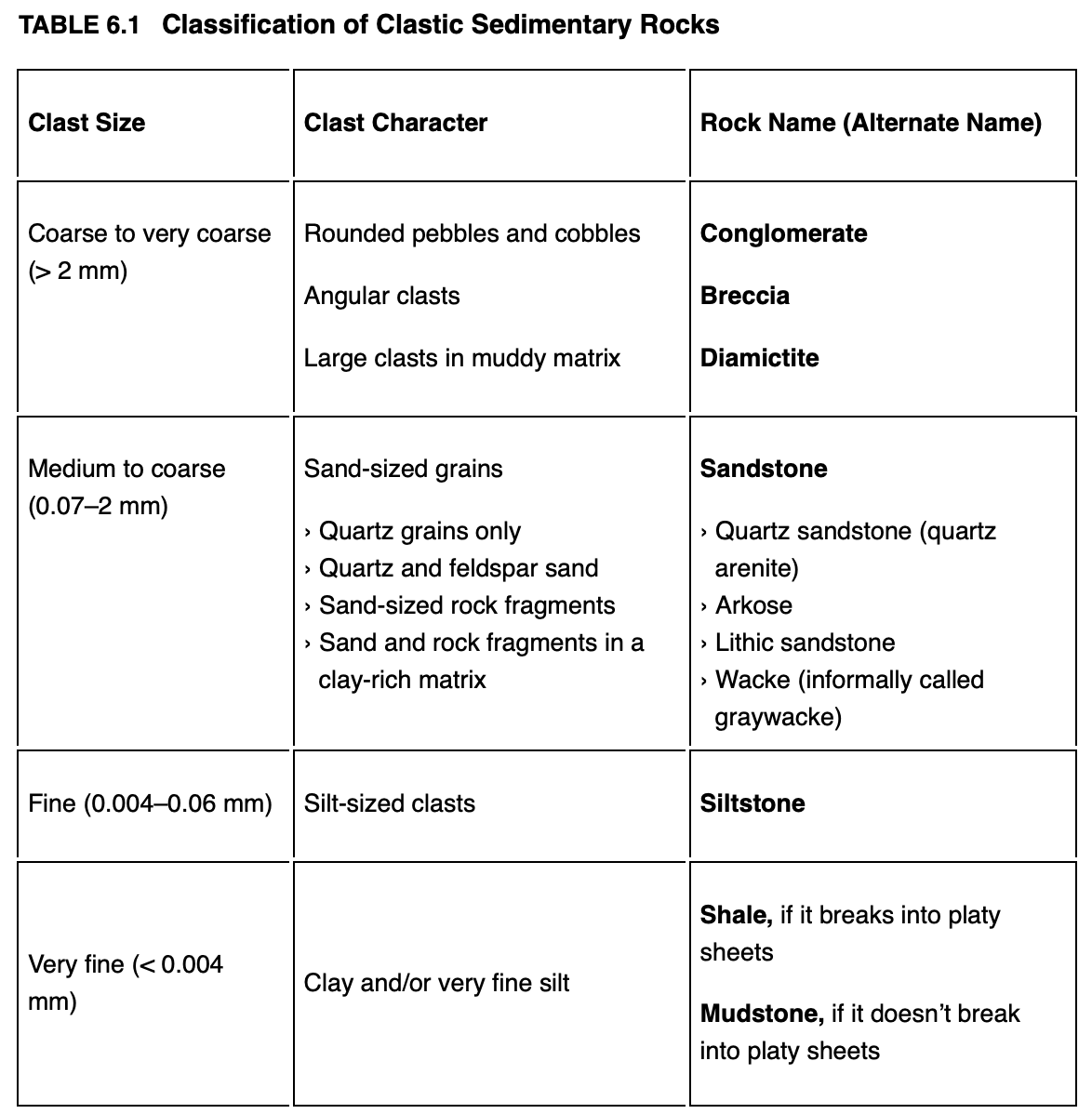
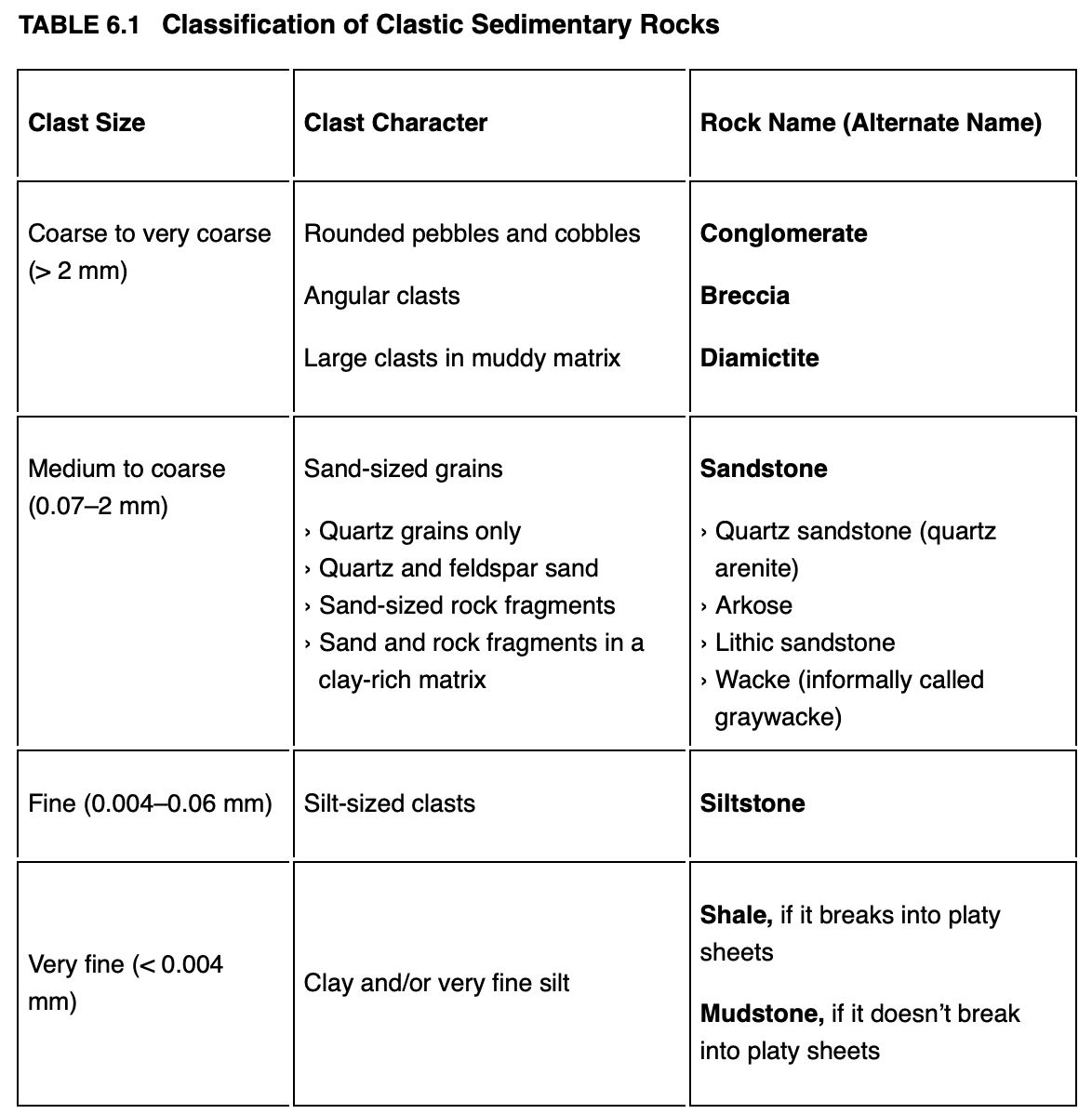
forms from cemented-together clasts which are solid fragments and grains broken off of pre-existing rocks due to physical or chemical weathering
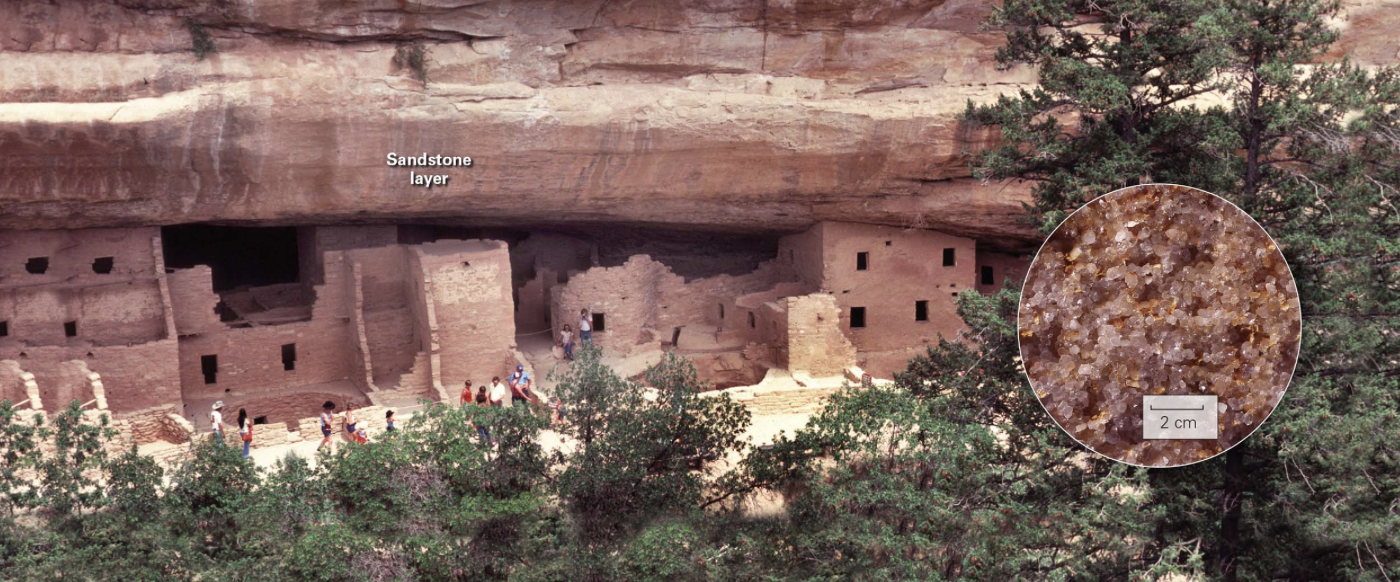
Sandstone:
coarse-grained sedimentary rock consisting almost entirely of cemented quartz
feel gritty, and small grains of quartz would break free and roll under your thumb
clastic sedimentary rock
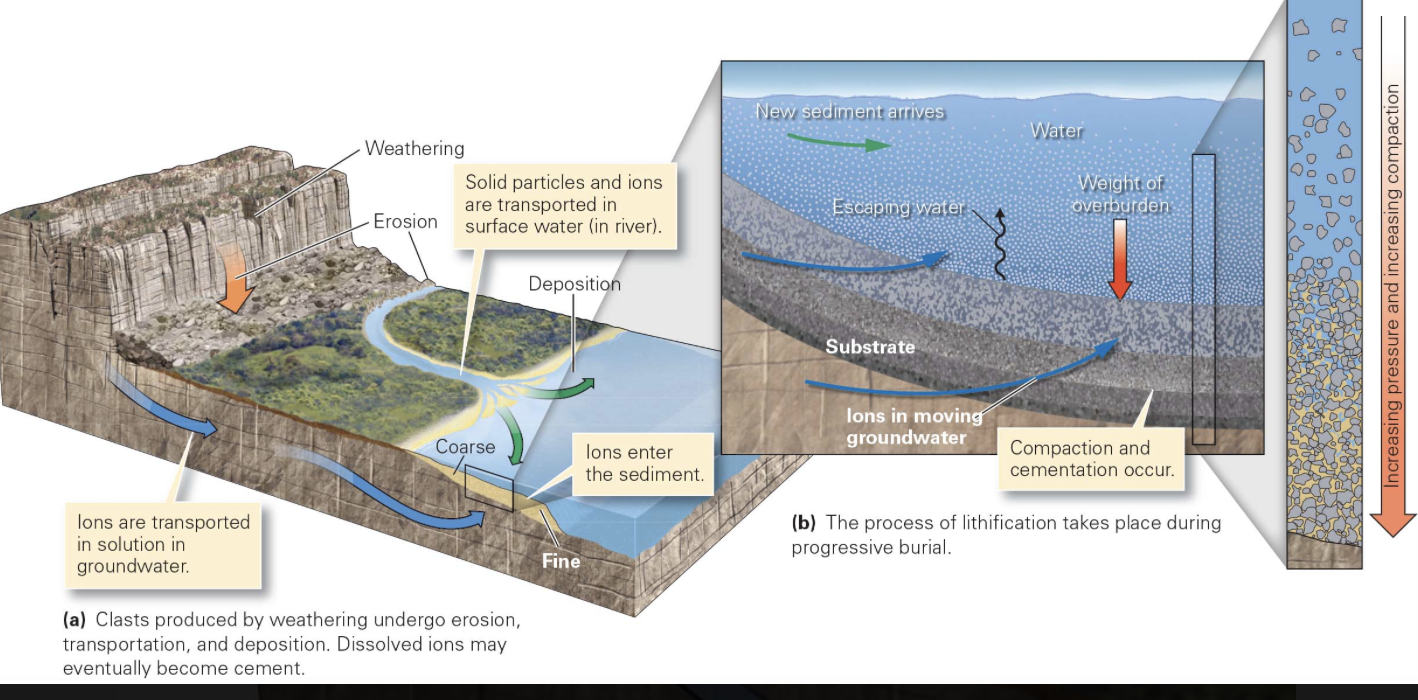
What are the 5 steps in the production of a clastic sedimentary rock?
Weathering
Erosion
Transportation
Deposition
Lithification
Weathering:
clasts form by disintegration of bedrock into separate grains
physical → no change
chemical → changes chemical composition into new rock
Erosion:
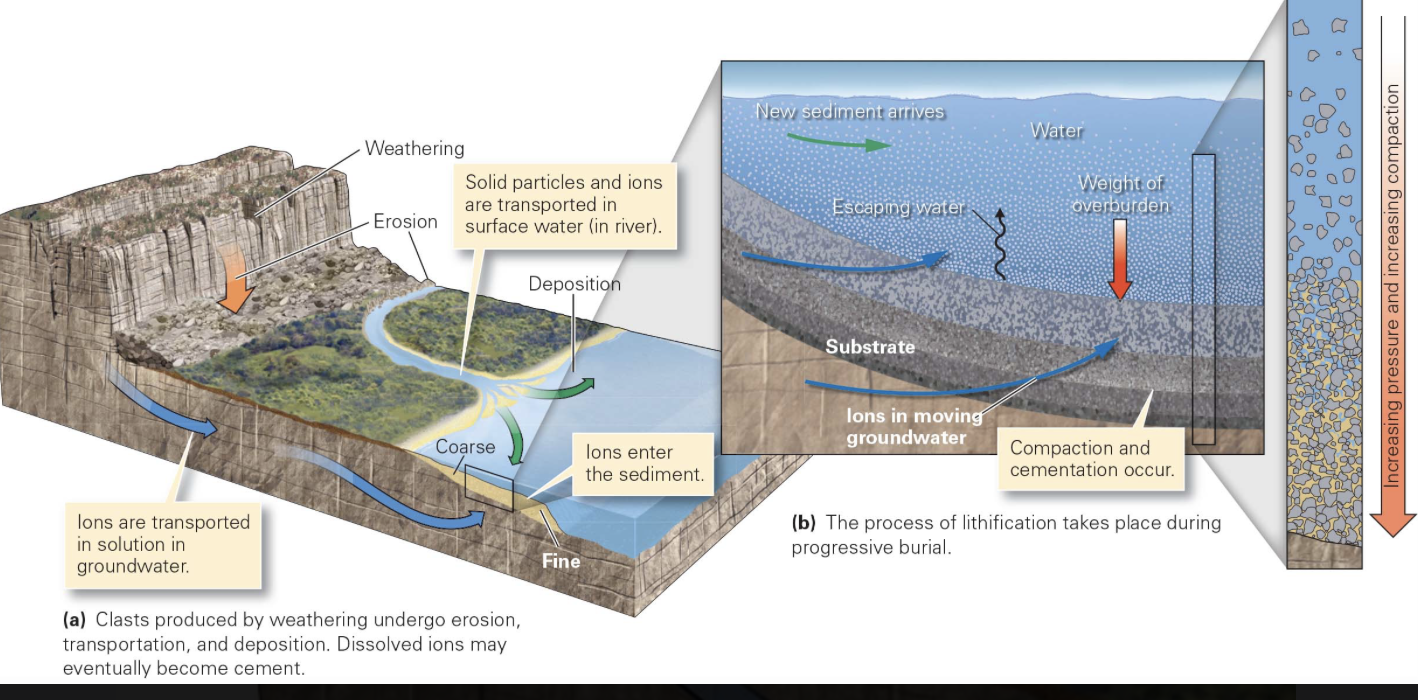
combination of processes that separate rock or regolith (surface debris) from its substrate and it involves abrasion, falling, plucking, scouring, and dissolution
grinding away and removal of the Earth’s surface materials by moving water, air, or ice
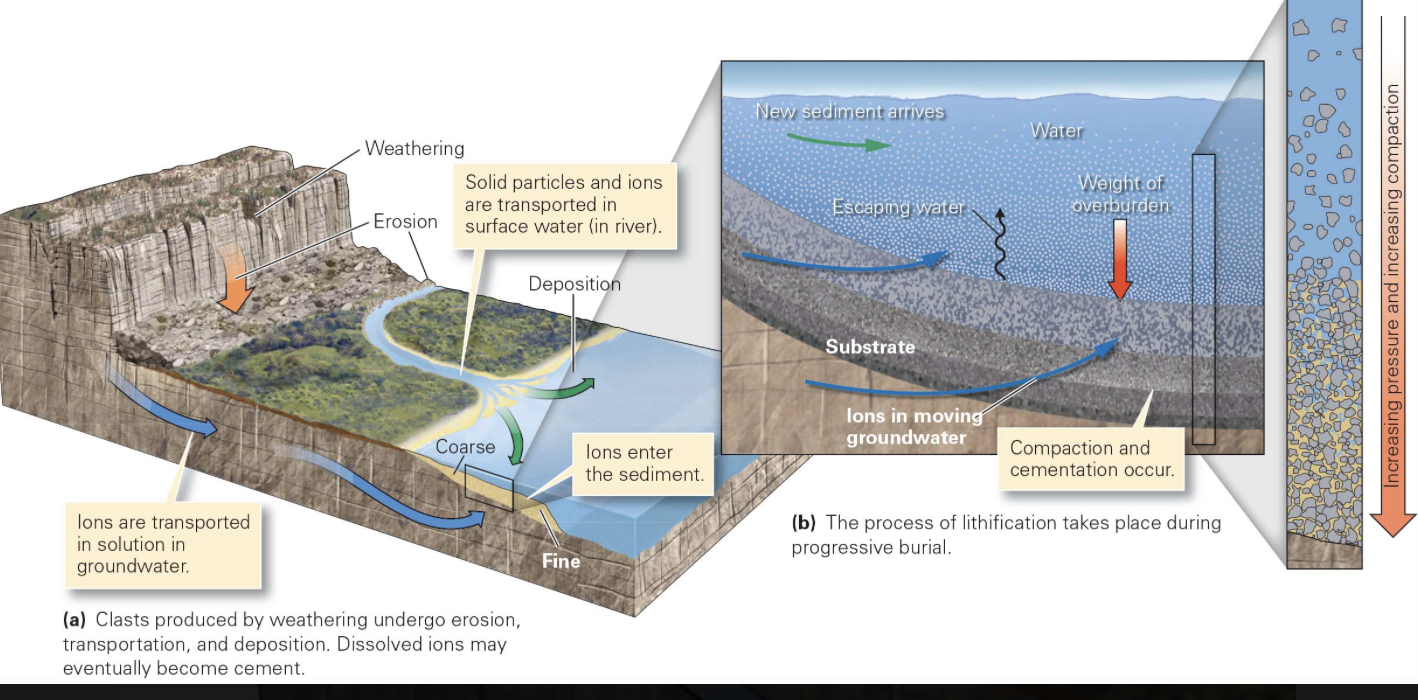
Transportation:
ability of a medium (gravity, wind, water, ice) to carry sediment depends on viscosity and velocity where solid ice can transport sediment of any size, regardless of how slowly the ice moves
very fast-moving, turbulent water can transport coarse fragments (cobbles and boulders), as well as finer ones
moderately fast-moving water can carry only sand and gravel
slow-moving water carries only finer-grained sediments, such as silt and clay
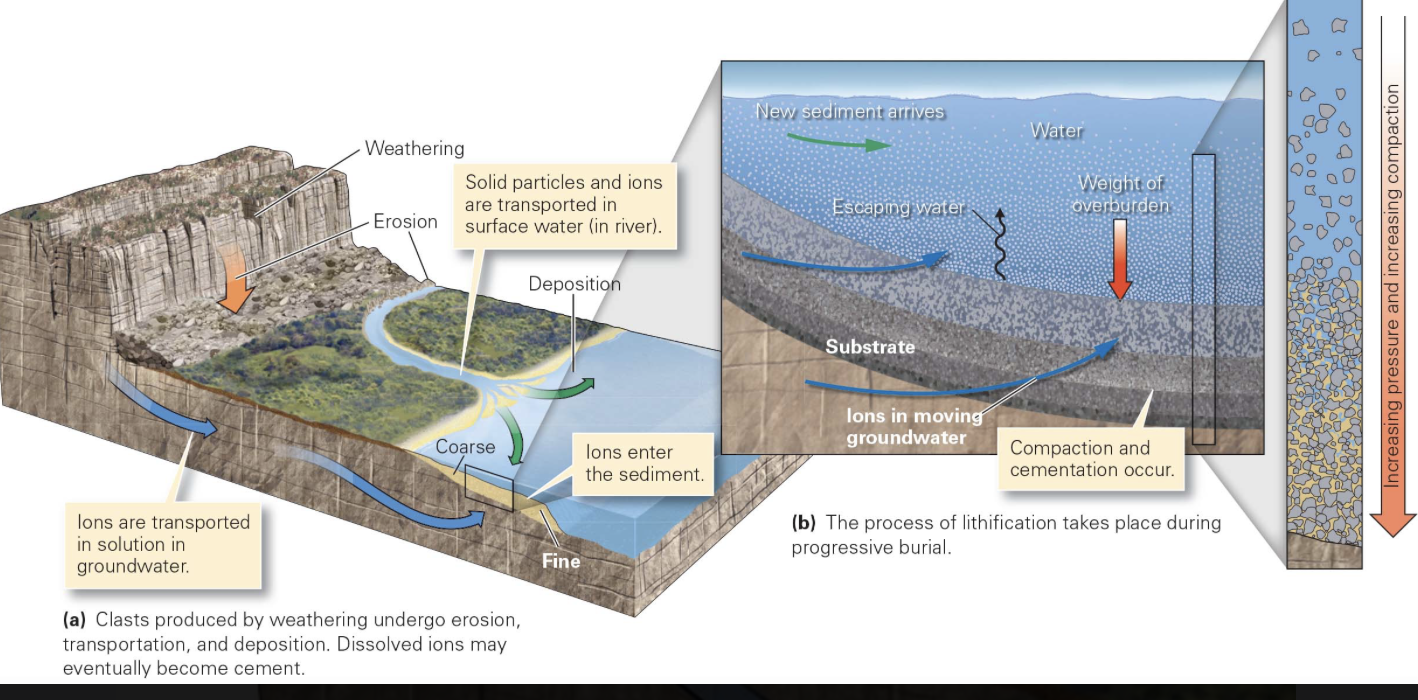
Deposition:
process by which sediment settles out of the transporting medium and settles out of wind or moving water when these fluids slow down because as the velocity decreases, the fluids no longer have the ability to carry sediment
sediment carried by ice accumulates when the ice melts
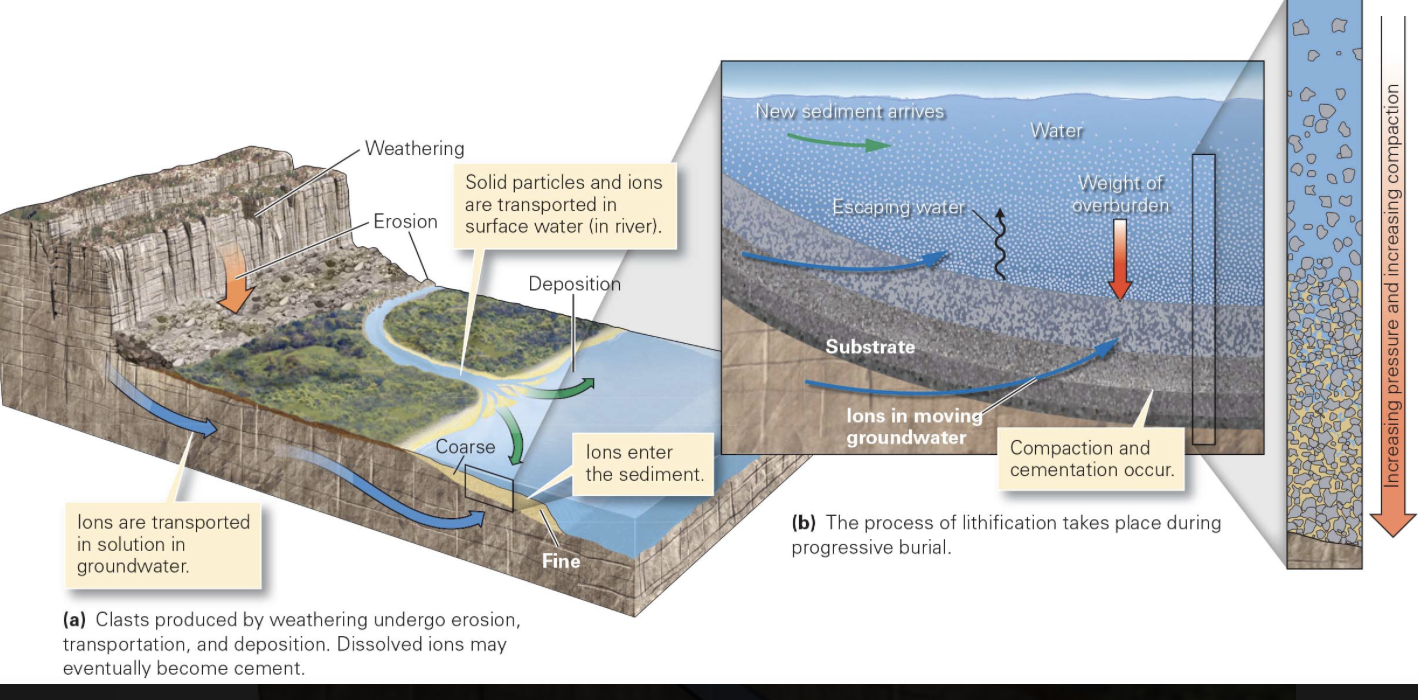
Lithification:
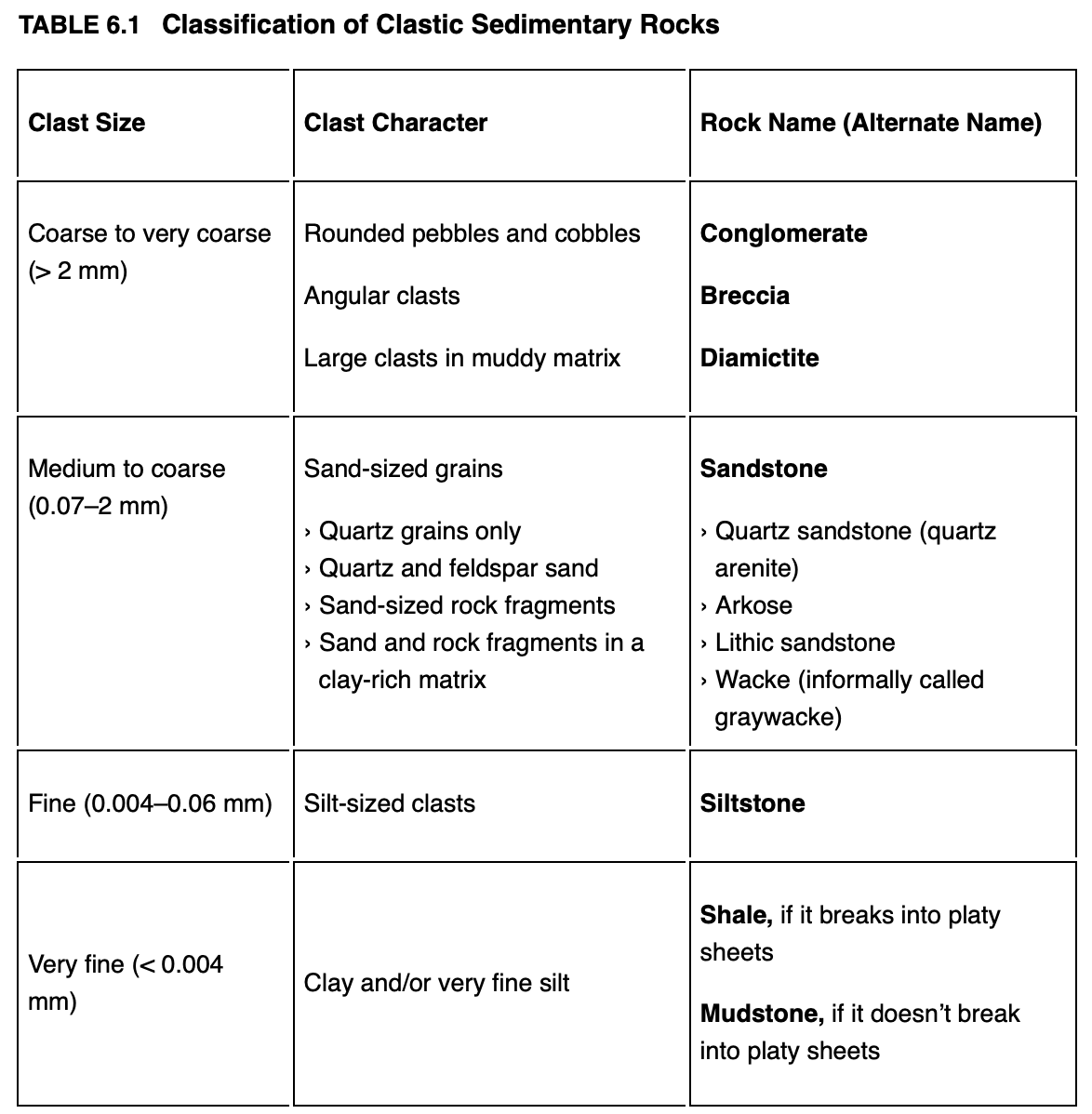
transformation of loose clasts into solid rock, a process that begins with compaction so grains can fit together more tightly and ends with cementation which form a cement that binds grains together
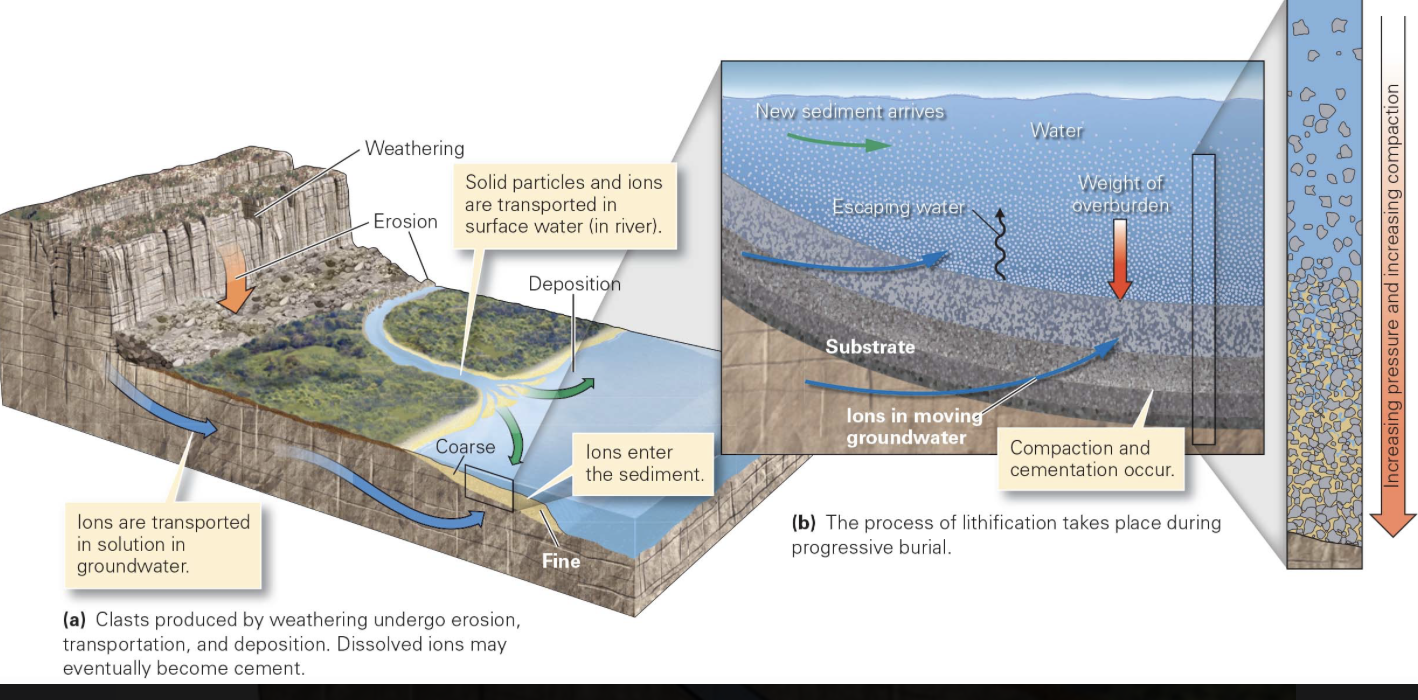
Compaction:
phase of lithification in which the pressure of the overburden on the buried rock squeezes out water and air that was trapped between clasts, so the grains can fit together more tightly
Cementation:
phase of lithification in which cement, consisting of minerals (commonly quartz or calcite) that precipitate from groundwater, partially or completely fills the spaces between clasts and attaches each grain to its neighbor to form a cement that binds grains together
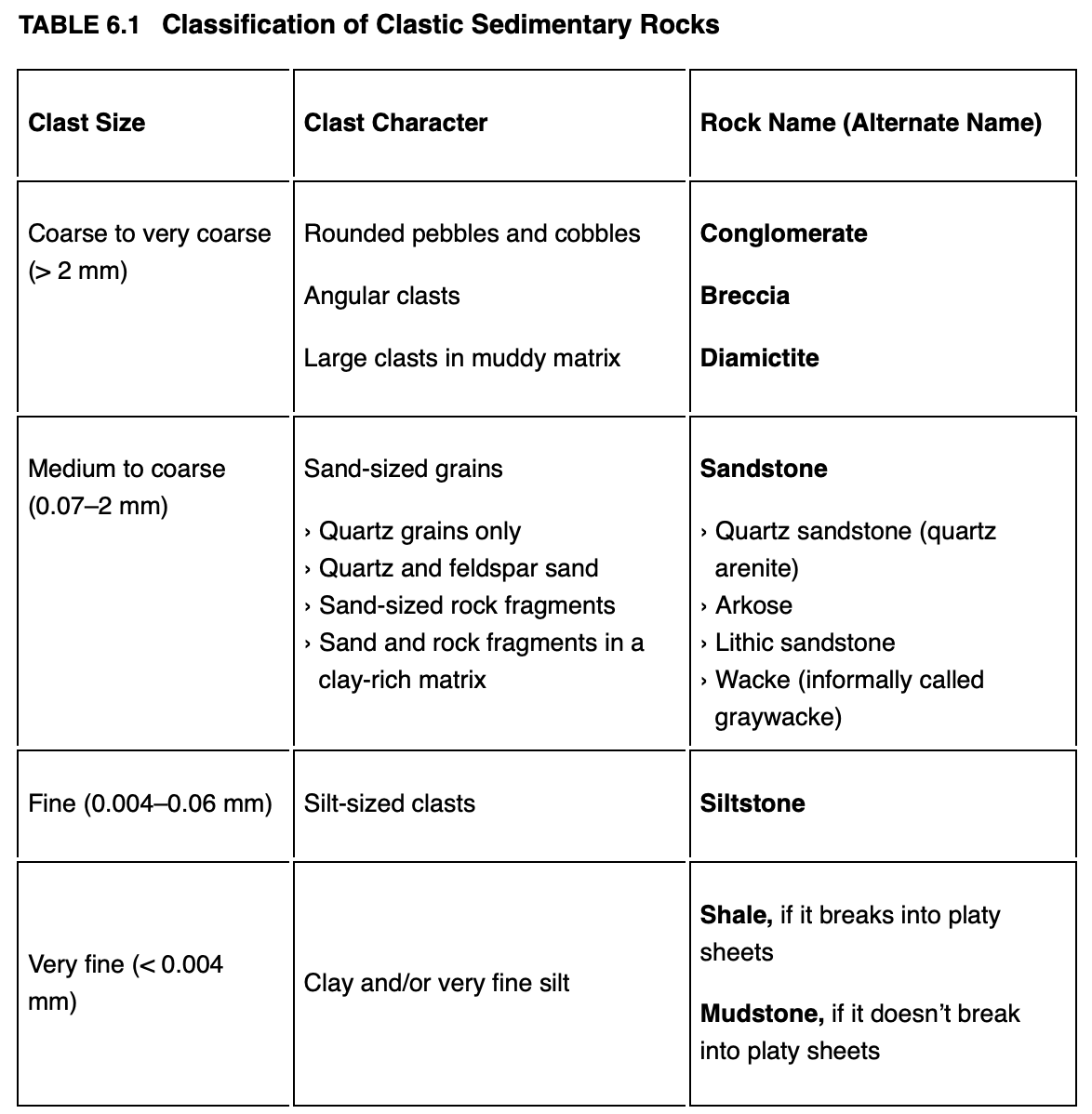
How do we classify clastic sedimentary rock?
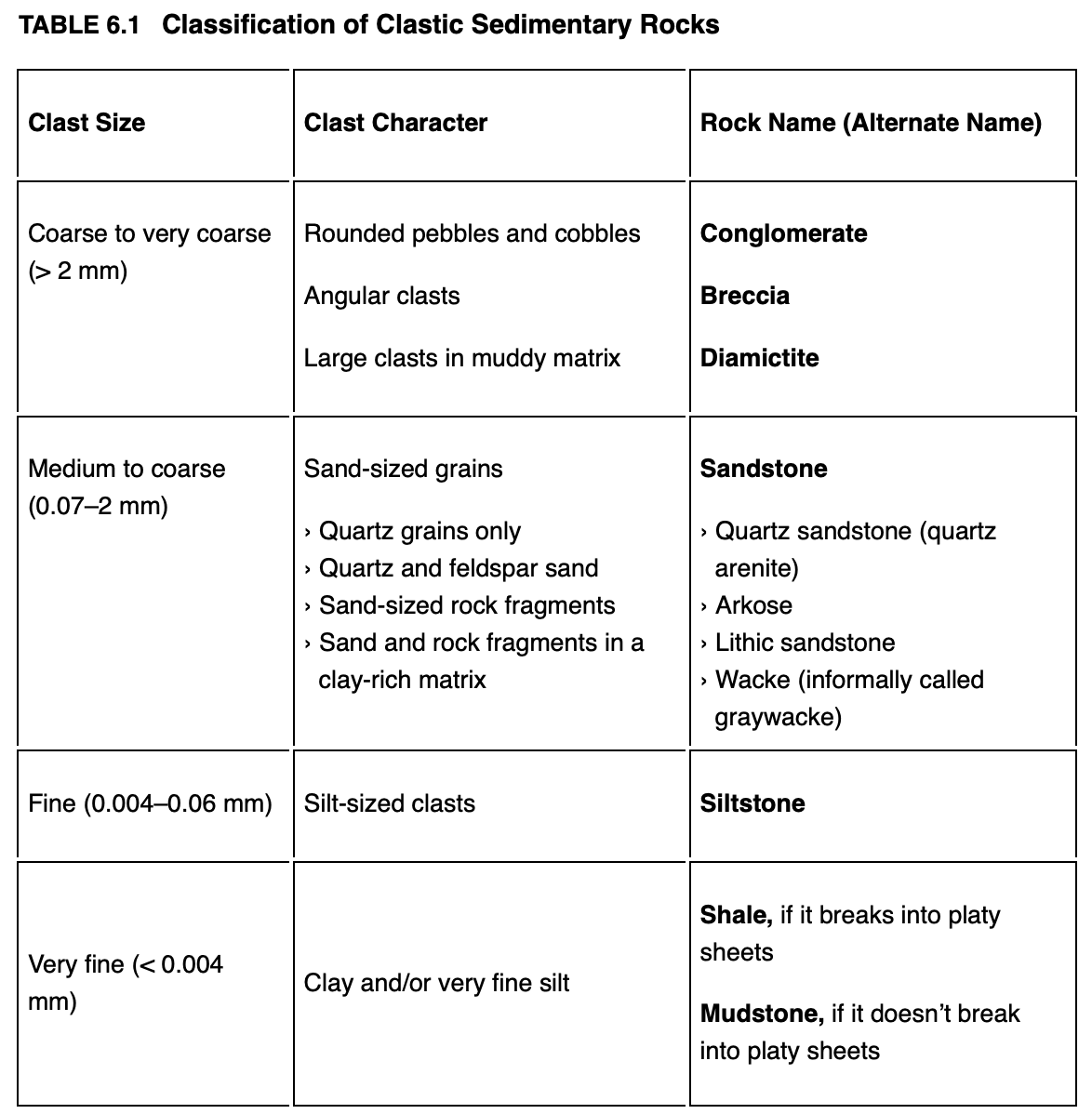
classify based on the clast size, composition, angularity + sphericity, sorting, and character fo cement
Clast size:
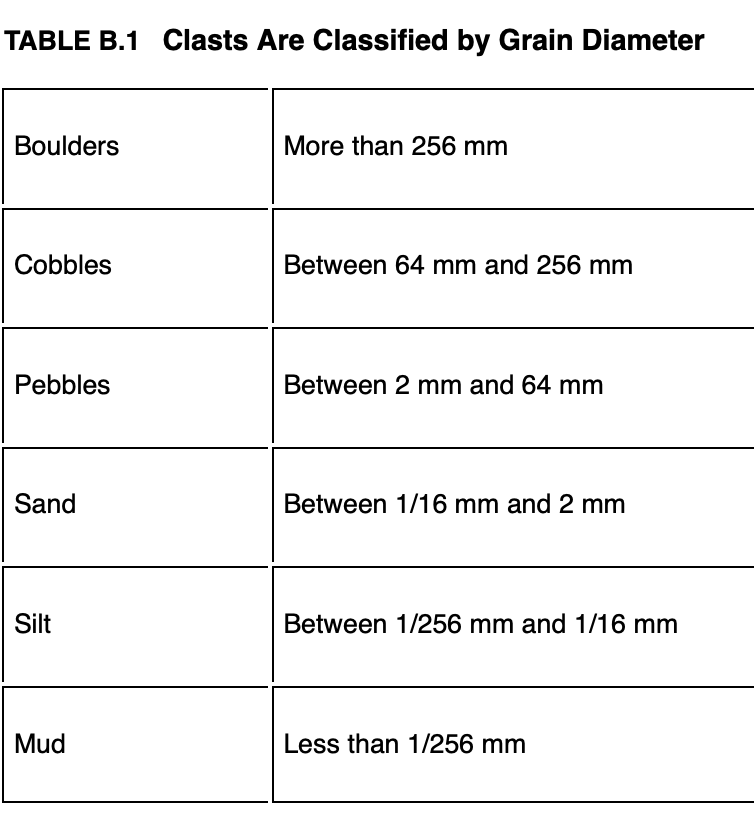
refers to the diameter of fragments or grains making up a rock and names used for clast size, listed in order from coarsest to finest, are boulder, cobble, pebble, sand, silt, and mud
Clast composition:
refers to the makeup of clasts in sedimentary rock which may be composed of rock fragments or individual mineral grains
Sand typically consists mostly of quartz grain
What is the difference between angularity and sphericity?
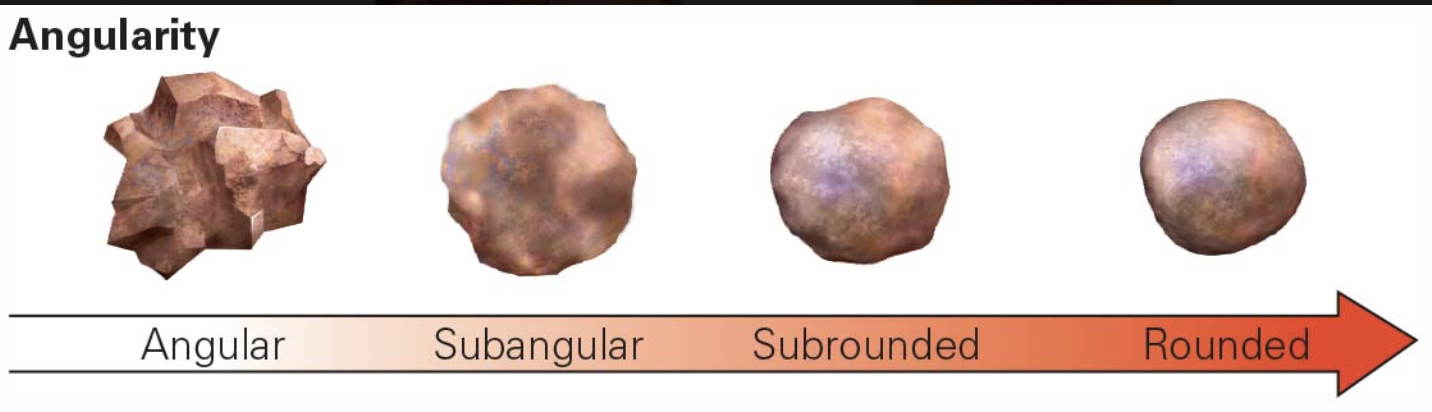
Angularity indicates the degree to which clasts have smooth surfaces, or have sharp corners and edges while Sphericity refers to how closely the shape of a clast resembles a sphere
Sorting of clasts:
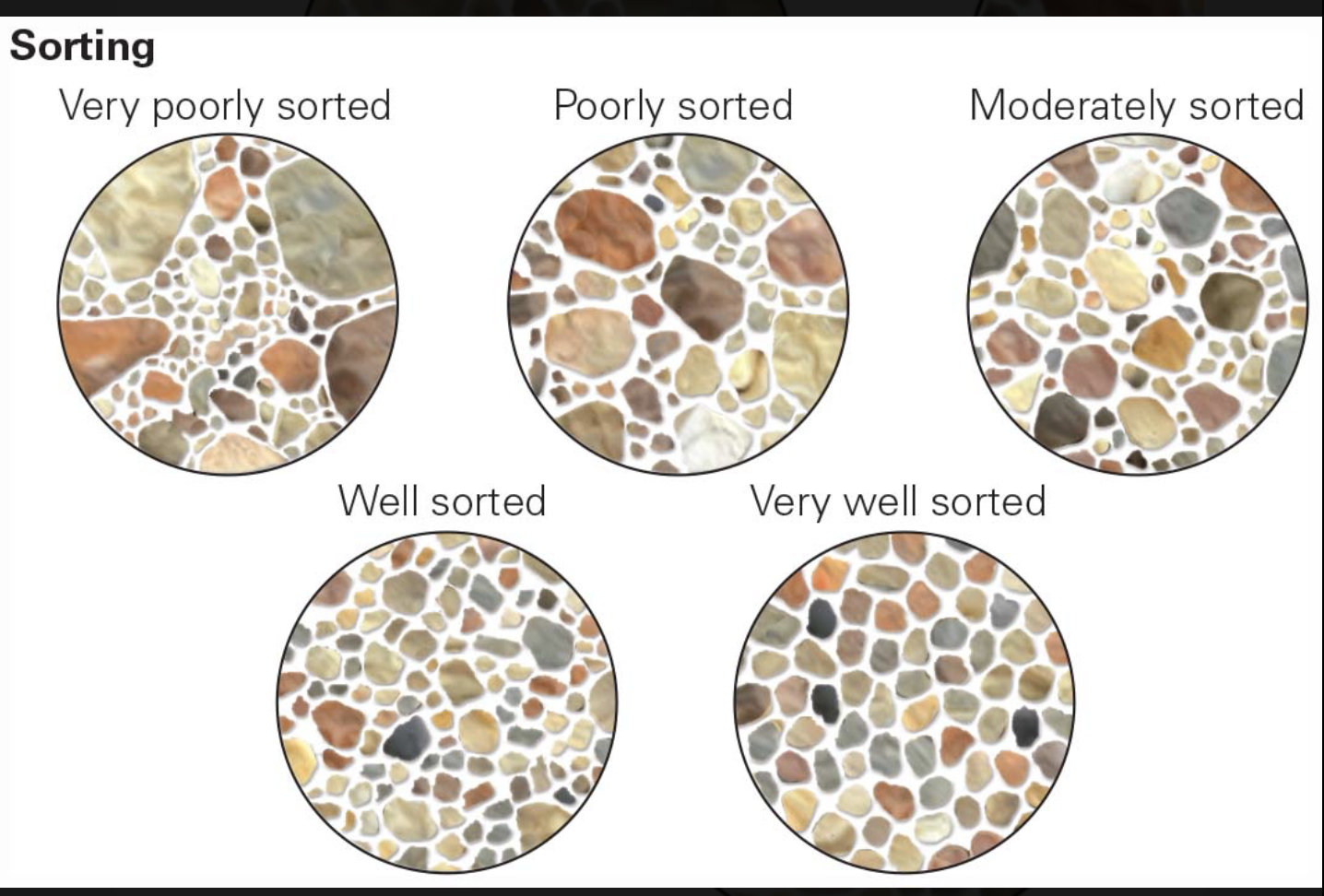
indicates the proportion of clasts in a rock that are the same size where well-sorted sediment consists entirely of clasts that are the same size, whereas poorly sorted sediment contains a mixture of clast sizes
range of clast sizes in a collection of sediment
degree to which sediment has been separated by flowing currents into different-sized fractions
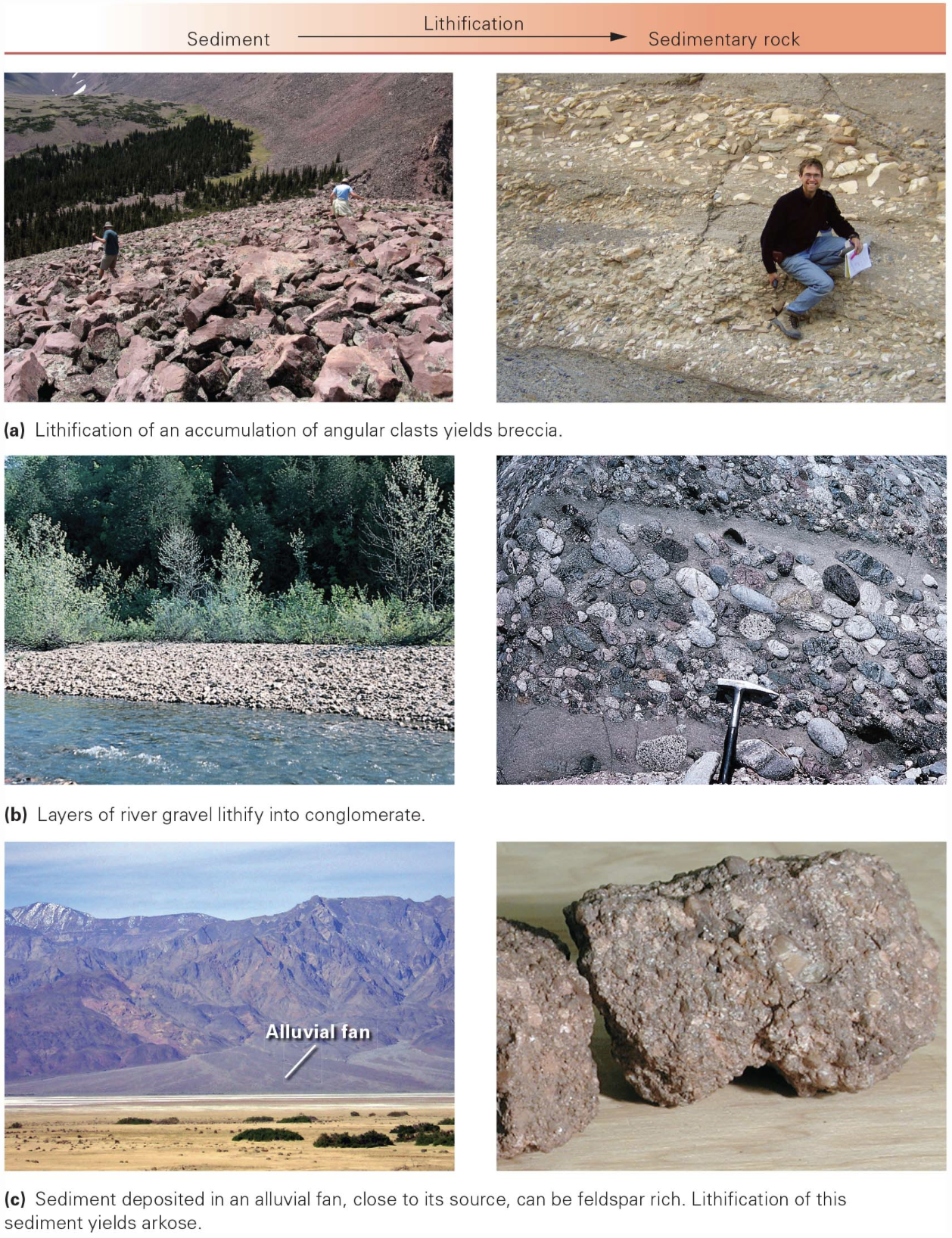
Breccia:
coarse sedimentary rock consisting of angular fragments; or rock broken into angular fragments by faulting
sharp and unworn, it indicates they traveled very little from their source before being cemented together
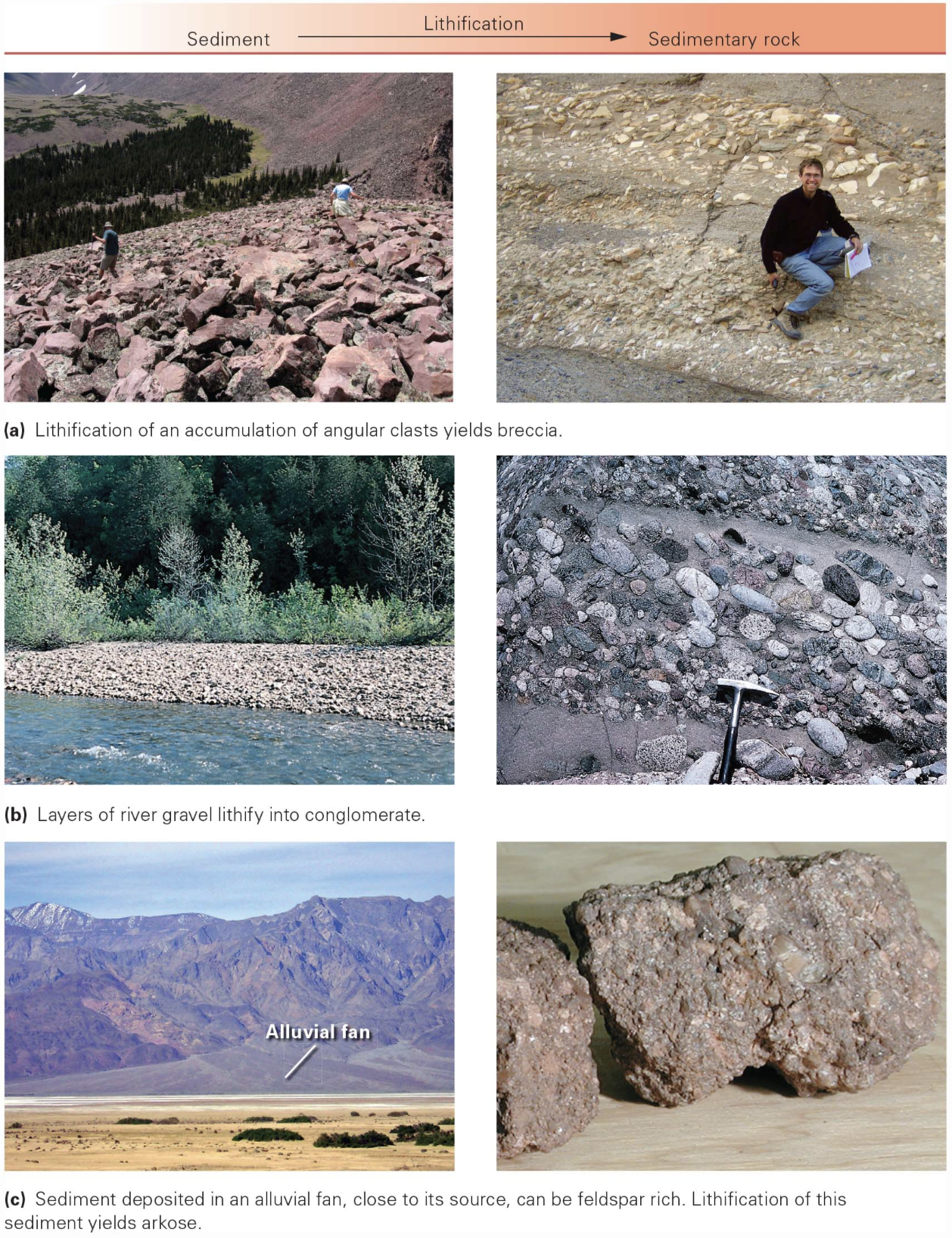
Conglomerate:
very coarse-grained sedimentary rock consisting of rounded clasts such as pebbles, cobbles, and boulders
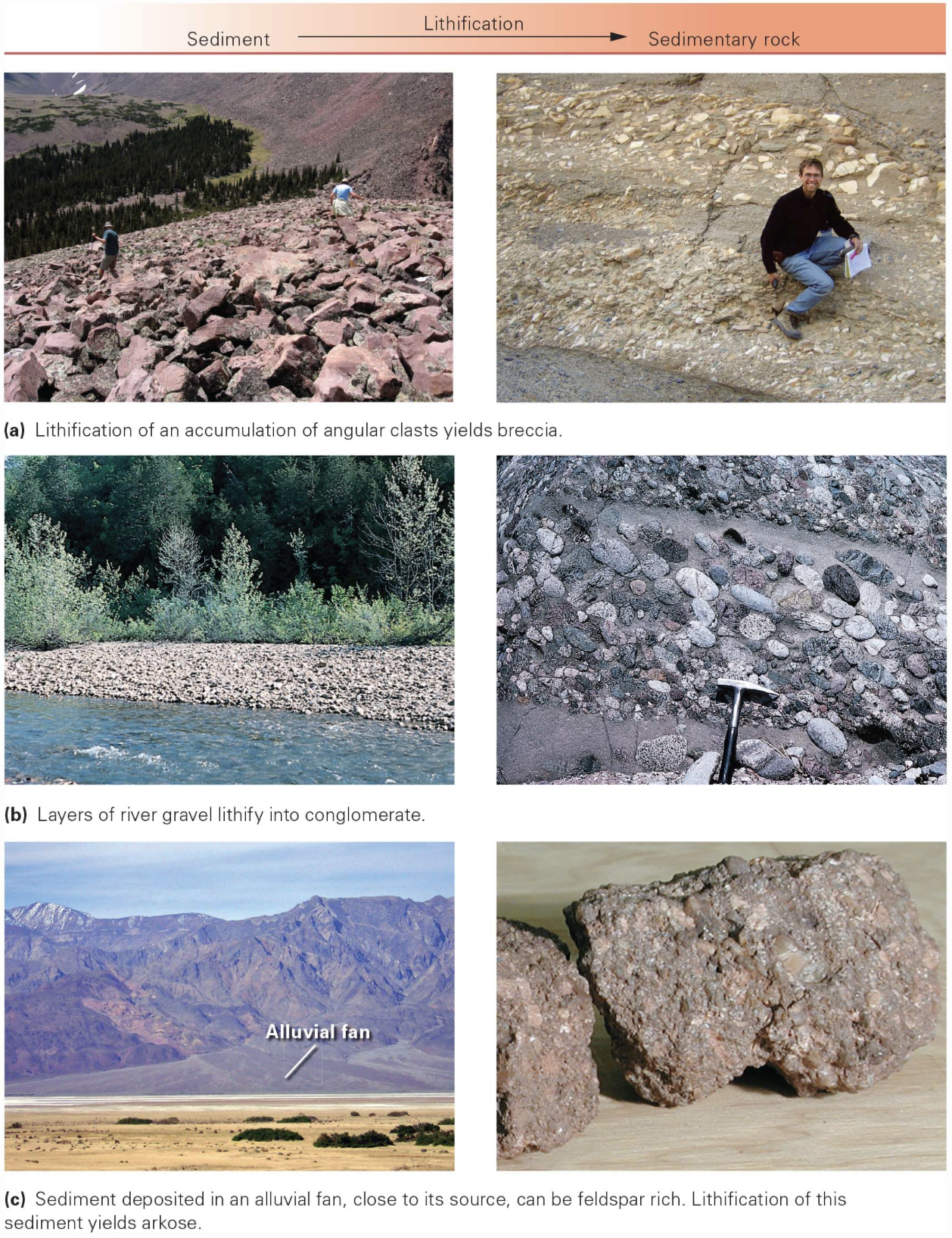
If the gravel stays put for a long time, it undergoes chemical weathering. What is a consequence of this?
cobbles and pebbles break apart into individual mineral grains, eventually producing a mixture of quartz, feldspar, and clay where clay is so fine that flowing water easily picks it up and carries it downstream, leaving sand containing a mixture of quartz and some feldspar grains that if buried and lithified, becomes arkose
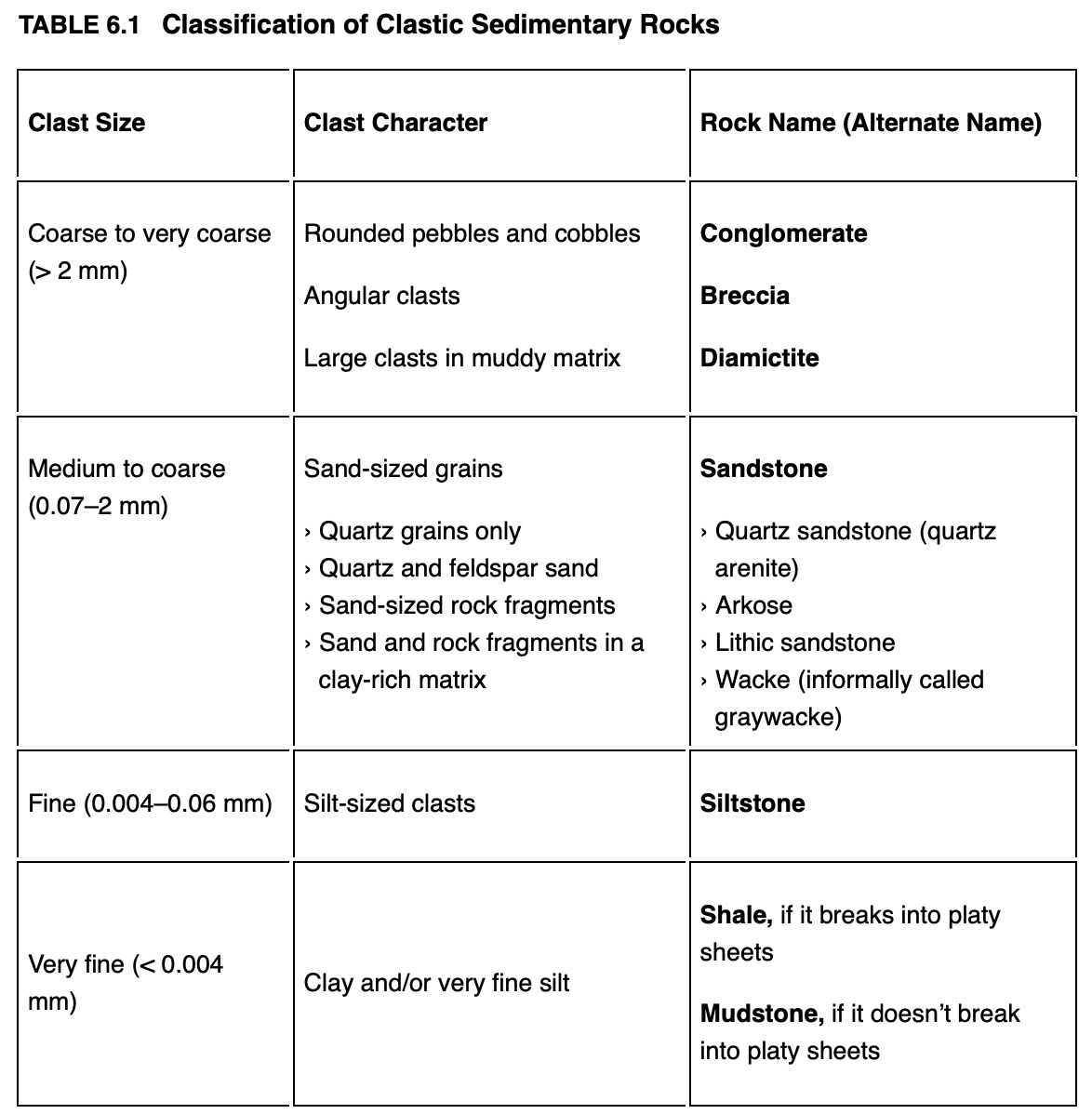
Arkose:
a coarse sandstone containing at least 25% feldspar grains typically formed from the rapid weathering and erosion of granite in arid or cold environment → often has a pinkish or grayish color
Siltstone:
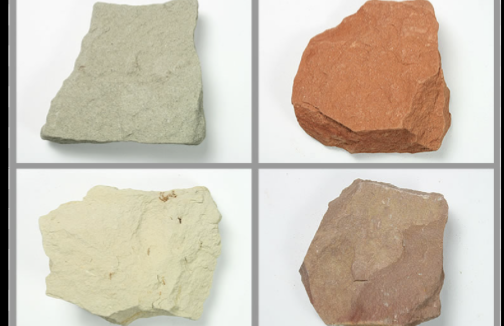
fine-grained sedimentary rock generally composed of very small quartz grains
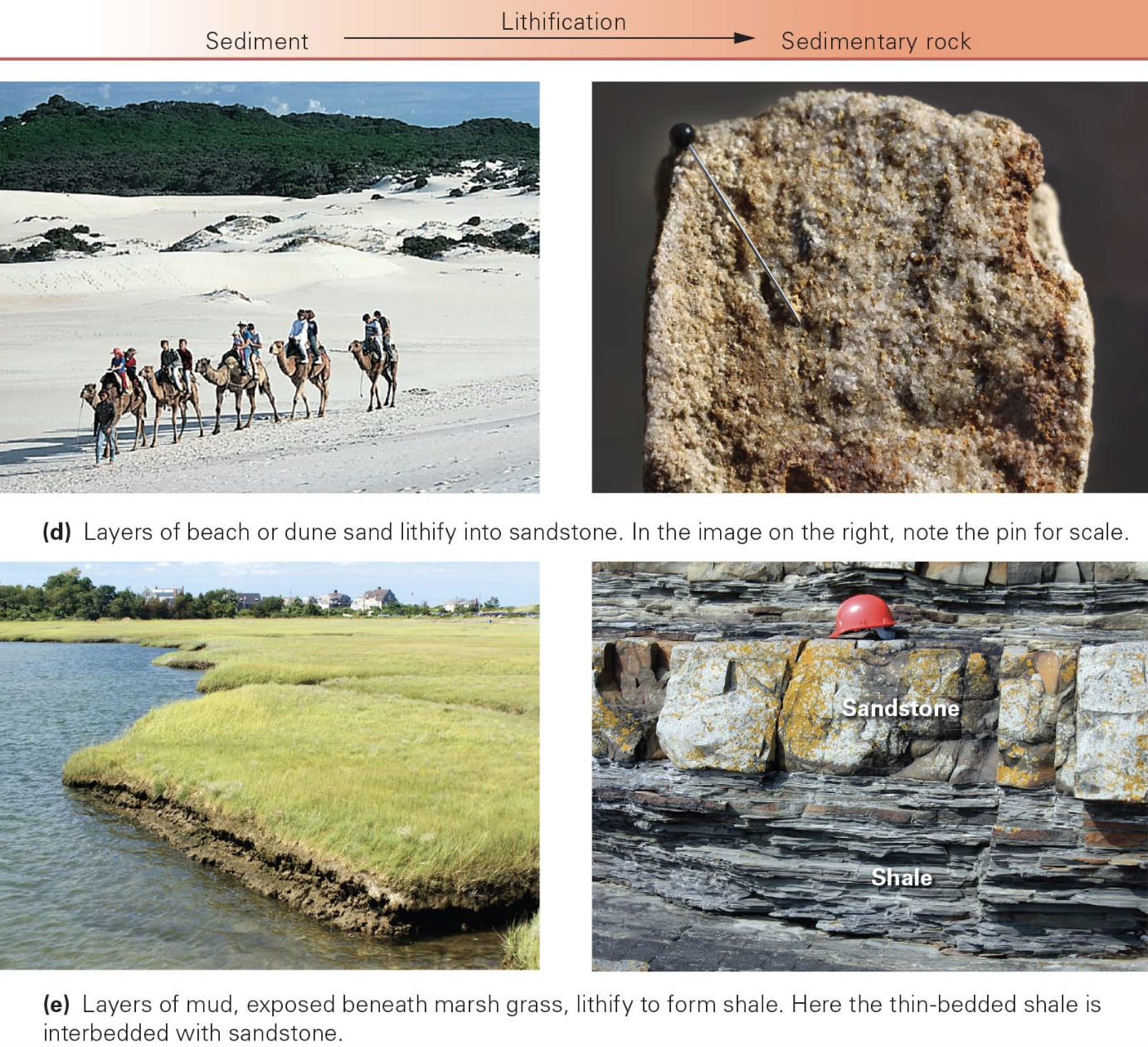
Shale:
very fine-grained sedimentary rock that breaks into thin sheets; most abundant
Mudstone:
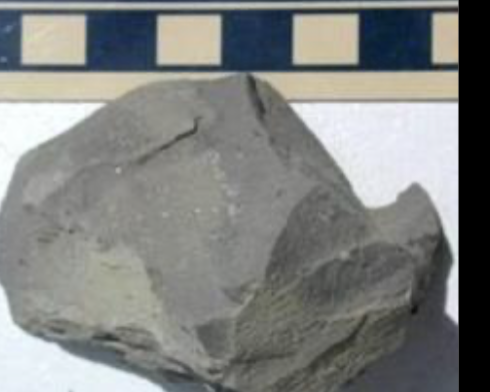
very fine-grained sedimentary rock that will NOT easily split into sheets
Biochemical Sedimentary Rock:
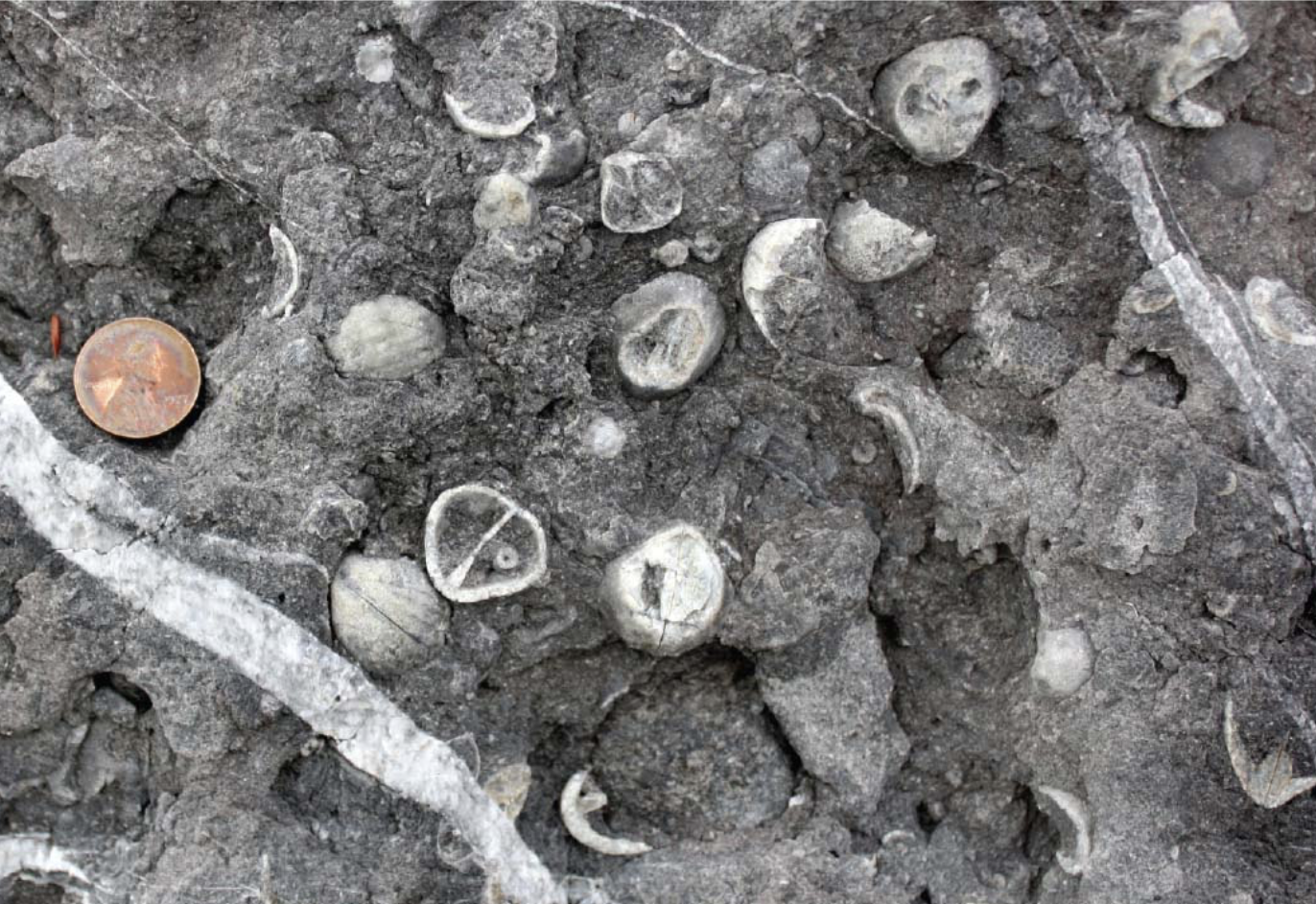
formed from material (such as shells) produced by living organisms
limestone → CaCO3
chert → SiO2
Biochemical limestone:
rock formed predominantly from material of shells where after an organism dies their shells which contain calcium carbonate (CaCO3) crystallizes either as calcite or aragonite → type of carbonate rock
variety of textures, because the material that forms it accumulates in a variety of ways
several processes change the texture of the rock over time, after it has been buried deeply
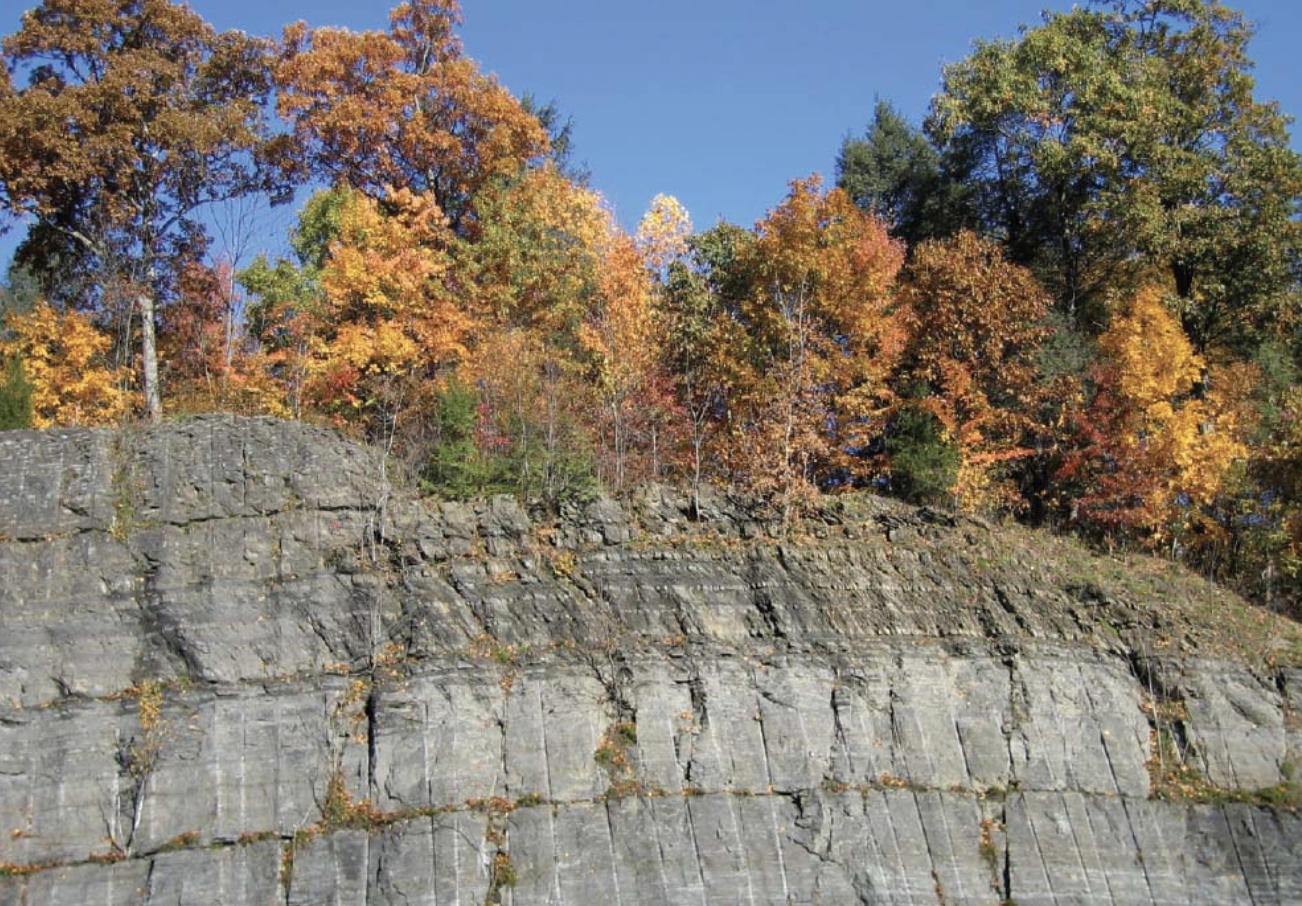
Biochemical chert:
formed from the shells of silica-secreting (SiO2) plankton that accumulated on the seafloor and gradually after burial, the shells dissolved, forming a silica-rich gel which then formed into Chert when the gel solidified
made from cryptocrystalline → consisting of quartz grains that are too small to be seen without extreme magnification of an electron microscope
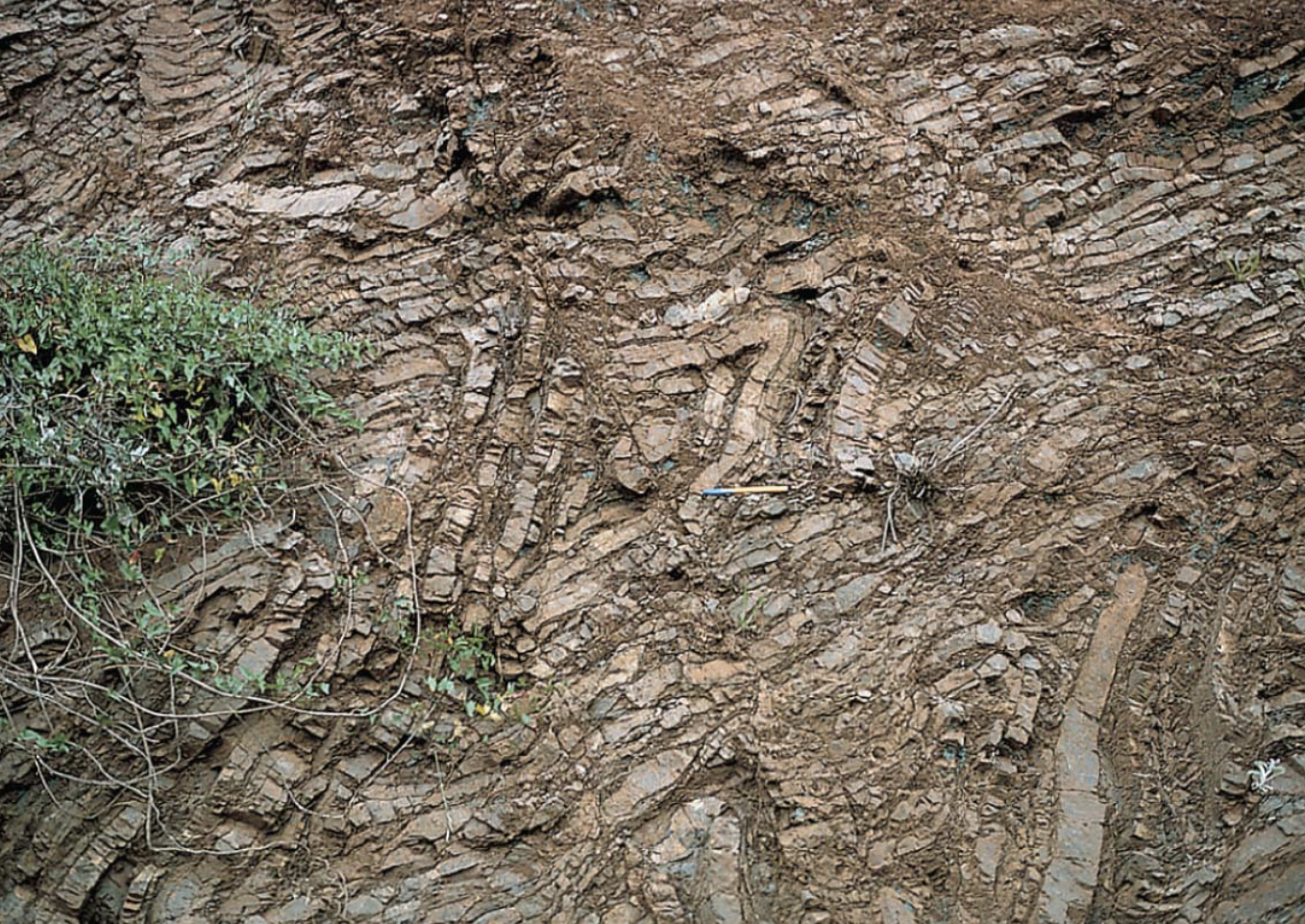
Organic Sedimentary Rock:
rock (such as coal) formed from carbon-rich relicts of plants or other organisms where organic debris settles along with other sediment and is eventually buried and lithified
coal and oil shale
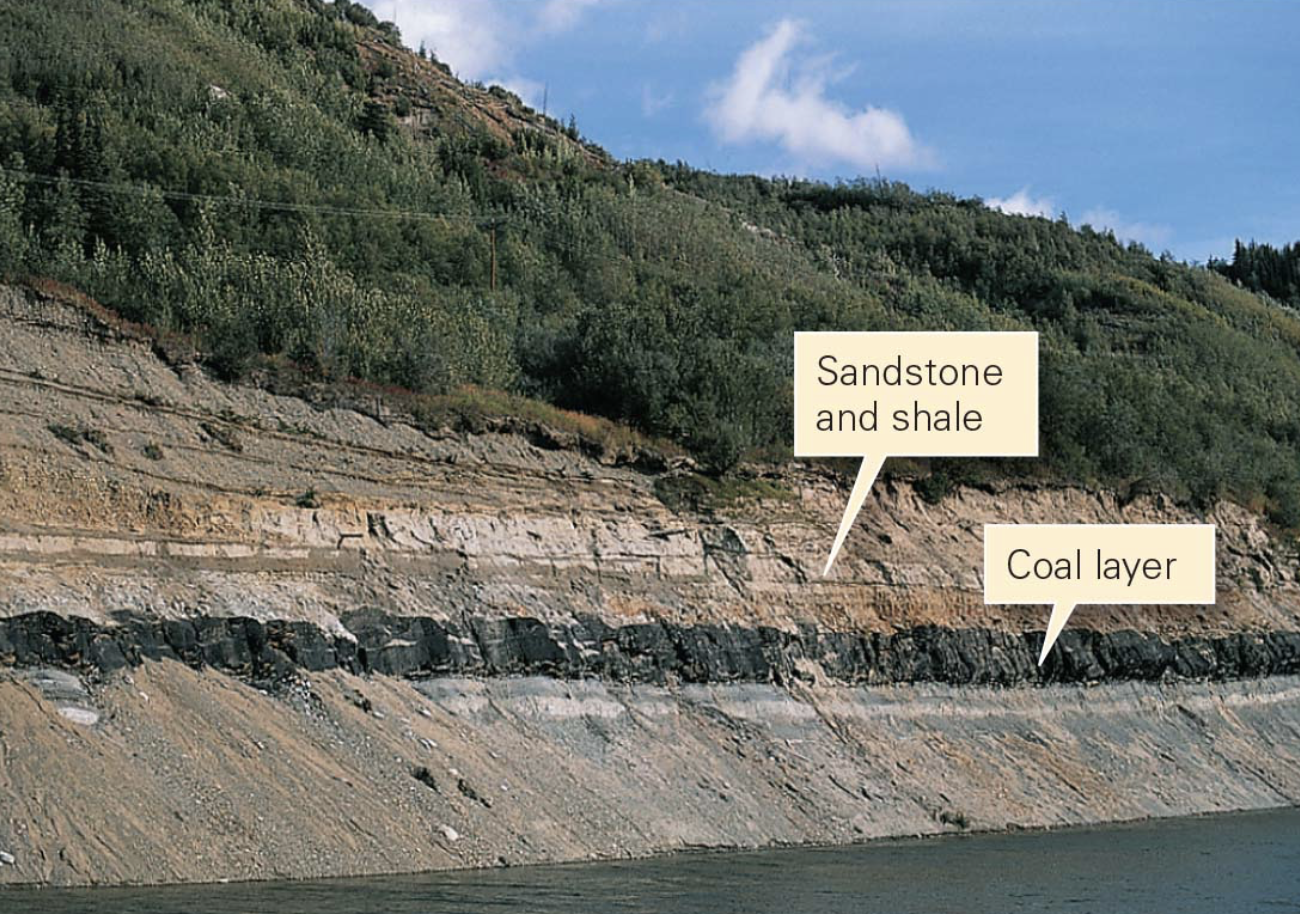
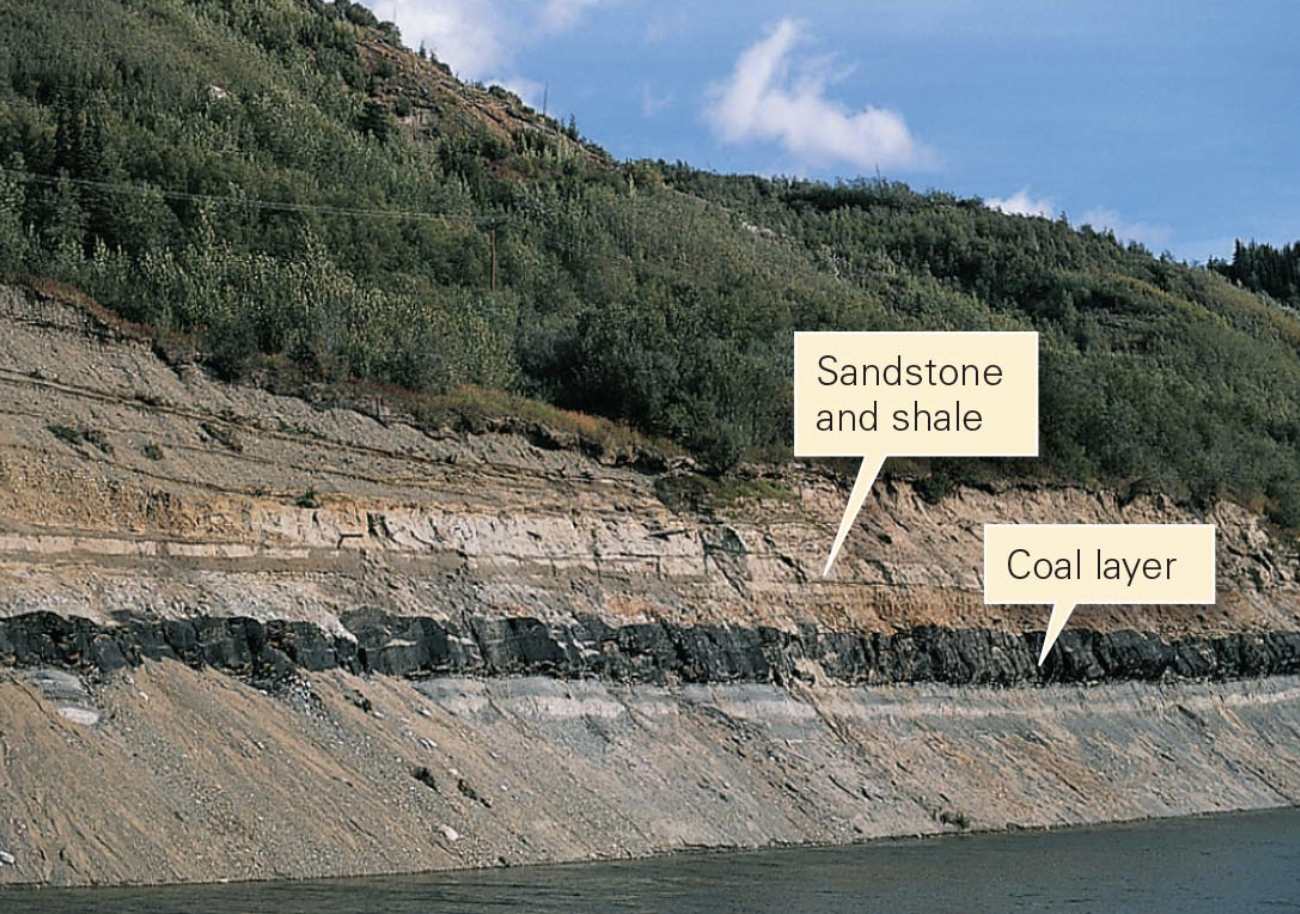
Coal:
forms when plant remains have been buried deeply enough and long enough for the material to become compacted and to lose significant amounts of volatiles (H, H2O, CO2, and ammonia) where as volatiles seep away, the concentration of carbon increases
black, combustible rock containing between 40- 90% carbon and remainder consists of clay and quartz
carbon occurs in large, complex organic molecules
Oil shale:
contains clay and between 15- 75% organic material in a form called kerogen that comes from the fats and proteins that made up the living part of plankton or algae where presence of organic material colors oil shale black
tiny organisms settle in an environment where they do not immediately rot away or get eaten and mix with the clay minerals in mud
mud gets buried and lithified to form shale and organic material transforms into kerogen
Chemical Sedimentary Rock:
made up of minerals that precipitate directly from water solution, typically having a crystalline texture partly formed during their original precipitation and partly when, at a later time, new crystals grow at the expense of old ones through a process called recrystallization
evaporites
travertine carbonates
cave carbonates
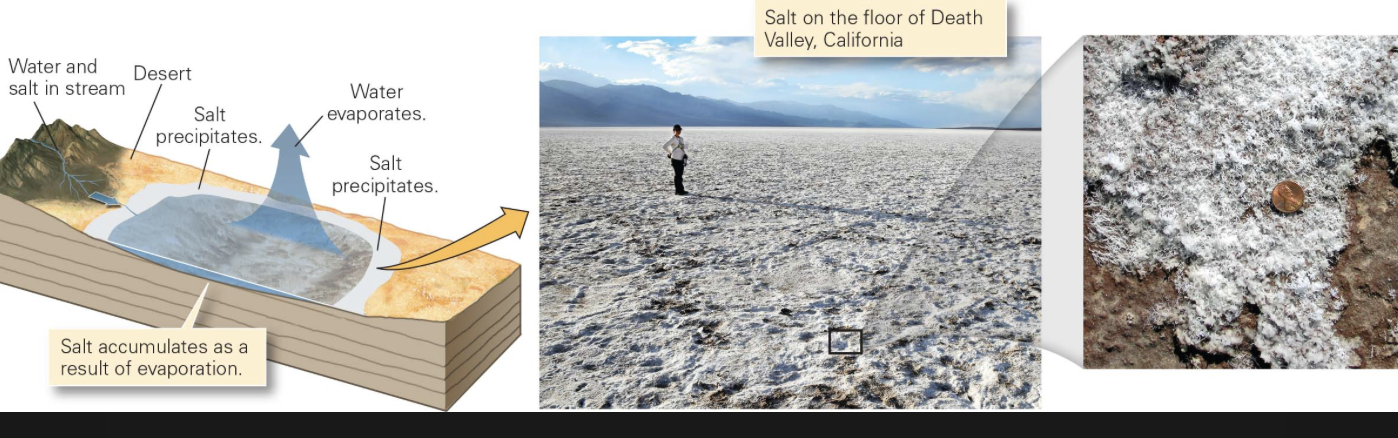
Evaporites:
thick salt deposits that form as a consequence of precipitation from saline water where the specific types of salt minerals that make up an evaporite depend on the amount of evaporation
Gypsum → 80% of the water evaporates
Halite → 90% of the water evaporates
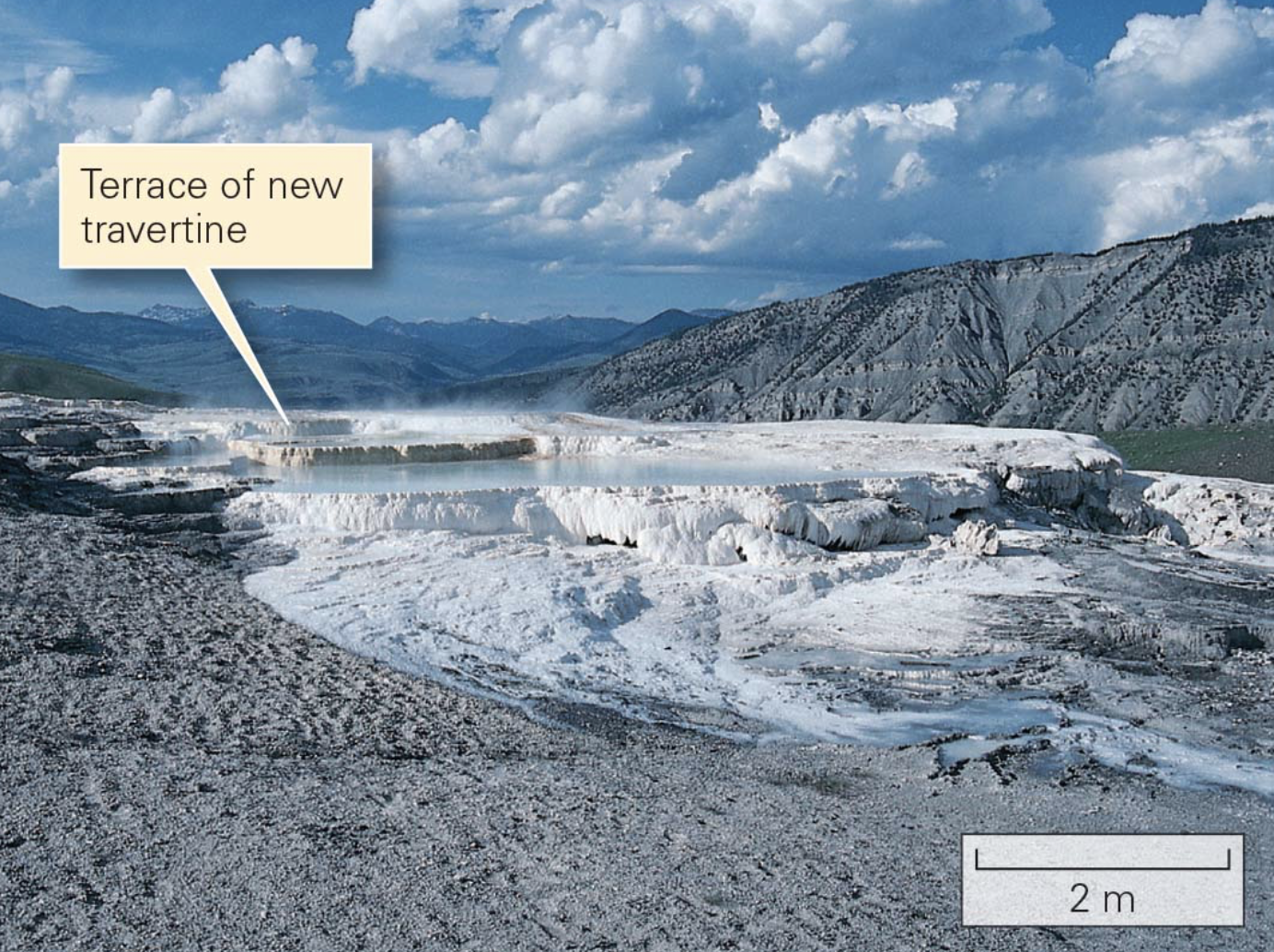
Travertine:
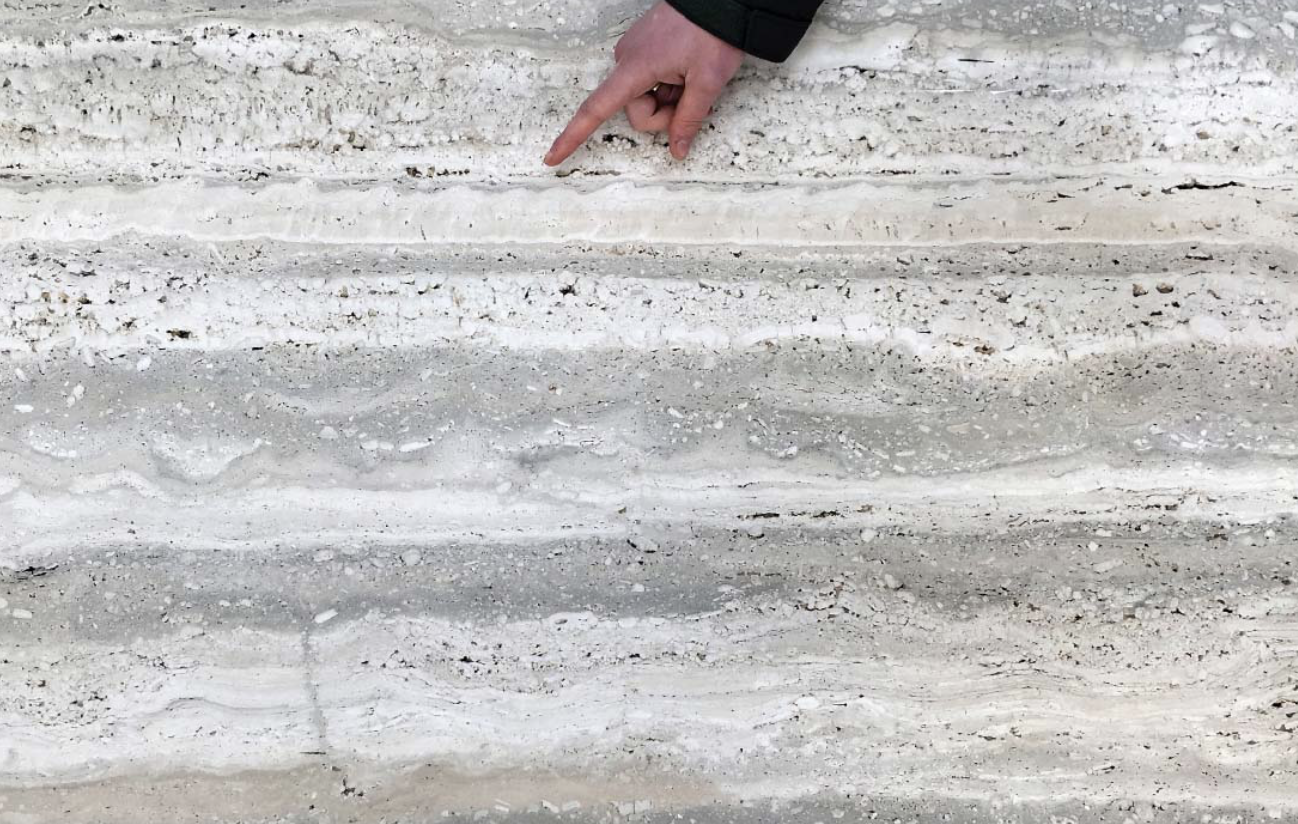
a rock composed of crystalline calcium carbonate (CaCO3) formed by chemical precipitation from groundwater that has seeped out at the ground surface either in hot- or cold-water springs, or on the walls of caves
has distinct layering making it a popular stone for construction
What causes precipitation of Travertine?
happens, in part, when the groundwater degasses, meaning that some of the CO2 that had been dissolved in the groundwater bubbles out of solution and encourages the precipitation of carbonate
precipitation also occurs when water evaporates, thereby increasing the concentration of carbonate
maybe even biological activity from microbes in environment
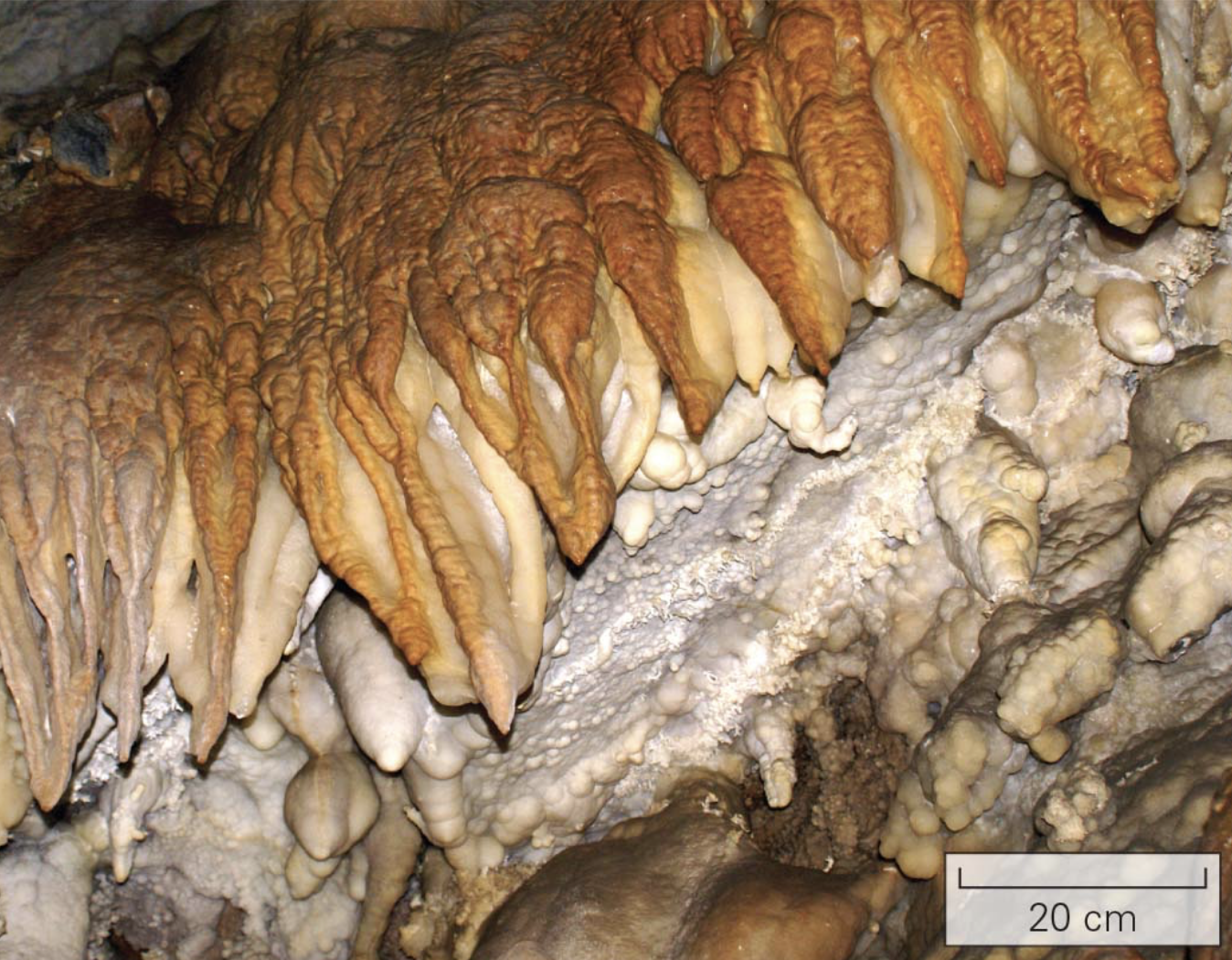
Travertine in cave settings:
grows on the walls of caves where groundwater seeps out where travertine builds up beautiful and complex growth forms called speleothems
Dolostone:
carbonate rock that differs from limestone in that it contains the mineral dolomite (CaMg[CO3]2), which contains equal amounts of calcium and magnesium
forms by a chemical reaction between solid calcite and magnesium-bearing groundwater
change may take place beneath lagoons along a shore soon after the limestone has formed, or a long time later, after the limestone has been buried deeply
![<p>carbonate rock that differs from limestone in that it contains the mineral dolomite (CaMg[CO<sub>3</sub>]<sup>2</sup>), which contains equal amounts of calcium and magnesium</p><ul><li><p>forms by a chemical reaction between solid calcite and magnesium-bearing groundwater</p></li><li><p>change may take place beneath lagoons along a shore soon after the limestone has formed, or a long time later, after the limestone has been buried deeply</p></li></ul><p></p>](https://assets.knowt.com/user-attachments/06d29815-03be-472f-bb75-41d843c90e5b.png)
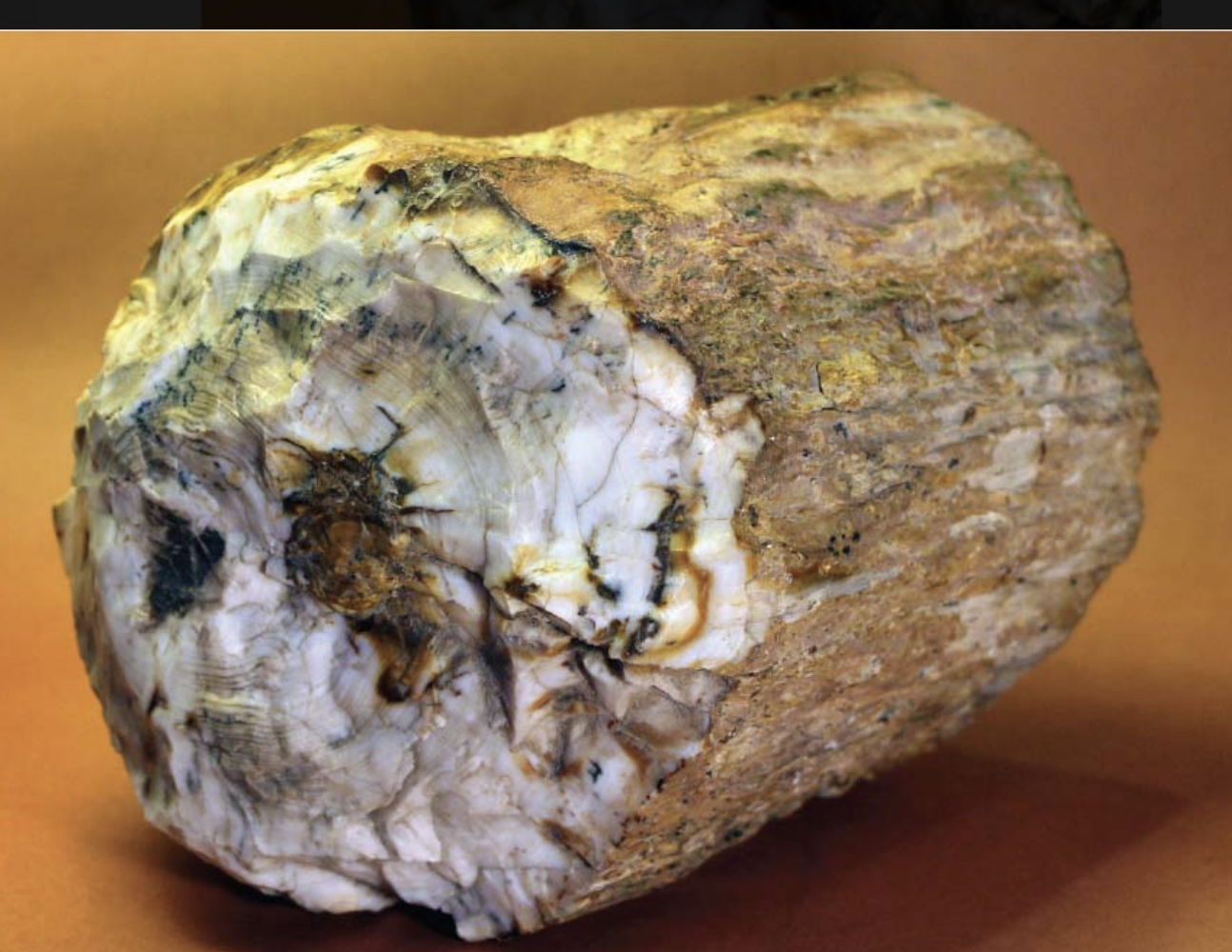
Petrified wood:
chert that forms when silica-rich sediment, such as ash from a volcanic eruption, buries trees where the silica dissolves in groundwater and then later precipitates as microcrystalline quartz within wood, gradually replacing the wood’s cellulose
chert deposit retains the shape of the wood cells and the growth rings within it
Sedimentary structure:
a geometry or arrangement of material in sediment or sedimentary rock that formed during or shortly after deposition, not in response to later tectonic stress; examples include cross beds and mudcracks
help geologists understand the depositional environment in which sediments accumulated
Bed:
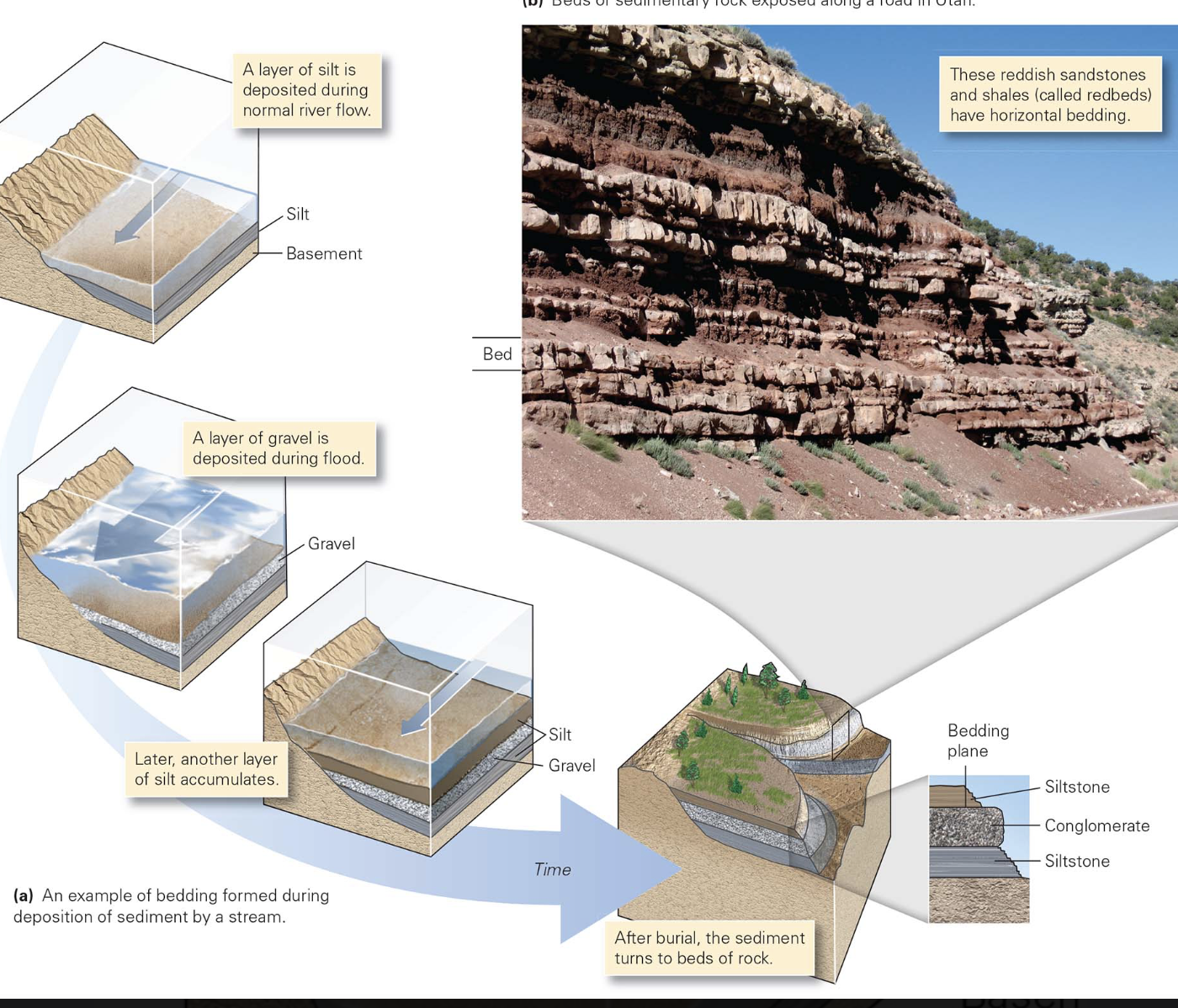
single layer of sediment or sedimentary rock with a recognizable top and bottom where the bedding plane is the boundary between two beds
strata → succession of several layers or beds together
bedding → overall arrangement of sediment into a sequence of beds
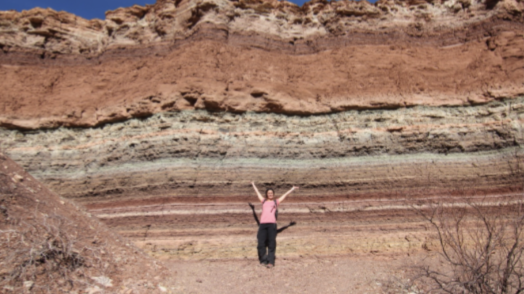
Why does bedding form?
think about how sediment accumulates in which changes in the climate, water depth, current velocity, or the sediment source control the type of sediment deposited at a location at a given time
Ex → if sea level rises, and water submerges an area in which desert sand had been accumulating, layers of carbonate shells may be deposited over layers of sand when lithified
sand layers become beds of sandstone
shell layers become beds of limestone
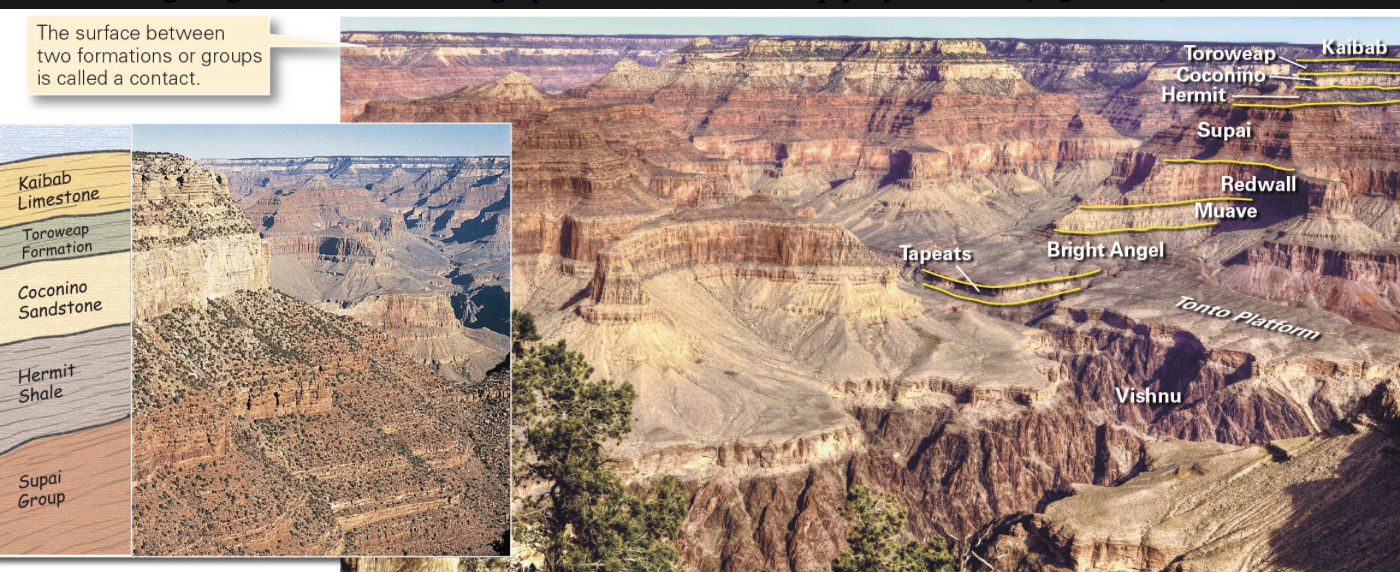
Stratigraphic formation:
a recognizable layer of a specific sedimentary rock type or set of rock types, deposited during a certain time interval, that can be traced over a broad region; sequence of strata that is distinctive enough to be traced as a unit across a fairly large region
Ex → sequence of sandstone and shale beds as one formation and the sequence of limestone beds as another
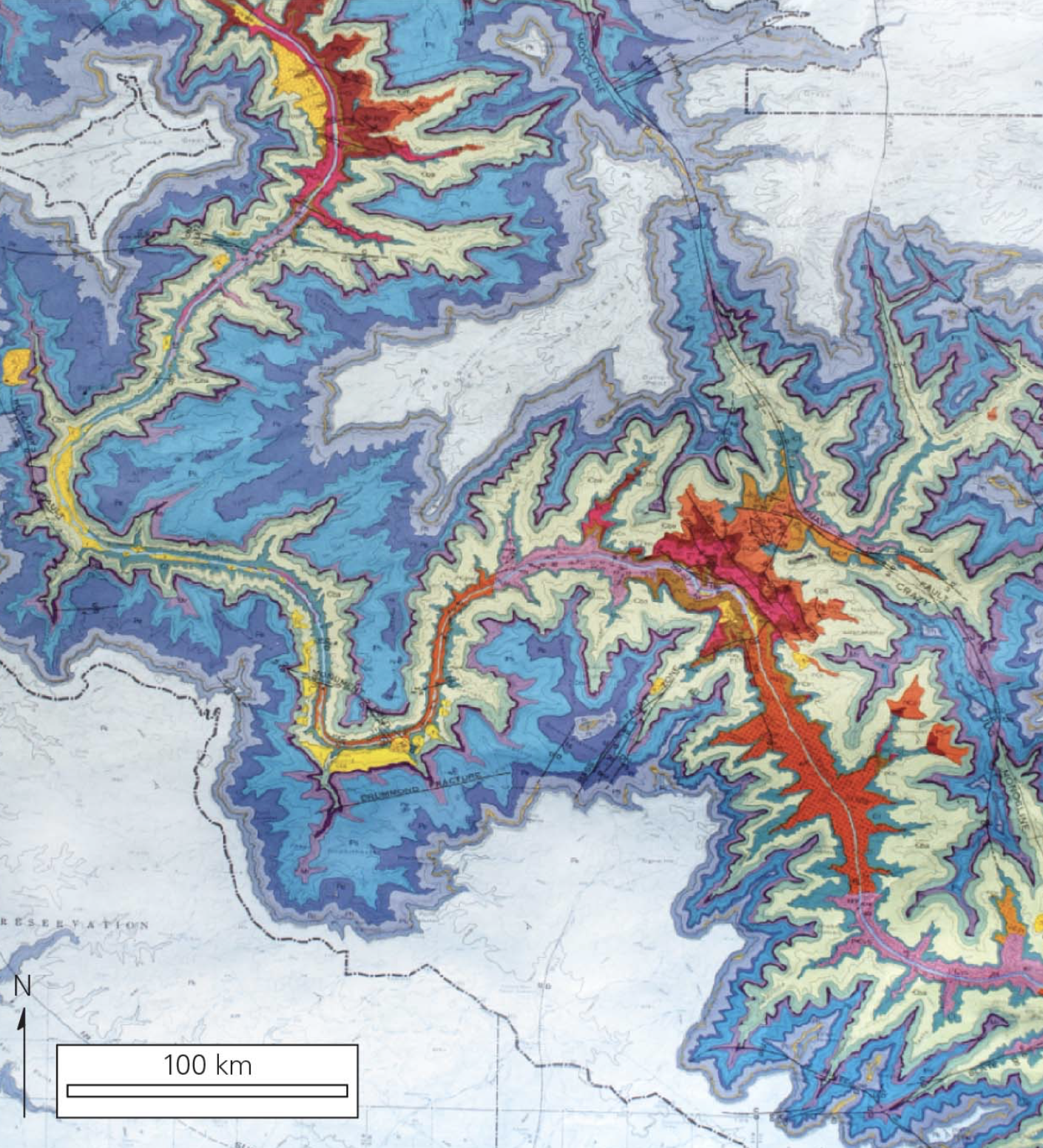
Geologic map:
map showing the distribution of rock units and structures across a region
What are bedforms?
sedimentary structures that develop at the interface between the sediment and the fluid given their location and reflect such factors as the velocity of the flow and the size of the clasts
ripple marks
dunes
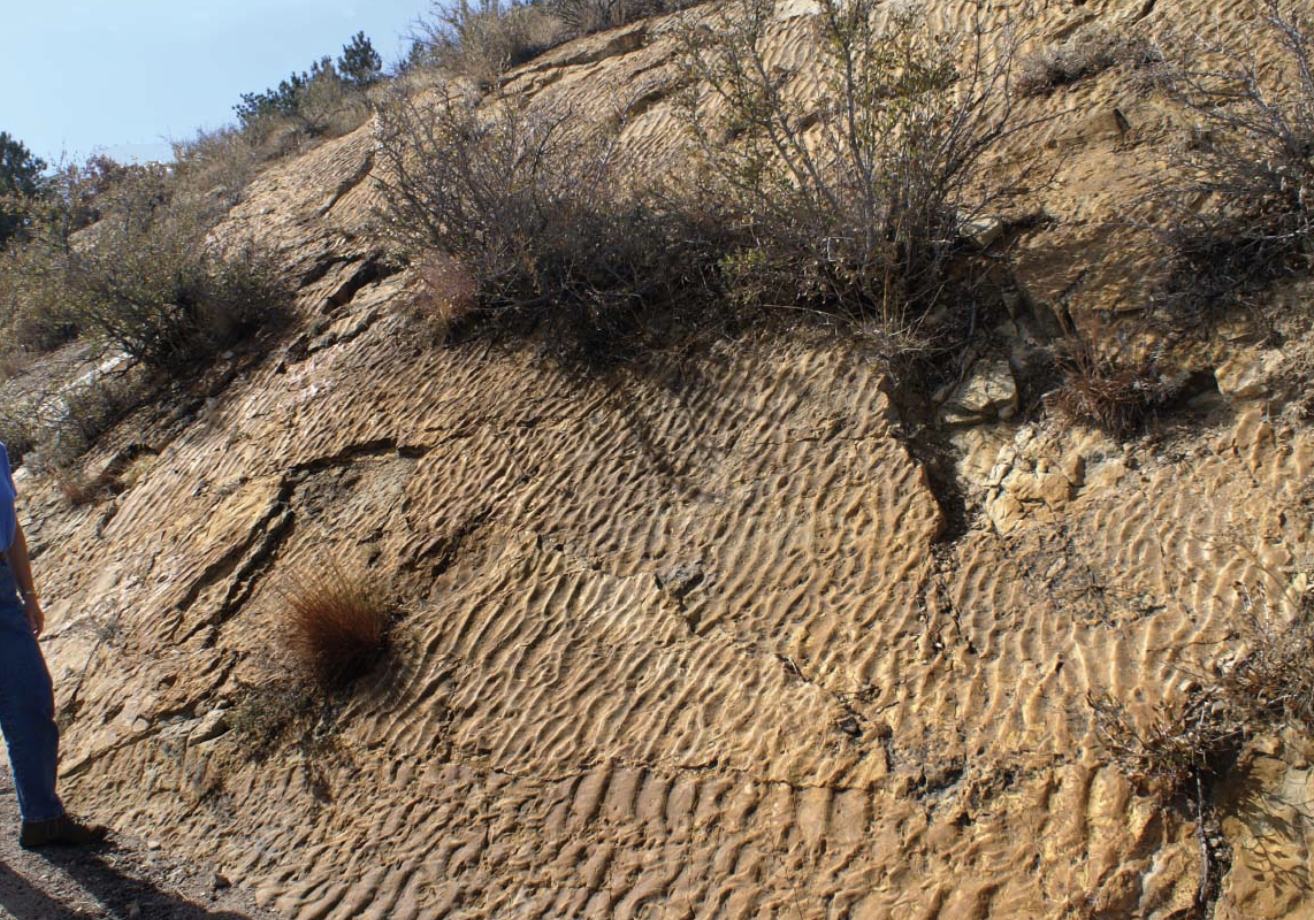
Ripple marks:
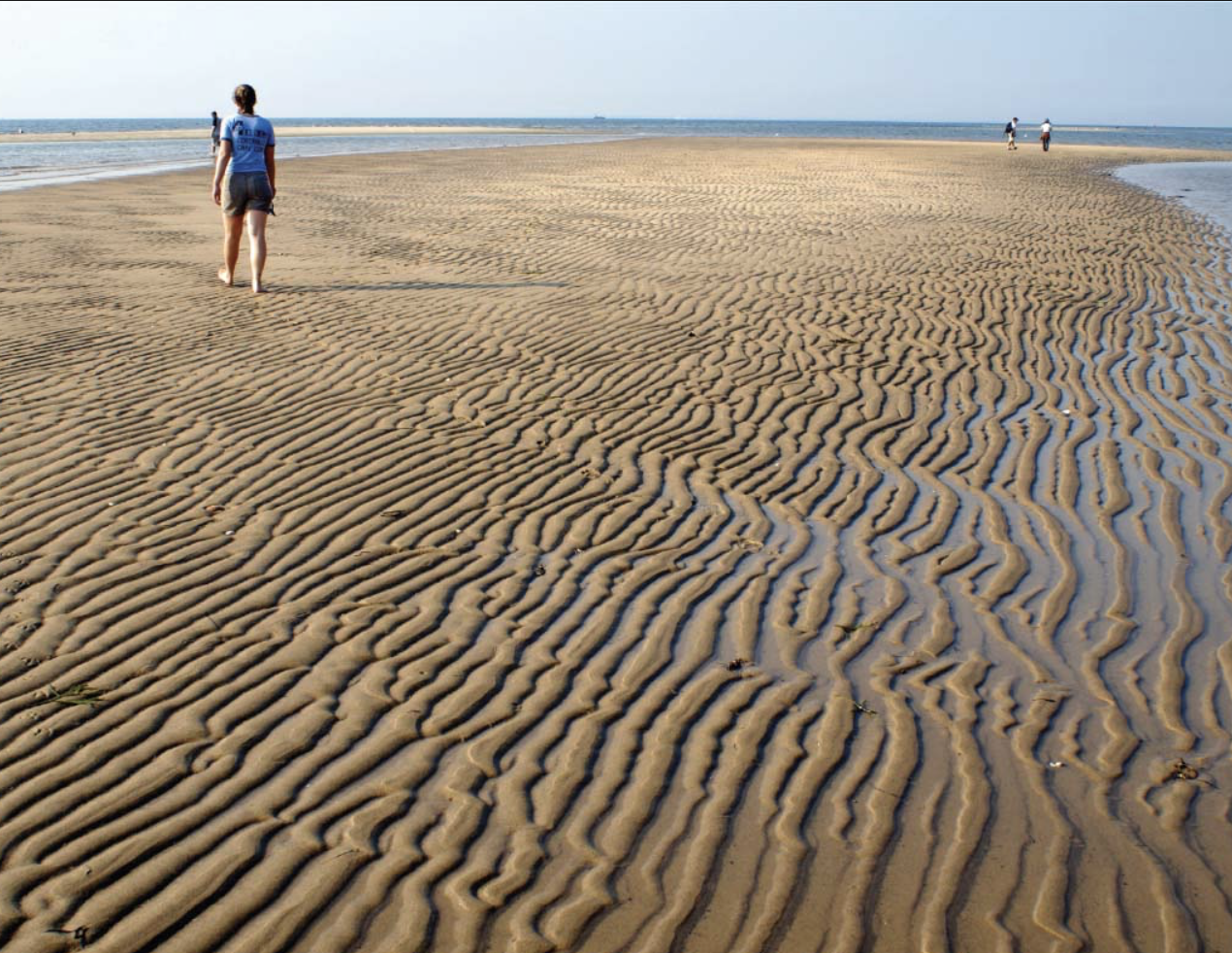
relatively small (generally no more than a few centimeters high), elongate ridges that form on a bed surface at right angles to the direction of current flow
found on modern beaches or streambeds, and others preserved on bedding planes of ancient rocks
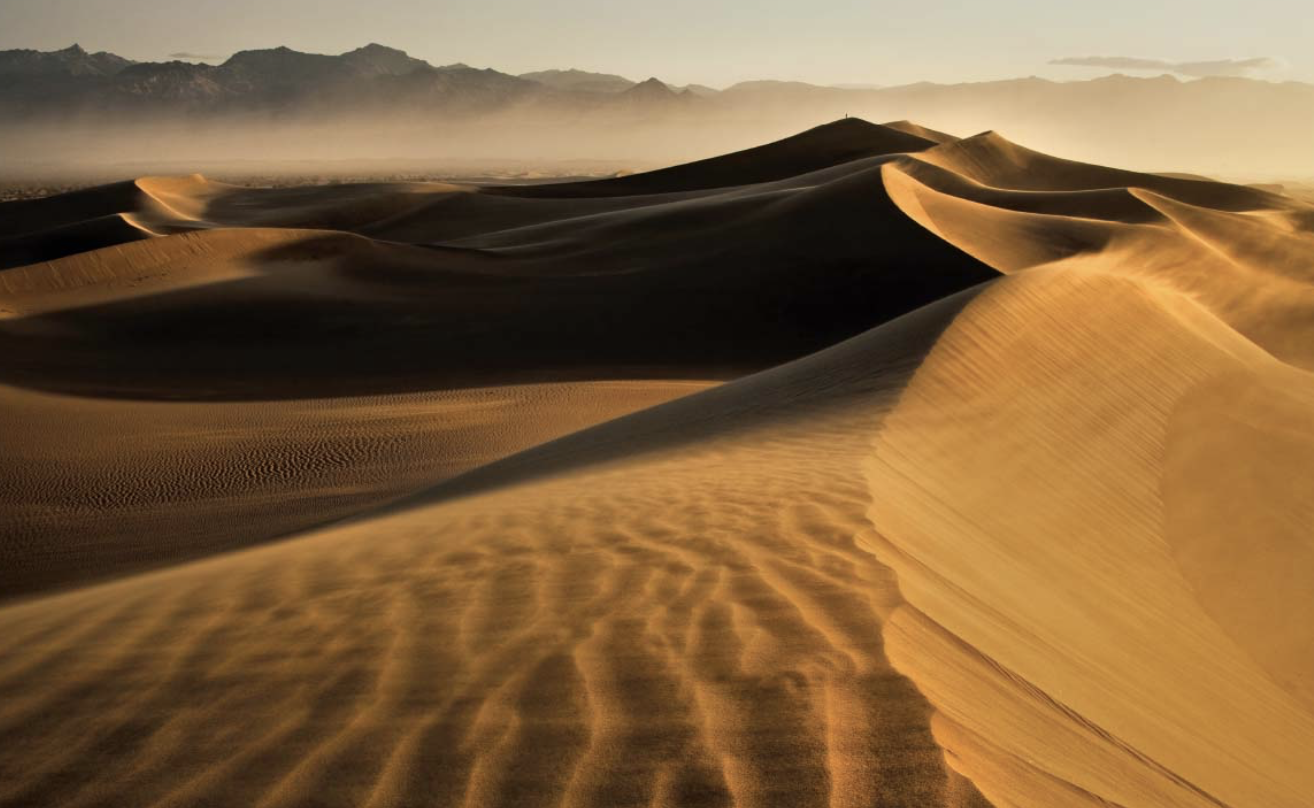
Dunes:
looks like a ripple, only it’s much larger capable of being tens of centimeters to several meters high, and wind-formed dunes in deserts may be tens of meters to over 100 meters high
pile of sand generally formed by deposition from the wind
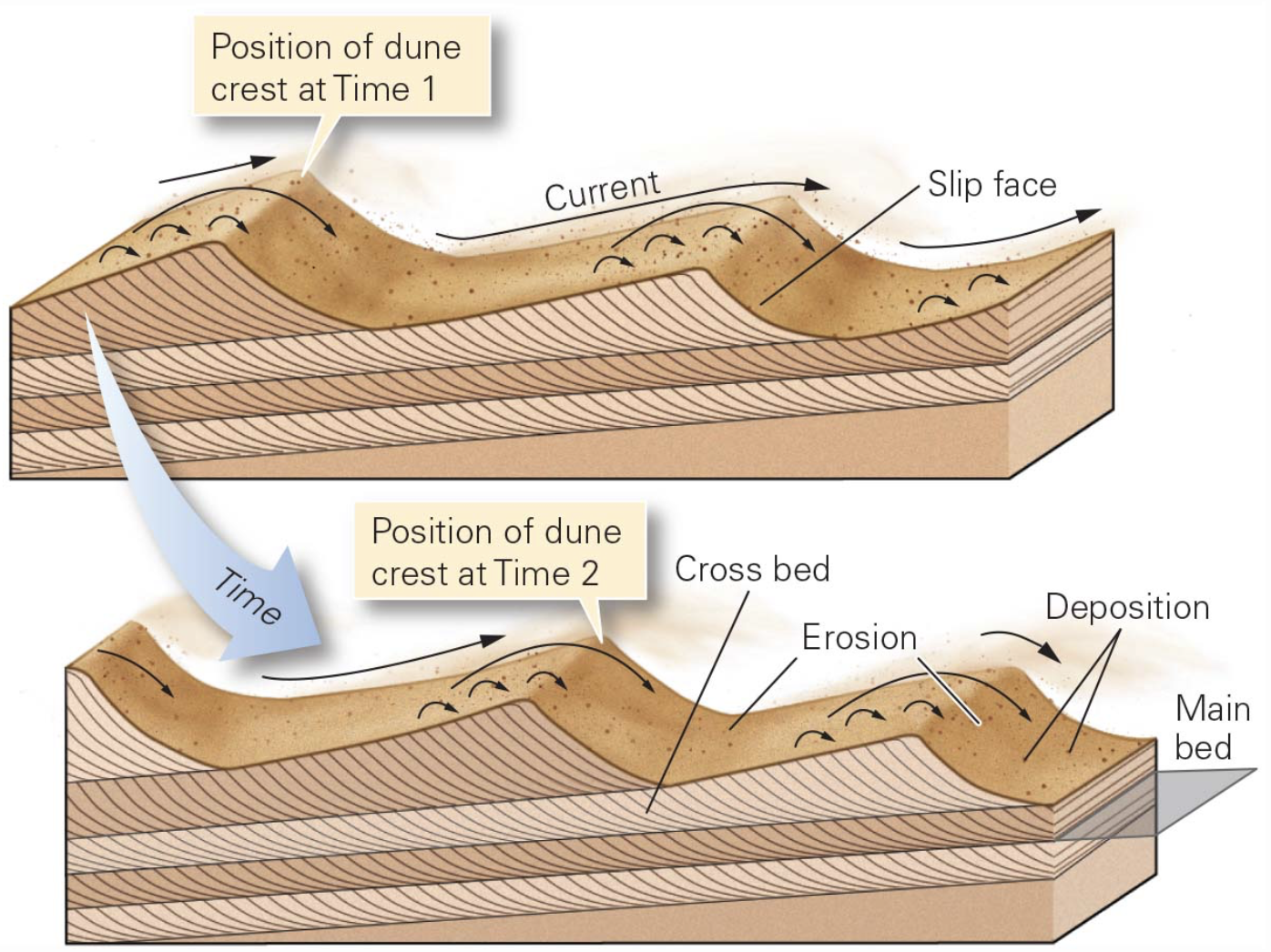
Cross beds:
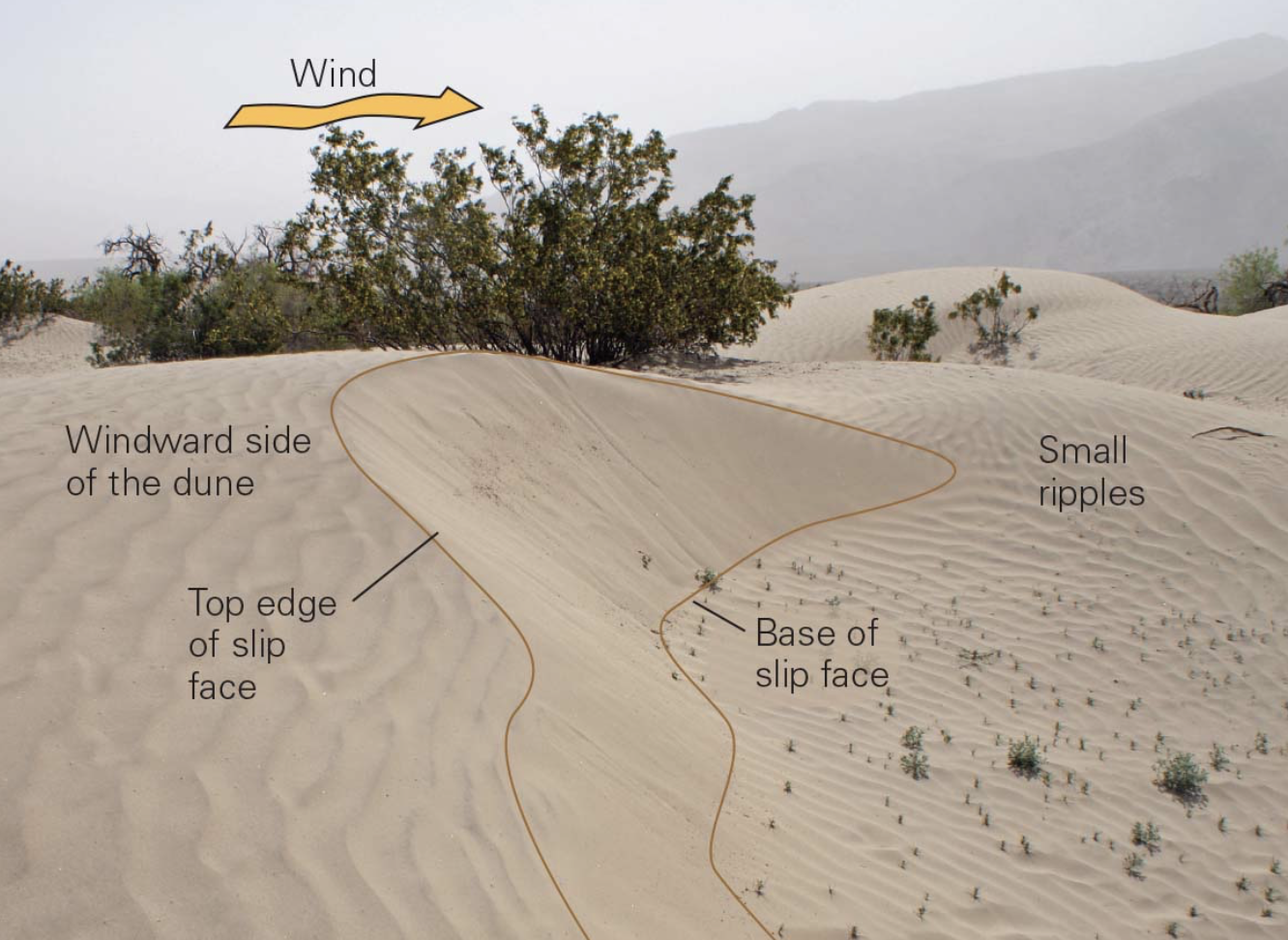
internal laminations in a bed, inclined at an angle to the main bedding (boundary between two successive layers); are a relict of the slip face of dunes or ripples
surface of the slip face establishes the shape of the cross beds where eventually, a new cross-bedded layer builds out over a pre-existing one
Sediment deposited on a submarine slope tends to be what?
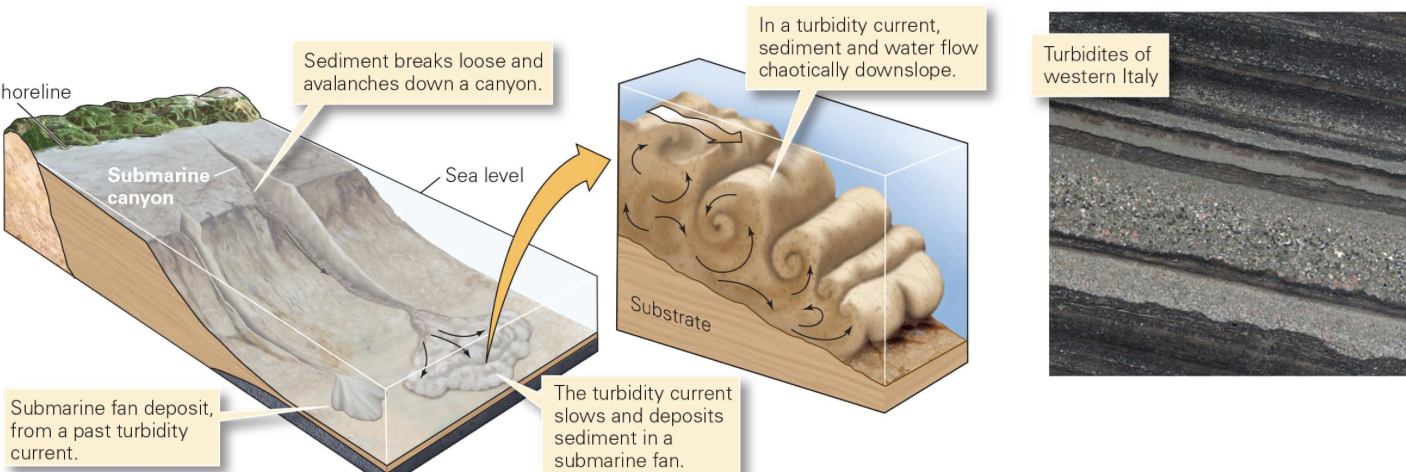
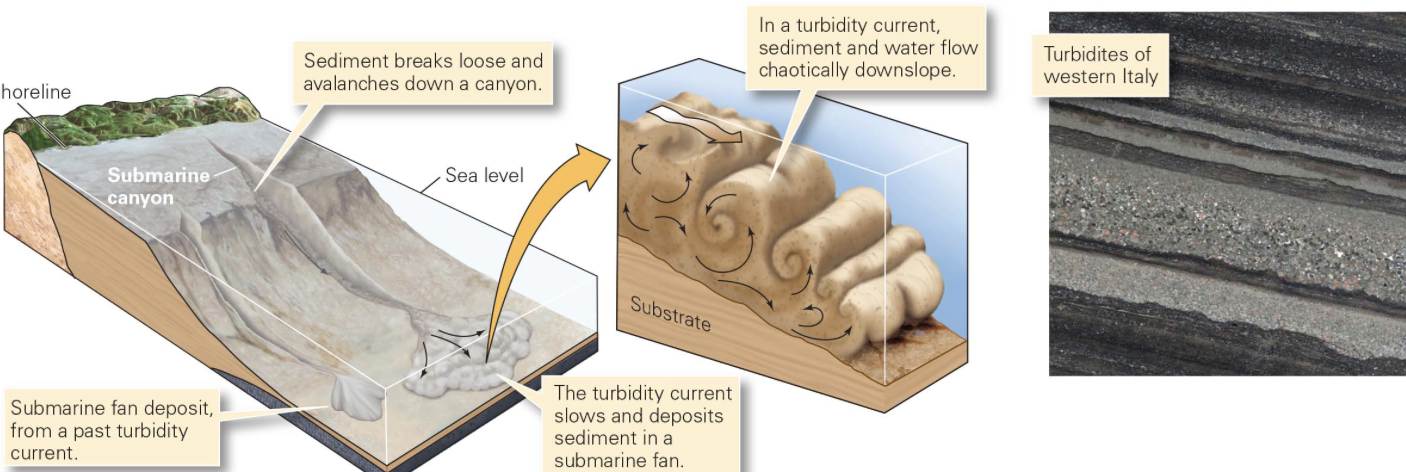
tends to be unstable, so an earthquake or storm might disturb this sediment and cause it to slip downslope and mix with water to produce a murky, turbulent cloud that is denser than clear water + flows downslope like an underwater avalanche → turbidity current
How do we form a graded bed?
as sediment goes downslope, turbidity current slows, and the sediment that it carried starts to settle out where larger grains sink faster through a fluid than do finer grains, so the coarsest sediment settles out first
finer grains accumulate on top, with the finest sediment (clay) settling out last
turbidites → deposit from a turbidity current
many overlapping turbidites build into a broad apron called a submarine fan
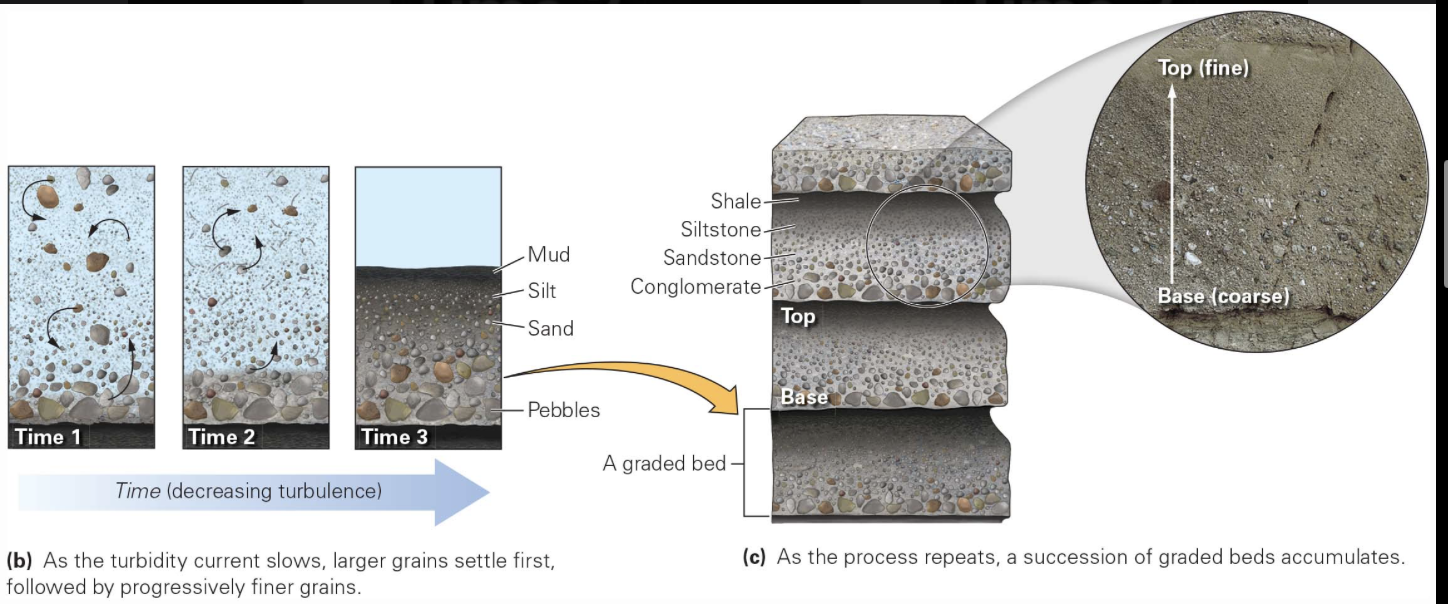
What features develop features on the surface of a bed as a consequence of events that happen during deposition or soon after, while the sediment layer remains soft?
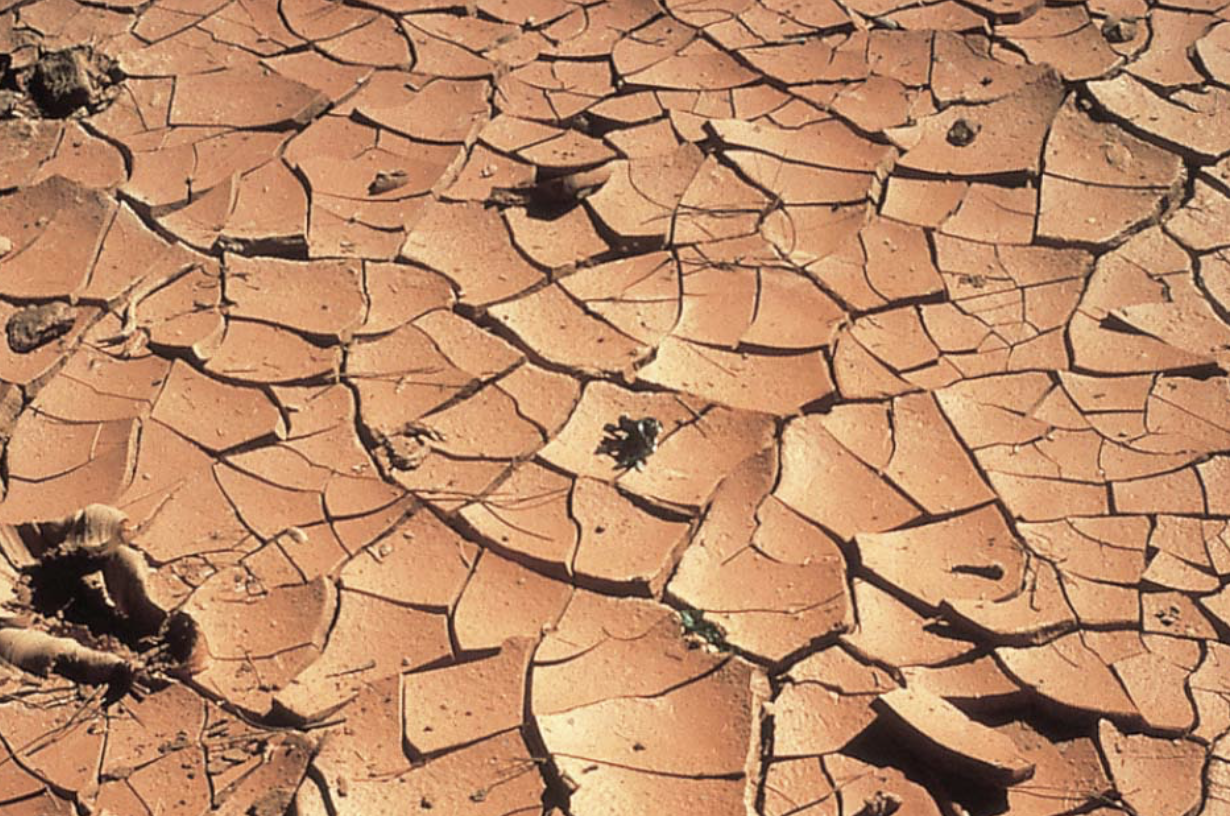
bed-surface markings such as mud cracks, scour marks, and fossils
Mud cracks:
openings between the plates when a mud layer dries up after deposition and cracks into roughly hexagonal plates that typically curl up at their edges
indicate that the sediment layer was exposed to the air and dried out
Scour marks:
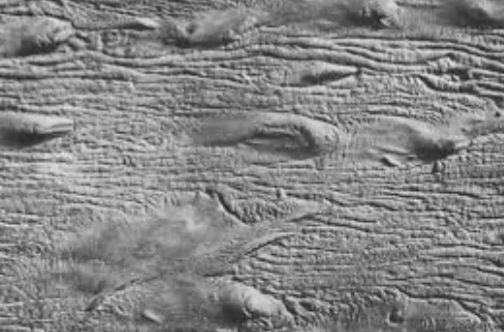
as currents flow over a sediment surface, they may erode small troughs parallel to the current flow
Fossil:
remnant, or trace, of an ancient living organism that has been preserved in rock or sediment
tell us whether sediment was deposited along a river or in the deep sea, because different species of organisms live in different environments
Presence of ripple marks and cross bedding indicate what?
indicates that layers were deposited in a current
Depositional environment:
a setting in which sediments accumulate; its character (fluvial, deltaic, reef, glacial, etc.) reflects local conditions
terrestrial → conglomerate, arkose sandstone, sandstone, shale
coastal → sandstone, shale
marine → carbonates, lime mud, SiO2 mud
Terrestrial Depositional Environments:
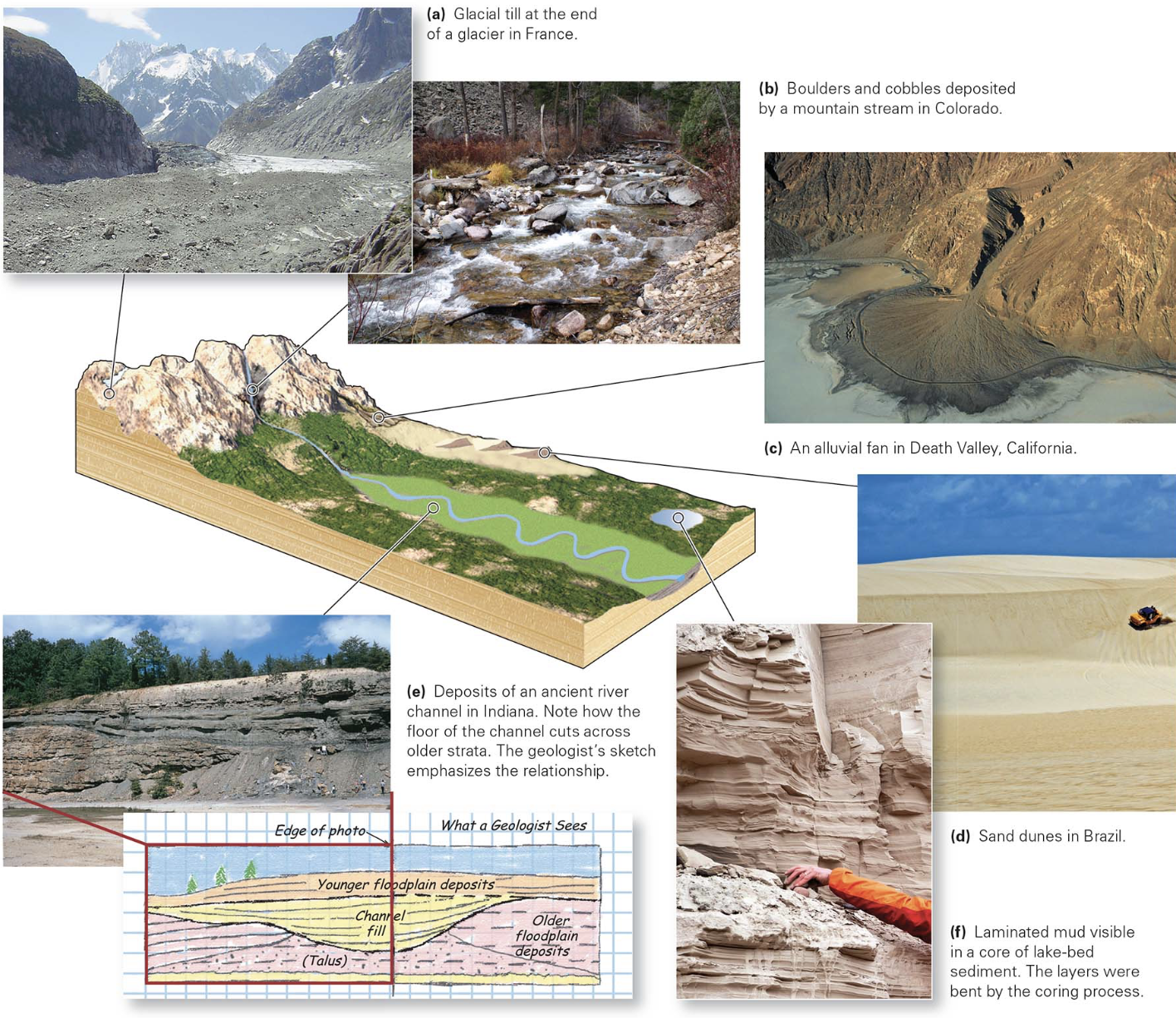
those that develop inland, far enough from the shoreline that they are not affected by ocean tides and waves and sediments accumulate either on dry land or under and adjacent to freshwater
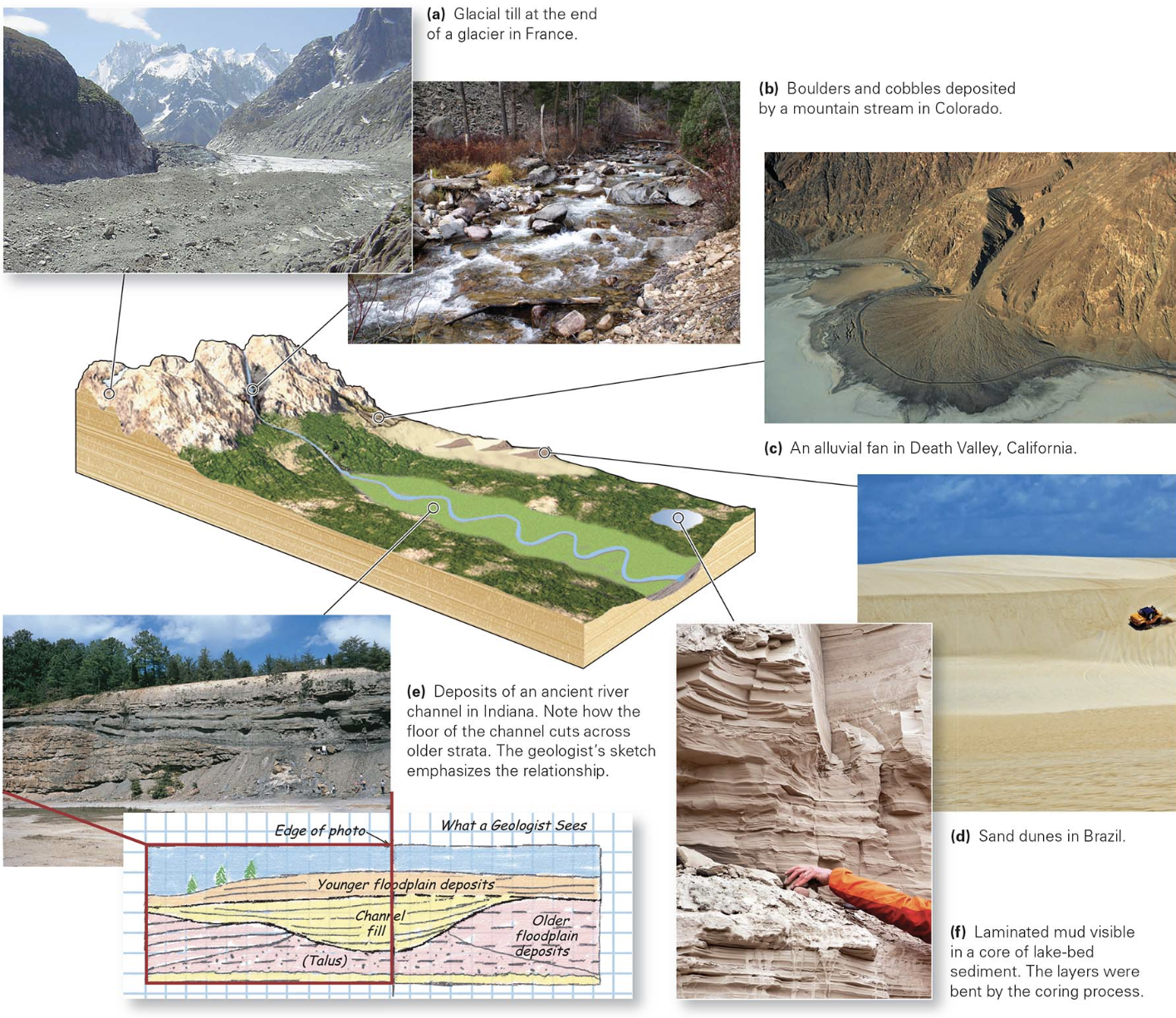
glacial
mountain stream
alluvial fan
desert
river + lakes
Glacial Environments:
because ice is a solid, it can move sediment of any size so as a glacier moves, it carries along all the sediment that falls on its surface or gets plucked from the ground at its base or sides
when ice finally melts away, the sediment that had been in or on the ice accumulates as glacial till
unsorted and unstratified as it contains clasts ranging from clay size to boulder size all mixed together
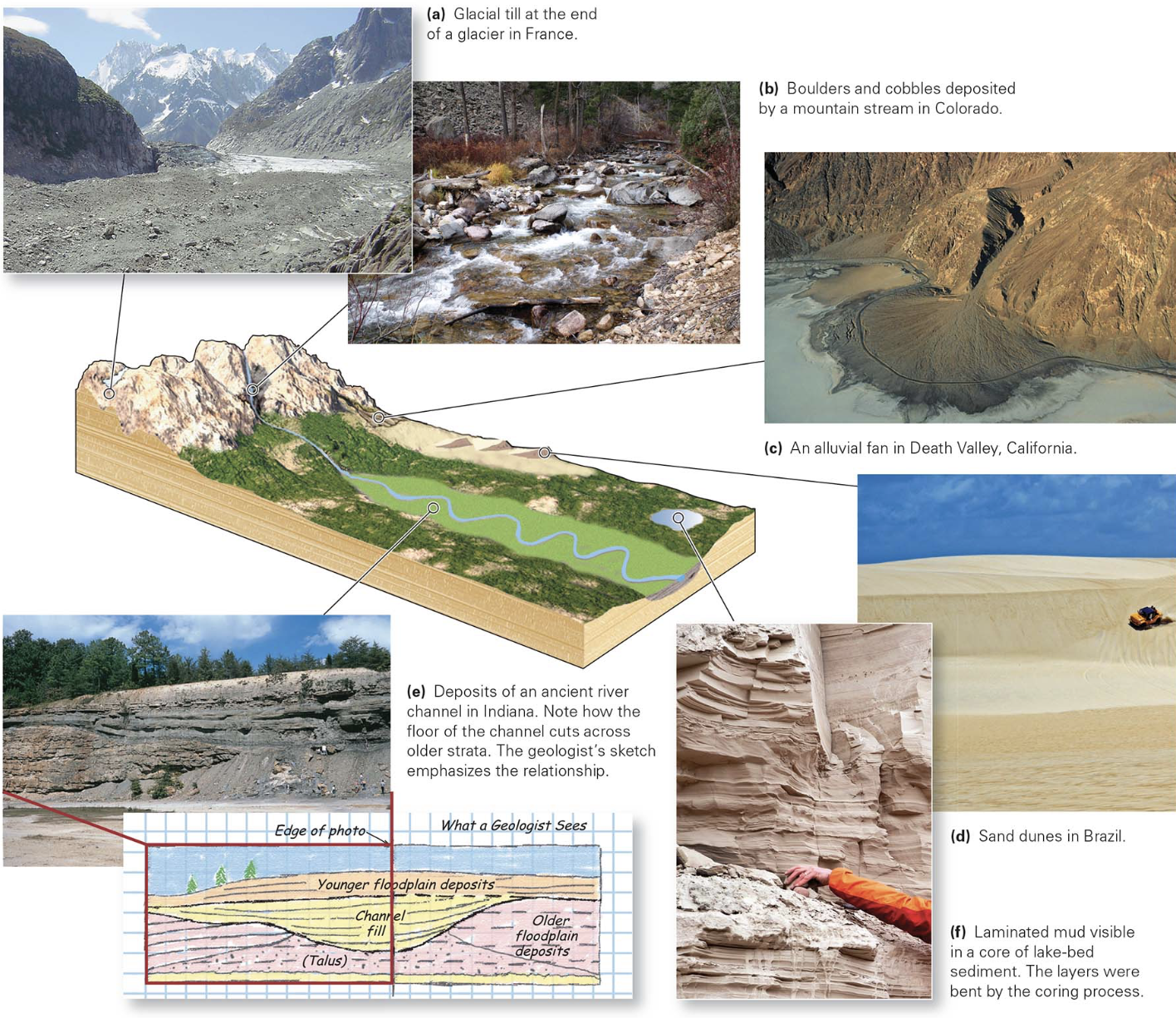
Mountain Stream Environments:
turbulent streams rush downslope in steep-sided valleys with the power to carry large clasts down the streambed where as slopes decrease and water flow slows, the larger clasts settle out to form gravel and boulder beds, while the stream carries finer sediments like sand and mud farther downstream
sedimentary deposits → breccia and conglomerate
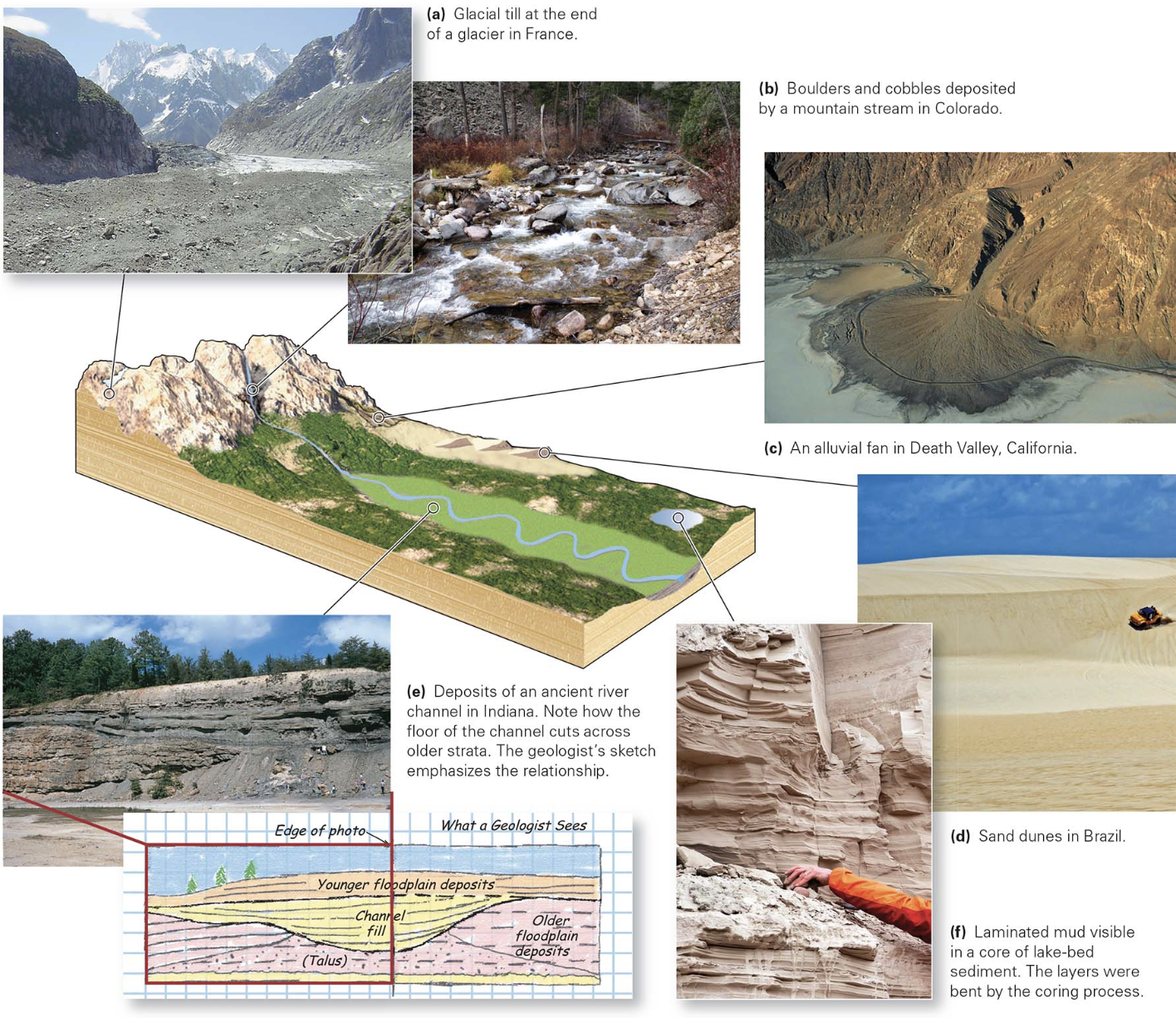
Alluvial fan:
arid regions where there is not enough water for the stream to flow continuously and deposits its load of sediment near the mountain front, producing a wedge-shaped apron of gravel and sand
Sediment in alluvial fans may accumulate close to the source, so it will not have undergone much chemical weathering
sand layers contain feldspar grains and become breccia, conglomerate, and arkose
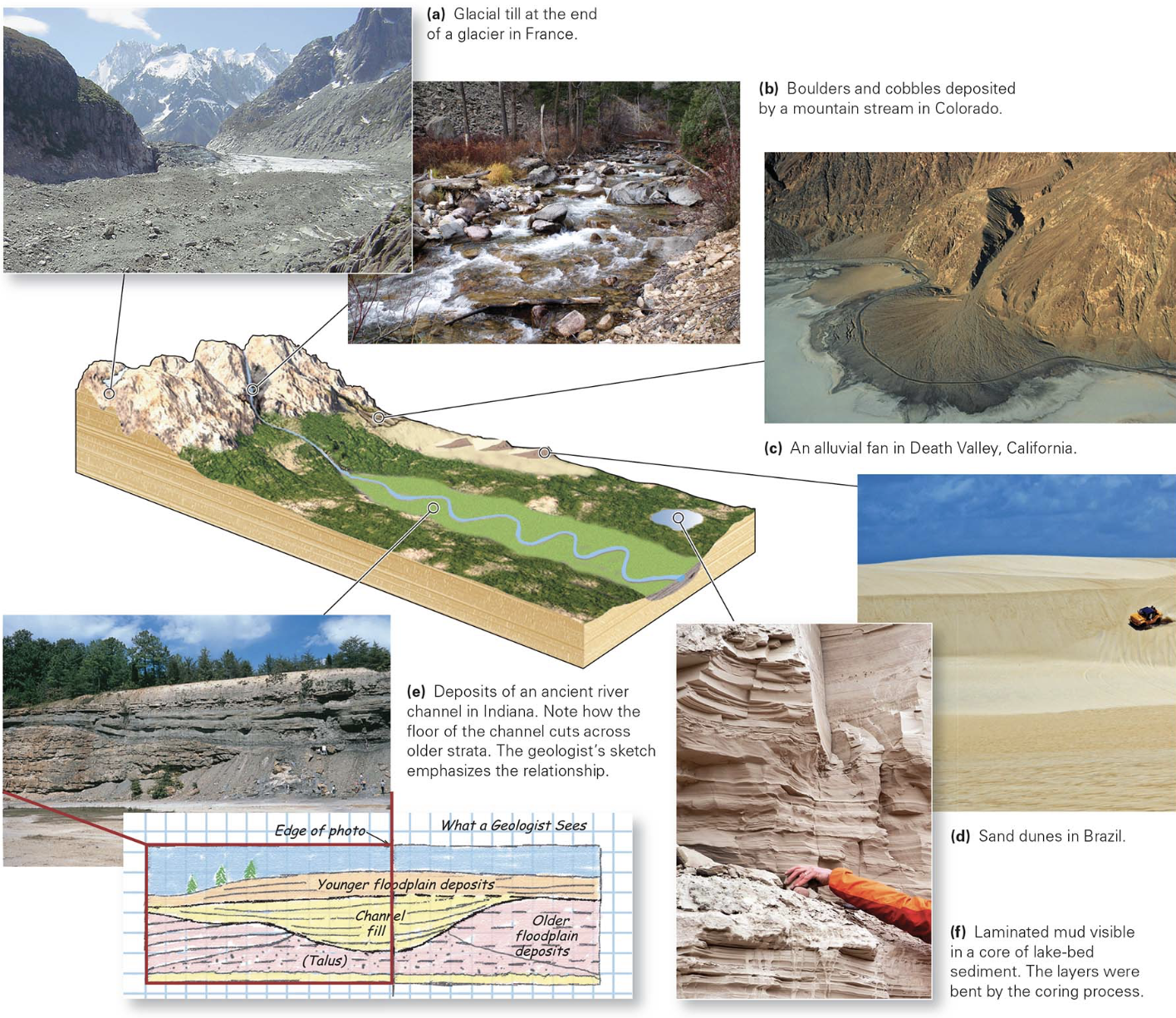
River Environments:
transport gravel, sand, silt, and mud where coarser sediment tumbles along the bed in the river’s channel and collects in cross-bedded, rippled layers, while the finer sediment drifts along, suspended in the water
fine sediment settles out along the banks of the river (floodplain) where mud layers dry out between floods, so they develop mud cracks
lithify to form rippled sandstone, siltstone, and shale
refer to river deposits as fluvial sediments
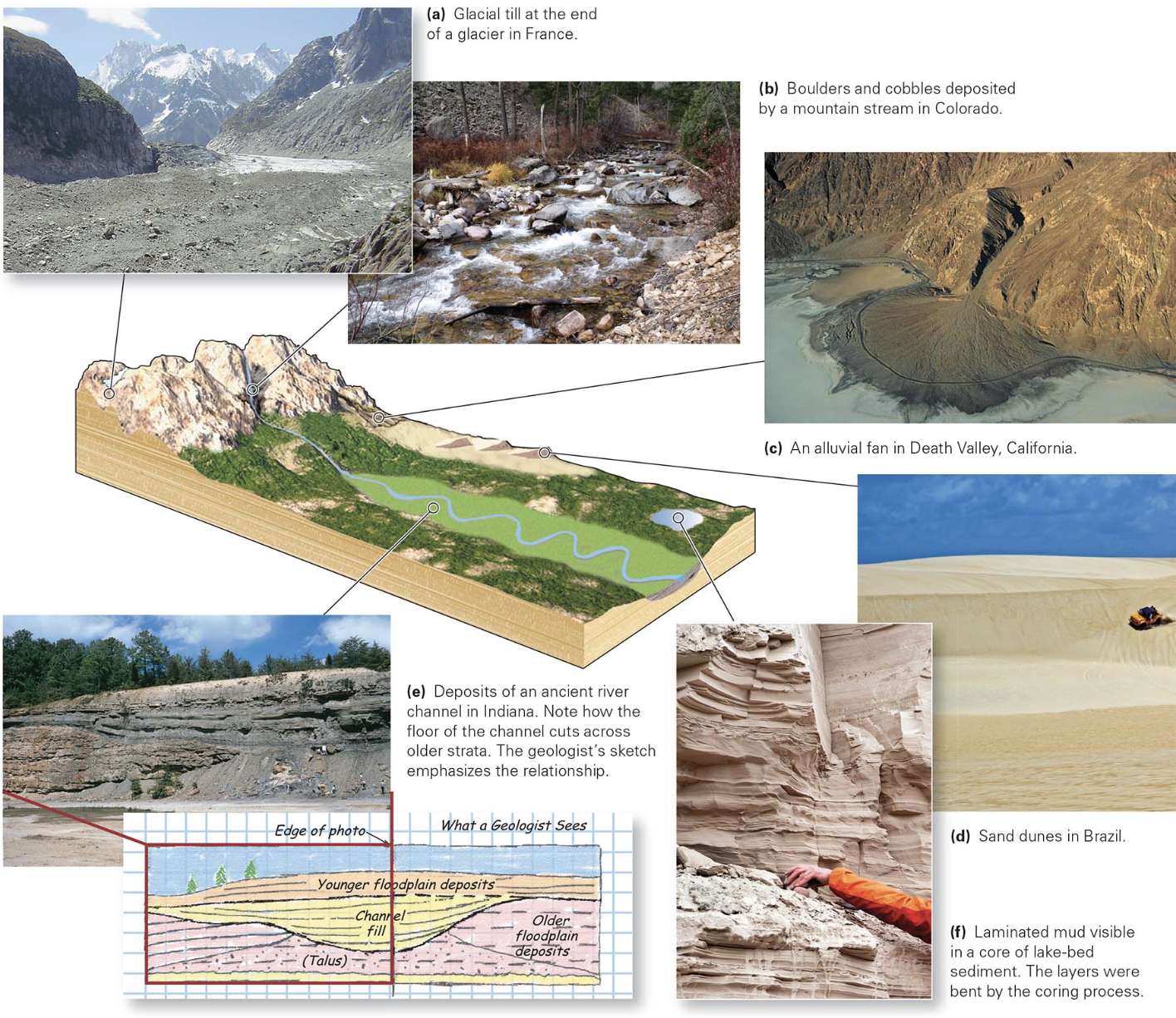
Lake Environments:
water remains at the surface throughout the year and in the offshore portions of a lake, the deeper water is relatively quiet, and clay can settle out to form mud on the lake bed; when lithified, such laucustrine mud turns into shale
at the mouths of streams that empty into lakes, small deltas may form
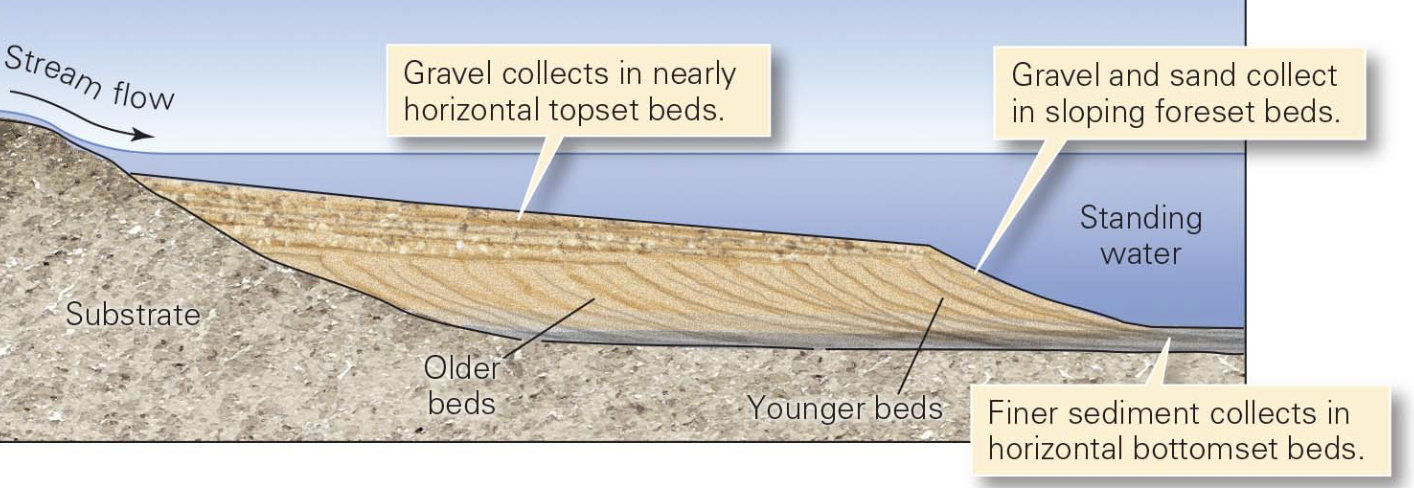
Delta:
wedge of sediment formed at a river mouth when the running water of the stream enters standing water, the current slows, the stream loses competence, and sediment settles out
topset beds composed of gravel
foreset beds of gravel + sand
silty bottomset beds
Coastal and Marine Depositional Environments:
character of each reflects the nature of the sediment supply and the climate where Marine environments start at the high-tide line and extend offshore to the deep seafloor and the type of sediment deposited at a marine location depends on the climate, water depth, and whether or not clastic grains are available
marine delta deposits
coastal beach sands
shallow-marine clastic deposits
shallow-marine carbonate environment
deep-marine deposits
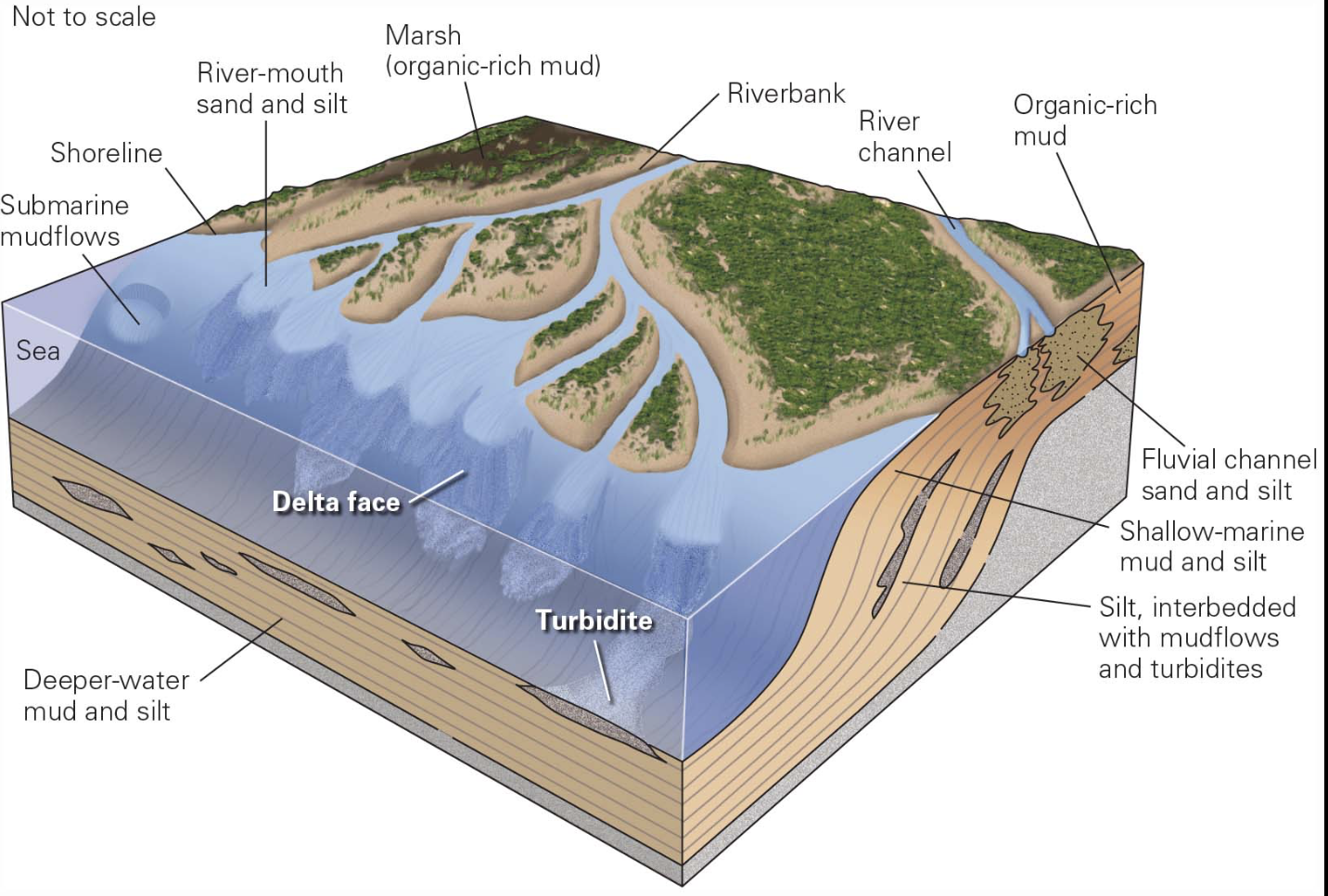
Marine Delta Deposits:
river emptying into the sea where water stops flowing, so sediment settles out to build a delta of sediment and include many different sedimentary environments, such as swamps, channels, floodplains, and submarine slopes
Sea-level changes may cause the positions of the different environments to move with time causing deposits to produce a great variety of sedimentary rock types
large marine deltas are much more complex
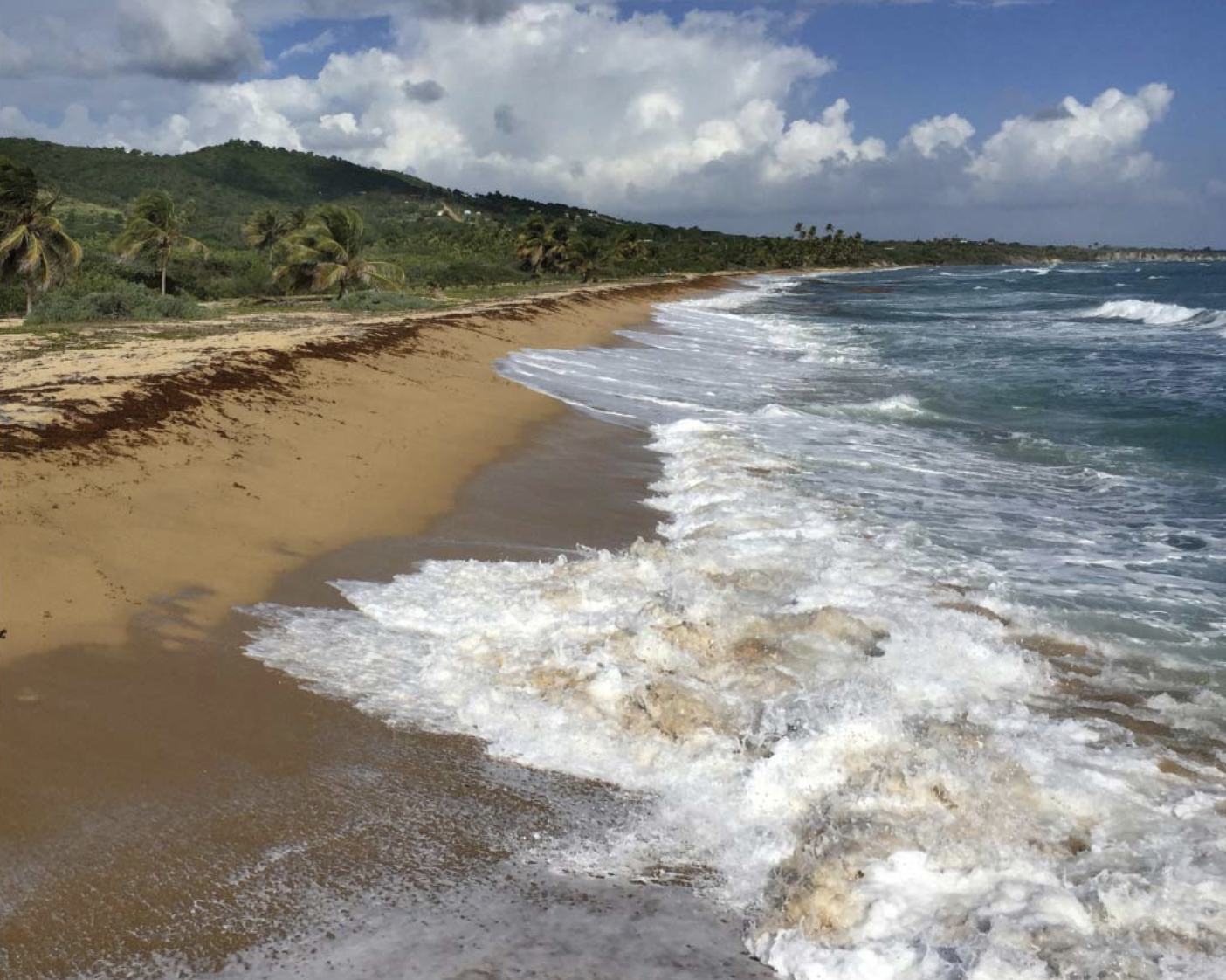
Coastal Beach Sands:
Oceanic currents transport sand along the coastline which washes back and forth in the surf, so it becomes well sorted (waves winnow out silt and mud) and well rounded, and because of the back-and-forth movement of ocean water over the sand, the sand surface may become rippled
well-sorted, medium-grained sandstone, perhaps with ripple marks, you may be looking at the remnants of a beach environment
Shallow-Marine Clastic Deposits:
deeper water, where wave energy does not stir the seafloor, finer sediment can accumulate and tend to be fine-grained, well-sorted, well-rounded silt, and they are inhabited by a great variety of organisms such as mollusks and worms
beds of siltstone and mudstone containing marine fossils, you may be looking at shallow-marine clastic deposits
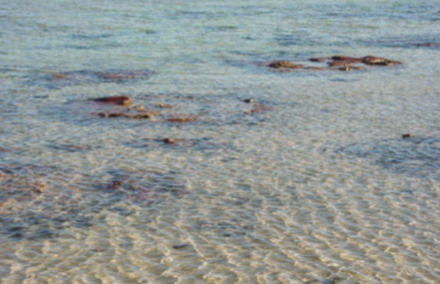
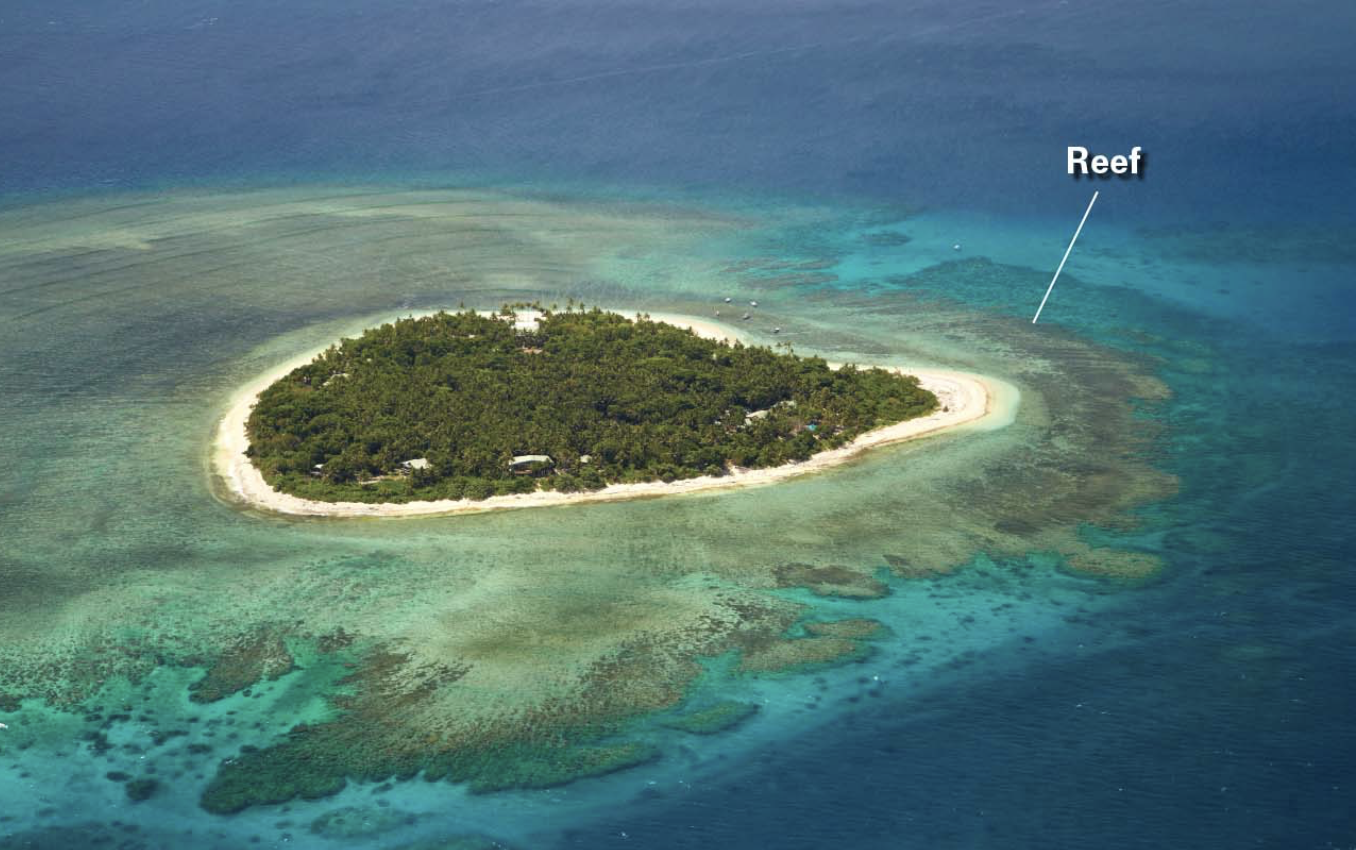
Shallow-Marine Carbonate Environments:
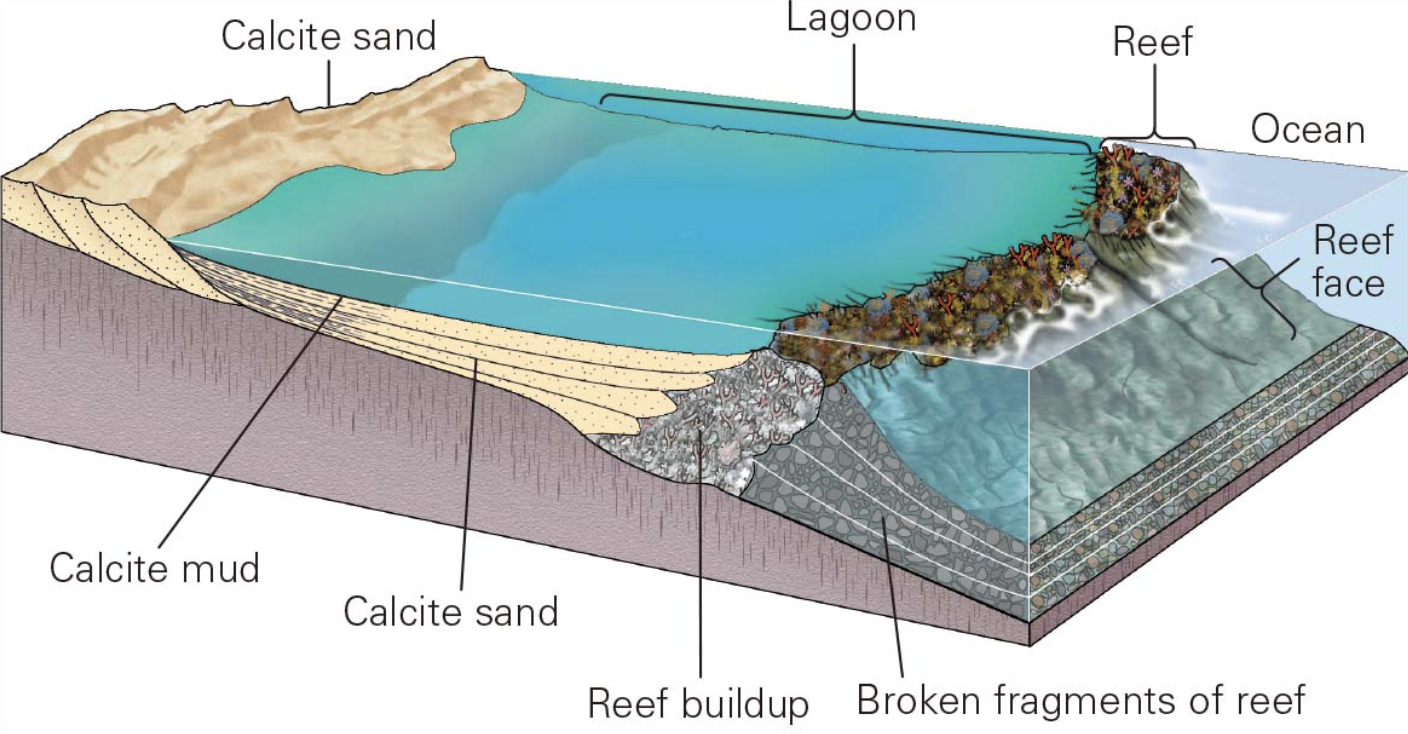
relatively little sand and mud enters the warm, clear, nutrient-rich water that can host an abundance of organisms with carbonate shells, which eventually become carbonate sediment and can transform into various kinds of limestone
Beaches collect sand composed of shell fragments
Lagoons are sites where carbonate mud accumulates
Reefs consist of coral and coral debris
Deep-Marine Deposits:
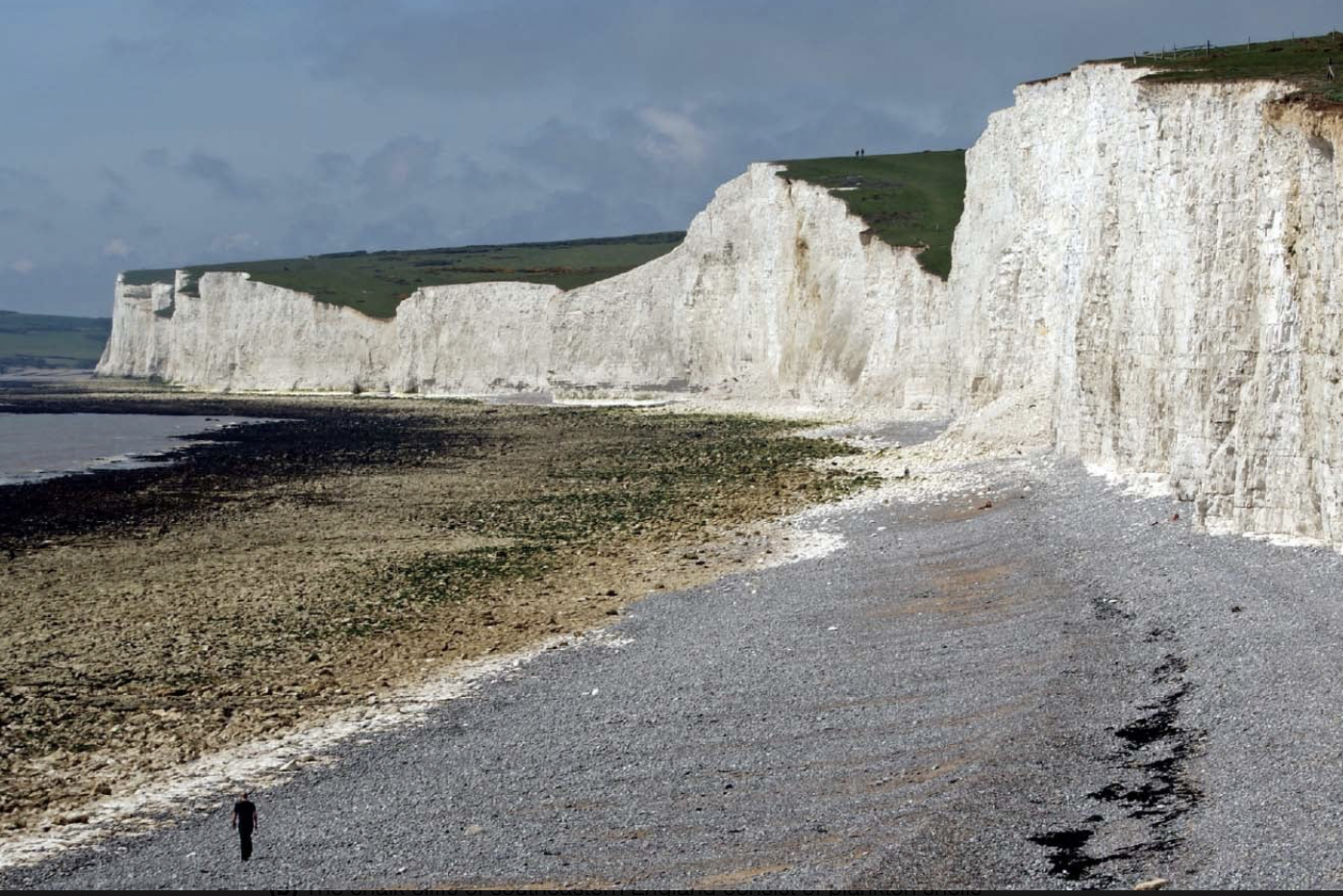
along the transition between coastal regions and the deep ocean, turbidity currents deposit graded beds where in the deep-ocean realm only fine clay and plankton provide a source for sediment
clay eventually settles out onto the deep seafloor, forming deposits of finely laminated mudstones, and plankton shells settle to form chalk (from calcite shells) or chert (from silica shells)
deposits of mudstone, chalk, or bedded chert indicate a deep-marine origin
Subsidence:
vertical sinking of the Earth’s surface in a region, relative to a reference plane; process by which the surface of the lithosphere sinks
Sedimentary basin:
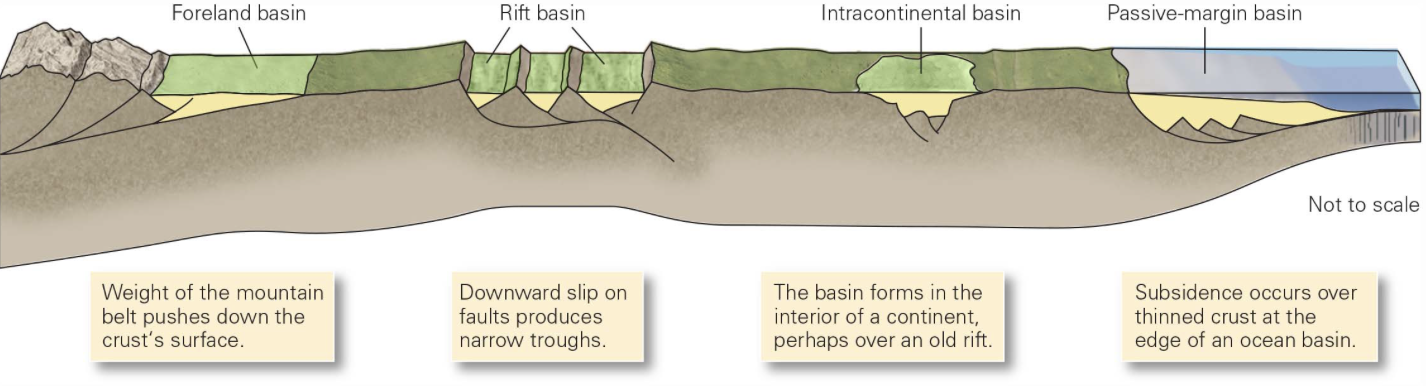
depression, created as a consequence of subsidence, that fills with sediment formed by rift basins, passive margins basins, intracontinental basins, and foreland basins
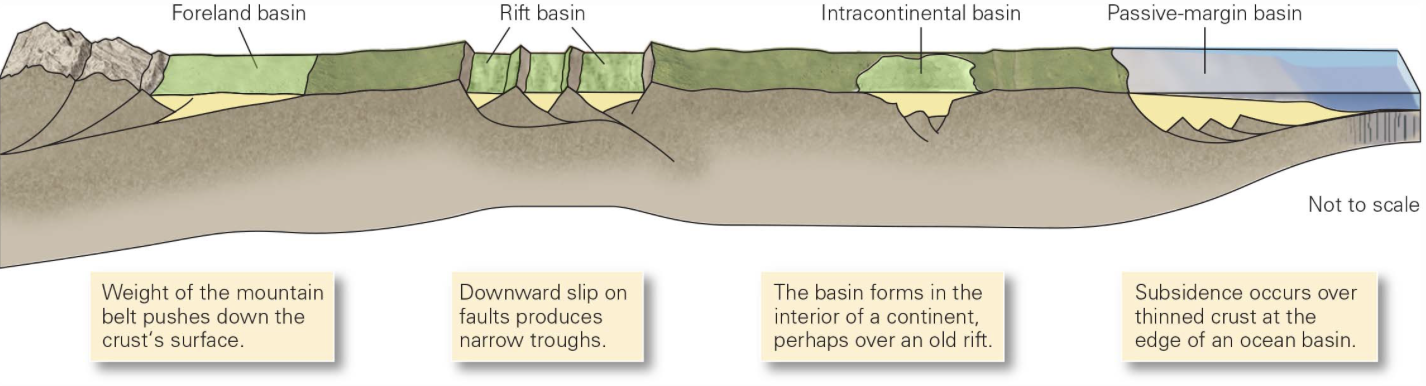
Rift basins:
form in continental rifts, regions where the lithosphere is stretching horizontally, and therefore thins vertically; As the rift grows, slip on faults drops blocks of crust down, producing low areas + narrow basins bordered by elongate mountain ridges
basins fill with terrestrial sediment
in deserts, overlapping alluvial fans line the margins
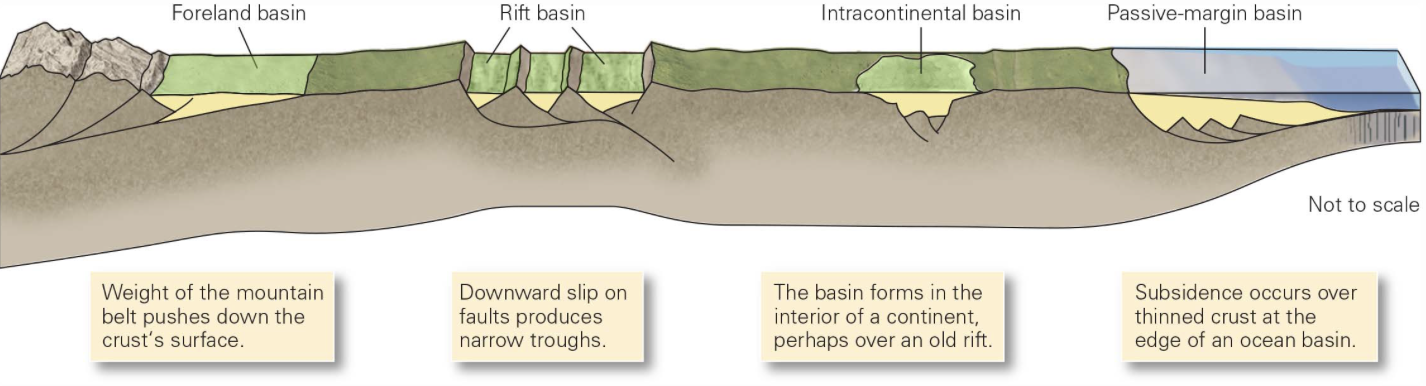
How do passive-margin basins produce sedimentary basins?
form along edges of continents that are not plate boundaries and are underlain by stretched lithosphere, the remnants of a rift whose evolution successfully led to the formation of a mid-ocean ridge and subsequent growth of a new ocean basin
form because subsidence of stretched lithosphere continues long after rifting ceases
fill with sediment carried to the sea by rivers + carbonate rocks formed in coastal reefs
some of the thickest accumulations of sediment on the Earth
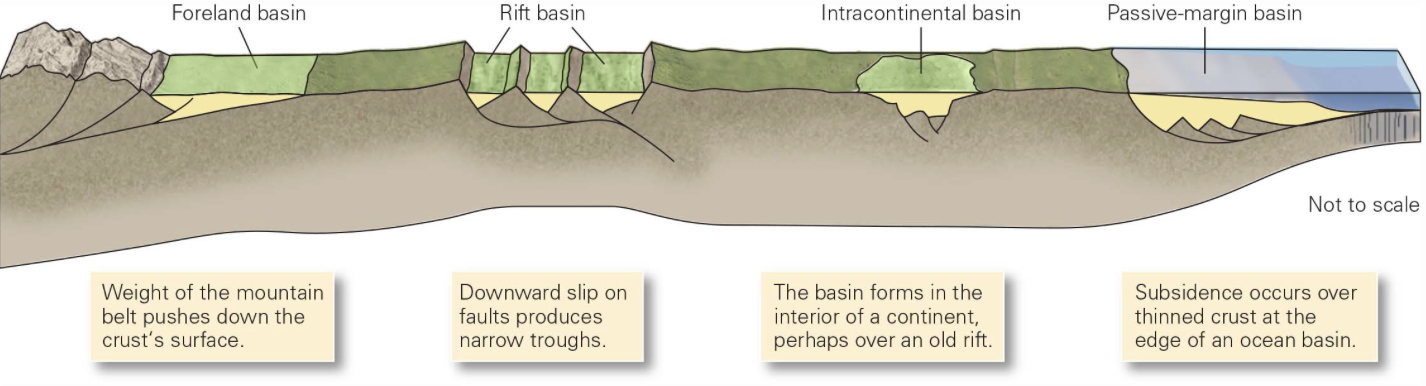
Intracontinental basins:
develop in the interiors of continents, initially because of subsidence over a rift and continue to subside in pulses, even hundreds of millions of years after they formed, for reasons that are not well understood
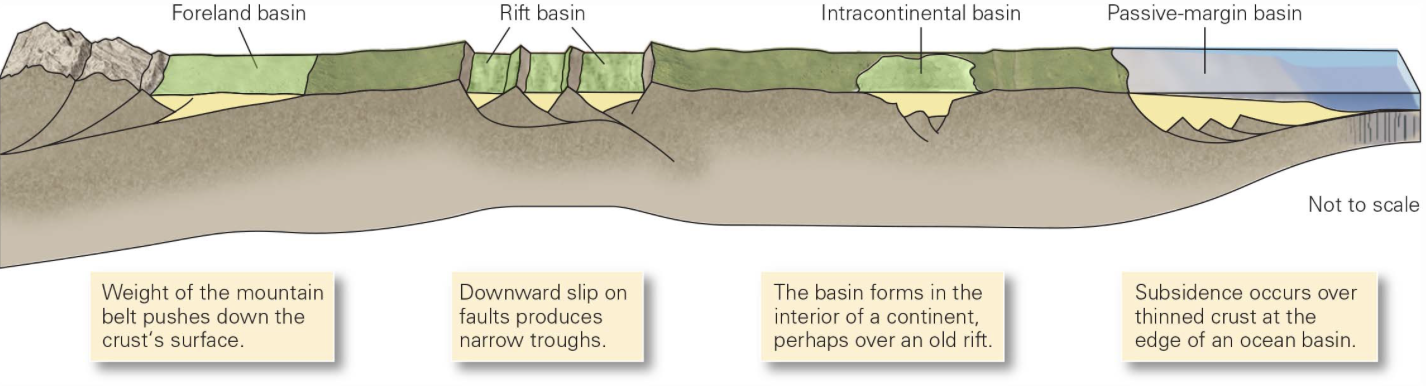
Foreland basins:
form on the continental side of a mountain belt because the forces produced during convergence or collision push large slices of rock up faults and onto the surface of the continent
weight of slices pushes down on surface of continent, producing a wedge-shaped depression adjacent to the mountain range that fills with sediment eroded from the range
Fluvial and deltaic strata accumulate
True or False: Changes in sea level, relative to the land surface, control the succession of sediments that we see in a sedimentary basin.
True
Transgression:
inland migration of shoreline resulting from a rise in sea level
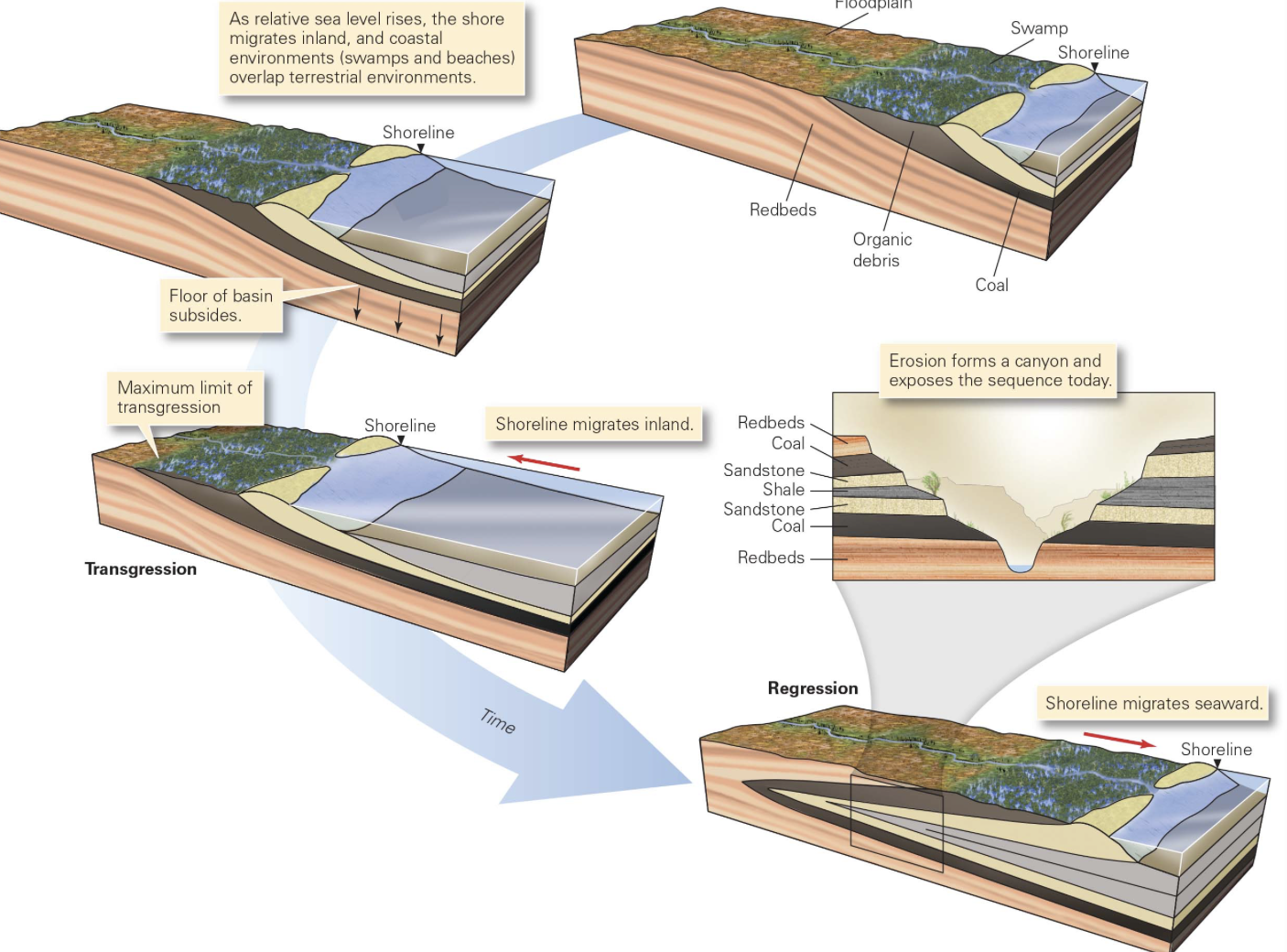
Regression:
seaward migration of a shoreline caused by a lowering of sea level
What happens to depositional environments during transgression and regression?
positions of depositional environments migrate, so the depositional environment at a given location changes over time where processes, acting over time, can lead to the formation of broad blankets of sediment
age of a given sediment layer deposited during a transgression or regression varies with location
Diagenesis:
all of the physical, chemical, and biological processes that transform sediment into sedimentary rock and that alter the rock after the rock has formed in response to pressure and to interaction with groundwater
transition between diagenesis and metamorphism in sedimentary rocks is gradational and occurs between temperatures of 150°C and 300°C