Reproduction
 Call Kai
 Learn
Learn Practice Test
 Spaced Repetition
 Match
Match Flashcards
 Knowt Play
1/18

There's no tags or description
Looks like no tags are added yet.
Name | Mastery | Learn | Test | Matching | Spaced | Call with Kai |
|---|
No analytics yet
Send a link to your students to track their progress
19 Terms
Gonochroistic
born sperm or egg producing and maintain status throughout entire life
Heterogametic
sexes are assigned by differing chromosomes
XY: sperm producing (heterogametic)
XX: egg producing (homogametic)
fishes do not have gender
GSD/GSD+ESD/ESD
GSD: sex determining gene on sex chromosomes (trout and pufferfish (XX/XY), yellowtail and tongue sole (ZZ/ZW)
GSD+ESD: sex determining genes and sex changing environmental factors (flounder and eel) GSD+ESD)
ESD: sex changes in environmental factors (mangrove rivulus (simultaneous; both M/F) clownfish and grouper (either M→F or F→M)
Dioecious
one sex for life
sperm producing or egg producing
Hermaphrodites
interchangeable between M and F
simultaneous or sequential
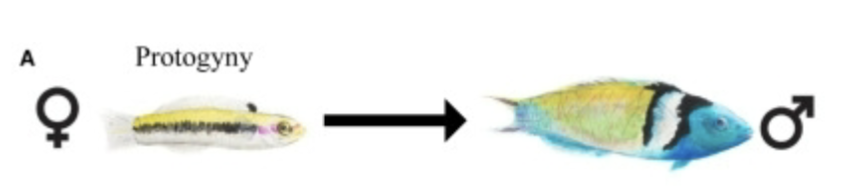
Protogyny
starts as females turns to male (wrasses)
Monandric: males develop only from females (one pathway)
Diandric: males can develop from females or directly from juvenile males (two pathways)
Protandry (clownfishes)
start as males turns to female
Hormone used: androgen
Oviparous (flying fish)
eggs fertilized inside or outside but laid outside by female
Ovoviviparous (mosquitofish)
fertilized egg inside mom and hatch inside
Viviparous (sharks)
direct physical connection with mom, born in womb. like humans, no egg hatched or needed
Parthenogenesis
Gynogenetic: Form of asexual reproduction, may or may not require sperm. maternal genetic material only meaning males do not pass down DNA
Hybridogenentic (aka parasitism): reproduction between different species. uses male genetic material for the offspring's body but discards it when creating her eggs, transmitting only the mother's genome and is renewed by mating with another male corresponding species.
Spawning
eggs and sperm released or deposited into water and are fertilzed by other animals
Sexual parasitism (angler fish)
relationship in which one sex benefits and the other is harmed
male fishes bite onto females and latches on fusing tissues and shares one circulatory system
Brooding
Mouth: fertilized eggs are carried and incubated in thevparent's mouth. (cuckoo cichlid)
Head: fertilized eggs are carried on a supraoccipital hook on the male’s head (nursery fish)
Pouch: is a sac or cavity in an animal's body where eggs or embryos are received and developed (seahorse)
Nest: eggs are laid in nests and kept there until they hatch, nest guarding (usually by males) occurs in marine and anadromous fishes but is most common in freshwater species. (betta fish - bubble nest)
Harems vs satellite males
Harem males: Polygyny group of fishes, where there is one harem male, usually significantly larger than the females, and multiple females within the group. If the male is removed from the harem, the largest female may begin courting the other females and develop male organs. Low genetic diversity if 1 male
satellite males: non-territorial males that adopt an alternative mating strategy, positioning themselves near dominant territorial males to intercept females and fertilize eggs
Breeding tubercles
Appear as either partial or fully keratinized cells in particular regions on males. Used to stimulate females during reproduction. Development of stimulated by hormones.
Intermittent organs
Gonopodium - modified anal fin that can allow a male hook onto a female before releasing sperm
Priapum - located under the chin, a combination of the pelvic girdle, postcleithrum, and pectoral pterygial elements in males are used to hold onto the female while fertilizing eggs before they are released
Sperm storage
When males mate with a single female, this female is able to store sperm for long periods of time (female bamboo sharks)
This offers females the option to fertilize eggs in optical conditions
This allows males it allows for passing of genes
Sexual Dimorphisms
Coloration: (Betta Fish) Male betta fish are much more vibrant than females of the species showing a wide variety of coloration.
Size and Shape-Angler Fish: Female angler fish are much larger in size compared to the males (60 times the length). Males may find difficulty in finding food and their alimentary canals of some males be stunted.