impact of symbiosis on human health and disease
 Call Kai
 Learn
Learn Practice Test
 Spaced Repetition
 Match
Match Flashcards
 Knowt Play
1/24

Earn XP
Description and Tags
Lecture 16 MICR221
Name | Mastery | Learn | Test | Matching | Spaced | Call with Kai | Chat |
|---|
No analytics yet
Send a link to your students to track their progress
25 Terms
what are pathogens
bacteria that cause disease
commensals or mutualistic bacteria characteristics (3)
don’t cause disease
benefit from association with humans
can provide benefits to humans (mutualistic)
symbiosis
‘living together’ of two organisms
what is commensalism
relationship where one organism benefits and the other is neither helped nor harmed
what is mutualism
relationship where both organisms benefit
what is pathogenesis
relationship where one organism is harmed
ways bacteria ‘help create us’ (3)
intestinal flora help with human nutrition
stimulate proper growth of intestine and immune system
perturbation of normal bacterial flora can contribute to disease
areas of body colonised by commensal/mutualistic bacteria (5)
skin
oral cavity
nasopharynx
stomach
gastrointestinal tract
classic approach to identifying bacteria that colonise certain sites in the body
culturing
limitations of culturing (2)
many microbes in human body can’t be grown in lab conditions
labour-intensive
modern approach to identifying bacteria that colonise certain sites in the body
DNA sequencing of 16S rRNA
what does the modern approach (DNA sequencing) allow
identification of bacteria at the genus level
in commensalism, what does the host provide? (2)
habitat and nutrients
in mutualism, what can the microbe provide to the host (human specific)? (4)
vitamin synthesis
facilitate digestion (enzymes)
develop immune system
develop physiology e.g. intestinal epithelium
main ways microbes assist with human nutrition (2)
synthesise vitamins
digest polysaccharides
pH factor microbes living in the stomach must adapt to
low pH
pH factor microbes living in the small intestine must adapt to
acidic (but less acidic than stomach)
factors microbes living in the colon must adapt to (2)
neutral pH, little to no oxygen
what about the 16S subunit in ribosomes makes it identifiable?
similarity in most amino acid positions but there are a few unique differences based on the species
what percent of bacteria weren’t able to be cultured in the Gill et al. study?
83%
metagenomics
study of genomic material recovered from natural bacterial communities
what is the approach used for metagenomics?
genome sequencing of the all bacterial genomes present
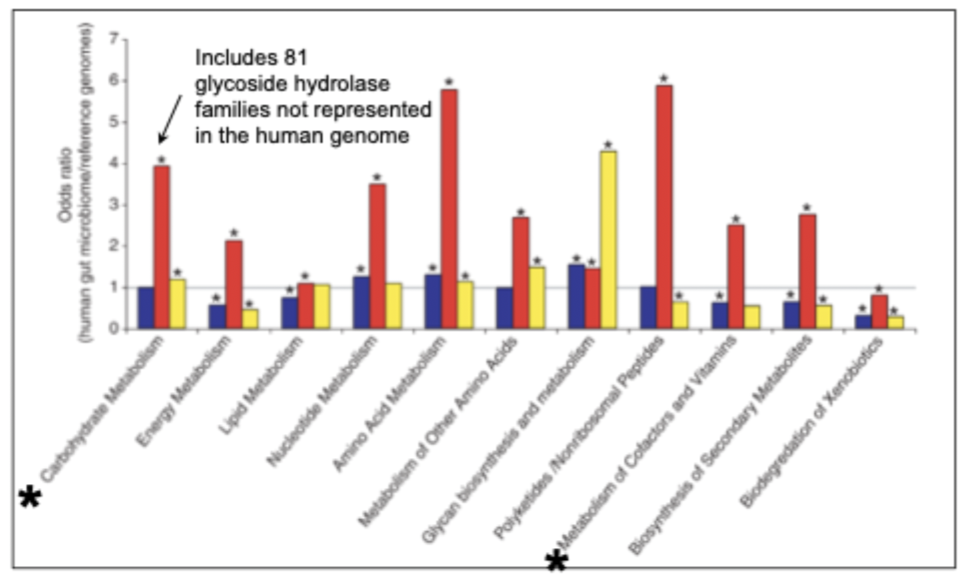
what does a value of greater than one in the red columns of this graph indicate, given the blue is human genes relating to that function
bacteria are providing more genes with the specified function
germ-free/gnotobiotic organism
born with no microbes present