respiration and gas exchange
 Call Kai
 Learn
Learn Practice Test
 Spaced Repetition
 Match
Match Flashcards
 Knowt Play
1/19

There's no tags or description
Looks like no tags are added yet.
Name | Mastery | Learn | Test | Matching | Spaced | Call with Kai |
|---|
No analytics yet
Send a link to your students to track their progress
20 Terms
what is respiration and how does it produce ATP?
respiration is the process of transferring energy from glucose, which happens constantly in every living cell. Oxygen is used to oxidise food (mainly glucose), and carbon dioxide is released as a waste product. The chemical energy in the glucose is then converted into ATP. When a cell needs energy, ATP molecules are broken down and energy is released.
ATP provides energy for:
the contraction of muscle cells
building large molecules such as proteins
what does ATP do?
ATP is the molecule that stores and supplies energy for cellular processes
what is aerobic respiration?
respiration that uses oxygen, and it is the most efficient way to transfer energy from glucose. It can produce 32 ATP molecules per molecule of glucose. All living cells with a mitochondria can respire anaerobically if oxygen is available.
what is anaerobic respiration?
it happens when oxygen isn’t available or is in short supply, for example during vigorous exercise. Glucose is not completely broken down, so less energy is released - only two ATP molecules per molecule of glucose.
During exercise, anaerobic respiration provides enough energy to keep the overworked muscles working for a short period. However, lactate also builds up in the muscle cells and the bloodstream, causing pain. After the exercise, the lactate is respired aerobically in the mitochondria.
what is the balanced chemical symbol equation for aerobic respiration in living organisms?
C6H12O6+ 602→ 6CO2+6H2O
what is the word equation for aerobic respiration in living organisms?
glucose + oxygen → carbon dioxide + water (+energy)
what is the word equation for anaerobic respiration in plants?
glucose → ethanol + carbon dioxide (+energy)
what is the word equation for aerobic respiration in animals?
glucose → lactic acid (+energy)
describe the structure of the thorax
When we breathe in, air enters our nose or mouth and passes down the trachea (a long tube). The trachea then splits into two smaller tubes called the bronchi, which leads to each lung, and in the lungs there are even smaller tubes called the bronchioles which end in air sacs called alveoli. The pleural membranes are two thin membranes that form an airtight seal around each lung
The lungs are protected by the ribcage, which surrounds the thorax, and intercostal muscles are located between the ribs. The diaphragm is a large sheet of muscle which separates the thorax from the lower part of your body.
what is ventilation?
ventilation is the movement of air in and out of the lungs, and it requires a difference in air pressure as air moves from a place where the pressure is high to one where it is low.
why are the intercostal muscles and the diaphragm important in ventilation?
When you breathe in, the outer intercostal muscles contract, pulling the ribs up. At the same time, the diaphragm contracts, pulling the diaphragm down into a flatter shape. This increases the volume of the thorax, which decreases the pressure inside it, causing air to enter the lungs. This process is called inhalation.
When you breathe out, the external intercostal muscles relax and the internal intercostal muscles contract, pulling the ribs down. At the same time, the diaphragm muscles relax and the diaphragm moves back into its normal dome shape. The volume of the thorax decreases, so the pressure is raised and air is forced out of the lungs into the trachea and eventually exits the body through the nose or mouth. This process is exhalation.
how are alveoli adapted for gas exchange?
there are millions of alveoli, which increases the surface area for gas exchange
they have thin walls made up of cells, that are only one cell thick so there is a shorter distance for gases to diffuse across, causing a faster rate of diffusion
they are folded to increase the surface area available for gases to diffuse across
the walls are permeable so gases can diffuse across easily
what lung condition can smoking cause? (e)
emphysema - emphysema is a lung disease commonly caused by smoking. The smoke damages the walls of the alveoli, which then break down and fuse together again, creating irregular air spaces. This reduces the surface area for gas exchange, making it less efficient and meaning less oxygen enters the blood, which means less ATP is produced.
what lung condition can smoking cause? (l)
Lung cancer - tar builds up in a smoker’s lungs, including carcinogens which can cause uncontrollable cell division, forming a tumour in the lung
what lung condition can smoking cause? ( c )
chronic bronchitis - normally, goblet cells lining the bronchi produce mucus. Dust, dirt, and bacteria get trapped in it, but ciliated epithelial cells move the mucus out of the airways. However, tar in cigarette smoke damages the ciliated epithelial cells so the mucus stays in the lungs and builds up dust, dirt and bacteria which can cause chronic bronchitis.
what circulatory system condition can smoking cause? ( c )
coronary heart disease - the carbon monoxide in cigarette smoke reduces the amount of oxygen the blood can carry by binding to haemoglobin molecules. To make up for this, heart rate increases, leading to an increase in blood pressure which damages the artery walls, making the formation of blood clots more likely. This increases the risk of coronary heart disease.
how can you investigate the effect of exercise on breathing rate?
sit still for 5 minutes
count the number of breaths you take in one minute
do four minutes of exercising and count your breaths for 1 minute as soon as you stop
repeat and calculate the mean for breaths per minute resting and after exercise
Result: exercise increases breathing rate because your muscles need more energy during exercise, so your muscle cells respire more. They need to be supplied with more oxygen and have more carbon dioxide removed, so your breathing rate increases.
Control variable: the time spent exercising/the temperature of the room
independent variable: exercise/resting
dependent variable: breaths per minute
how can you investigate the release of carbon dioxide?
set up two boiling tubes, and put the same amount of limewater in each
put your mouth around the mouthpiece and breathe in and out several times
result: as you breathe in, air from the room is drawn in through boiling tube A. This air contains very little carbon dioxide, so the limewater in tube A remains colourless. When you breathe out, the air you exhale contains CO2 produced in respiration, so the limewater in boiling tube B turns cloudy.
Control variables: volume of limewater in each tube, same person breathing, same apparatus
Independent variable: type of air
Dependent variable: colour of limewater
investigate the evolution of carbon dioxide from living organisms
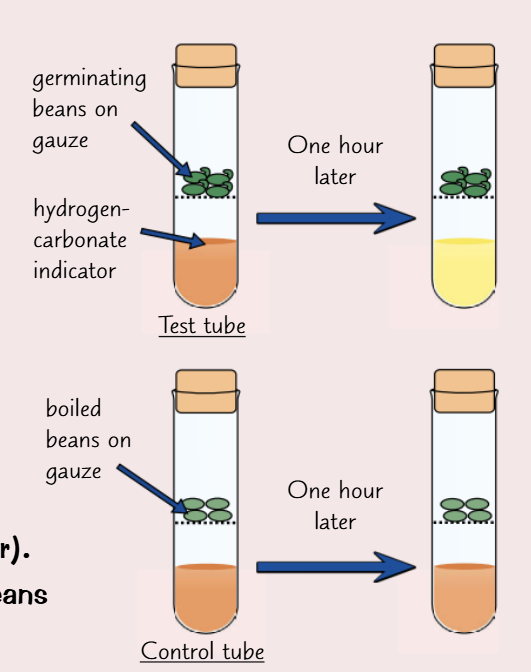
First, soak dried beans in water for a day - they will start to germinate. Germinating beans will respire.
Then, boil some dried beans, which will kill them and make sure they can’t respire. This is the control.
Put the same amount of hydrogen-carbonate indicator into two test tubes
Place a platform made of gauze into each test tube and place the beans on it
seal the test tubes with a rubber bung
leave the apparatus for a set period of time
Results: You can use hydrogen-carbonate indicator to show living organisms produce CO2 as they respire, as the solution in normally orange, but changes colour to yellow in the presence of CO2. Therefore, the hydrogen-carbonate indicator in the tube with the germinating beans should have turned yellow, while the indicator in the other tube should have stayed orange.
Control variables: the temperature, the volume of hydrogen carbonate, the species of seed
Independent variable: whether the seeds are alive or dead
Dependent variable: the colour of the hydrogen-carbonate
investigate the evolution of heat from living organisms
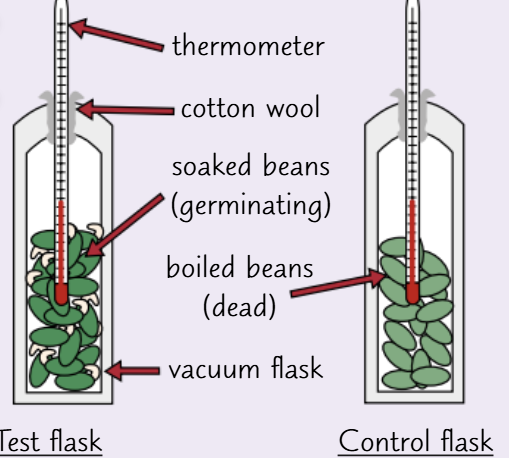
prepare two sets of beans the same way as the carbon dioxide experiment
add each set of beans to a vacuum flask, making sure there’s still air left in the flasks so the beans can respire aerobically
place a thermometer in each flask and secure the top with cotton wool
record the temperature of each flask daily for a week
result: the beans are well insulated in the flasks, so the test flask’s temperature will increase as the germs respire, and the temperature of the control flask will stay the same because the beans weren’t respiring
control variables: the same starting temperature, the number of beans
independent variable: whether the seeds are alive or dead
dependent variable: the temperature of the test flasks