Microbiology Exam 3 chapters 9, 12, 13, 14
 Call Kai
 Learn
Learn Practice Test
 Spaced Repetition
 Match
Match Flashcards
 Knowt Play
1/113

There's no tags or description
Looks like no tags are added yet.
Name | Mastery | Learn | Test | Matching | Spaced | Call with Kai |
|---|
No analytics yet
Send a link to your students to track their progress
114 Terms
__________________________________________ is the transfer of genetic material between unrelated individuals, whereas __________________________________________ is the transfer of genetic material from parental organism to progeny.
Horizontal gene transfer, vertical gene transfer
Main Modes of Horizontal Gene Transfer:
1. Transformation – _____________________________________________________________________
__________________________________________________________________________________________
2. Conjugation – ________________________________________________________________________
__________________________________________________________________________________________
3. Transduction – _______________________________________________________________________
__________________________________________________________________________________________
Transformation - Organisms pick up freely existing DNA pieces from the environment, mostly from nearby recently dead cells.
Conjugation - Direct DNA / gene transfer utilizing cell to cell contact, which is initiated via a sex pilus.
Transduction - Transfer of DNA and genetic material from one bacterial cell to another, with a virus acting as the means of transport.
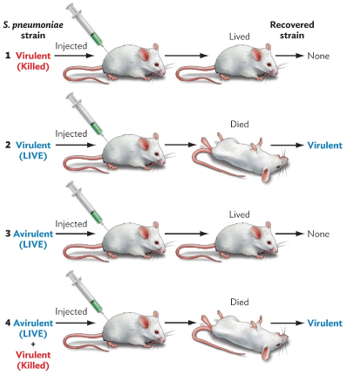
Transformation
Explain in your own words how this experiment with using two strains of a species (virulent and avirulent S. pneumoniae) showed that bacteria can pick up exogenous DNA from the environment and incorporate it into its own genome.
In this experiment, the controls for this experiment showed that the virulent strain of bacteria caused death to the mouse, but the heat killed virulent strain and the avirulent strain did not kill the mouse. When there was a mixture of dead virulent and live avirulent given in the same mixture, the mouse was killed. This showed that the live avirulent picked up the DNA from the dead virulent strain and added the virulent strain’s DNA into its own genome, which allowed the avirulent strain to become virulent, via DNA Transformation (picked up DNA from the environment.
True or False: All bacterial cells are able to successfully and efficiently perform Transformation processes.
False
What are three different forced ways that Transformation can be accomplished in lab-based settings? Briefly explain how these methods get the foreign DNA to enter the bacterial cell.
1. Calcium Chloride – __________________________________________________
2. Heat Shock – __________________________________________________
3. Electroporation – __________________________________________________
Calcium Chloride - Chemical method to temporarily disrupt the cell membrane to allow DNA to pass through.
Heat Shock - Physical method to disrupt the cell membrane to allow DNA to pass through.
Electroporation - Uses positively charged electrical impulses to shoot the negatively charged DNA through the cell membrane.
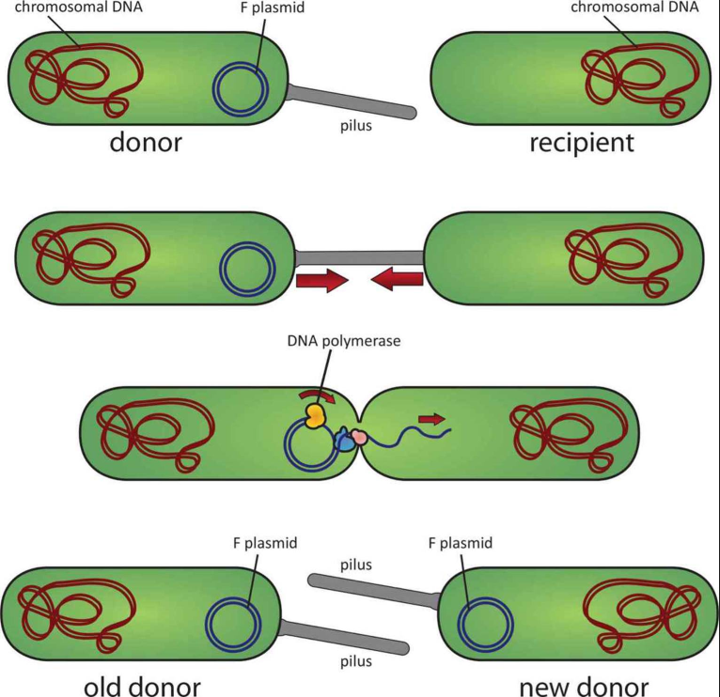
Conjugation
Use this diagram to fill in the blank the needed steps for bacterial cells to undergo conjugation.
1. The donor F+ cell makes the ______________________________ that is used for direct cell-to-cell contact during conjugation.
2. The _______________________ attaches to the recipient cell and _________________________________________ in order to have direct contact with each other.
3. A __________________________________ is formed after the cell membranes are temporarily broken down to form a connecting hole through each cell.
4. The plasmid in the F+ cell is cut at the _______________________________, so one complete strand of the plasmid can be threaded and crossed into the recipient cell.
5. DNA ______________________________________ occurs independently for the plasmids in each cell, each cell using their individual strand to serve as the complement to synthesize a new strand.
6. The ____________________________________ holding the cells together breaks apart and now the recipient cell has the F+ plasmid and can initiate conjugation with other F- cells.
sex pilus
sex pilus, pulls the recipient cell in closer
protein bridge
oriT
replication
protein bridge
True or False: Some plasmids can integrate with the organism’s chromosome containing the entire genome, and when this occurs, there is a possibility, even though its very unlikely, that an organism could pass an entire genome to another organism via conjugation.
True
Why is it highly unlikely that an entire genome would not be able to be successfully transferred to another organism via conjugation in an environmental setting, and we really only see that in a lab-based setting?
The temporary protein bridge that forms to stabilize the connection between the two cells is fairly weak, so most of the time the connection between the cells would be broken due to changes in the environment before enough time had passed for an entire chromosome to be transferred into a recipient cell.
What environmental structure that bacterial cells can form offers a great place for conjugation to take place in? ___________________
Explain why this structure offers a great place for conjugation to take place in. _________________________________________________________________________________
Biofilms
The thick matrix that the EPS offers from a biofilm formation is highly resistant to environmental changes, both chemical and physical, so it offers a very stable environment for conjugation to take place, with the protein bridge not as likely to be disrupted
Transduction
Transduction is the movement of bacterial DNA from one bacterial cell to another via a _____________________________________________, which is specifically a virus that infects bacterial cells.
bacteriophage
Generalized Transduction:
When a virus infects a bacterial cell, it takes over that bacterial cell and forces it to make phage parts: the proteins that make up the phage structure, replicate its genome, assemble and put the phage together, etc.
During phage replication and assembly, sometimes the bacterial genome can become degraded and start to break down into pieces. When this happens, sometimes mistakes occur during the phage assembly process, and instead of phage DNA/genome, random __________________________________________ gets packed inside the phage capsid instead.
Now, when that virus gets released into the environment and goes and “infects” a new cell, the only DNA that will be delivered to the new cell is __________________________________________.
host bacterial DNA, bacterial DNA
Specialized Transduction:
When some phages inject their genome into a bacterial cell, it _________________________________ into a specific region within the host bacterial chromosome, meaning it enters and becomes part of the bacterial genome. When this happens, the phage DNA region of the host bacterial chromosome is called a ___________________________________.
During the time the phage is inside the host genome, the virus is dormant, but once activated again, it _______________________________, or cuts out of the bacterial chromosome to become a separate viral genome again, but when this occurs, sometimes it takes pieces of host genome with it.
integrates, prophage
excises
Now the virus takes over the bacterial cell and forces it to make all the phage pieces, including replicating the phage genome, but it is now phage genome PLUS a small part of bacterial DNA as well.
The phage genomes get packaged inside the capsids, and once phage are released to go infect other cells, not only are they injecting their phage genome, they are injecting a bit of Recombination ________________________________________ DNA as well into these new host bacterial cell.
bacterial
Recombination
Define recombination – ______________________________________________________________________
What are the major differences in generalized recombination when compared to site-specific recombination events?
__________________________________________________________________________________________
The addition of new DNA to a host cell’s genome.
In Generalized Recombination the overall length of the genome doesn’t really change. Taking out a piece that is broken and adding in a new, unbroken gene. Site-specific Recombination is adding in genes in totality, so actually making the genome longer by adding genes that didn’t exist before.
What are the two main reasons generalized recombination serves as a beneficial function in bacterial cells?
___________________________________________________________________________________________________________________
____________________________________________________________________________________________________________________
Cells with damaged chromosomes use DNA donated by others of the same species to repair their damaged genes.
Recombination is also part of a “self-improvement” program to obtain genes from other organisms that might enhance the competitive fitness of the cell.
Evolution
Random mutations accumulate at steady rates over generations of replicating bacterial cells. Because bacteria do not interbreed and mix DNA together like humans, we call the accumulation of these random mutations bacterial cells accumulate _________________________________________ which causes genome sequences to _______________________________________, meaning become genetically different and more dissimilar, over time.
We can track these genetic changes through different means. These methods include using molecular clocks. One type of molecular clock that is specifically used to track the historical relationship between species by looking at sequence similarity and differences is depicted in a diagram called a __________________________________________________.
genetic drift, diverge
phylogenetic tree
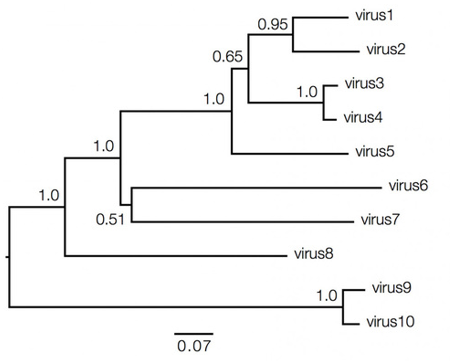
· Based on this phylogenetic tree, which organism(s) is(are) most divergent, or most dissimilar, from the rest of the species listed in the tree? _____________________________________________________
· Virus3 has the highest sequence homology, or most sequence similarity, to species ________________________________________.
· Looking at the clade, or group, of Virus6 and Virus7, are these two organisms more closely related to Virus8, or Virus5? _____________________________________________
Virus9 and Virus10
Virus4
Virus5
What are the three domains of life? _____________________________________________________________
True or False: Each domain shows unique traits that distinguish it from the other two domains.
Bacteria, Archaea, and Eukarya
True
________________________________________________ is the process whereby organisms better adapted to their environment tend to survive and produce more offspring.
What types of environmental factors influence natural selection? _______________________________
Loss of traits in the absence of selection pressure is called _____________________________________
Natural Selection
(Includes but not limited to) Nutrient availability, Temperature, and Antibiotic presence
degenerative or reductive evolution
Define Bioinformatics – _____________________________________________________________________
The application of tools of computation and analysis to the capture and interpretation of biological data.
When looking at DNA sequences, scientists look for ORFs, which are _________________________________________________________, which are sections of the DNA were start and stop sites of genes exist, and based on the translation, scientists can predict the proteins that are formed and what their function in the cell is.
One way to detect foreign DNA or recombination events in bacterial cells is by looking at the ______________________________________________, which is the proportion of the proportion to G’s and C’s in a DNA sequence compared to the A’s and T’s, which is typically unique to bacterial species. When an organism has a region of DNA that has an abnormal proportion of these nucleotides, it typically means that DNA came from a foreign organism.
open reading frames
GC content
Finding sequence homologies, or similarities, between genes or proteins suggests evolutionary relatedness. We can define genes between species into different classification types.
· Homologous Gene – __________________________________________________________________
· Analogous Gene – ____________________________________________________________________
Homologous Genes - Genes that are inherited in two species from a common ancestor.
Analogous Genes - Genes that share no inheritance from common ancestors but still perform a very similar function in different species.
Homologous genes can be broken down into subcategories:
· Ortholog – __________________________________________________________________________
· Paralog – ___________________________________________________________________________
Otholog - Genes in different species that evolved from a common ancestral gene by speciation, and, in general, orthologs retain the same function during the course of evolution.
Paralog - One gene or a set of genes in a single species duplicate, and one gene copy evolves to carry out a function different from that of the other copy.
Viruses are ____________________________ which means they are located everywhere, and viruses cannot replicate on their own, which means they require a _______________host________________ in order to make more viruses.
ubiquitous, host
Explain in your own words how each model below describes how viruses first originated:
1. Virus-First Model – ___________________________________________________________________
2. Reduction Model – ____________________________________________________________________
3. Escape Model – ______________________________________________________________________
Virus-First Model - States that viruses existed as cellular microbes before any other microbe existed – they were there first. The problem with this model is that viruses require a host to replicate, therefore viral existence always requires the existence of a host cell.
Reduction Model - Viruses might have evolved from parasitic cells, by genome reduction.
Escape Model - Viruses might have arisen from cell parts that “escaped” and evolved the ability to infect other cells.
Viruses can only infect certain hosts, meaning they have a certain ___________________________________, which describes those particular organisms that a particular virus can infect. The process of reaching and infecting a new host is called ______________________________________.
host range, transmission
Just like how viruses can only infect certain organisms, within those organisms there are only certain tissue types the virus can infect and this is called _______________________________________.
Broad Tropism – ___________________________________________________________________________
Narrow Tropism – __________________________________________________________________________
tissue tropism
Broad Tropism - Able to infect and replicate in a wide variety of tissue types within their host organism.
Narrow Tropism - Able to infect and replicate only in a single type or limited type of tissue types within their host organism.
Explain in your own words why it is so difficult for researchers to develop antiviral drugs for humans to take to fight viral infections:
__________________________________________________________________________________________
It is difficult for researchers to develop antiviral drugs because antiviral agents are hard to discover because most viral pathogens only have a few specific parts, antiviral agents have severe side effects, and viral genomes mutate very fast, even faster than bacteria.
What is the purpose of the Baltimore Model for viruses? _________________________________________
__________________________________________________________________________________________
What are the three main characteristics that go into classification using the Baltimore Model?
1. ____________________________________________________________________________________
2. ____________________________________________________________________________________
3. ____________________________________________________________________________________
To classify viruses into similar viral groups.
Whether the genome of the virus is DNA based or RNA based.
Whether the genome is a single strand or double stranded.
If single stranded: can that genome directly code for proteins, or does a complement of the strand need to be made in order to code for proteins.
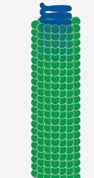
Name the type of capsid that certain viruses have based on the structure:
Filamentous
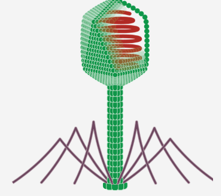
Name the type of capsid that certain viruses have based on the structure:
Complex Tailed

Name the type of capsid that certain viruses have based on the structure:
Icosahedral
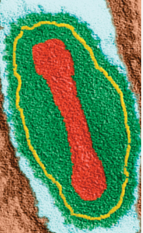
Name the type of capsid that certain viruses have based on the structure:
Amorphus
Some viruses possess a structure on the outside of their capsid, which is inherited from the host cell’s cell membranes, and this structure is called the viral _______________________________________. On the outside of this structure, it can contain structures called spike proteins which aid the virus in _________________________________________ during infection, and sometimes this structure also has proteins called ____________________________________, which aid the virus in viral replication.
envelope, attachment, tegument proteins
True or False: The range in viral genome size does not vary much between virus species, and all are generally around the same size.
False
What are viroids? ___________________________________________________________________________
What are prions? ___________________________________________________________________________
Viroids - Virus-like infectious agents in which an RNA genome is itself the entire infectious particle. There is no protective capsid. Most infect plants. Because of their odd structure it is difficult for organisms to identify and break down.
Prions - Abnormal forms of a protein that arise out of a preexisting cell; because of the misformed shape.
Replication Life Cycle
Write in order the 5 steps that all viruses need to successfully complete in order to infect a cell, and briefly describe what is happening in each phase of the life cycle.
1. ________________________________ – __________________________________________________
2. ________________________________ – __________________________________________________
3. ________________________________ – __________________________________________________
4. ________________________________ – __________________________________________________
5. ________________________________ – __________________________________________________
Attachment - Virus binds to outside of target host cell.
Penetration - Virus ejects its genomic material onto the target host cell.
Replication - Virus takes over host cell replication and translation machinery and the host cell makes all of the virus parts and makes copies of the virus genome.
Assembly - Virus parts get put together and the capsid gets packaged with a copy of the virus genome.
Release - The host cell bursts or buds the viruses out of the cell – either way, virus is released back into the environment from the host cell.
Viruses that complete the lytic life cycle are more likely to be associated with ___________________________________ transduction events, whereas virus that complete the lysogenic life cycle are more likely to be associated with ___________________________________ transduction events.
Explain in your own words the difference between the lytic and lysogenic lifecycle:
__________________________________________________________________________________________
generalized, specialized
The Lytic lifecycle completes the 5 step process of the viral replication life cycle immediately, and the genome of the virus never integrates into the host cell’s genome. In the Lysogenic life cycle, the virus genome integrates into the host cell’s chromosome and becomes part of the entire host cell’s genome. The host cell will continue normally and when it undergoes replication and binary fission, it will pass the virus onto its progeny. At some point a trigger will cause the viral genome to excise from the host’s genome and trigger the virus back into the finished the lytic life cycle process. The virus will then undergo replication, assembly and release.
Viruses can mutate up to ten to one hundred times faster than compared to bacterial cells, and viruses accumulate random mutations that lead to ____________________________________________, in which new strains of virus can come from, and immune systems may no longer recognize these mutations to respond in the same way as they did for the previous strains.
antigenic drift
Papillomavirus (HPV)
· A DNA based genome that has strains of both cancer causing and non-cancer causing strains.
· This virus infects up to 80% of all adults and is passed via sexual contact.
· It infects basal epithelial cells and remains dormant until those juvenile basal cells start to differentiate into keratinocytes (mature epithelial cells)
· HPV shows __________narrow____________________ tropism – strains only infect specifically the surficial skin (cutaneous epithelium) or the mucous membranes.
· Small circular ds-DNA genome that contains overlapping reading frames
o Explain how overlapping reading frames leads to an overall smaller viral genome:
_________________________________________________________________________________
narrow
Within a single coding region, there are multiple start codons embedded into that region, depending on how you begin clustering the codons. In doing so, a single section of genome can code for multiple different proteins, instead of having all of those proteins be represented as individual separate genes.
Influenza Virus
· An RNA based genome made up of 8 chromosome ________________________________________, meaning is it is not a single complete genome molecule
· causes about 10% of the US population annually to get sick from and on average kills around 36,000 in the US each year
· Infects cells of the upper respiratory mucosa only, so this virus shows ___________________________ tropism.
· causes fever, sore throat, headache, and other symptoms
· Influenza strains can mutate via _______________________________________________ (consists of small changes (or mutations) in the genes of influenza viruses that can lead to changes in the surface proteins of the virus, HA (hemagglutinin) and NA (neuraminidase)) AND can experience large mutations via ____________________________________________ (in which genome segments reassort from two or more different influenza viruses)
segments
narrow
antigenic drift, antigenic shift (shift represents a larger change)
HIV
· HIV is a retrovirus that causes infections that progress slowly over many years
o A retrovirus is unique, in a sense that it carries a gene that produces a ________________________________________________ gene
The reverse transcriptase enzyme allows for viral RNA to be converted back into DNA
o Then the DNA of the virus incorporates into the host cell’s chromosome
reverse transcriptase gene
If 100% of the DNA contents inside a viral capsid of a transducing bacteriophage was DNA from the host bacterial chromosome, what would happen when the bacteriophage infected a new bacterial cell?
No more bacteriophage would be synthesized, as there is no bacteriophage genome available to direct synthesis of new viruses.
Why might an organism undergo recombination of DNA that is homologous (the same) to its own?
To repair its own damaged genome.
Shigella dysenteriae undergoes a duplication event of a gene set and now has two copies of that gene set in its chromosome. Over time, one of the gene sets mutates and evolves and takes on a different function independent of the original gene set. This is an example of what type of gene?
Paralogous
The gene proV codes for an ABC transport protein responsible for bringing proline or glycine betaine into the cell in response to osmotic stress. This gene serves a similar function in both species of Salmonella enterica and Escherichia coli. This is an example of __________ genes.
Orthologous
An enveloped virus obtains its envelope from...
The cell membranes of the host cell.
A particular virus can cause disease in a wide variety cell tissues, including skin cells, respiratory cells, and mucosal cells. Because it can infect multiple types of cellular tissue, this virus is said to have ________________.
Broad tissue tropism
There are viruses that exist in the world that can infect...
Plants
All of the above
Prokaryotes
Eukaryotes
Archaea
All of the above
What type of bacteriophage infection results in immediate death of the host cell?
Lytic
An organism is said to have high sequence homology to another organism. What does this mean?
The DNA sequence has a lot of identically matching base pairs
The tRNA sequence has a lot of identically matching base pairs
The organisms underwent the same selective pressures
The DNA sequences differ greatly from one another
The DNA sequence has a lot of identically matching base pairs
When new DNA enters a bacterial cell, it may or may not get added to the genome. When it does, this is called...
Generalization
Homology
Phylogeny
Recombination
Recombination
All of the following are driving forces of evolution and species divergence EXCEPT...
Transcription
Selective Pressures
Random mutation
Reductive Evolution
Transcription
Which of the following is TRUE regarding the domain "Bacteria"
There are no known pathogens within this domain
They have compartmentalized and membrane bound organelles
They have a nucleus housing their DNA
Their cell walls are made from peptidoglycan
Their cell walls are made from peptidoglycan
Recombination events that require very little sequence homology and typically adds brand new genes to a genome is...
Site-specific Recombination
Generalized Recombination
Site-specific Recombination
True or False: Biofilms offer an excellent structure for horizontal gene transfer events between different bacterial species to occur.
True
Using the Baltimore model, viruses are classified by all of the following EXCEPT...
Whether the genome of the virus is DNA or RNA based
Whether the virus has a wide transmission host range
Whether the genome of the virus is single or double stranded
If single stranded, whether the strand is the coding or noncoding strand
Whether the virus has a wide transmission host range
True or False: The envelope of a virus comes from the host cell's membrane and the envelope aids the virus in attachment.
True
What is a prion?
A type of viral species that infects human cells
A circular strand of RNA that acts as an infectious particle
A misfolded protein that acts as an infectious particle
A type of bacterial cell that infects human cells
A misfolded protein that acts as an infectious particle
The process of killing and removing only some disease-causing organisms and microbes from inanimate surfaces. ____________________________________
Disinfection
The process of killing and removing all living cells, spores, and viruses on an object. ____________________________________
Sterilization
The process of killing and removing only some disease-causing organisms and microbes from living surfaces. ____________________________________
Antisepsis
The process of reducing the total number of the microbial population on a surface to what is deemed and classified as a safe level, but not necessarily resulting in sterilization. ____________________________________
Sanitation
The five categories of methods that we can utilize to potentially achieve sterilization status are:
1. ________________________________________________________
2. ________________________________________________________
3. ________________________________________________________
4. ________________________________________________________
5. ________________________________________________________
Wet heat
Dry heat
Filtration
Irradiation
Chemicals/Solvents
Physical Sterilization and Control Methods
An autoclave is a type of sterilizing instrument that incorporates the use of high _________________________ and high _________________________ in order to destroy microbes from a product.
True or False: An autoclave can kill and destroy spores and hyperthermophiles.
True or False: All materials that need to be sterilized are suitable for scientists and researchers to use an autoclave as their means to reach sterilization.
heat, pressure
True
False
_______________________________________ is a physical sterilization method that uses a filter with very small pore sizes, that allow the desired product undergoing the sterilization to pass through, but the filter captures undesirable contaminants like bacteria, endospores, yeasts, molds, etc.
True or False: A pore size of 0.2 µm is a standard pore size for most filtration systems, and the pore size is small enough to capture viruses out of the sample that is being filtered.
Filtration
False
What are some examples of irradiation methods that can be utilized to sterilize surfaces and objects?
__________________________________________________________________________________________
True or False: UV radiation would be a great option to sterilize a very large, very deep tub of saline to be packaged for IV saline drips.
Why or why not?______________________________________________________________________
UV, gamma rays, X-rays, electron beams
False, UV radiation is good for surfaces, but does not penetrate through those surfaces to sterilize beneath it.
__________Ionizing___________________________ radiation, like Gamma Rays, have ______high____________ wavelength, and therefore have higher energy. This type of radiation has the ability to disrupt bonds by removing electrons, protons, or neutrons.
___________Non-ionizing__________________________ radiation, like Ultraviolet Light, have a very __________low________ wavelength, and therefore have lower energy. This type of radiation can only disrupt hydrogen and possibly alter covalent bonds.
Ionizing, high
Non-ionizing, low
What are three physical methods that control microbial growth, but don’t necessarily result in complete sterilization? Briefly describe their process and how it works to achieve sanitation.
1. _______________________________________ - ___________________________________________
2. ______________________________________ - ___________________________________________
3. _______________________________________ - ___________________________________________
Cold - Greatly slows the growth of microbes, but doesn’t necessarily kill already established populations. Can even serve as means of microbial preservation for long periods of time if kept cold enough.
Pasteurization - Liquids are raised to a high enough temperature for a long enough time to kill the microbe Coxiella burnetiid. The goal is not sterilization, but to kill pathogens without affected texture, color, or taste of the product.
Canning - Uses high heat and pressure with airtight sealing for a duration of time to kill microbes, especially spore forming microbes, and proper canning ensures a 12-D standard.
Chemical Agents of Disinfection
What are examples of different factors that influence the efficacy of chemical agents on how well they might reduce microbial populations?
1. _______________________________________ - ___________________________________________
2. _______________________________________ - ___________________________________________
3. _______________________________________ - ___________________________________________
4. _______________________________________ - ___________________________________________
1. Presence of Organic Matter – Organic matter interferes with the chemical agent because the chemical can end up binding to the organic matter, and not come in contact with the microbial population.
2. Type of microbe(s) present – Certain microbes are more resistant to certain chemicals than others, and mixtures of bacteria can create issues with certain chemicals so a chemical needs to be chosen on accordance to what microbes you are trying to destroy.
3. Corrosiveness – The chemical should not damage or corrode surfaces and what you use on one surface, like a table or a toilet, may not be the safest choice to use on your hands.
4. Stability, odor, and surface tension – What type of surface are you sanitizing? Does it have a lot of porous components or not? Does the product carry a harsh smell that should only be used in well ventilated areas, etc?
____________________________ sterilization is a method that can be utilized as a way to sterilize solid products that cannot be exposed to high heat, pressure, certain chemicals, steam, etc.
True or False: Microbes can develop resistances to antimicrobial chemicals, similarly to how they develop resistances to antibiotics.
Gas
True
Antibiotics are chemical compounds that are synthesized by some organisms in order to kill other microbes, and these chemical agents exhibit _________________________________________________, which means the antibiotic compound only kills and harms the pathogen, not the host.
selective toxicity
Measuring Minimum Inhibitory Concentrations (MICs)
Explain the following experimental designs in how they obtain the Minimum Inhibitory Concentrations for antibiotics against certain bacterial species.
Tube Dilution Test – ________________________________________________________________________
MIC Strip Test – ___________________________________________________________________________
Kirby-Bauer Disk Susceptibility Assay – ________________________________________________________
True or False: The minimum inhibitory concentration of a particular drug against a certain microbe is also always the minimum bactericidal concentration for that drug too.
Tube Dilution Test - Through a series of tubes, the concentration of the drug is diluted in a serial dilution, and a known volume of bacteria is added to the tubes and then incubated. When we see bacterial growth stop, we know that the minimum inhibitory concentration is between two concentrations – the concentration where we saw growth, and the next concentration where growth was inhibited.
MIC Strip Test - A bacterial species is inoculated via spread plate onto a growth medium, and certain MIC strips containing different antibiotics are placed down on it, and based on the ellipsis of growth, we can figure out quickly the MIC because it will be exactly at the point where growth just intersects with the strip.
Kirby-Bauer Disk Susceptibility Assay - This test is similar to the MIC strip test in that we inoculate an organism via a spread plate, and we add multiple antibiotic discs to the plate in order to measure the zone of inhibition that results. This zone of inhibition will allow us to determine whether or not that microbe is resistant to the drug, intermediate to the drug, or susceptible to the drug based on the measurement of the zone of inhibition by applying it to published data.
False
Explain in your own words what it means for a combination of antibiotics to be synergistic for a patient to take together:
__________________________________________________________________________________________
Explain in your own words what it means for a combination of antibiotics to be antagonistic for a patient to take together:
__________________________________________________________________________________________
When taken together, the drugs work better than they would if they were taken independently from one another.
When the drugs are taken together, they work worse or are completely ineffective than they would if they were taken independently from one another.
What are the different types of Mechanisms of Action that different chemical antibiotics can utilize in order to kill and target bacterial cells?
_________________________________________
_________________________________________
_________________________________________
_________________________________________
_________________________________________
_________________________________________
_________________________________________
Inhibit protein synthesis
Inhibit cell wall synthesis
Inhibit nucleic acid synthesis
Inhibit enzyme synthesis
Interrupt metabolic pathways and metabolic activity
Alter membrane permeability and integrity
Alter colloidal state of cytoplasm
What are the three main mechanisms of antibiotic resistance that microbes can utilize to protect themselves against antibiotic drugs? Briefly explain how these categories work and what kinds of examples fall under these mechanisms.
1. _______________________________________ - ___________________________________________
2. _______________________________________ - ___________________________________________
3. _______________________________________ - ___________________________________________
1. Prevent intracellular accumulation – The bacteria might destroy the antibiotic as it comes into the cell before it can cause damage, the bacteria might use efflux pumps to get rid of the drug, it can alter its membrane permeability to not allow the drug to diffuse into the cell, etc.
2. Prevent antibiotic binding to its target structure – The bacteria might change the target the antibiotic wants to bind to so the drug no longer recognizes the structure and therefore cannot complete its drug action, the bacteria might change the chemical composition of the drug like adding methyl or phosphate groups onto the drug so it can be deactivated.
3. Dislodge the antibiotic from its target site – If the antibiotic does bind to its target, the microbe might be able to synthesize proteins that act like a “battering ram” to come in and dislodge the antibiotic form its binding site so normal metabolic activity can resume.
The bacteria, yeasts, fungi, archaea, and protozoa that inhabit our body naturally, and do not cause harm to us make up our ___________________________________.
The process in which microbes take up space on and in our human body, which makes it difficult for foreign invading pathogens to colonize us is called _______________________________________.
microbiome (microbiota)
microbial antagonism
Define Bioburden: ______________________________________________________
The number of microbes living on a surface or within a particular region of the human body – the amount of bacteria that makes up the skin, mouth, intestinal tract, and genitourinary tract.
The Skin
True or False: The skin is a very uniform and consistent environment, and it does not have a lot of environmental changes or influences, so there are not a lot of different types of ecosystems that make up the skin.
Even though the skin comes in direct contact with the environment all the time, and because of this we have routine, direct exposure to pathogens on our skin frequently, healthy individuals do not get skin infections from these dangerous pathogens often. Offer explanations based on the properties of the skin as to why this is the case.
________________________________________________________________________________________
False
Because the skin has such a diverse ecosystem, a lot of microbes do not colonize the skin very easily to begin with. Combine that with the fact that we have a naturally existing microbiome of microbes that colonize the skin commensally and mutualistically, our microbiome is highly successful at outcompeting potential foreign invaders to start growing.
The Eye
The eye directly comes in contact with the environment on a regular basis. Even with this fact, the bioburden of total resident microbes that make up the eye microbiota is surprisingly _____________________________.
What is an example of a natural antimicrobial that the eye secretes to prevent a build of bacterial growth in the eye? ______________________________________
low
Lysozyme
Oral and Nasal Cavities
Define nasopharynx: ________________________________________________________________________
Define oropharynx: _________________________________________________________________________
The area from the nose to oral cavity.
The area between the soft palate and the upper edge of the epiglottis.
True or False: An infant’s oral and nasal cavities are inoculated with microbes within minutes to hours of being born, mostly from the air, parent’s skin and clothes, and breast milk/formula.
True
Bacteria that grow just below the gumline of teeth are growing in a region that lacks oxygen, which makes these bacteria _____________________________________. These bacteria are able to form biofilms, specifically called a(n) _____________________________________, and this biofilm firmly adheres to oral surfaces.
anaerobic, glycocalyx
The Respiratory Tract
True or False: The respiratory tract, including the trachea and deep lung tissues, are sterile environments.
What is the Mucociliary Escalator? _____________________________________________________________
False
A protection mechanism of cilia and mucous that constantly sweep upwards, pushing foreign particles up and out of the lungs. This structure is very important for preventing respiratory infections.
The Stomach and Intestines
The stomach plays an important role as a defense mechanism in preventing infections due to its _____________________________________.
True or False: The stomach is a sterile environment and there are no resident microbes that live in the stomach or stomach lining full time.
What type of infection does Helicobacter pylori cause? How does it survive the acidity of the stomach acid to cause infection?
__________________________________________________________________________________________
high acidity/low pH
False
H. pylori causes gastric stomach ulcers. It is able to use an enzyme called urease, which causes the bacteria to secrete ammonia into the immediate surrounding area. Ammonia is very basic/high pH, so the bacteria is able to raise the localized pH so it is able to grow and cause infection.
The _____________________________________ and _____________________________________ which make up the upper GI intestinal tract is slightly basic in pH, which means __________________________________ grow here. The _____________________________________, _____________________________________, and _____________________________________ which make up the lower GI intestinal tract is slightly acidic to neutral pH, which means __________________________________ and __________________________________ grow here. The lower GI tract has a __________________________________ ecosystem in terms of microbiota compared to the upper GI tract.
duodenum, jejunum, alkalophiles
ileum, cecum, colon, acidophiles, neutrophiles, much higher and more diverse ecosystem
What are the main functions of the gut microbiota in terms of human health?
1. _______________________________________________________________________________________
2. _______________________________________________________________________________________
3. _______________________________________________________________________________________
4. _______________________________________________________________________________________
5. _______________________________________________________________________________________
6. _______________________________________________________________________________________
1. Ferment unused energy substrates
2. Train the immune system
3. Prevent growth of pathogenic bacteria
4. Regulate the development of the gut
5. Produce vitamins for the host like biotin and vitamin K
6. Produce hormones to direct the host to store fats
How can having an overabundance of archaea that perform methanogenesis in the gut system lead to obesity?
__________________________________________________________________________________________
Archaea that perform methanogensis use H2 as a part of their starting material. H2 acts as a way to slow down and control how much fermentation bacteria do. Because of this, there is never a high enough abundance of H2 to inhibit the bacteria, so fermentation goes out of control, which produces a lot of fatty acids in the person, which increases obesity.
The Genitourinary Tract
The following structures make up the genitourinary tract. State whether these structures contain normal microbiota, or are sterile environments, and if there are microbes present in these structures, it means there is an infection.
· Kidneys ____________________________________________
· Ureters ____________________________________________
· Urinary Bladder ____________________________________________
· Urethra ____________________________________________
· Female Vagina ____________________________________________
· Male Penis ____________________________________________
Kidney, Ureters - Sterile
All else - Contain normal microbiota
Lactobacillus crispatus is an organism that should predominate in total numbers of the bioburden for a healthy female in terms of the vagina. This organism helps to prevent the colonization of infectious microbes and sexually transmitted diseases, in a process called __________________________________________________.
microbial antagonism
What are some of the health benefits for a person in having a microbiome?
__________________________________________________________________________________________
· Food digestion
· Production of needed vitamins
· Training and stimulating immune system
· Protection from pathogens due to space and nutrient competition
· Stronger immune system
· Less allergies and illnesses
What are some of the risks for a person in having a microbiome? __________________________________________________________________________________________
· Opportunistic infections
· Change of location of microbes within their normal space to an abnormal location can trigger infection
· Immunocompromisation can lead to challenges with hosting a microbe
What is an Opportunistic Pathogen? ___________________________________________________________
One that rarely causes disease in people with healthy immune systems but can cause disease especially when the host’s resistance is low or if the microbe is in a region where it is not normally located.
What is Dysbiosis? _________________________________________________________________________
How can we restore the balance of an altered gut microbiome?
· ____________________________________________________________________________________
· ____________________________________________________________________________________
An imbalance between the types of organism present in a person’s natural microflora, especially that of the gut, thought to contribute to a range of conditions of ill health.
· Probiotics – taking in live cultures of microbes that are beneficial and can help aid in the colonization of the “good bacteria” in your gut.
· Prebiotics – taking in the proper food and fiber that the good bacteria thrive off of.
What is the importance of epithelial barriers in terms of our own microbiota and human health?
__________________________________________________________________________________________
The epithelial barriers are the major barrier barriers separating us from our microbiota, stopping it’s members from slipping past our own cells and infecting us. Epithelial barriers are a layer of glycoprotein-covered epithelial cells lining the mucosa of our digestive, genitourinary, and respiratory tracts.
What is the role of the Blood-Brain Barrier?
__________________________________________________________________________________________
The blood brain barrier is a selective semi-permeable membrane between the blood and the brain, allowing cerebral blood vessels to regulate molecule and ion movement between the blood and the brain. This means most microbes, including most viruses, are too large to pass through, which protects the brain from infectious materials in the blood.
What does the theory of the “disappearing microbiota hypothesis” state? What are contributing factors that support this theory?
_________________________________________________________________________________________
It states that our human microbiome is decreasing in microbe diversity, which is leading us to be more susceptible to new diseases that we have not seen before, and the driving force behind the decrease of our microbial diversity is our current human behavior. By having cleaner water, using proper sanitation of waste, using drugs to fight infections, washing our hands more, etc. our microbiome is not being challenged as much, which is leading to a decrease in biota diversity and we may have lost certain ancestral microbes that helped prevent these diseases from occurring in past generations.
Because it is an essential component for every individual, supplements may be required if enough vitamin C is not found in the diet. Vitamin C is sensitive to heat and pressure. So that it can be safe for human consumption, how can vitamin C be sterilized before being packaged into supplements?
autoclaving
baking
filtration
freezing
pasteurization
Filtration. All of the others either use heat or in the case of Freezing, do not sterilize it.
Which of the following growth control methods would work best to sterilize a very large packaged shrinkwrap-sealed palette of medical equipment that can't be exposed to high heat and pressure?
Ethylene Oxide Gas Chamber
Detergent
Autoclave
Clorox Bleach
UV Radiation
Ethylene Oxide Gas Chamber. The others either use heat, detergent doesn’t sterilize, or are not practical for big sealed things and through packages.
How does the presence of organic matter affect the efficacy of a disinfectant?
Chemicals in the organic matter inactivate the chemicals in the disinfectant so the chemicals never reach the microbes.
It is easier for disinfectants to work when organic matter is present.
It does not affect the efficacy of a disinfectant.
Chemicals in the disinfectant bind to organic matter and which causes interference for the chemicals reaching the microbial population.
Bacterial cells are immune to disinfectants when in the presence of organic matter.
Chemicals in the disinfectant bind to organic matter and which causes interference for the chemicals reaching the microbial population.