Intro to theraputics
 Call Kai
 Learn
Learn Practice Test
 Spaced Repetition
 Match
Match Flashcards
 Knowt Play
1/14

There's no tags or description
Looks like no tags are added yet.
Name | Mastery | Learn | Test | Matching | Spaced | Call with Kai |
|---|
No analytics yet
Send a link to your students to track their progress
15 Terms
QuEST
Quickly and accurately assess the patient
Establish that the patient is an appropriate self-care candidate
Suggest appropriate self-care strategies
Talk with the patient
SCHOLAR
Symptoms: What are the main and associated symptoms?
Characteristics: What is the situation like? Is it changing?
History: What has been done so far? Has it happened before?
Onset: When did it start?
Location: Where is the problem?
Aggravating Factors: What makes it worse?
Remitting Factors: What makes it better?
MAC
Medications: prescription/non-prescription, complementary and alternative products
Allergies: to medications or substances; include reaction experienced
Conditions: coexisting health conditions
SOAP
Subjective: “Here’s what the patient is telling me…”
Objective: “Here’s what I’ve gathered about the patient…”
Assessment: “Here’s what I think about this patient’s care…”
Plan: “Here’s what I’m going to do for this patient…”
Collect:
You are looking to generate a relevant history.
Comprised of subjective and objective information
Subjective = from patient report
Objective = from trusted source of information (i.e. chart/record)
Don’t always assume charted information is correct!
The questions you ask are key to collecting enough of the right information.
Assess:
So you have some information…
Is the patient sick? How sick? Can you help?
Huge assessment piece for pharmacists…medications!
Are they causing illness? Or another/different medication needed?
What does the patient want?
Can they afford your recommendation? Will they understand it?
Are there red flags? Do you need someone else to help?
Plan:
Recommendation: do this.
Did you consider what the patient wanted? (cost, flavor, dosage form...)
Goals of Therapy: I want this to happen.
Complete resolution, improvement, or prevention
Clear Expectations: this should take “x” amount of time.
If longer…do this. Seek additional help? Or come back?
Implement:
Communication is a/the key component of the implementation step!
Here is where you educate the patient…
Recommendation, goals of therapy, expected outcome
Do this if our plan doesn’t work.
If medications are involved in plan, counsel on…?
A method to ensure the patient understands:
Follow-Up: Monitor and Evaluate:
Lack of follow-up can destroy all your hard work up to this point.
Some situations may not require follow-up (i.e. self-care encounters).
However, the role of the pharmacist often involves making sure that plans are made and implemented by the patient.
Approximately 20% of patients seen for primary care are lost to f/u.
More than 20% of patients living with HIV go 12+ mos. without f/u.
Around 38% of new VTE patients on new OAC have no f/u by 3 months.
The Core
Collaborate: patients, caregivers, other healthcare providers
Communicate: active listening, demonstrating empathy
Avoid leading questions (this is true, right?)
Beware nonverbal modes of communication (voice tone, facial expression)
Is the patient comfortable sharing in the physical space they’re in?
Document: continuity of care, legal justification, billing/reimbursement
Seldom done in self-care/community setting
Pediatrics:
Newborn Infants: 0 – 27 days
Infants and Toddlers: 28 days – 23 months
Children: 2 – 11 years
Adolescents: 12 – 18 years
Geriatrics:
Technically defined as 65 years and older.
Though…some patients at 65 may be healthier than others at 35.
Geriatric patients are also experiencing many changes…
Weight, organ function, cognitive capacity
Not all of these have to be attributed to age.
Many medications for many disease states
Or just…many medications for…?
Pregnancy:
Balance between health of mother and health of unborn infant.
Many medications cross the placenta to some extent.
Is the patient pregnant, possibly pregnant, or of reproductive capability?
One of the few times you have the license to ask about pregnancy…
Safety of medication can depend upon trimester of pregnancy.
Safe in trimester one does NOT mean safe in trimester three.
Lactating
Medications can affect the mother and child in different ways.
Pass through milk to infant, increase/decrease milk supply
Again, ask!
Do NOT assume recently pregnant patients are now breastfeeding.
Use your resources!
LactMed is a free database, peer-reviewed
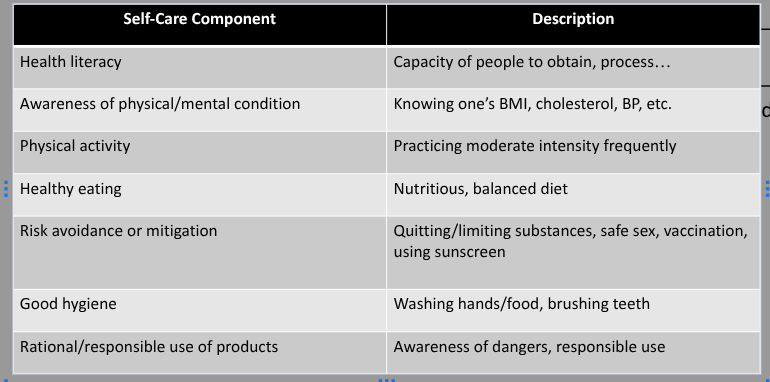
Seven Pillars of Self-Care