Alekenes and Alkynes Organic OAT
 Call Kai
 Learn
Learn Practice Test
 Spaced Repetition
 Match
Match Flashcards
 Knowt Play
1/56

There's no tags or description
Looks like no tags are added yet.
Name | Mastery | Learn | Test | Matching | Spaced | Call with Kai |
|---|
No analytics yet
Send a link to your students to track their progress
57 Terms
Hydrohalogenation rxn (addition of HX to an alkene)
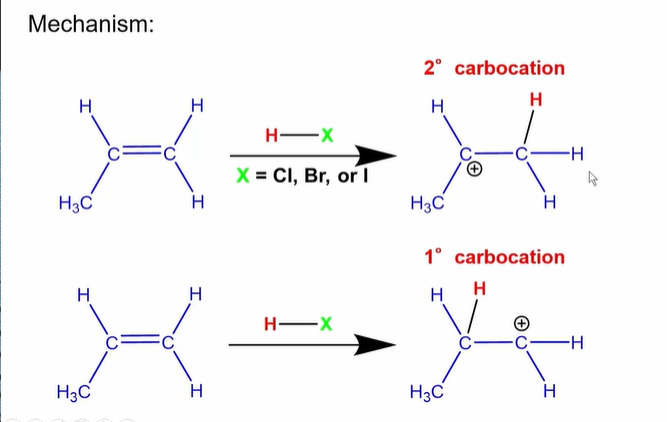
The H goes on the C with the most amount of H’s on it. The halogen goes on the one with fewer H’s
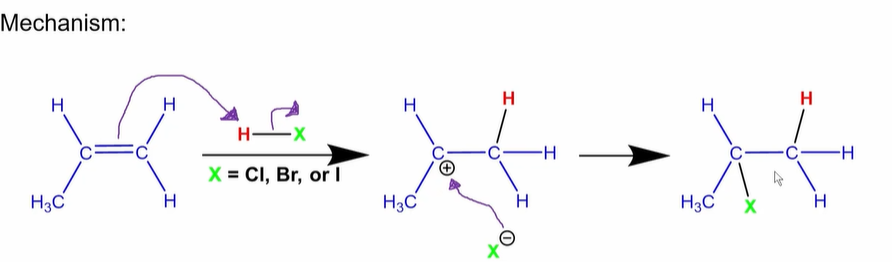
In hydrohalogenation why does the hydrogen bond to the carbon with the most H’s?
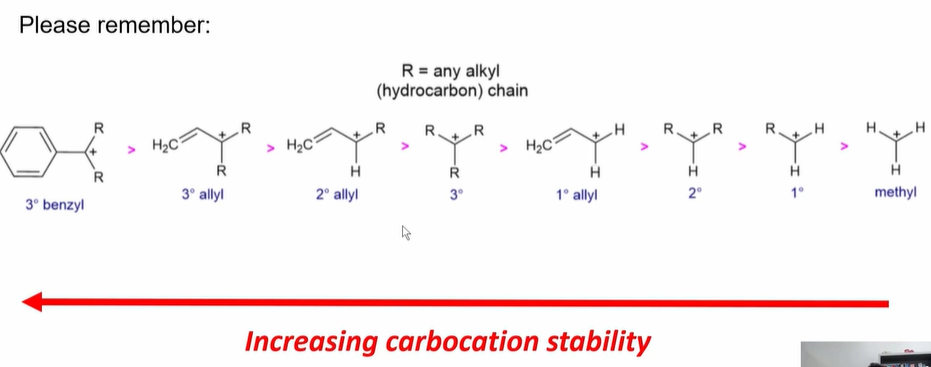
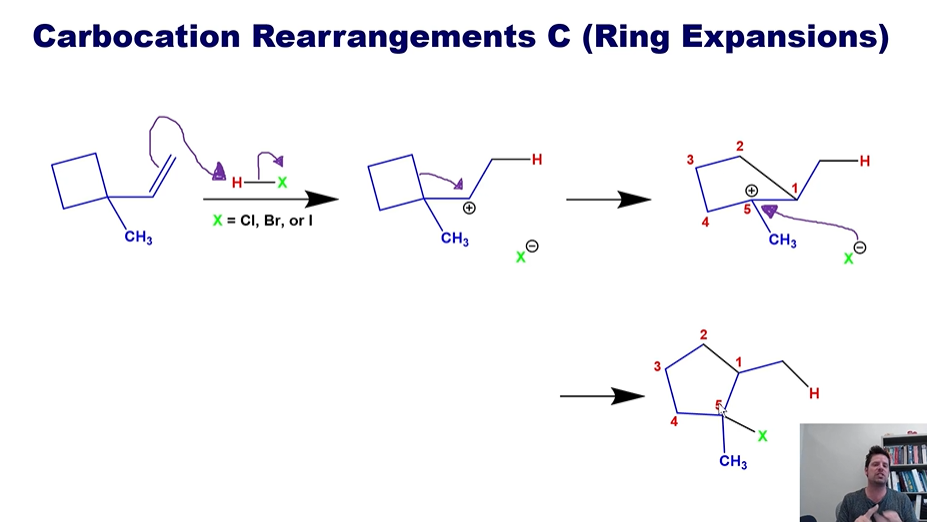
Carbocation Stability
Primary carbocation NEVER FORM. They are far to unstable.
What is carbocation stability
CARBON CATIONS are more stable as they have more carbons attached to them.
Primary Allyl’s have resonance.
Markovnikov Products
The alkene addition product that comes from the most stable carbocation intermediate.
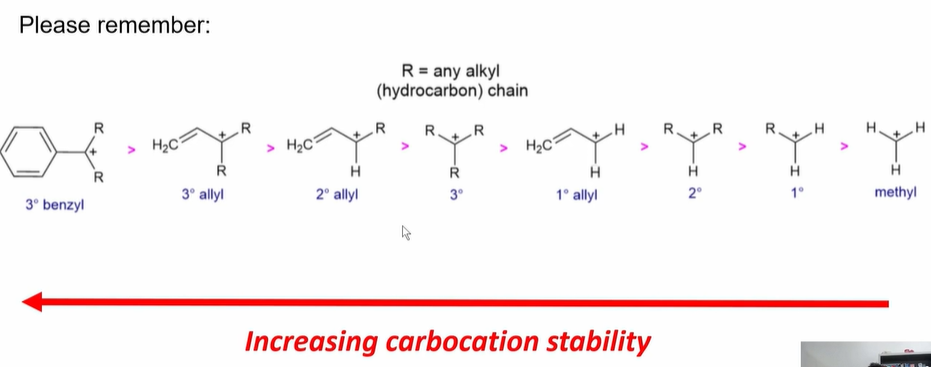
1,2 Hydride Shifts (carbocation rearangments)
Essentially, if a hydrogen can shift a carbocation into a more stable carbocation by adding itself, it will do so.
This cannot be done to do a equal carbocation stability
KEEP IN MIND THIS CAN ONLY HAPPEN IF THE HYDROGEN IS DIRECTLY NEXT DOOR.
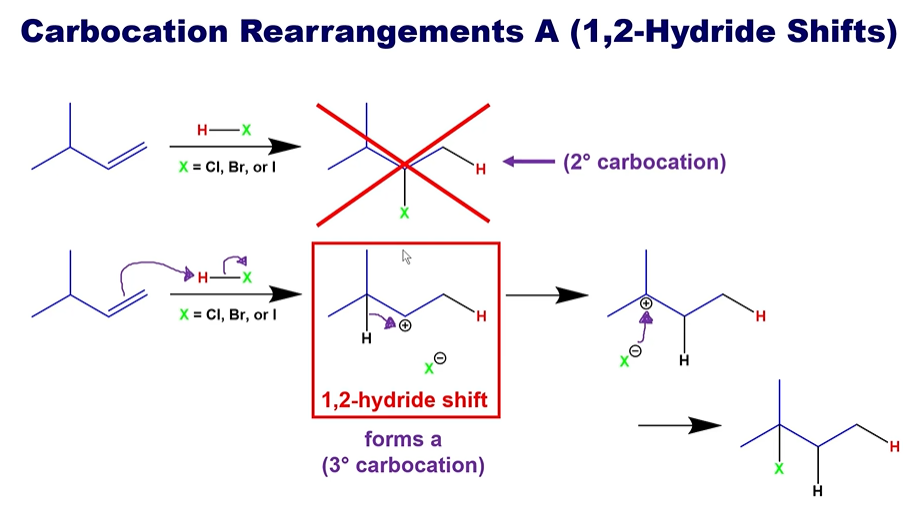
1,2 Methyl Shift (carbocation rearrangments)
Essentially, if a methyl can shift a carbocation into a more stable carbocation by adding itself, it will do so.
This cannot be done to do a equal carbocation stability
KEEP IN MIND THIS CAN ONLY HAPPEN IF THE HYDROGEN IS DIRECTLY NEXT DOOR.
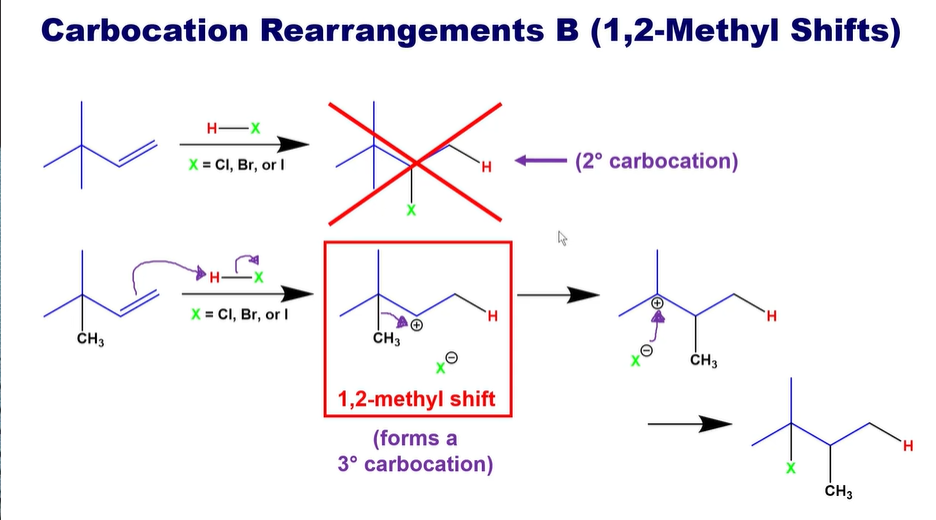
C ring expansions (carbocation rearrangments)
Why does it happen?
Usually done to relieve angle strain (any rings not in 5 or 6)
C ring expansions (carbocation rearrangments) : mech
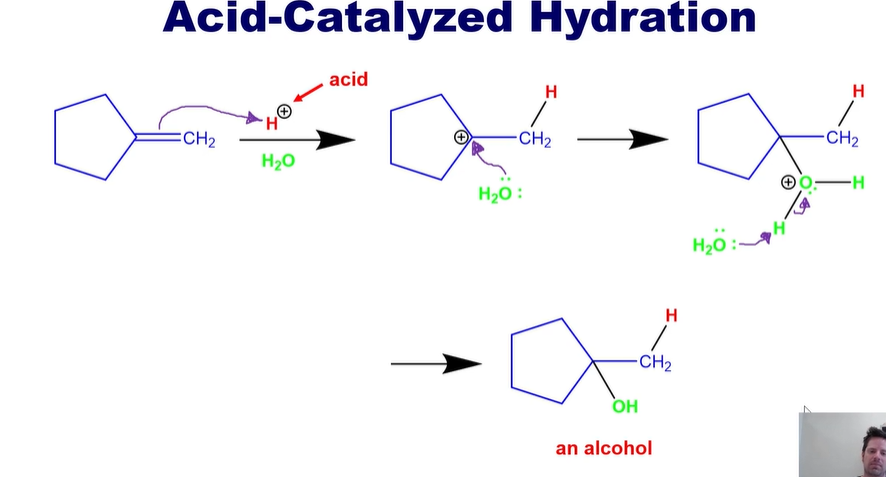
Acid Catalyzed Hydration
It’s intermediates CAN undergo carbocation rearrangements if it INCREASES stability.
This can be good or bad.
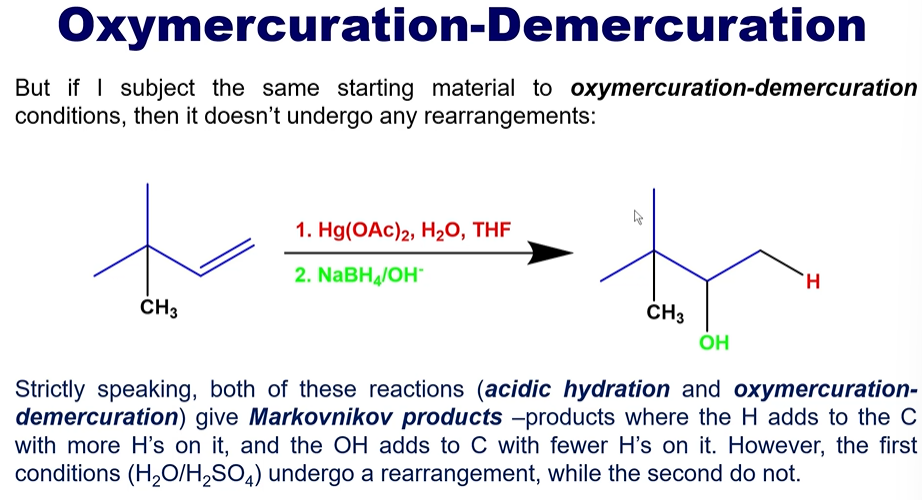
Oxymercuration - demercuration
USED for Acid catalyzed hydration reactions:
SINCE: It’s intermediates CAN undergo carbocation rearrangements if it INCREASES stability.
SO INSTEAD:
A reaction that does the same thing as acid catalyzed hydration without the rearrangements.
BOTH ARE STILL MARKOVNIKOV (we are only avoiding a carbocation rearrangment)
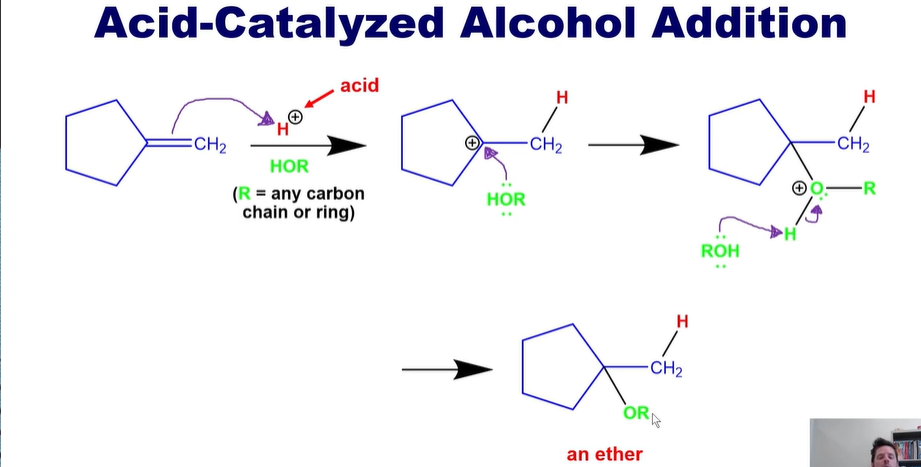
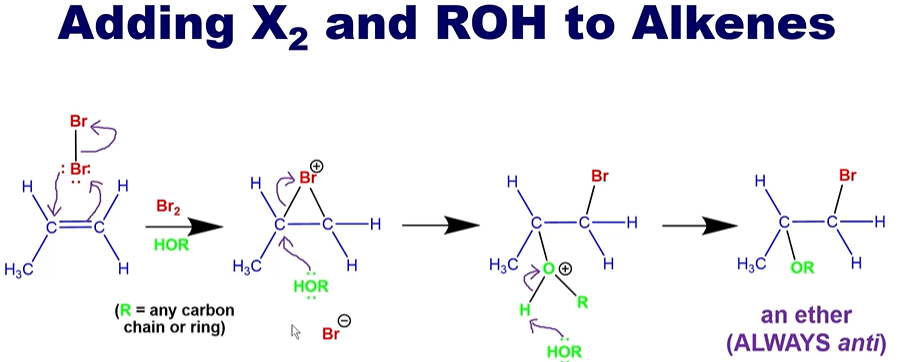
Acid Catalyzed Alcohol Addition
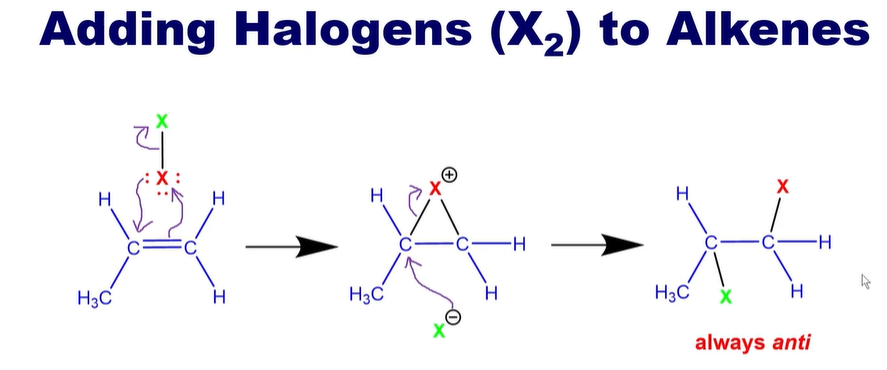
Adding Halogens (X2) to alkenes
Always ANTI
NO REARRANGMENTS DUE TO RINGED HALOGEN INTERMEDIATE
Adding Halogens (X2) and H2O to alkenes
Since H2O is the solvent, there is SO much more of it in the system
NO REARRANGMENTS DUE TO RINGED HALOGEN INTERMEDIATE
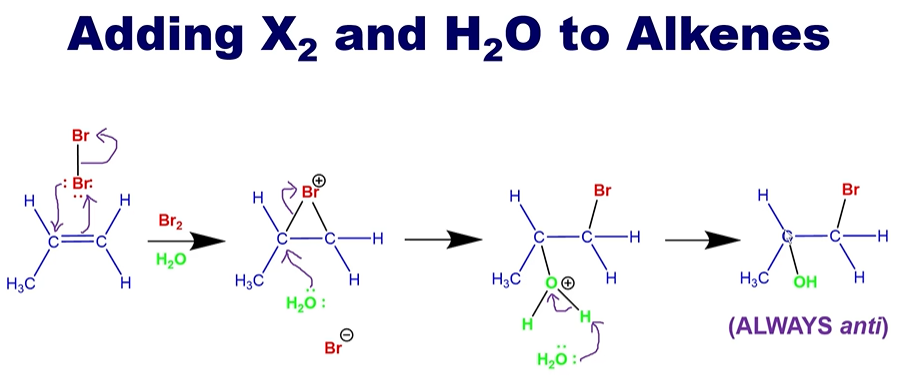
Adding Halogens (X2) and ROH to alkenes
R = carbon chain or ring
THERE is SOOO much more of HOR in the system (it is the solvent)
Antimarkovnikov?
Adding a reagent to the position that is not Markovnikov (most stable carbocation)
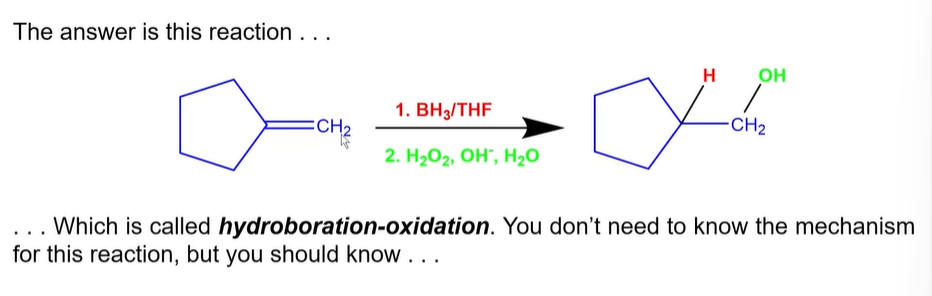
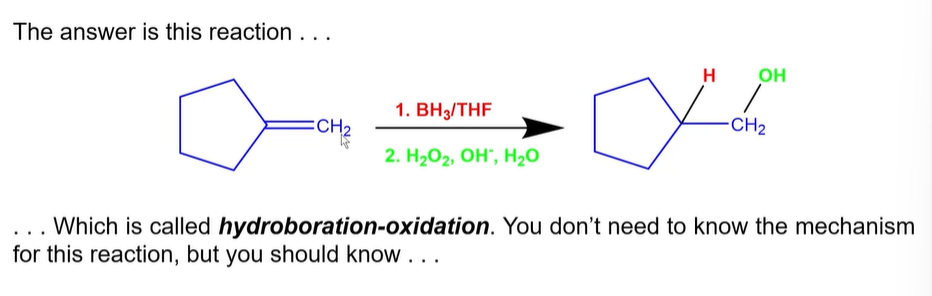
Hydroboration-Oxidation
They end us sys (not anti)
(same direction)
BH3/THF
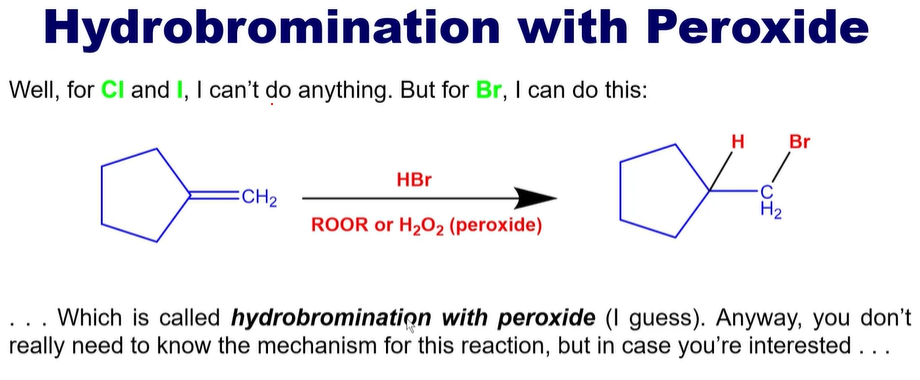
Hydrobromination with peroxide
Antimarkovnikov
NO REARRANGMENTS
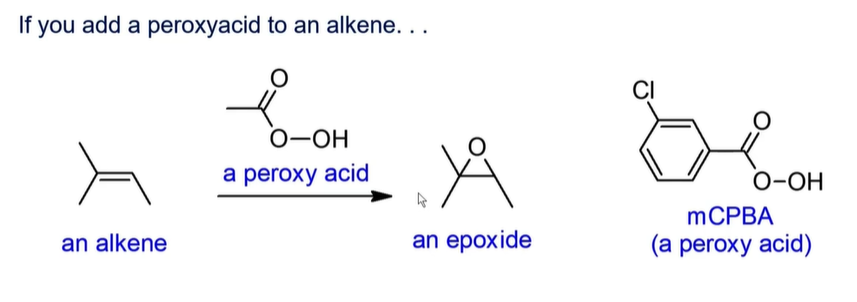
Peroxy Acid
another example is mCPBA
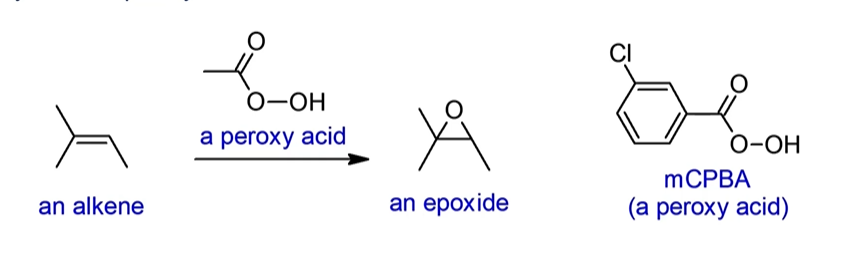
Epoxidizing Alekenes
Adding a peroxyacid to an alkene to make it into an EPOXIDE
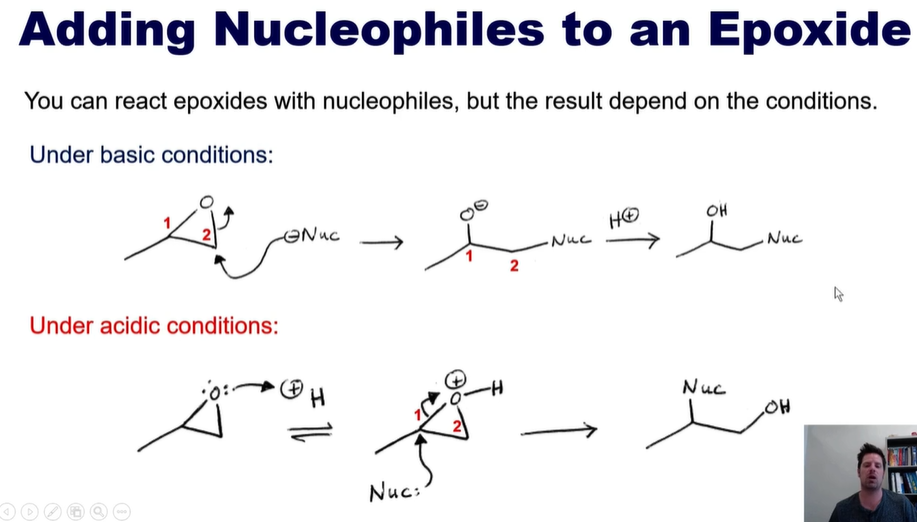
Adding nucleophiles to an epoxide (both acidic and basic conditions) (with variability)
Under basic Conditions: Gets added to the carbon with least interference.
Under Acidic Conditions: We are going to have the nucleophile attack the most stable carbocation.
Anti-dihydroxylation
Adding nucleophiles to an epoxide basic conditions (even molecule)
anti
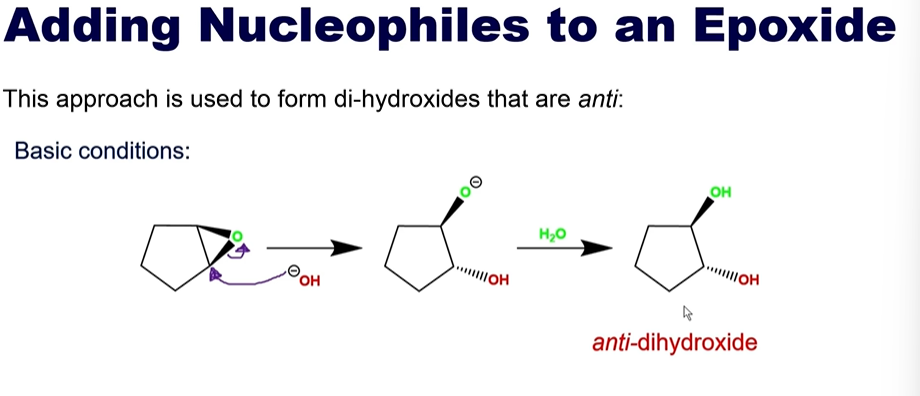
Anti-dihydroxilation
Adding nucleophiles to an epoxide acidic conditions (even molecule)
anti
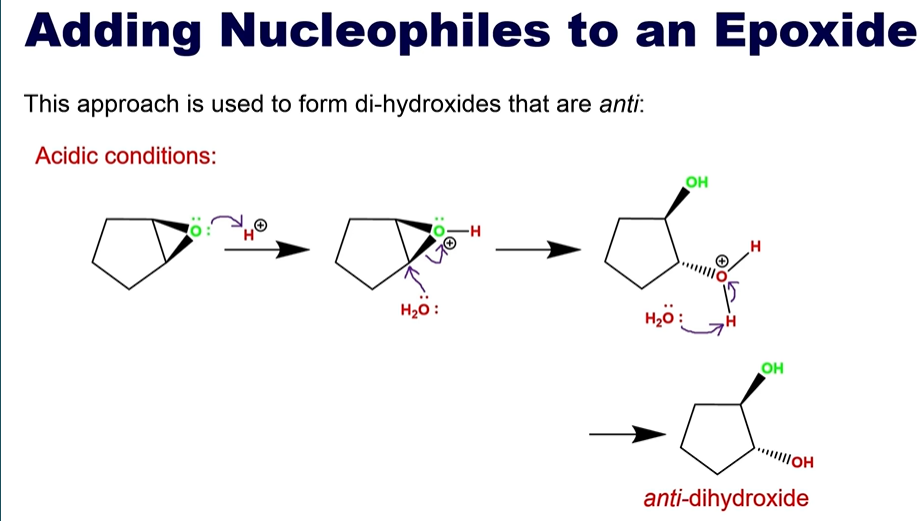
Anti-dihydroxilation
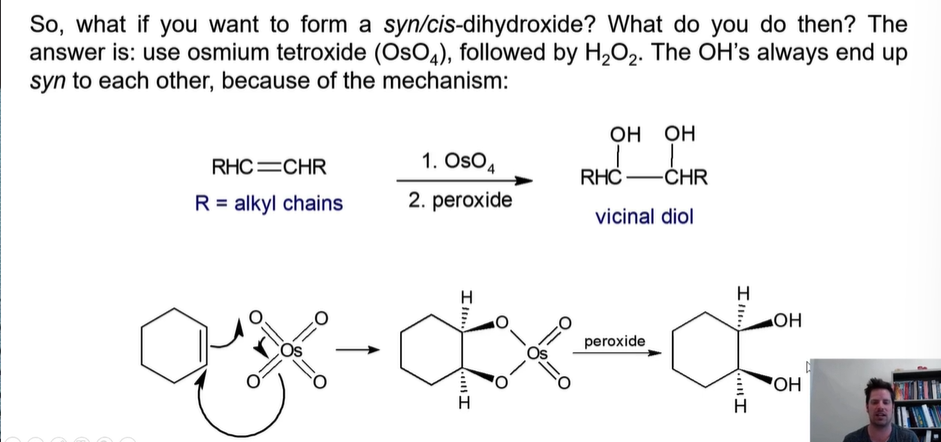
sys dihydroxide
OSO4
Peroxide
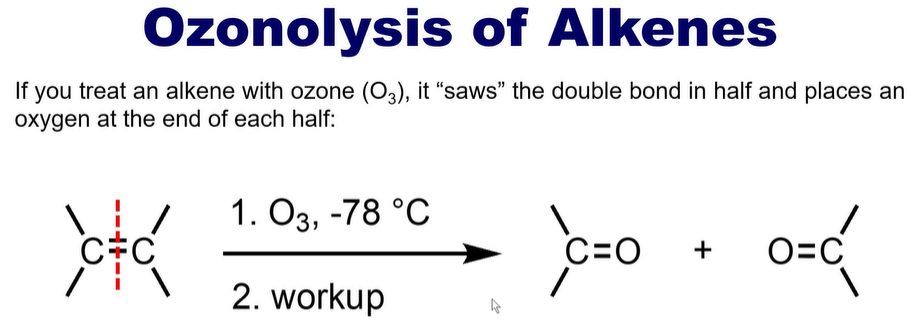
Ozonolysis of Alkenes
Treating an alkene with Ozone (O3), it cuts the double bond and puts an oxygen at the end of each half.
But it can vary depending on the workup
Ozonolysis: Workup: Zn, H20 or DMS (CH3)2S

Ozonolysis: Workup: H2O2
1 and ONLY 1 of those extra H’s is replaced with an -OH. (carboxylic acid)
If there is NO extra H’s you get the same product as in ozonolysis with H2O and Zn or DMS

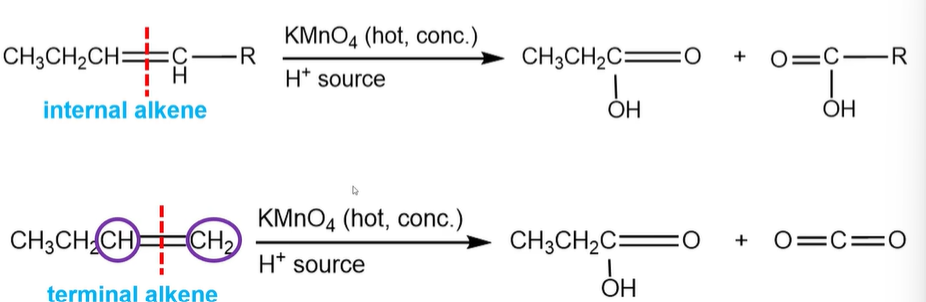
Ozonolysis using KMnO3 (hot conc) / H3O+
This occurs only to internal alkenes. (alkenes with a carbons on either side of the alkenes.
It does the same ozynolysis reaction.
BUT if it is instead a terminal alkene (has a carbon attatched to an H) then instead it will turn the terminal carbon into CO2.
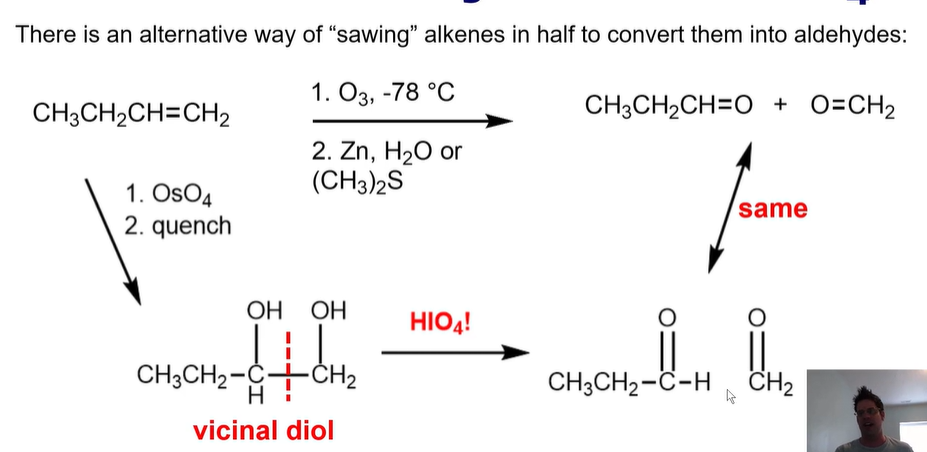
Alkene ozonolysis with HIO4
Use of OsO4 to add two sys OH groups
Then you use HIO4! to split them and convert them to aldehydes.
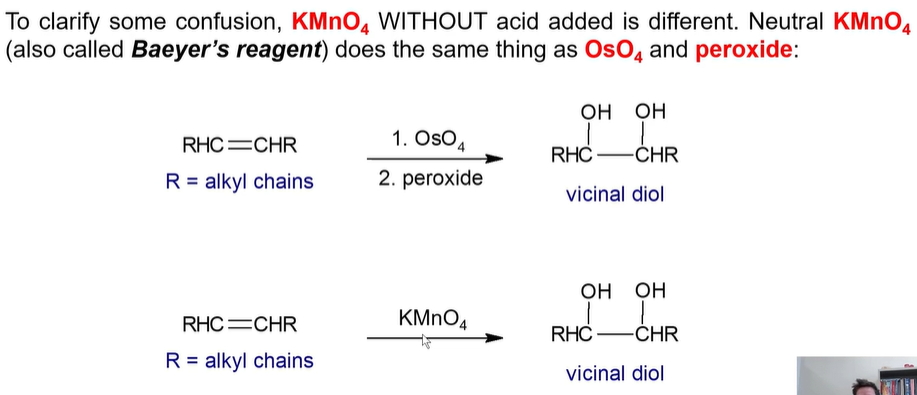
KMnO4 (regular not treated)
Makes a vicinal diol (two OH’s added on an alkene group. )
same as OSO4 and peroxide.
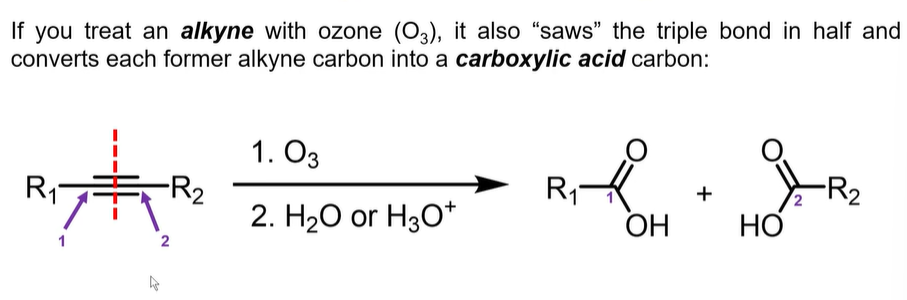
Alkyne Ozonolysis
We end up getting two carboxylic acids instead of ketones.
O3, H2O or H3O+
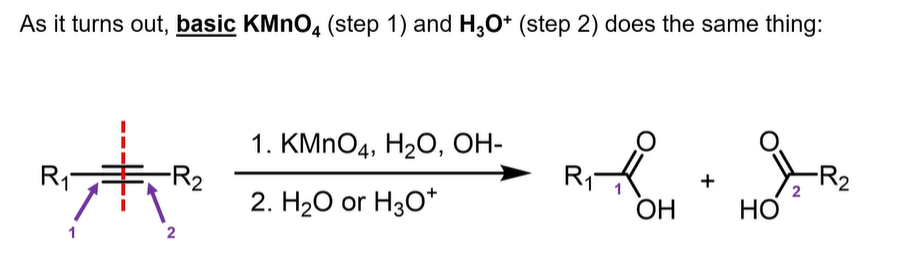
Basic KMnO4 and H3O+
Gives two carboxylic acids.
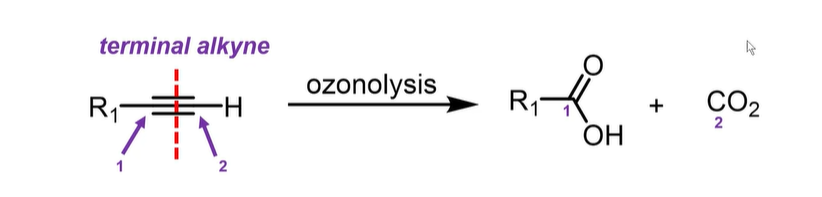
Terminal Alkyne Ozonolysis
Forms CO2 and of course a carboxylic acid.
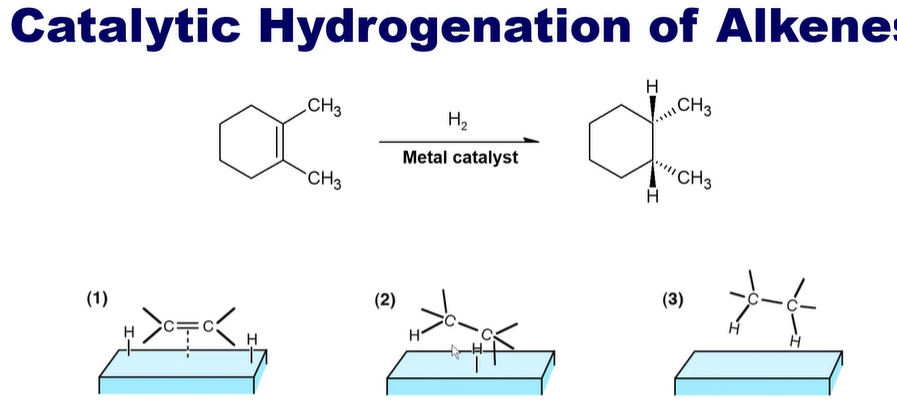
Catalytic Hydrogenation of Alkenes
Breaks rules of traditional alkene addition reactions.
They form a cis product and remove the double bond.
They attatch to a metal and then add cis H’s.
Metals include:
Pd, Pt, Rh, or Ni catalyst.
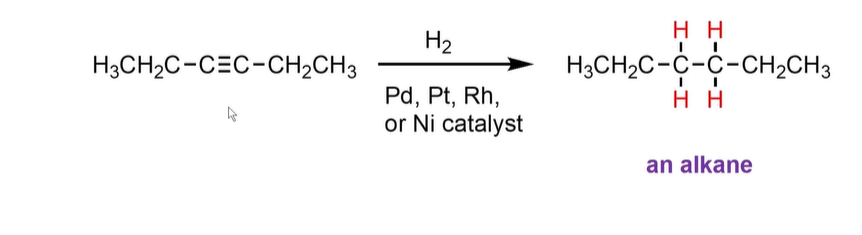
Catalytic Hydrogenation of Alkynes
They form a cis product and remove the triple bond all the way to single. (does not stop at alekene)
They attatch to a metal and then add cis H’s.
Metals include:
Pd, Pt, Rh, or Ni catalyst.
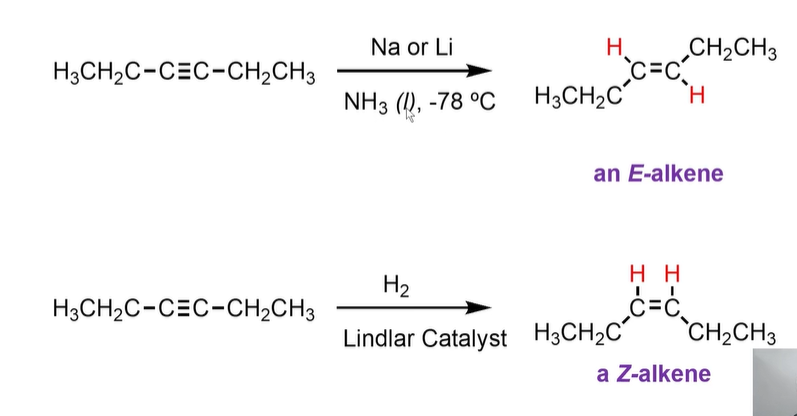
Catalytic Hydrogenation of Alkynes to get to an alekene to get a E alkene
Goes from a triple to an alkene. HOWEVER, it is a Z alkene. (zame zide)

Catalytic Hydrogenation of Alkynes to get to an alekene. (E)
Na or Li
NH3, at low temperatire.
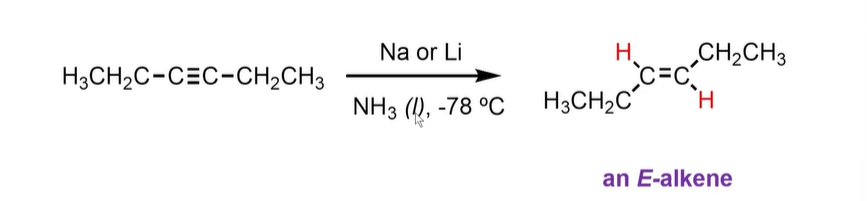
Catalytic Hydrogenation of Alkynes to get to an alekene. (Z)
H2, Lindlar Catalyst
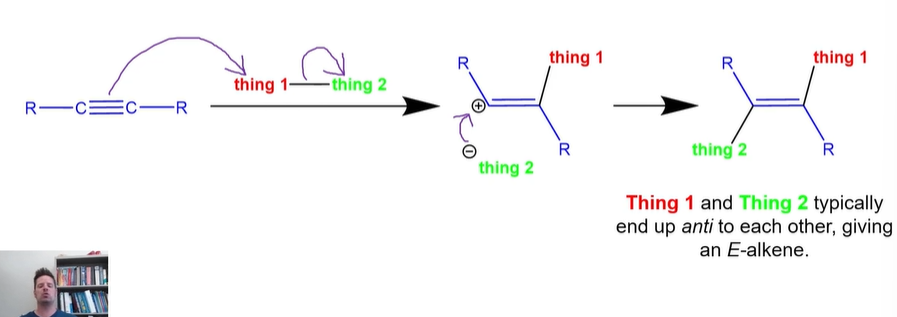
Alkyne Addition Reactions: DEFS of terminal vs internal alkynes
General Alkyne Reactions
Generally Anti (E alkene)
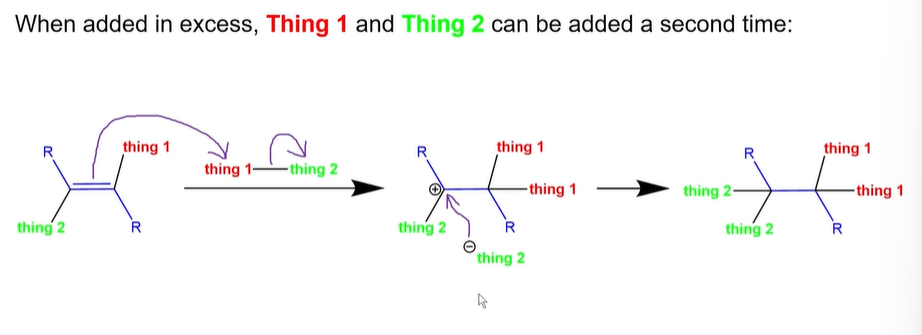
Excess reactions for alkynes
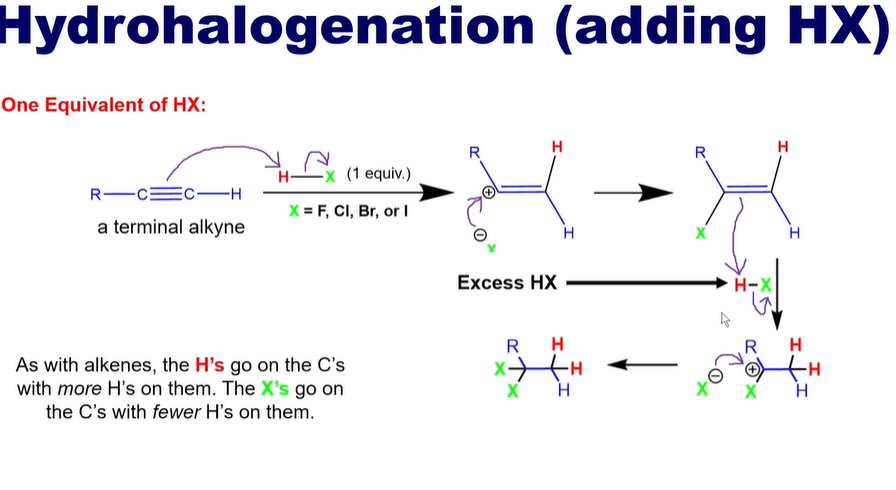
Hydrohalogenation with halogens. (and also what would happen in excess)
Wants to go to carbon with most H’s initially once more.
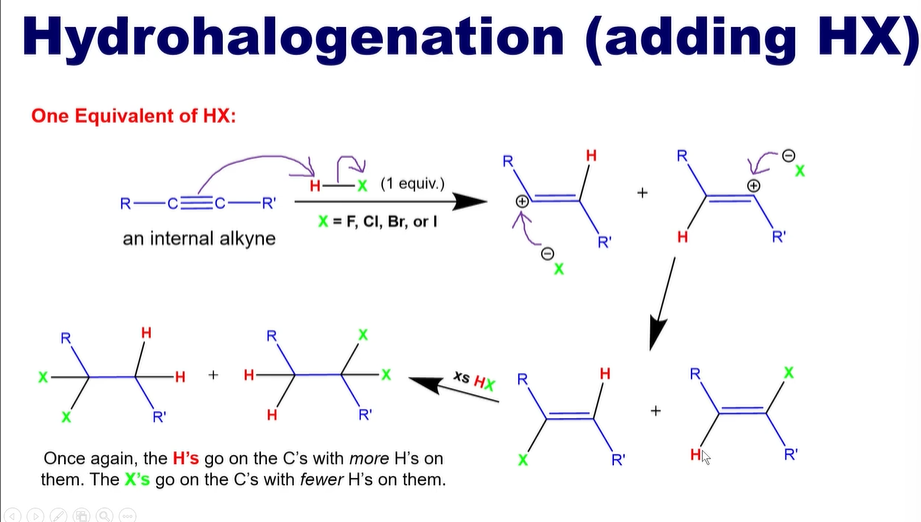
IF not in an external ALKYNE like this example, the HX reaction will appear in a mixture.
Hydrohalogenation with halogens. (and also what would happen in excess) (internal alkyne)
Still end up on the same side since once the initial reaction occurs, then there will be an H, which is more favorable for the H’s and the X will go with the more substituted one.
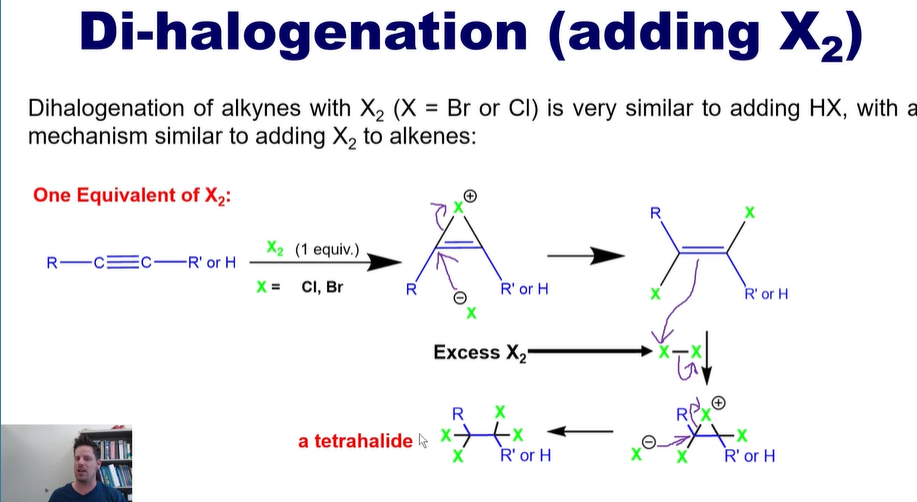
DiHalogenation (alkynes)
They will be anti since the Halogen will go toward the interior position.
Remember, it can not be in water or ROH solvent
Dihalogenation (alkeynes)
Remember, it can not be in water or ROH solvent
Hydrobromination with Peroxide (alkynes) (also in excess)
Antimarkovnikov

Acid Catalyzed Hydration (alkynes) terminal
NEED HgSO4
Markovnikov
They then turn to ketones afterward (more stable)
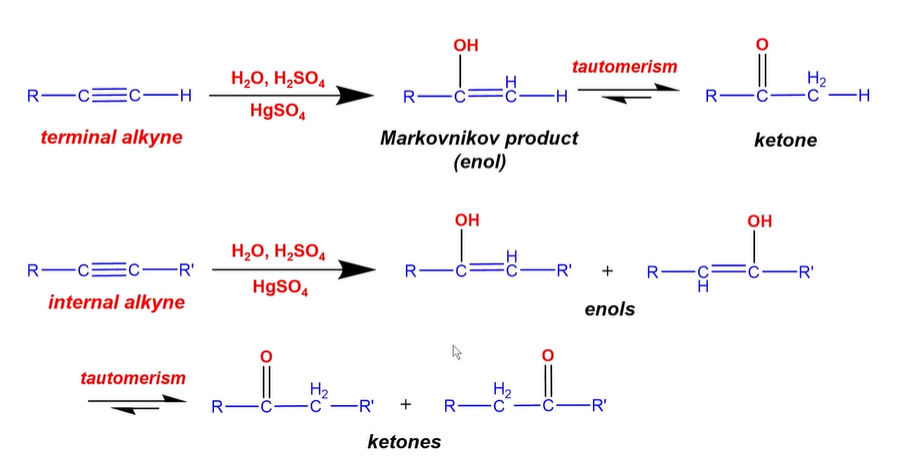
Acid Catalyzed Hydration (alkynes) internal
NEED HgSO4
mixture of products (no defining H)
They then turn to ketones afterward (more stable)
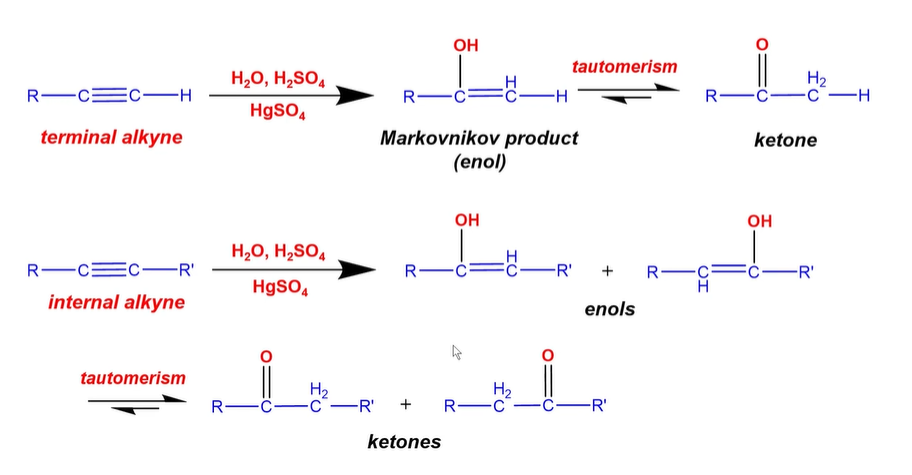
Hydration of alkynes (antimarkov)
BH3 / THF or (Sia)2 BH * THF
H202, OH-, H2o
INSTEAD of ketone, we get a aldehyde.
Alkylating Alkynes (with a alkylhalide)
The H atoms on the ends of terminal alkynes are sufficiently acidic to allow them to be removed using sodamide (NaNH2)
These can then have an halide added to them to add an alkyl group (or carbon chain)
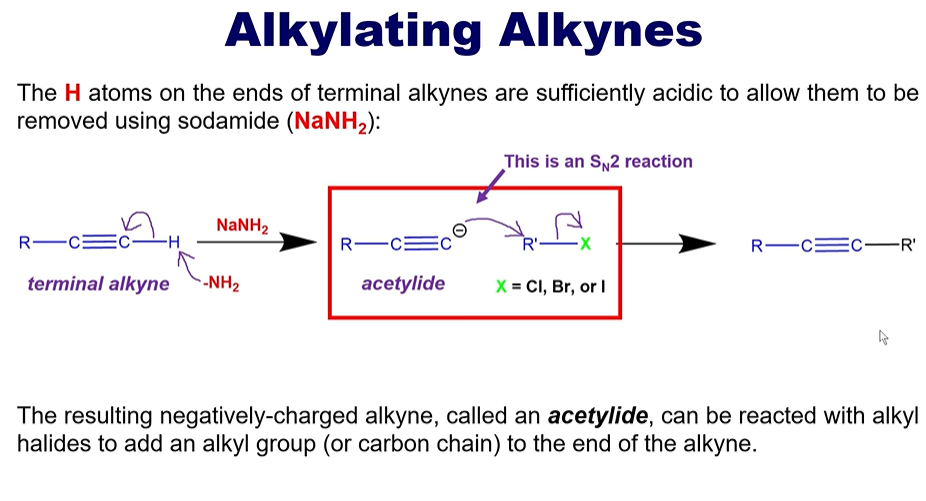
Alkylation with a ketone
The H atoms on the ends of terminal alkynes are sufficiently acidic to allow them to be removed using sodamide (NaNH2)

Alkyation with an epoxide
Basic conditions shown in image (less substituted)
The H atoms on the ends of terminal alkynes are sufficiently acidic to allow them to be removed using sodamide (NaNH2)

Alkanes to Alkynes
NaNH2 is used to kick out the hydrogen. and subsequent halogens to create an Alkyne
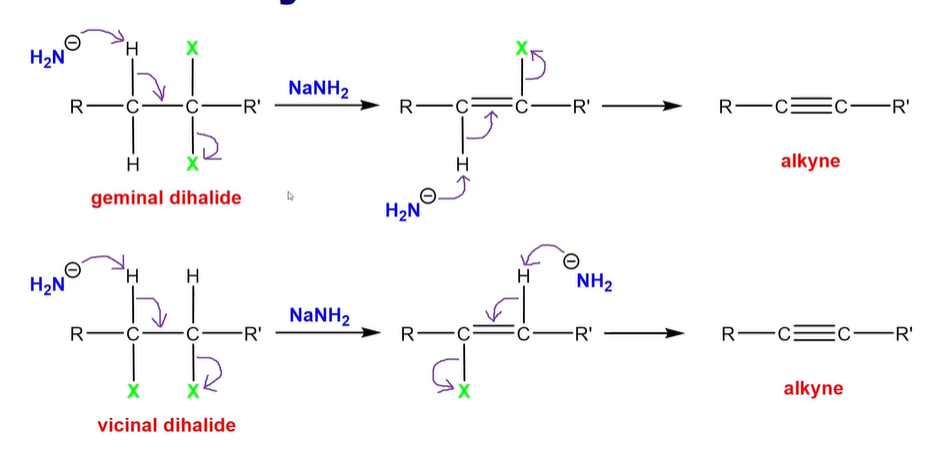
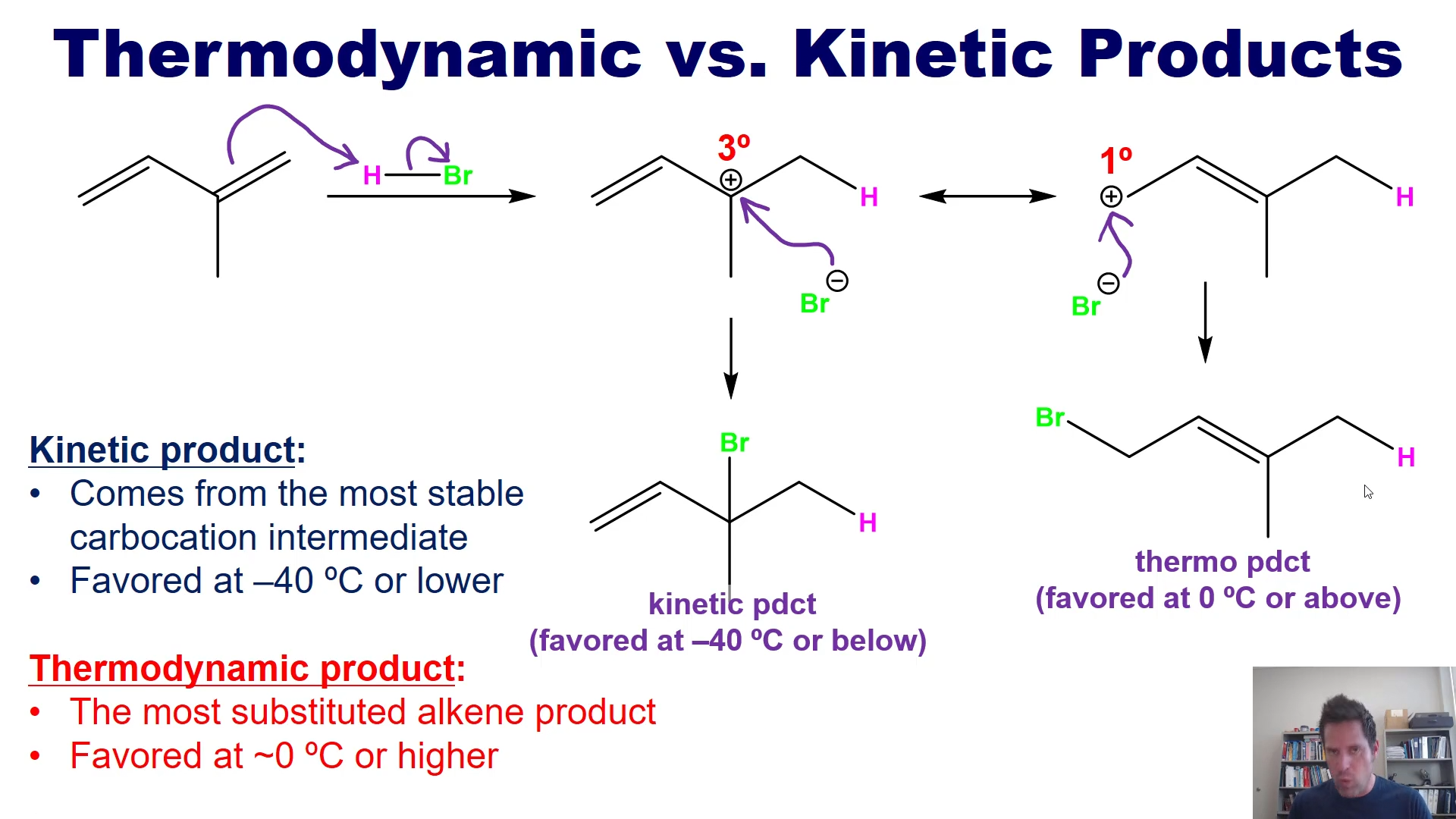
Kinetic Products Organic
KINETIC:
Forms fastest
Comes from most stable carbocation intermediate
Is favored at low temperature (kinetic control)
-40o or lower.
Thermodynamic Products Organic
Forms more slowly
Favored at high temperature
Most substituted (most internalized) alkene product, which is the most stable final product (Zaistev’s rule)
Zaistev’s Rule
Two isomeric alkenes, the one with the largest number of non-hydrogens in its c=c double bond is the most thermodynamically stable alkene. (most substitued)
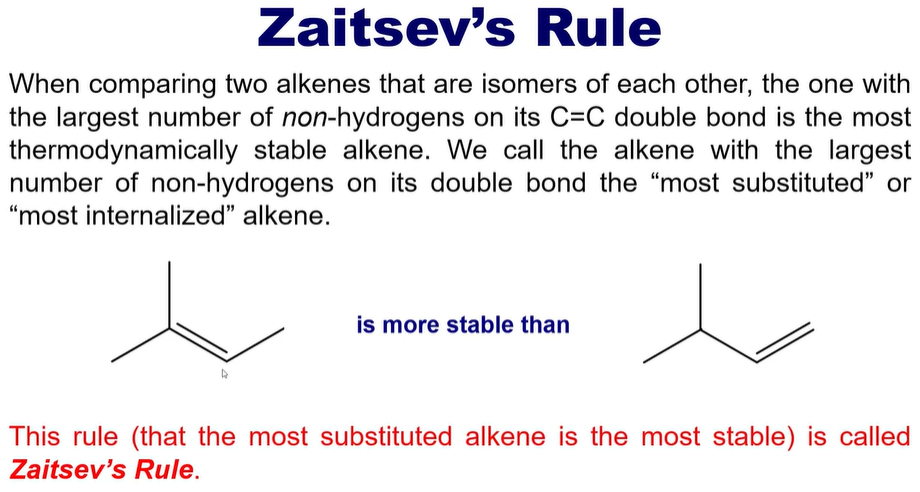
Thermodynamic vs kinetic product determination.