Mushrooms Exam 2
 Call Kai
 Learn
Learn Practice Test
 Spaced Repetition
 Match
Match Flashcards
 Knowt Play
1/106

There's no tags or description
Looks like no tags are added yet.
Name | Mastery | Learn | Test | Matching | Spaced | Call with Kai | Chat |
|---|
No analytics yet
Send a link to your students to track their progress
107 Terms
Gastrointestinal irritants
the most frequent form of mushroom poisoning is caused by…
Nausea, vomiting, cramps, diarrhea
Muscarine
symptoms occur within 15-30 min of ingestion - focused on involuntary nervous system
excessive salivation, sweating, tears, lactation, plus severe vomiting and diarrhea
severe results in death
dogs are particularly susceptible
Most frequent form of mushroom poisoning is caused by:
Gastrointestinal irritants
Symptoms that are caused by consuming mushrooms that are gastrointestinal irritants:
Diarrhea, vomiting, nausea
Onset time of symptoms from consuming mushrooms that are gastrointestinal irritants
½ to 3 hours
Mushrooms that contain Amatoxins?
Galerina autumnalis
Amanita phalloides
Amanita bisporigera
Toxins that have been linked to neurodegenerative diseases?
Hydrazine
TRUE OR FALSE - IN THE 1950S the CIA used LSF in a super secret mind control program called Operation MK-Ultra
True
What mycotoxin does Aspergillus flavus
Aflatoxin
What mycotoxin does Fusarium oxysporum produce?
Fumonisins
What mycotoxin does Fuasarium graminearum produce?
Zearalenone
What mycotoxin does Aspergillus carbonarius produce?
Ochratoxin A
Which government agency has a monitoring program to help ensure that the foods available for you to buy are not contaminated with mycotoxins?
FDA
The majority of mycotoxin producing fungi are in which phylum?
Ascomycota
Chestnut blight is caused by
Ascomycete
TRUE OR FALSE - American Chestnut trees are infected by ascospores of Cyrphonectria parasitica, but not by conidia.
False
The Oxo gene transferred into the genome of the Darling chestnut trees produces which:
Oxalate Oxidase
TRUE OR FALSE - Tar spot has devastated the Sugar Maple trees in the Northeast, which has led to falling production and increasing prices of maple syrup
FALSE - it primarily affects Norway maple, but has very little effect on tree health
Which tree diseases depend on an insect to create a wound or act as a vector for a fungal infection?
Beech Bark Disease and Dutch Elm Disease
The disease caused by the fungus Ophiostoma ulmi is called Dutch Elm disease why?
the cause was discovered by 5 dutch women scientists
Why did TACF withdraw its support from the Darling Project?
Lab errors at SUNH ESF
Disagreement concerning commercialization
D58 Performance was inconsistent
Potential Regulatory issues
Components of Lichens?
Green alga
Ascomycete fungus
Cyanobacterium
Yeast
Basidiomycete fungus
The dual hypothesis of lichens was proposed by whom?
Simon Schwendener
Eukaryote Domain evolved when a bacterium engulfed another bacterium that continued to live inside it in a process called
endosymbiosis
According to the lecture, an the geological time scale lichens first appeared 250 million years ago during the ______ period
Triassic
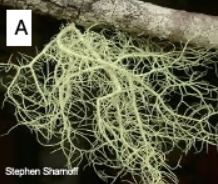
Which lichen growth form is this?
Fruticose
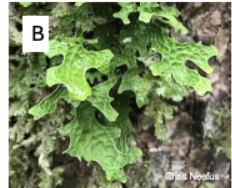
Which lichen growth form is this?
Foliose
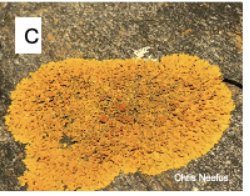
Which lichen growth form is this?
Crustose
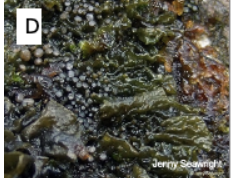
Which lichen growth form is this?
Gelatinous
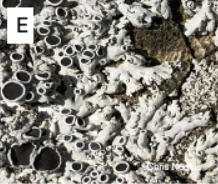
Which lichen growth form is this?
Squamulose
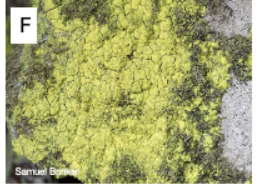
Which lichen growth form is this?
Leprose
The oldest living organism is a Geographic Map Lichen (rhixocarpon geographicum) that is ______ years old
8,600
The Wolf Lichen (Letharis Vulpina) produces _____ acid, a toxin that was used to kill wolves
Vulpinic
In 2016, Spibrille et al. published an article in Science magazine where they revealed that in addition to a fungus, an alga and/or cyanobacterium, a third component of lichens is
yeast
Mycorrhizae are a symbiotic relationship between a fungus, referred to as the ______ and a plant referred to as the ______
Mycobiont, Phytobiont
The two general types of mycorrhizae are ______ mycorrhizae, in which hyphae penetrate the cell walls of the root cortex
endomycorrhizal
_______ mycorrhizae where the hyphae grow between the cortical cells, but don’t penetrate the cells
Ectomycorrhizae
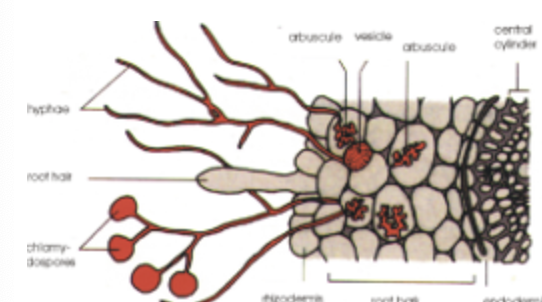
What is this a diagram of?
Arbuscular mycorrhizae
What phylum is the fungal partner of Arbuscular mycorrhizae
Glomeromycota
In Ectomycorrhizae, the sheath of hyphae surrounding the outside of the root top is called the _____ and the network of hyphae growing between the cortical cells is called the ______
Mantel, Hartig Net
Most ectomycorrhizal fungi belong to the ______
Basidiomycota phylum
TRUE OR FALSE - In Mycorrhizial symbiosis, he fungus benefits by receiving sugars and lipids from the plant, while the plant benefits by recieving water, nitrogen and phosphorus from the fungal partner
True
TRUE or FALSE - A single fungal species can form different types of mycorrhizal connections depending on the plant species it is connecting to
True
In monotropoid mycorrhizae, that form Monotropa unifora, the fungal partner provides carbohydrates to the plant that it obtains from ___
EcM partners
Toxin and symptoms of Alcohol Inky
Toxin = coprine
Symptoms = similar to alcohol poisoning, nausea, palpitations
Toxin and symptoms of false morels
Toxin = Gyromitrin —> Monomethylhydrozene
Symptoms = headache, abdominal pain, severe diarrhea
Toxins and symptoms of Jack O’ Lantern
Toxins = Illudin
Symptoms = Nausea, diarrhea, vomiting
Toxins and symptoms of Shiitake Mushrooms
Toxin: Lentinan
Symptoms: flagellate rash
What is the deadliest mycotoxin?
Aflatoxins
What foods does Alfatoxins occur in ?
Rye, barley, wheat, corn, alcohol, sugar cane, sugar beets
How does mycotoxic get into our food supply?
Fungus infects plant and produces mycotoxin —> fungus may die off, by mycotoxin remains —> food contaminated even though fungus is no longer present
Ergot poisoning
severe condition caused by ingesting grain or flour contaminated with the fungus Claviceps purpurea
Dermatotoxins symptoms
Damaging mucous membranes and skin
Hepatoxins symptoms
Leading to liver damage
caridotoxins symptoms
Cardiovascular diseases
Nephrotoxins symptoms
damaging the kidneys
neurotoxins symptoms
affecting the central nervous system
Pulmotoxins symtpoms
pulmonary edema
What mushrooms contain Amatoxins?
Galerina autumnalis
Amanita bisporigera
Amanita phalloides
What toxin has been linked to neurodegenerative diseases
hydrazine
Aspergillus flavus produces
Aflatoxin
Fusarium oxysporum produces
Fumonisins
Fusarium Graminearum produces
Zearalenone
Aspergillus carbonarius produces
Ochratoxin A
The majority of mycotoxin producing fungi are in which phylum
Ascomycota
What is a lichen?
an organism comprised of a fungus and an alga/cyanobacterium. May also include yeast, bacteria, and viruses
most are ascomycetes
“verbs as well as nouns”
Why did TACf withdraw its support from the darling project?
Lab errors at SUNH ESF
disagreement concerning commercialization
D58 Performance was inconsistent
Potential regulatory issues
Mycobiont
fungal component of lichen
photbiont
algal component of lichen
How do fungus and algal components work together in lichen?
Fungus absorbs the water, enzymes to extract nutrients, provides mineral nutrition and protection —> Algae uses sunlight to fix CO2 to produce sugars
How are lichens taxonomically classified?
by the fungal component
Ernst Haeckel
1866 “Ecology” - the relationship between organisms and their environment
Alexander von Humbolt
nature is an interconnected whole - a system of active forces
Simon Schwendener
Swiss botanist - 1869 proposed the dual hypothesis of lichens
suggests some organisms have dual evolutionary lines
Albert Frank
proposed the term symbiosis to describe the relationships in lichens
Heinrich Anton de Bary
Generalized the term symbiosis to describe the full spectrum of relationships
Joshua Lederberg
discovered that bacteria could acquire traits from other bacteria
Lynn Margulis
pushed for endosymbiso
What is the importance of horizontal gene transfer
major jump in eukaryotic evolution - transfer entire genomes
What is the importance of endosymbiosis
Eukaryotic domain evolved when a bacterium engulfed another bacterium that continued to live inside it
eukaryotes are inseparable composite of multiple evolutionary lines
Wolf Lichens
fruticose lichen
grows on conifers
red listed in norway
produced vulpinic acid
eaten by reindeer and moose
toxic to wolves
used as yellow dye
Tree Lungwort
Foliose tripartite ascolichen
Reproduces by soredia, isidia and after 25 years apothecia
Contribute to forest soil N reserve
Bioindicator - acid rain lowers pH inhibits nitrogen reductase
Herbal medicine
Lichen asexual reproduction
fragmentation-pieces of lichen break off. Soredia particles of algal cells enveloped by fungal hyphae
Lichen sexual reproduction
fungus produces spores —> sprores land, germinate and hyphae grows to find right species of alga —> fungus grows through the agla develops
Endomycorrhizal
one of the most common types of Mycorrhizae - fungi grow inside root cells
Fungal phylum - glomeromyctota
Contains:
Arbuscular mycorrhiza
Ericoid mycorrhiza
Orchid mycorrhiza
Arbuscular mycorrhizae
AM Fungi - 80% of all vascular plant species
Hyphae penetrate the cell wall of cortical cells of roots
form branched arbuscules between wall and cell membrane
Have storage organs - vesicles or auxillary cells
Asexual spores
Ectomycorrhizae
Outside root cells - hyphae do not penetrate the cell wall of cortical cells of roots
most are Basidiomycota or ascomycota
10% of all vascular plant families, many are trees
Mycorrhizae
a relationship between a plant and a fungus
phytobiont usually provides sugars and lipids - mycobiont provides minerals, water, protection
Mycorrhizae - benefits to plants
Increased plant water and mineral nutrient supply by extending the volume of the soil accessible to plants
plant to plant carbon transfer through fungal connections
Help seedlings become established or contribute to the growth of shaded plants
Mycorrhizae - benefits to fungi
sugars and lipids from plants
living in or around roots provides a protected habitat
Wood wide web
90% of all plants have mycorrhizal connection to fungi
organisms interact through their soil environments
Suzanne Simard
Found that 6% of carbon was transferred between birch and fir trees via a shared Mycorrhizal network
further found when she shaded fir trees - they received more carbon from the birches
source sink dynamics —> resources flow downhill
Older ‘Mother trees’ can support seedlings
what SMNS do - Shared mycorrhizal networks
Allow transfer of carbon, nitrogen, water
can influence seedling establishment and plant survival under stress
faciliate resource redistribution based on gradients
organisms involved in SMNS
plants, mycorrhizal fungi , possibly microbes
Source - sink dynamics
source = exports resources
sink = imports resources
resources move along concentration gradients
what controls source - sink dynamics?
Light availability, plant size/age, nutrient status, seasonality, species identity and fungal partners, distance/network structure
Lignin
a key component of plant cell walls that makes wood wood
Wood cell wall structure
Lignified cell walls
Lignin - rot resistant phenolic bipolymer
cellulose
hemiceullose
Brown Rot
Exclusively by basidiomycetes
attacks dead wood
mostly associated with conifers
mostly in temperate and boreal zones
lignin remains in modified forms
degradation of hemicellulose and cellulose takes place at different stages
White rot
Basidiomycetes - all the main groups
some ascomyetes
some attack living wood - some attack dead wood
lignin is broken down leaving bleached white cellulose
selective dignification - lignin broken down more than cellulose or hemicellulose
Simultaneous rot - mostly in broad leaf trees, lignin, cellulose, and hemicellulose are broken down at the same rate