Unit 4: Energy Expenditure during Gait
 Call Kai
 Learn
Learn Practice Test
 Spaced Repetition
 Match
Match Flashcards
 Knowt Play
1/23

There's no tags or description
Looks like no tags are added yet.
Name | Mastery | Learn | Test | Matching | Spaced | Call with Kai |
|---|
No analytics yet
Send a link to your students to track their progress
24 Terms
how is energy expenditure during gait measured?
measured in amount of energy used in calories per meter walked per kilgram of body weight
how does energy expenditure change as walking speed increases?
Energy expenditure generally increases with walking speed due to higher muscular demands and metabolic rates. However, there is a desirable walking speed (1.33 m/sec or 80 m/minute) that is lowest, and going slower than that rate actually increasing the energy expenditure
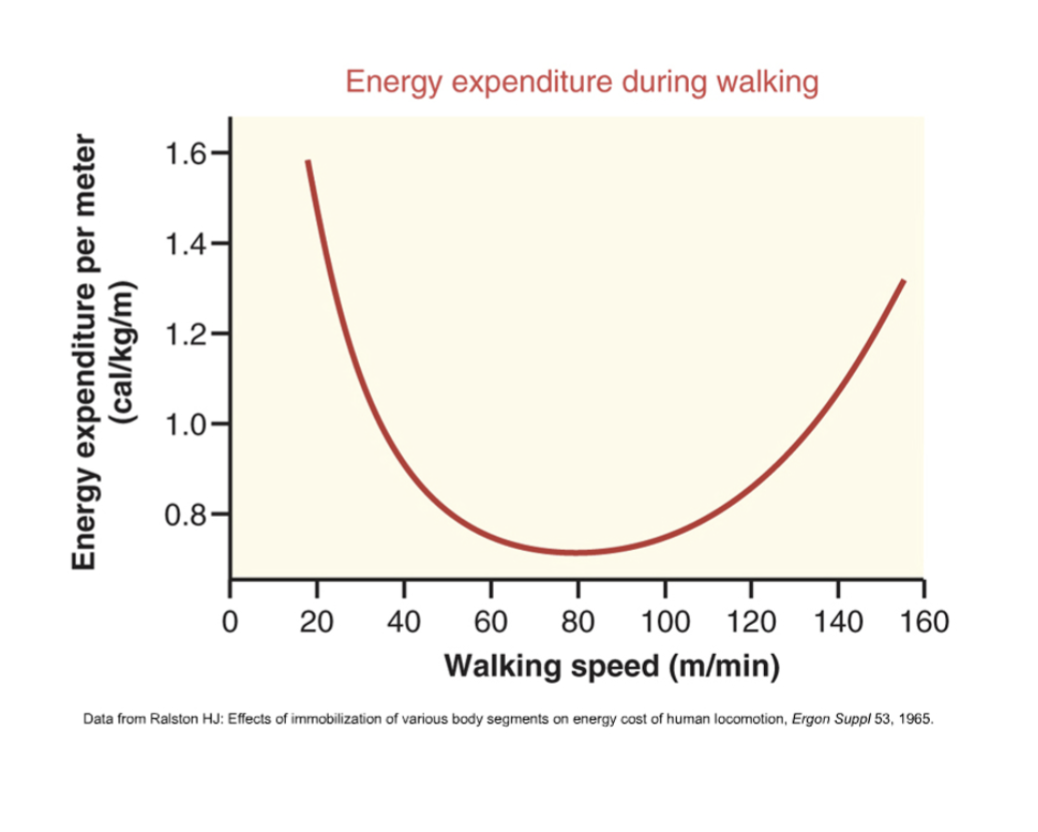
what is the maximum energy efficiency?
ideal combination of step length and cadence, the imposition of a different step length or step rate increases energy expenditure
how is maximum energy efficiency achieved?
by optimizing the excursion of the center of mass, controlling the body momentum, and taking advantage of the intersegmental transfers of energy
how does the center of mass displace during gait?
The center of mass typically moves in a smooth, sinusoidal pattern during gait, with vertical and horizontal displacements resulting from the alternating phases of stance and swing.
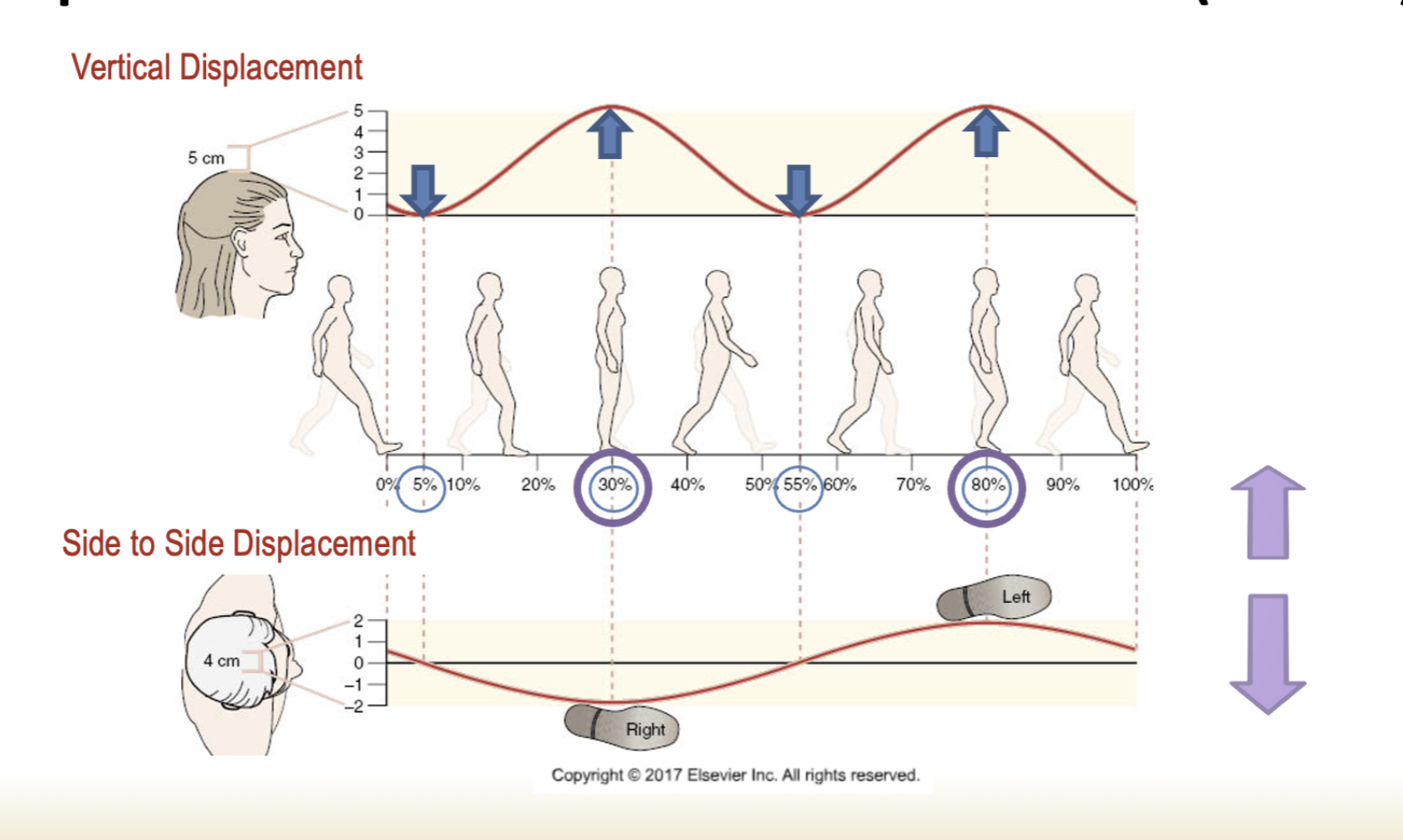
how does teh body minimize vertical COM displacement?
horizontal plane pelvic rotation, sagittal plane ankle rotation, stance phse knee flexion, and frontal plane pelvic rotation
how does the body minimize side to side displacement?
frontal plane hip rotation (step width)
what is the goal of the kinematic strategies of walking?
decrease energy expenditure related ot the muscular effort needed to lift the body, and most recent research shows that there is an optimal amount of oscillation of the COM
how does horizontal plane pelvic rotation minimize vertical displacement?
reduced downward displacement of CoM. allows to advance the entire swing leg forward with minimal hip flexion and extension
how does sagittal plane ankle rotation decrease vertical displacement of the CoM?
reduces downward displacement of CoM by elongating the LE at heel contact and at the end of stance (PF)
how does stance phase knee flexion reduce vertical displacement?
reduces upward dispalcement when teh LE is in its most vertical orientation
how does frontal plane pelvic rotation reduce vertical displacement?
reduces upward displacement of CoM as the iliac crest alternatively rise and fall around the body’s CoM (second sacral vertebrae_
how does frontal plane rotation reduce side to side displacement?
with hip abduction and adduction, normal step width reduces the side to side displacement, a step width of greater than 8-10 cm increases stability but increases energy expenditure
what is mechanical energy?
the capacity to do mechanical work
what is kinetic energy?
energy in motion, direction function of the body’s velocity, minimum at mid stance, and max at double limb support
what potential energy?
energy of position or stored energy, direct function of the height of the body’s CoM, minimum at double limb support and max at mid stance
what minimized energy expenditure when walking at free speed?
efficient exchange of KE and PE during gait
describe the muscle activity of the large muscle groups during gait
activity of large muscles mostly demonstrates eccentric contraction (decelerate the joints) followed by concentric contraction (joint forward motion). some of the energy stores in stretched muscles is released during the muscles’s shortening to help propel the limb forward without requiring additional energy (this ability of muscle to store E contributes to the overall efficiency of gait)
what does energy transfer between limb segments depend on?
the power generated and absorbed at joints, reflects the rate of generating and absorbing energy by muscles and connective tissue crossing a joint. Concentric activation generates power (positive value), and eccentric muscle activity absorbs joint power (negative value). also depends on normal sequencing of angular changes
how might joint stiffness in OA or RA lead to less ability to transfer energy?
if a joint has low angular velocity then it has low power generation or absorption, which leads to less ability to transfer energy
what other conditions might lead to less ability to transfer energy?
generalized rigidity of parkinsons, decreased walking speed in elderly
what are the implications of joint stiffness then?
treatments to decrease joint stiffness or improve fluid movement and timing of the limb segments during gait (to increase efficiency)
describe the energy cost of walking for pts with OA
individuals with knee OA exhibit decrease energy exchange between KE and PEs. decreased walking speed could decrease KE. KE and PE rise and fall together throughout much of the gait cycle. Increasing the efficiency of gait then might make walking as exercise more appealing and feasible for these individuals.
what are clinical considerations of gait?
normal locomotion is remarkable efficient, when walking the body minimizes energy cost by optimizing the excursion of CoM, using a pattern of eccentric then concentric muscle activation as an efficient means of generating muscle force and storing energy