Blanchette Ecology Test (tuesday)
 Call Kai
 Learn
Learn Practice Test
 Spaced Repetition
 Match
Match Flashcards
 Knowt Play
 Podcast
1/32

Earn XP
Description and Tags
100 Points (you need to be able to explain)
Name | Mastery | Learn | Test | Matching | Spaced | Call with Kai | Chat |
|---|
No analytics yet
Send a link to your students to track their progress
33 Terms
Biosphere
A combination of all of earths ecosystems. It has a combination of biotic and abiotic components. (Examples → Amazon rainforest → Trees, Rain, Animals)
Biome
A large geographical region with a specific climate. (Desert, Rainforest, Tundra, etc.)
Ecosystem
A community of living organism and non living organisms. (plants, animals, microbes, soil, water)
Community
A combination of different organisms interacting in a certain area.
Population
the number or inhabitants given in a certain area.
Organism
An individual animal, plant or single cells organism.
Symbiosis
A close relationship between species
Mutualism
Both species benefit
Commensalism
One species benefits, and the other is unaffected
Parasitism
One organism benefits at the expense of the other
Predation
One organism hunts and kills another
Competition
Species compete for the same recourses
Whats the difference between a community and population
A population is a group of an individual species in an area while a community is the different species that interact in the same area.
In terms of energy consumed and transferred, explain why populations of top carnivores such as hawks are always smaller than populations of herbivores such as grasshoppers.
Because 10% of the energy transfers from each trophic level. This leads to energy loss and it requires large base levels of the food chain so they can support the higher levels.
How does the biomass of the hawk population likely compare to the biomass of the grasshoppers?
The hawks biomass is much less because the biomass gets lost at each step of the food chain.
How much energy passes from the 1 trophic level to the next?
10% because some energy goes to the organism and some gets lost
How does the biomass compare from one trophic level to the next?
It decreases significantly from one trophic level to the nxt because 10% is lost each time.
What is biomagnification and how does it change between trophic levels?
The process where a concentration of a substance gets greater as it moves up the food chain.
Homeostasis
The bodies ability to maintain a stable internal environment
Does biodiversity help maintain homeostasis in a community?
Yes because the organisms in a community can support eachother if something happens to a species population
What are negative effects of climate change on species?
It destroys the organisms habitats and it makes it more likely for extinction.
Why do invasive species grow fast in their new nabitats?
They don’t have their normal predators, competitors, diseases and it removes the natural population controls.
What are density dependent factors that could cause a population to reach carrying capacity?
Competition for recourses
Biotic potential
Theoretical maximum growth rate of an organism under ideal conditions
Carrying capacity
Is the growth limit of an organism set by the environment
What’s a survivorship curve?
A graph that shows the proportions of an individual organism survival rate.
Type 1 survivorship curve
This curve is a high curve that drops low that shows organisms live to an old age and have very little offsprings. (Such as humans)
Type 2 survivorship curve
This is a straight diagonal line that shows how animals have an equal chance of dying at any point in life
Type 3 survivorship curve
Curve starts high at the beginning and falls very sharply. Very few organisms make it to adulthood (such as insects and fish).
R strategist
Have many offspring and high population growth rates but very little survive
K strategist
Produce fewer offspring and live near the carrying capacity. (Such as humans)
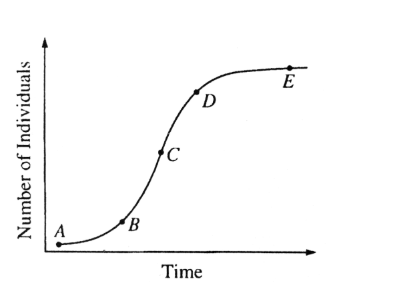
What has the Most biotic Potential?
C
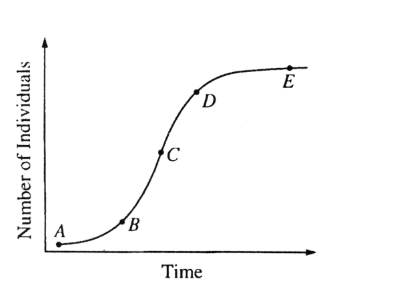
What has the highest carrying capacity?
E