Rate equations
 Call Kai
 Learn
Learn Practice Test
 Spaced Repetition
 Match
Match Flashcards
 Knowt Play
1/39

Earn XP
Description and Tags
Name | Mastery | Learn | Test | Matching | Spaced | Call with Kai |
|---|
No analytics yet
Send a link to your students to track their progress
40 Terms
Give an equation for calculating the gradient of a line on a graph.
Gradient = change in y / change in x
How do you work out the gradient of a specific point on a curve?
1) Draw a tangent line on the point.
2) Find the gradient of the tangent line.
What does the rate equation link?
The rate of a reaction and the concentration of substances in the reaction.
Give the rate equation for this reaction:
A + B → C + D
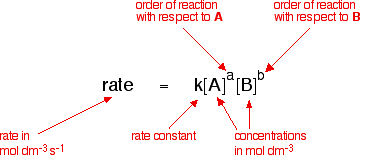
What is the order of a substance?
A value (0/1/2) telling us how the concentration of a substance affects the rate of reaction.
How does a substance of 0 order affect the rate of reaction?
A substance of 0 order has no effect on the rate of reaction.
How does a substance of 1st order affect the rate of reaction?
When a substance of 1st order is changed, the changed that happens to the rate of reaction is proportional to that of the change to the substance.
How does a substance of 2nd order affect the rate of reaction?
When a substance of 2nd order is changed, the rate of reaction undergoes a square proportional change (changes by the value that the substance was changed by squared).
True or false? It is possible to determine orders just by seeing the equation for a reaction.
False. IT IS ONLY POSSIBLE TO DETERMINE ORDER EXPERIMENTALLY.
True or false? The rate constant is only valid at one temperature, so if temperature changes so does the rate constant.
True.
How does an increased rate constant value affect the rate of reaction?
Increased rate of reaction.
What is the initial rate of a reaction?
The rate of reaction at 0 time.
How do you calculate the initial rate of a reaction from a graph?
1) Draw a tangent line at 0 time.
2) Find the gradient of this tangent line, this is the initial rate of the reaction.
How do you work out the order of a reactant where in the experimental tables it’s concentration has changed but the concentration of the other reactant (of which you know the order) has not been kept the same?
1) Work out what the initial rate value would be if only the concentration of the reactant of which you know the order had been changed, if there is a difference between this value and the actual initial rate value then the reactant of which you don’t know the order does have an affect on the rate so cannot be zero order.
2) Work out the difference between the real initial rate and your answer the (1), if the difference is that it’s been halved the reaction is 1st order, if the difference is that it’s been quaterred the reaction is 2nd order.
Give four things you can use to measure the rate of reaction.
pH change.
Volume of gas produced.
Mass lost.
Speed of colour change.
What is the best piece of equipment to use when measuring the rate of reaction with pH change?
pH meter.
What is the best piece of equipment to use when measuring the rate of reaction with a colour change?
Colorimeter.
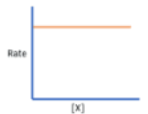
Sketch a rate-concentration graph for a substance that is 0 order.
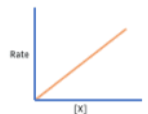
Sketch a rate-concentration graph for a substance that is 1st order.
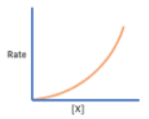
Sketch a rate-concentration graph for a substance that is 2nd order.
Sketch a concentration-time graph for a substance that is 0 order.
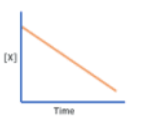
Sketch a concentration-time graph for a substance that is 1st order.
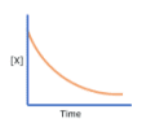
Sketch a concentration-time graph for a substance that is 2nd order.
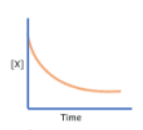
What is the rate-determining step?
The slowest step in a multi-step reaction.
How does the rate equation help in working out the rate-determining step?
All of the substances involved in the rate equation must also be in the rate-determining step.
True or false? Catalysts can also appear in the rate equation.
True.
How can you work out the order of a substance in the rate equation from seeing it in the rate-determining step?
The coefficient of the substance will be it’s order in the rate-determining step (1 or 2).
How can you work out the rate equation when you have all the steps in a reaction?
1) Work out the rate determining step, any reactants in that must be in the rate equation.
2) Any reactants that form the reactants in the rate-determining step must also be in the rate equation.
How do you work out the rate-determining step when you have the rate equation for the reaction? (“chemical bingo”)
1) The orders of each substance in the rate equation give the coefficient of each substance, the coefficient for each substance gives how many times in must be “crossed off” in the steps (in order) for the overall reaction.
2) Once you have “crossed off” everything in the rate equation you stop (“bingo”), the step you stop on is the rate-determining step.
How do you choose the reaction mechanism for a reaction (when you have multiple options) from the rate equation?
Choose the mechanism that contains a step that contains only the substances in the rate equation as the reactants.
What does the Arrhenius equation link?
Rate constant, activation energy, temperature.
Give the Arrhenius equation (labelled and with units for each component).

k = rate constant (varying units)
Ae = Arrhenius constant
Ea = activation energy (J)
R = gas constant (J K-1 mol-1)
T = temperature (K)
As the activation energy decreases, the rate constant…
increases.
As temperature increases, the rate constant…
increases.
Give the Arrhenius equation when the natural log (ln) of both sides is taken.

Which two things can you work out from an Arrhenius plot?
Activation energy.
Arrhenius constant.
What is on the x and y axis on an Arrhenius plot?
x axis = 1/T
y axis = lnk
What does the gradient of an Arrhenius plot represent from the Arrhenius equation?
-Ea/R
Talk me through how to work out the Arrhenius constant from an Arrhenius plot.
1) Work out the gradient of the Arrhenius plot to get -Ea/R.
2) Rearrange your answer to (1) to get the the activation energy (Ea).
3) Rearrange the Arrhenius equation so that the Arrhenius constant is the subject.
4) Plug all values into rearranged Arrhenius equation to get Arrhenius constant.
How do you convert from lnA to A?
elnA = A