CBNS Lecture 6- Neurotransmitter systems
 Call Kai
 Learn
Learn Practice Test
 Spaced Repetition
 Match
Match Flashcards
 Knowt Play
1/9

There's no tags or description
Looks like no tags are added yet.
Name | Mastery | Learn | Test | Matching | Spaced | Call with Kai |
|---|
No analytics yet
Send a link to your students to track their progress
10 Terms
Foundations
NT possibilities
a) What is Dale’s Principle?
→ A neuron releases the same neurotransmitter at all its synapses
b) What are co-transmitters?
→ When a neuron releases multiple neurotransmitters (e.g., amine + peptide)
c) What does “-ergic” mean?
→ Refers to the neurotransmitter used
→ Example: cholinergic, GABAergic, glutamatergic
Criteria for labeling a NT
a) must be synthesized and stored in the presynaptic terminal
b) must be released at the terminal
c) must have the same effect when applied experimentally
Studying NT systems
In situ hybridization
→ Detects mRNA → shows where proteins are madeImmunocytochemistry
→ Uses antibodies to locate specific molecules in cells
Studying Synaptic Mimicry
Microiontophoresis
→ Applies tiny amounts of a substance to test postsynaptic effectsMicroelectrode
→ Measures changes in membrane potential
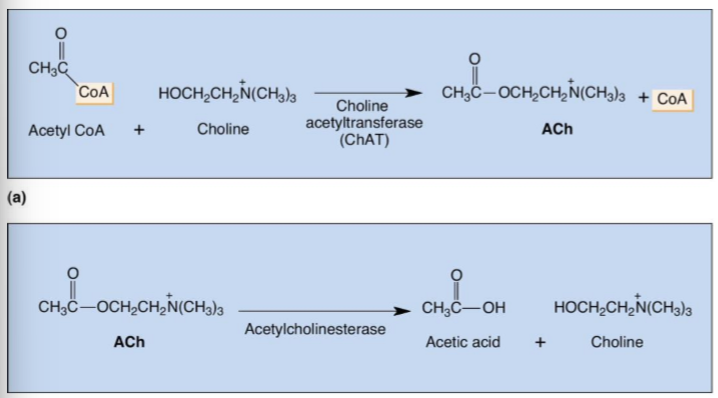
Ach
Why is ACh important?
→ First discovered neurotransmitter
→ Major transmitter at neuromuscular junctionACh synthesis enzyme
→ Choline acetyltransferase (ChAT)ACh breakdown enzyme
→ Acetylcholinesterase (AChE)
Catecholaminergic neurons
What are catecholamines derived from?
→ Tyrosine
Three main catecholamines
→ Dopamine
→ Norepinephrine
→ Epinephrine
Key enzymes in catecholamine synthesis
→ Tyrosine hydroxylase (rate-limiting step)
→ Dopa decarboxylase
→ Dopamine β-hydroxylase
→ PNMT
1. Tyrosine → L-DOPA Enzyme: Tyrosine hydroxylase (TH) What happens: A hydroxyl group (–OH) is added to tyrosine Importance: This is the rate-limiting step (slowest, tightly regulated)
2. L-DOPA → Dopamine Enzyme: DOPA decarboxylase What happens: A carboxyl group (–COOH) is removed (decarboxylation) Result: Formation of dopamine, an important neurotransmitter
3. Dopamine → Norepinephrine Enzyme: Dopamine β-hydroxylase (DBH) What happens: A hydroxyl group (–OH) is added to the side chain Result: Norepinephrine (noradrenaline)
4. Norepinephrine → Epinephrine Enzyme: Phenylethanolamine N-methyltransferase (PNMT) What happens: A methyl group (–CH₃) is added to the amine Result: Epinephrine (adrenaline)
Functions of catecholamines
→ Movement
→ Mood
→ Attention
→ Visceral functions
Serotoninergic neurons
Serotonin is derived from
→ Tryptophan
Functions of serotonin
→ Mood
→ Sleep
→ Emotional behavior
Serotonin synthesis enzymes
→ Tryptophan hydroxylase
→ 5-HTP decarboxylase
1. Tryptophan → 5-Hydroxytryptophan (5-HTP) Enzyme: Tryptophan hydroxylase What happens: A hydroxyl group (–OH) is added to the aromatic ring Key point: This is the rate-limiting step (like tyrosine hydroxylase in the other pathway)
2. 5-HTP → Serotonin (5-HT) Enzyme: Aromatic L-amino acid decarboxylase (aka 5-HTP decarboxylase) What happens: The carboxyl group (–COOH) is removed Result: 5-Hydroxytryptamine (serotonin, 5-HT)
What do SSRIs do?
→ Block serotonin reuptake → increase serotonin levels
Amino acidergic neurons
Nt’s
glu
gaba
glycine
Gaba synthesis: Glu to gaba (GAD)
VESICULAR TRANSPORTERS- Presynaptic site
a) vGAT
→ Loads GABA into vesicles
b) vGlut
→ Loads glutamate into vesicles
Receptor subtypes
ACh Receptors
Things have been done to inhibit ACH receptors …
a) Nicotonic
Curare darts block normal synaptic transmission of NMJ (Ach to nicotonic receptors)
Either mimics ach action or blocks
b) Muscarine
Atropine found to block muscarine
Glutamate Receptors:
a) AMPA (transmission)- permeable to Na and K
b) NMDA (plasticity)- permeable to Na, K, and Ca
depol occurs on presynaptic side and releases Glu
Blu binds to AMPA and it opens allowing Na and K to rush in (depol on post)
depol causes Mg block to leave NMDA allowing for Na, k, and Ca to flow in (LTP)
GABA receptors
GABAa
a) ionotropic
b) inhibitory
GABAb
a) metabatropic
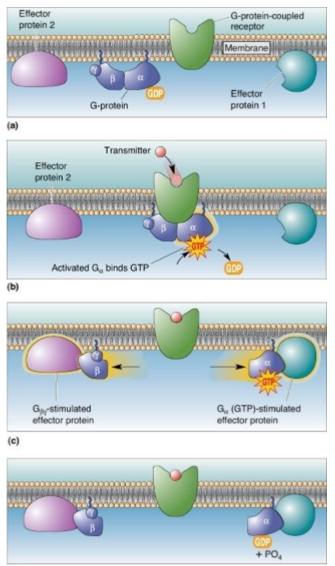
b) GPCRs = turn outside signal into an inside cellular response using G proteins
structure: 7 membrane spanning alpha helices (one protein crosses the membrane 7 times) sitting in the cell membrane
Steps:
Signal binds = ligand (nt or hormone) binds to the GPCR on outside
G protein gets activated =
G protein has 3 parts alpha, beta, and gamma
when activated GDP becomes GTP on the apha subunit
separates alpha and beta
Cell Response =
separated alpha and beta parts go activated other proteins (effectors)
cellular response BANG
Reset =
apha subunit goes opposite way (GTP to GDP)
another round thank q
c) Effector Systems
the targets of the G protein that create a response
Shortcut pathway (ion channels):
the G protein directly opens/closes a channel
immediate effect
fast and direct
Ex: ach- autonomic nervous system
Secondary (enzymes):
G protein activates enzyme inside the membrane
the enzyme makes second messengers
slower but stronger/a mplified
more on GPCR effector systems
so yk the basics but now…
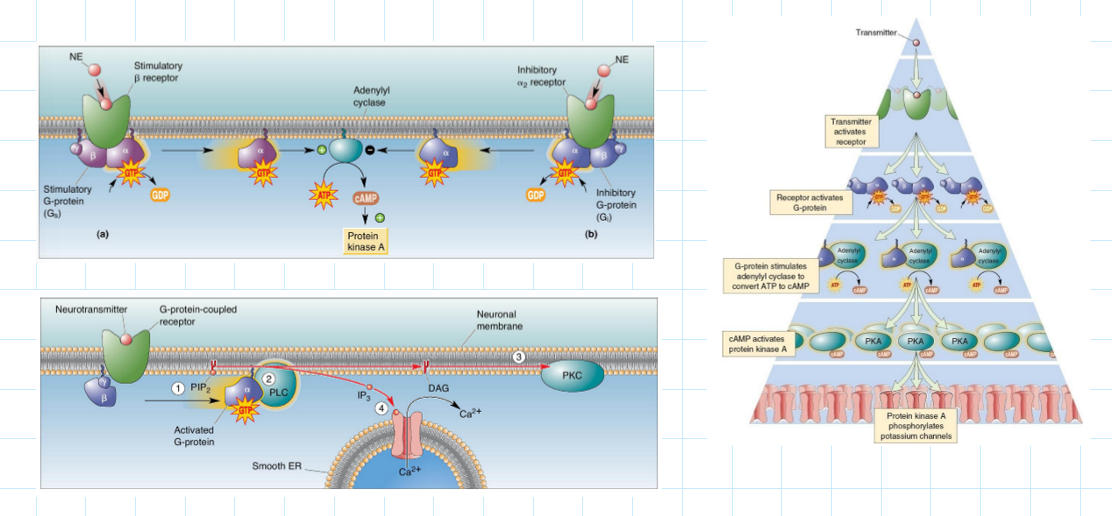
Push Pull signaling
Two different G proteins control the same enzyme (cAMP) but in opposite ways
a) Gs
activates cAMP and PKA
b) Gi
inhibits cAMP and PKA
Gq
Calcium pathway
Gq activates phospholiphase (PLC)
PLC splits one molecule into IP3 and DAG
Then =
Ip3 goes to the ER and releases Ca2+
DAG activates PKC
Final = calcium rises and there is an activation of enzymes
Amplification pyramid = small signal leads to big response