Topic 5 Forces
 Call Kai
 Learn
Learn Practice Test
 Spaced Repetition
 Match
Match Flashcards
 Knowt Play
1/77

There's no tags or description
Looks like no tags are added yet.
Name | Mastery | Learn | Test | Matching | Spaced | Call with Kai |
|---|
No analytics yet
Send a link to your students to track their progress
78 Terms
What is a scalar quantity?
A scalar quantity has magnitude (size) only and no direction
Examples:
Distance
Speed
Mass
Temperature
Energy
Time
What is a vector quantity?
A vector quantity has both magnitude and direction
Examples:
Force
Velocity
Displacement
Weight
Acceleration
Displacement
How are vector quantities represented?
By an arrow:
Length of arrow = magnitude (size)
Direction of arrow = direction of the vector quantity
What is a force?
A force is a push or pull on an object caused by interaction with another object
Force is a vector quantity
What are contact forces? Give examples
Contact forces occur when objects are physically touching
Examples:
Friction
Air resistance
Tension
Normal contact force
Water resistance
What are non-contact forces? Give examples
Non-contact forces act when objects are not touching
Examples:
Gravitational force
Electrostatic force
Magnetic force
Weight
What is weight?
Weight is the force acting on an object due to gravity
What causes weight on Earth?
Weight is caused by the gravitational field around the Earth, which pulls objects towards the planet
What is the equation for weight?
W = mg
W = weight (newtons, N)
m = mass (kg)
g = gravitational field strength (N/kg)
What does gravitational field strength mean?
Gravitational field strength (g) is the force acting on each kilogram of mass in a gravitational field
Where does the weight of an object act from?
The weight of an object acts from its centre of mass
What does the weight of an object depend on?
Its mass
The gravitational field strength (g) at the point where the object is
How are weight and mass related?
Weight ∝ mass (directly proportional)
How is weight measured?
Weight is measured using a calibrated spring balance / newtonmeter
What is a resultant force?
The sum of all force vectors on one object
Spec definition - the single force that has the same effect as all the original forces acting together on an object
How do you find the resultant force?
If forces act in the same direction → add them
If forces act in opposite directions → subtract the smaller from the larger
What are balanced forces?
Balanced forces occur when the resultant force is zero, so there is no change in motion.
What is a free body diagram?
A free body diagram shows all the forces acting on an object, represented by arrows (vectors)
What does it mean to resolve a force?
To resolve a force means to split one force into two component forces at right angles (90°) to each other
What are vector diagrams used for in forces?
Show direction and magnitude of forces
Find resultant forces
Show equilibrium (balanced forces) using scale drawings
What are the forces involved in an aeroplane flying at a constant velocity at a constant altitude?
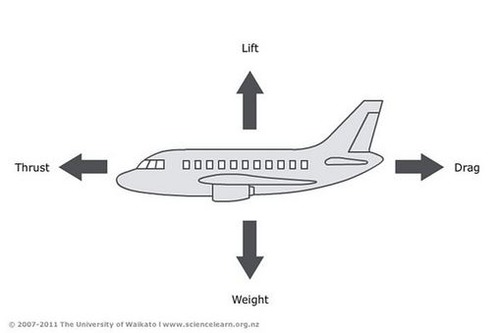
When is work done on an object?
Work is done when a force causes an object to move (displace) through a distance
What is the equation for work done?
W = F × s
W = work done (joules, J)
F = force (newtons, N)
s = distance moved in the direction of the force (metres, m)
What does 1 joule of work mean?
1 joule (J) is the work done when a force of 1 newton moves an object 1 metre
What units are used for work done?
Work done is measured in joules (J)
1 joule = 1 newton metre (1 J = 1 Nm)
What happens to energy when work is done?
When work is done, energy is transferred from one store to another
What happens when work is done against friction?
Work done against friction transfers energy to thermal energy, causing the temperature of the object to increase
What forces are involved in stretching, bending, or compressing an object?
Pulling forces (stretching)
Pushing forces (compression)
Opposite forces acting on different parts of the object
Why are two or more forces needed to change the shape of an object?
To stretch, bend, or compress an object, forces must act in opposite directions on the object. This causes the object to change shape
What is the difference between elastic and inelastic deformation?
Elastic deformation - object returns to its original shape when the forces acting on it are removed
Inelastic deformation - object does not return to its original shape when the forces acting on it are removed. It has permanently changed shape
What is Hooke’s Law?
The extension of a spring is directly proportional to the force applied, as long as the limit of proportionality is not exceeded
What is a spring constant (k)?
The spring constant shows how stiff a spring is
A larger k value means the spring is stiffer and harder to stretch
What is distance?
Distance is how far an object moves
It does not include direction, so it is a scalar quantity
What is displacement?
Displacement is the straight-line distance from the start point to the finish point, including direction
Why is displacement a vector quantity?
Because it includes both magnitude (distance) and direction
How should displacement be expressed?
Displacement must include:
Magnitude (how far)
Direction
Example: 5 m north
What is speed?
Speed is how fast an object moves
It does not include direction, so it is a scalar quantity
Why is speed usually not constant?
Speed changes because objects speed up, slow down, or stop during motion (e.g., walking or driving)
What factors affect the speed a person can travel?
Age
Terrain
Fitness
Distance travelled
What are typical human speeds?
Walking: ~ 1.5 m/s
Running: ~ 3 m/s
Cycling: ~ 6 m/s
What is a typical speed of sound in air?
The speed of sound in air is about 330 m/s
What is velocity?
Velocity is speed in a given direction
It includes both magnitude and direction so velocity is a vector quantity
What is the difference between speed and velocity?
Speed - scalar, no direction
Velocity - vector, includes direction
Example:
Speed = 10 m/s
Velocity = 10 m/s north
Why does an object moving in a circle have changing velocity even if speed is constant?
Because the direction is constantly changing, so the velocity changes even though the speed stays the same
What does a distance–time graph show?
A distance–time graph shows how the distance travelled by an object changes over time
How do you find speed from a distance–time graph?
Speed = gradient (slope) of the graph
A steeper line means a higher speed
How can you find the speed at a specific moment if the object is accelerating?
Draw a tangent at that point and calculate its gradient to find the speed
What does Newton’s First Law state?
If the resultant force on an object is zero:
Stationary object → stays stationary
Moving object → continues at the same speed and in the same direction (with the same velocity)
When will the velocity of an object change?
Only change if a resultant force is acting on it
What happens when a vehicle travels at a steady speed?
The driving force is balanced by resistive forces (like friction and air resistance), so the resultant force is zero and the vehicle maintains uniform velocity
What is inertia?
An object will stay stationary, or conitune moving at the same speed and direction, unless a resultant force is applied
What does Newton’s Second Law state?
The acceleration of an object is directly proportional to the resultant force acting on it and inversely proportional to the mass of the object
How can Newton’s First Law be applied in real life?
Examples:
A car continues moving forward when the engine is off until friction slows it down
A book stays on a table unless someone pushes it
What is the equation for Newton’s Second Law?
F = m × a
F = resultant force (N)
m = mass (kg)
a = acceleration (m/s²)
What is inertial mass?
How difficult it is to change the velocity of an object
An object with a larger interial mass will require a larger force to produce a given acceleration than an object with a smaller inertial mass
What does Newton’s Third Law state?
Whenever two objects interact, the forces they exert on each other are equal in size and opposite in direction
Example:
A man using a paddle to push on the water when canoeing. At the same time, the water pushes back on the paddle. This force is equal in magnitude but opposite in direction
How can Newton’s Third Law be applied in equilibrium situations?
In equilibrium, all forces balance, so every action force has an equal and opposite reaction, keeping the object stationary or moving at constant velocity
What is stopping distance?
The total distance travelled from when the driver first spots the obstruction to when the car stops
Stopping distance = thinking distance + braking distance
What is thinking distance?
Distance travelled during the driver’s reaction time (the time between seeing the obstruction and applying the brakes)
Thinking distance = speed x reaction time
What is braking distance?
The distance the car travels from when the driver first applies the brakes to when the car stops
Braking distance = (velocity)2 / 2 x acceleration
What factors affect stopping distance?
The greater the speed of the vehicle, the greater the stopping distance
What is reaction time?
The time a person takes to respond to a stimulus - e.g a driver seeing a hazard
Typical human reaction times: 0.2 s – 0.9 s
What factors can increase a driver’s reaction time?
Tiredness
Drugs or alcohol
Distractions
These all increase reaction times so increase thinking distance - making them dangerous
What factors affect braking distance?
Road conditions - wet, icy, or slippery surfaces reduce friction
Vehicle condition - worn brakes or tyres
Speed of vehicle - higher speed → longer braking distance
How does braking force reduce kinetic energy?
When a force is applied to the brakes of a vehicle, the friction acts between the brake and the wheel
Kinetic energy of the car is now converted into thermal energy in the brakes
This causes the temperature of the brakes to increase
This slows the car doen - losing kinetic energy
How do speed and braking force affect stopping a vehicle
Greater speed → longer braking distance
Greater braking force → greater deceleration
What are the safety risks of large decelerations?
Large decelerations may cause brakes to overheat and/or loss of control
What is momentum?
Momentum is the quantity of motion an object has
It depends on mass and velocity
All moving objects have momemtum. If the object is not moving, the momemtum is zero
What is the law of conservation of momentum?
In a closed system, the total momentum before an event equals the total momentum after the event
Momemtum in a canon ball fired
Before ther cannon fires, both the cannon and cannonball are not moving (stationary)
Total momentum is zero
When cannonball is fired, it has a momemtum in the forward direction
At the same time, the cannon recoils backwards with the same momentum
The total momentum after firing is zero (momentum has been conserved)
Terminal Velocity
When the skydiver jumps, their weight acts downward and the air resistance acts upward
At first the weight is greater than the air resistance, so there is a resultant force and the skydiver accelerates
As the skydiver’s speed increases, the air resistance increases
Eventually, the air resistance becomes equal to the weight, so the resultant force is zero and the skydiver falls at a constant speed called terminal velocity
When the parachute opens, the air resistance becomes greater than the weight, so the skydiver decelerates and slows down
As they slow down, they reach a new, lower terminal velocity
What is acceleration?
The acceleration of an object tells us the change in its velocity over a given time
Acceleration = change in velocity / time
How is the acceleration of an object calculated?
Calculated from the gradient in the distance-time graph
How is the displacement of an object calculated?
The area under the velocity time-graph
USE SUVA
Hooke’s law practical
1) Attach the spring and metre rule vertically to the clamps
2) The top of the spring must be at the zero point on the metre rule
3) Measure the length of the spring with NO force acting on it
4) Hang a 1N weight and measure the new length of the spring
5) Continue adding 1N weights and measuring the length until a total of 5N of force is added
6) Find the extension of the weights
7) Plot a graph of extension against weight
Results: Extension is directly proportional to the force applied up to its limit of proportionality
How to determine mystery object’s weight?
Hang the mystery object on the spring
Measure the extension and use the graph to determine the object’s weight
Check it using a newton meter
Acceleration practical
Clamp a pulley onto the edge of the desk
Attach a string to the trolley and place the string over the pulley
Attach a mass holder to the spring
Place a slotted mass on the mass holder
Use W = mg to calculate the force
Mark the starting and finishing points of the trolley on the runway
Measure the distance between two marks with a metre rule
Time how long it takes to travel between the two marks with a stopclock
Use V = s/t and a = change in velocity/time