Unit 3 Renal Physiology (BIOL 460)
 Call Kai
 Learn
Learn Practice Test
 Spaced Repetition
 Match
Match Flashcards
 Knowt Play
1/209

There's no tags or description
Looks like no tags are added yet.
Name | Mastery | Learn | Test | Matching | Spaced | Call with Kai |
|---|
No analytics yet
Send a link to your students to track their progress
210 Terms
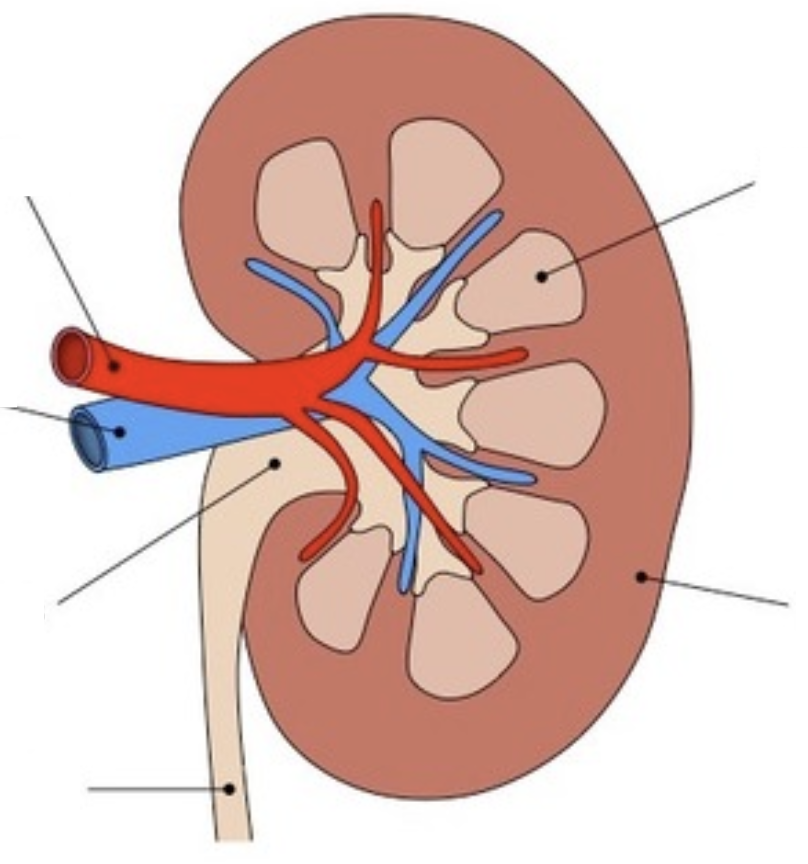
Lower right label
renal cortex
Upper right label (entire thing)
renal medulla
Cone shaped tissue masses located within the medulla
renal pyramid
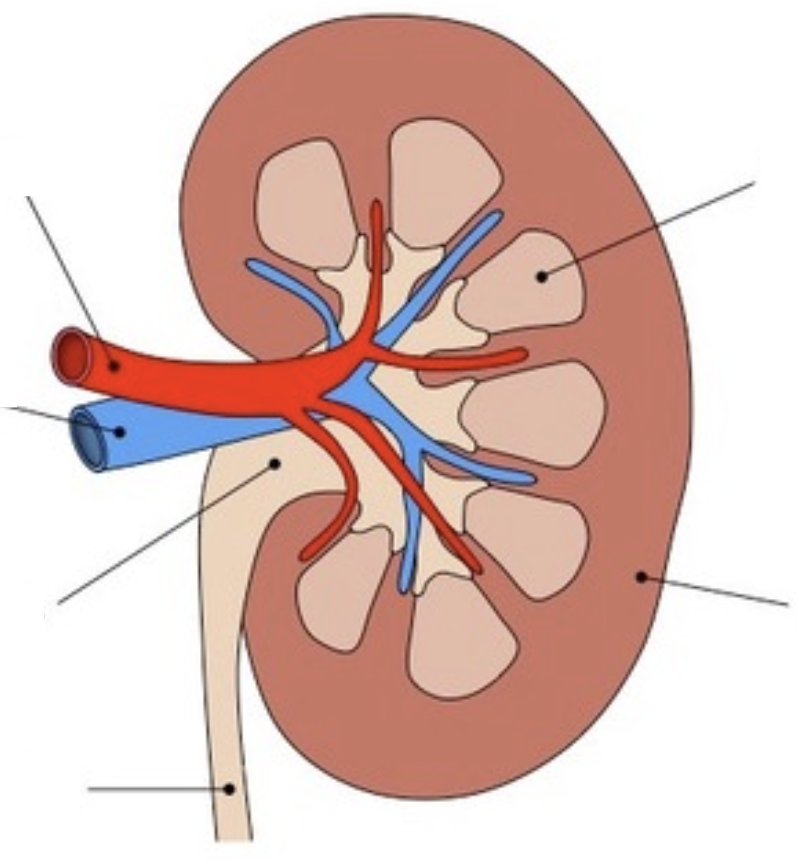
Lower left label
ureter
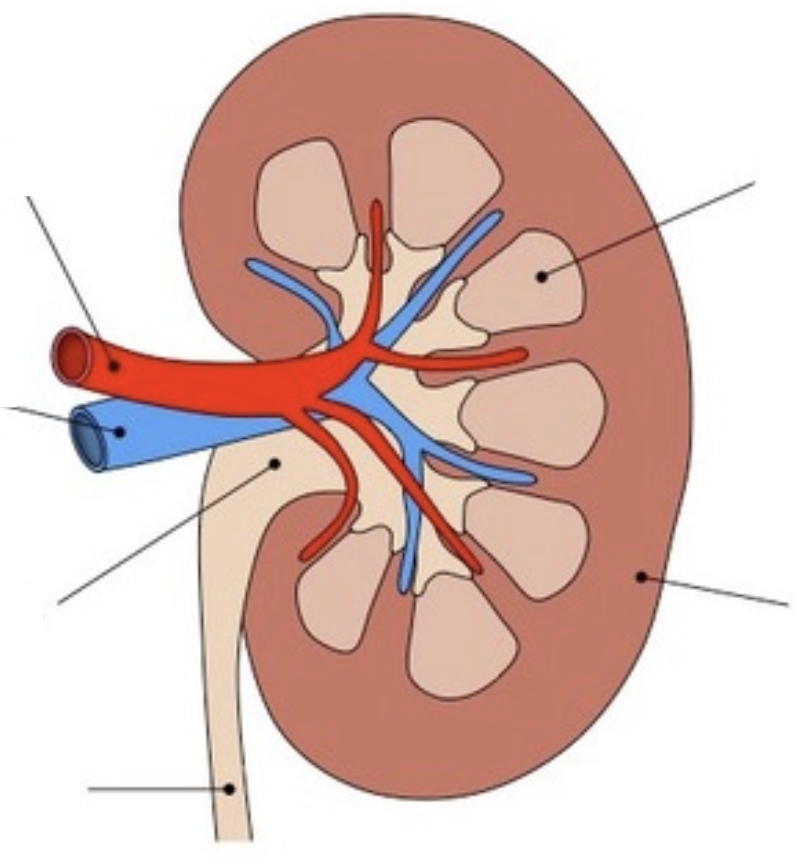
Middle left label
renal pelvis
Ureters, bladder, and the urethra ___ (do/do not) alter the composition of urine
do not
The functional unit of the kidney
nephron
There are about ___ nephrons in each kidney
1 million
The ball of capillaries that filters the fluid from the capillaries; no oxygen or nutrient exchange occurs here
glomerulus
Afferent arterioles deliver blood ___ (to/from) the glomerulus
to
Efferent arterioles deliver blood ___ (to/from) the glomerulus
from
The ___ (afferent/efferent) arteriole has a larger diameter
afferent
___ ___ surround and intertwine around the rest of the nephrons
peritubular capillaries
The peritubular capillaries supply the renal tissue with
blood
Nephrons can be ___ or ___
cortical or juxtamedullary
The peritubular cappilaries surrounding juxtamedullary nephrons are called
vasa recta
Vasa recta are ___ (circuitous and intertwined/straight and form hairpin loops)
straight and form hairpin loops
Nephrons in the corticals are ___ (circuitous and intertwined/straight and from hairpin loops)
circuitous and intertwined
The ___ ___ is a double walled sac that surrounds the glomerulus, together forming the renal corpuscle
Bowman’s capsule
The fluid that collects in the Bowman’s capsule is almost identical in composition to plasma, except that it has almost no ___
protein
The ___ convoluted tubule is located closer to the glomerulus
proximal
The ___ convoluted tubule is located farther from the glomerulus
distal
This structure is not technically a part of the nephron because they are shared among numerous nephrons
collecting duct
The ___ limb of the loop of Henle is from the PCT and travels down into the medulla
descending
The ___ limb of the loop of Henle goes to the DCT and travels up into the cortex
ascending
The PCT and DCT are located in the renal ___
cortex
The loop of Henle and collecting duct are located in the renal ___
medulla
The loops of Henle of cortical nephrons dip ___ (slightly/fully) into the medulla
slightly
The loops of Henle of juxtamedullary nephrons dip ___ (slightly/fully) into the medulla
fully
The percentage of nephrons that are juxtamedullary correlates with greater ___ ___ ability
urine concentrating
List the three key processes of urine production
glomerular filtration, tubular reabsorption, tubular secretion
About ___% of plasma that goes into the glomerulus is pushed into the Bowman’s capsule
20
The glomeruli in your kidneys filters ___ L per day
180
What percentage of the filtrate volume from the glomeruli gets reabsorbed back into the body
99%
The 80% of plasma that was not filtered leaves the glomerulus and travels to the ___ ___ for tubular secretion
peritubular capillaries
Glomerular filtration is ___ (selective/nonselective)
nonselective
Tubular reabsorption is ___ (selective/nonselective)
selective
Tubular secretion is ___ (selective/nonselective)
selective
Glomerular filtration is what is filtered ___ (from/back into) the blood
from
Tubular reabsorption is selective reclaiming ___ (from/back into) the blood
back into
Tubular secretion is selective elimination ___ (from/back into) the blood
from
The glomerulus is made of vessels that are surrounded by
podocytes
Podocytes form filtration ___
slits
Glomerular filtration is ___-based
size
The podocytes make ___ (large/small) filtration slits
small
The pores made by podocytes are too small for ___ to go through
proteins, rbc
Podocytes do allow the following to go through to the lumen of the Bowman’s capsule
water, glucose, amino acids
Glomerular filtration is passive, driven by ___ gradient
pressure
Glucose ___ (is/is not) regulated in the urine
is not
One goal of tubular reabsorption is retrieve all glucose and important nutrients ___ (based on/regardless of) need
regardless of
One goal of tubular reabsorption is to retrieve water, salts, and ions ___ (based on/regardless of) need
based on
Sodium itself is pulled out of the PCT into the blood by what primary active pump
Na/K ATPase
The Na/K ATPase pump also provides the energy for secondary active sodium co-transporters. The co-transports now push materials against their gradient ___ (into/out of) the PCT
out of
Secondary active sodium co-transporters also allow what other materials to be reabsorbed into the blood
glucose, amino acids, organic nutrients
Chloride ions follow ___ down the electrical gradient and into the blood
sodium
Water is also reabsorbed by the blood through ___ in the PCT wall and by squeezing between the cells
aquaporins
The movement of water being reabsorbed into the blood also encourages urea to ___ (stay in PCT/diffuse into blood)
diffuse into blood
How fast the people operating a conveyor belt can work is called the
transport maximum
The maximum absorption rate in a particular molecule per time
transport maximum
The number of items on the conveyor belt is called the
renal threshold
The concentration in the blood at which you exceed the transport maximum
renal threshold
Glucose is urinated, not because it’s regulated, but because its ___ ___ has been exceeded
renal threshold
If we reach the renal threshold, we ___ (do/do not) respond by changing the activity of the transporters
do not
List the three variables that play a role in reabsorption, transport maximum, and renal threshold
sodium pumps, amount of molecules, GFR
How fast the belt is moving is called the
glomerular filtration rate
The rate of how much blood passes through the glomerulus per minute
GFR
The descending limb of the loop of Henle is ___ (permeable/impermeable) to water
permeable
The ascending limb of the loop of Henle is ___ (permeable/impermeable) to water
imperable
Aquaporins are found the ___ limb
descending
Co-transporters are found in the ___ limb
ascending
Water leaves the ___ limb
descending
Na, K, and Cl salts leave the ___ limb
ascending
The co-transporters on the ascending limb pump ___ Na, ___ K, and ___ Cl out of the limb
1, 1, 2
The loop of Henle establishes a vertical ___ gradient in the medulla
osmotic
The deeper into the medulla, the ___ (more/less) salty it is
more
The countercurrent multiplier, maintained by the ___, creates the salty gradient in the medulla
loop of Henle
The countercurrent exchange, maintained by the ___, preserves/protects the gradient
vasa recta
Salt diffuses ___ (into/out of) the blood into the ISF from the vasa recta on the way down
into
Salt diffuses ___ (into/out of) the blood into the ISF from the vasa recta on the way up
out of
The countercurrent ___ ensures that the vasa recta doesn’t soak up the entire salt gradient
exchange
A majority of tubular secretion occurs in the ___
PCT
List some substances tubularly secreted in the PCT
H, drugs, toxins, waste
Tubular secretion in the PCT is ___ (active/passive)
active
Tubular secretion ___ (does/does not) occur in the loop of Henle
does not
List the materials tubularly secreted in the DCT
H+, K+
H+ is secreted in the DCT by the electronegative gradient established by the reabsorption of
sodium
Tubular secretion of K+ into the DCT is controlled by what hormone
aldosterone
Obligatory urine volume is ___ mL
500
Filter it and you will ___ it
pee
If you’re critically dehydrated, you will shut down ___ as a means of holding onto your water
filtration
The renal system can be regulated through ___ or ___-controlled mechanisms
GFR or hormone
If GFR is too high, you ___ (lose/retain) salt, water, glucose, etc.
lose
A fast GFR is a ___ (water and salt / glucose and amino acid) issue first and foremost
water and salt
If GFR is too slow, there will be a ___ accumulation
waste
GFR is determined by the net filtration pressure which includes:
glomerular blood pressure, capsule hydrostatic pressure, and osmotic pressure
What is the name of the pressure that forces filtrate out of the glomerulus and into the Bowman’s capsule; it is a reflection of systemic BP and of the fact that the afferent arteriole is larger than the efferent arteriole
glomerular blood pressure
What is the name of the pressure of fluid that is already in the Bowman’s capsule
capsule hydrostatic pressure
What is the name of the pressure that pulls water back into the blood along with the solutes
osmotic pressure
Children with Kwashiokor ___ (can/cannot) conserve their water because they lack protein to create the salty gradient and osmotic pressure to retain water
cannot
Capsule hydrostatic pressure pushes ___ (with/against) the fluid trying to enter to Bowman’s capsule
against