Sed Strat Week 13
 Call Kai
 Learn
Learn Practice Test
 Spaced Repetition
 Match
Match Flashcards
 Knowt Play
1/49

Earn XP
Description and Tags
biostrat and lithostrat
Name | Mastery | Learn | Test | Matching | Spaced | Call with Kai |
|---|
No analytics yet
Send a link to your students to track their progress
50 Terms
In a succession of beds, most of time is represented by…
surfaces that separate the beds (bedding planes; breaks in sedimentation over centuries). This amount of time is difficult to quantify.
Bioturbation intensity and surface exposure may provide clues
Evolution
Genetic changes in populations that live together and belong to the same species. Occur in response to environmental factors
Adaptations
Specialized features of animals and plants which perform one or more useful function (horns, teeth). Often mutations, where genes undergo structural change
Evolutionary divergence
Two or more species share a common ancestor but diverge at some point to favor different forms over the centuries
Homology
Presence of organs in 2 different groups of organisms that are the same in origin but perform different functions
Natural selection
Process in nature that parallels artificial selection in which different species gain adaptations, determining their survival
organisms do not revert to more primitive forms
Particulate inheritance
Genes retain their identities when being passed down to offspring. Dominant v. recessive genes
Species
Groups of interbreeding organisms that are separated from others
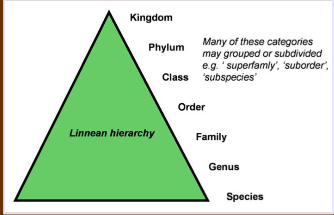
Linnean hierarchy
General term for ranks is “taxon” (taxa plural). Fundamental taxon rank is the “species”
similarities and differences in morphology define different species
Holotype
A single representative specimen against which other potential representatives of the species are compared
Genus
group of species that are closely related
Speciation
Geographic isolation of one population of the same species from the rest leads to evolutionary change, and thus the creation of a new species
Often appears to be a sudden event in the rock record
Phyletic transformation (phylogeny)
Change through time of a whole species that does not result in speciation
Phyletic extinction (pseudoextinction)
Ancestral species disappears, but not due to the death of the whole population. Result of changing forms
Phyletic gradualism
Idea that evolution is a steady, gradual process
Punctuated equilibria
Idea that evolution is not gradual but punctuated by periods of episodic change; rapid evolution occurs in bursts followed by hiatuses
Biozone
Fundamental unit of biostratigraphy. Defined by zone fossils and often interlinked w/ lithology, but not always
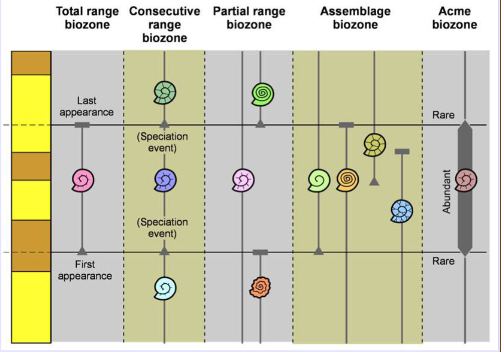
Interval biozone
defined by the occurrences within a succession of one or two taxa
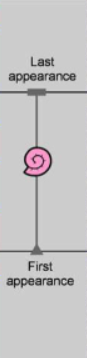
Total range biozone
first appearance and the disappearance of a single taxon is used as the definition
Concurrent range biozone
uses two taxa with overlapping ranges, with the base defined by the appearance of one taxon and the top by the disappearance of the second one
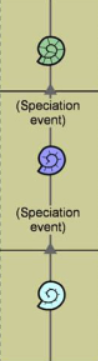
Partial range biozone
Base is defined by the disappearance of one taxon and the top by the appearance of the second
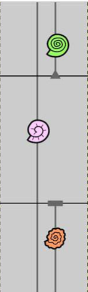
Assemblage biozone
defined by at least three different taxa that may or may not be related
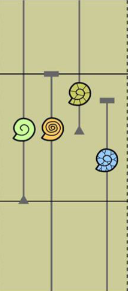
Acme biozone
An interval containing a statistically high proportion of a taxon may be used to define a biozone

Index fossil
An organism with hard parts that lived in all depositional environments and was abundant, with extensive evolutionary lineage
no such taxon has ever existed
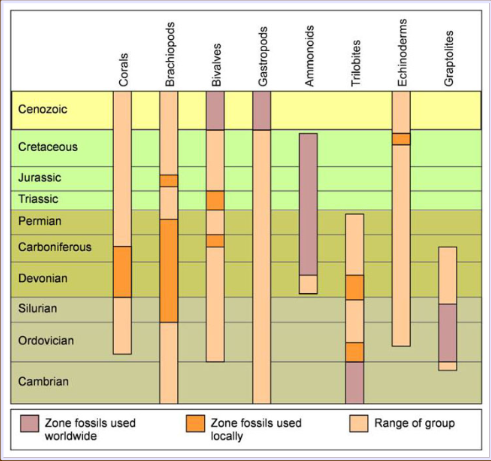
Endemism
A highly specialized species being localized to only one area on earth, due to its mobility and geographical barriers
Small vs large organism fossils
Smaller organisms tend to be more numerous, so there are more of their fossils than large vertebrates. This is why microfossils (forams, diatoms, conodonts etc) are useful in the rock record
Regional tectonics
Uplift and subsidence are never on a global scale; always localized to a particular area of a continent
Allostratigraphy
records externally driven changes (Milankovitch cycles) in stratigraphic record
Autostratigraphy
records internally driven changes (localized cyclic processes) in stratigraphic record
Sequence stratigraphy
Origin of sedimentary strata is a direct result of relative sea level change
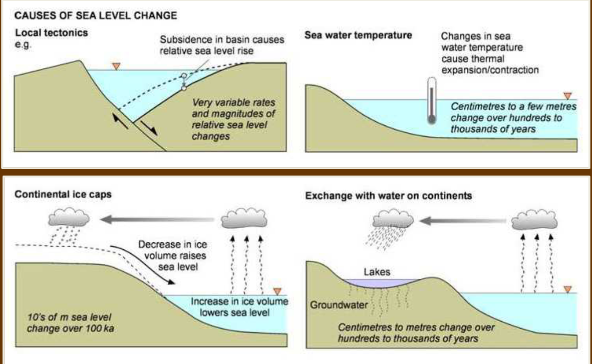
Drivers of transgression and regression
rate of eustacy
rate of regional tectonics
sedimentation rate (driven by climate)
Eustacy
Global sea level change
First order eustacy
200-400 my. Related to formation and breakup of supercontinents
Second order eustacy
10-100 my. Related to volume changes in mid-ocean spreading centers
Third order eustacy
1-10 my. Related to regional plate kinematics
Fourth-fifth order eustacy
0.01-1 my. Related to orbital forcing (Milankovitch)
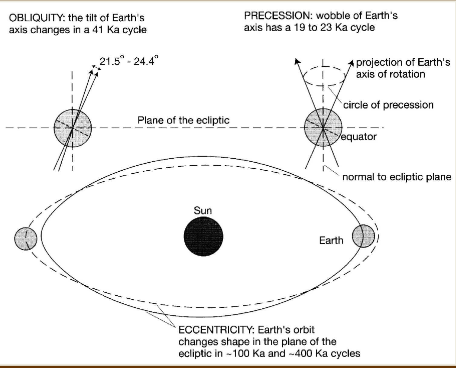
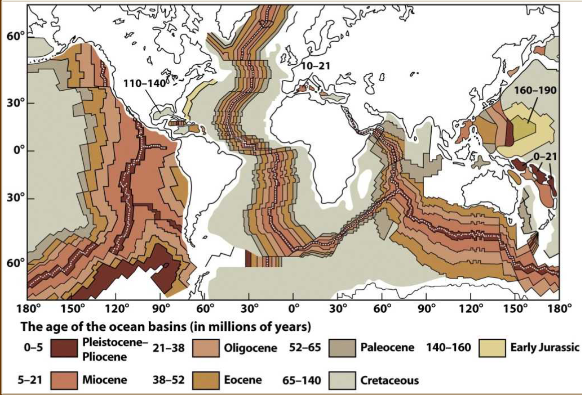
Crustal age
image
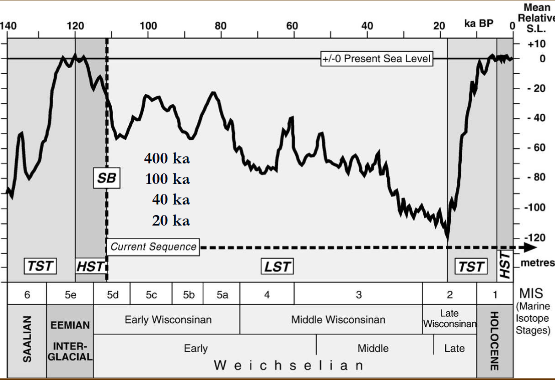
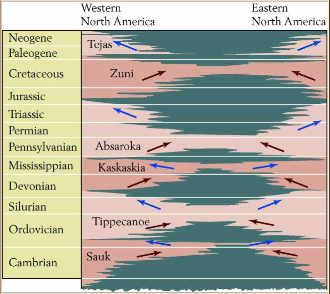
Eustacy over time
HST are high stand tracts (SL is highest)
TST are transgressive system tracts (SL is rising)
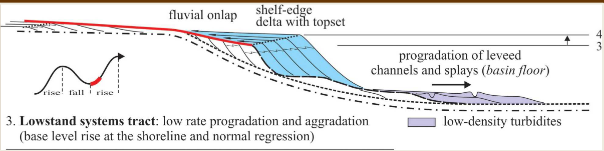
LST are low stand tracts (SL is lowest)
Sequences
Large bodies of marine sediment that are relatively conformable, genetically related (active at one time), and linked to eustatic change. Usually bounded by unconformities
accumulation during TST, erosion during RST
Stratal terminations generated from seismic
image
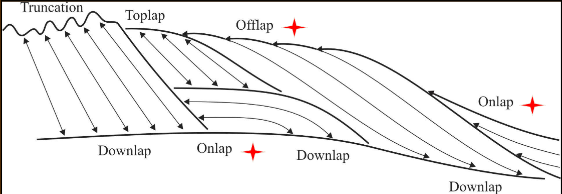
Onlap (transgressive)
Bedding surfaces pinch out moving landward (upward fining/thinning)
Offlap (regressive)
Bedding surfaces punch out moving seaward (upward coarsening/thickening)
HST (highstand systems tract)
Sea level reaches its apex and transgression ends, right before regression begins.
Sedimentation rate slows down and sediment becomes ponded near-shore
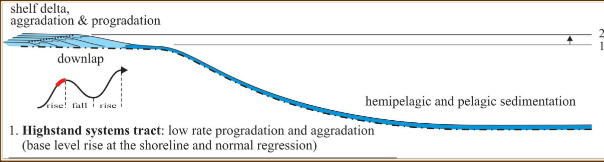
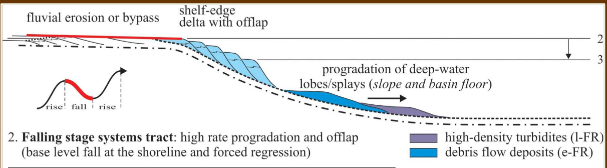
FSST (falling stage systems tract)
Sea level drops with accumulating speed and forced regression begins.
Sedimentation rate near-stops and erosion begins. Sediment progrades out to sea (offlap)
LST (lowstand systems tract)
Sea level drop hits its minimum and regression slows down, transgression begins.
Sedimentation rate begins to increase again. Sediment begins to slowly prograde onshore
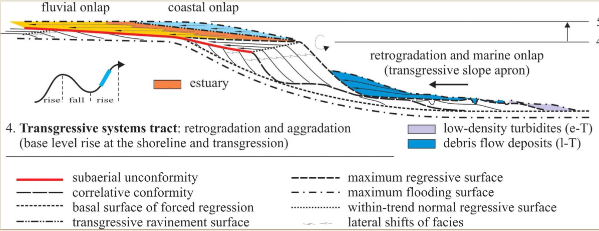
TST (transgressive systems tract)
Sea level rises rapidly and transgression speeds up.
Sedimentation rate increases rapidly and progrades quickly onshore (onlap)