Cog: imagery (copy)
 Call Kai
 Learn
Learn Practice Test
 Spaced Repetition
 Match
Match Flashcards
 Knowt Play
1/12

There's no tags or description
Looks like no tags are added yet.
Name | Mastery | Learn | Test | Matching | Spaced | Call with Kai |
|---|
No analytics yet
Send a link to your students to track their progress
13 Terms
true/false: implanting memories can be positive/useful
true
ex. teaching kids about liking veggies (telling them lies so they think they like them)
Imagery: reasoning
mental maps, mental rotation, spatial navigation
bill is smarter than ed, john is not smarter than ed, who is smartest
we draw this out in our head to make it make sense
what do we use imagery for?
reasoning
learning and comprehension
to treat trauma
imagery: learning and comprehension
skill learning: practicing moves
PTSD: creating new, better endings to traumatic memories, implanting positive memories, tweaking stories from trauma to reduce negative feelings
these replace the traumatic endings/aspects in LTM
dual-coding theory
concrete words easier to remember (imagine visual) than abstract words (harder visual)
table vs freedom
table would benefit from dual-coding (likely bc we are able to dual code it better with 2 modalities bc it’s double the representation)
ex. table = invision a table AND think about what it is
harder to use dual coding with abstract
Shepherd & Metzler: mental rotation task
would show participants these photos and ask if they were the same figure
then they would measure how much they would have to rotate it and how long it took them to do that
these studies lead to analog theory (the way you represent something in your mind, to scale: 1 to 1)
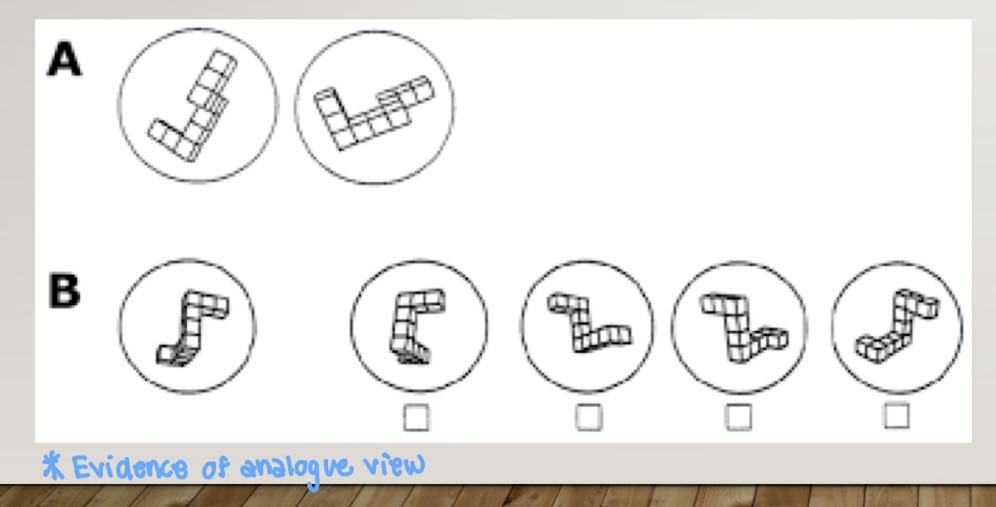
Analog View: Kosslyn (1977)
on map would look at 2 locations and attempt to determine how far apart they were to scale
further distance apart → longer response time
the way you represent imagery in your mind is the same process if you were to do it externally
might be smaller in mind but process is similar
Finke: 5 principles
images and percepts are functionally analogous (what you perceive, relate to each other)
images have spatial equivalence to pictures or objects (scaled down, keep ratios the same)
implicit (automatic) encoding of spatial info
images have transformational equivalence to percepts (different angles)
image will have structural equivalence and spatial relations of object
modalitity-specific interference
if we use the same neural areas in visual imagery as we do in perception, the 2 tasks should interfere w one another (but not an auditory task)
if 2 tasks w same neural areas, they will interfere
brain mechanisms in perception and imagery
visual imagery uses same brain areas as visual perception
perceptual areas show activity corresponding to mental imagery
haptic
musicians practicing in their head show activity in motor cortex (the same as when they actually do it)
somatosensory cortex active when participants asked to imagine feeling an object (same as when they actually feel)
auditory
participants ‘filling in’ song gaps show activity in brain (temporal auditory cortex) but only w familiar songs
propositional view of imagery (Pylyshyn 1987)
evidence not just for visual processing or verbal, but both
overwhelming evidence for visual
abstract processing links them - propositional
images are not the same as percepts, does not contain the same amount of detail (how many stripes does your tiger have?)
or to rearrange as easily (ie due or rabbit? 5 sec exposure, cant do it w just imagery)
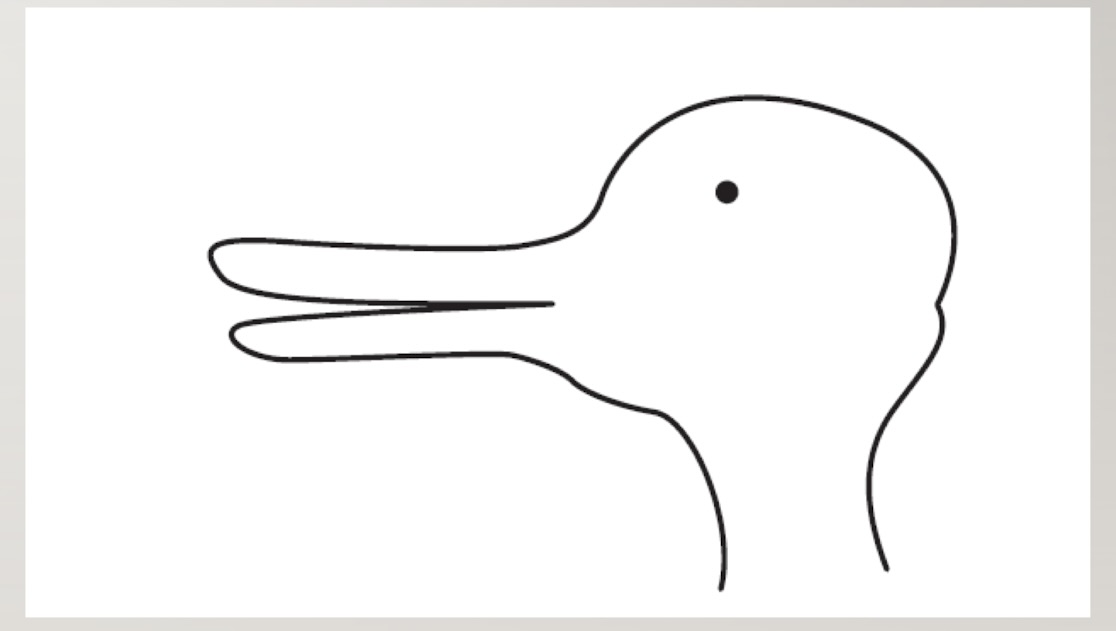
perhaps floor effects
box 7.5 finke (1989): imagery reorganization task
imagine k, place square on left, put circle in square and rotate 90 degrees (TV)
imagine D, rotate 90 degrees, place J on bottom (umbrella)
synesthesia
music appearing as colors → dual modality
can support musicians
some examples of this in our own language:
someone is “hot/delicious”
personality is “icey”
ex. different words have different flavors
this may be on a spectrum more than you have it or you don’t