Peer Review Process
 Call Kai
 Learn
Learn Practice Test
 Spaced Repetition
 Match
Match Flashcards
 Knowt Play
1/30

There's no tags or description
Looks like no tags are added yet.
Name | Mastery | Learn | Test | Matching | Spaced | Call with Kai |
|---|
No analytics yet
Send a link to your students to track their progress
31 Terms
Purpose and Importance of Peer Review
Purpose
Allow thorough evaluation of scientific/scholarly work by experts in the given field
Importance
Provides vital feedback to author(s)
Allows journals to assess quality of work prior to publication
What do Peer Reviewers Do?
Peer reviewers may assess:
Impact of research in the context of current literature
Effectiveness and accuracy of research methods and statistical analysis
Presentation of data
Quality of writing
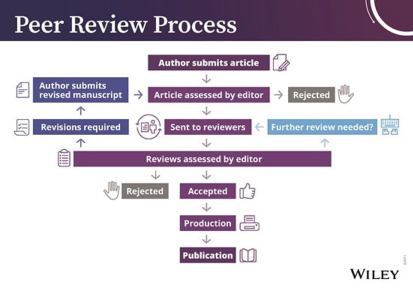
Based on these factors, they can choose to accept the manuscript as-is, after minor edits, or after major revision, or reject entirely
Typically an anonymous process or “double blind”
Peer Reviewer Process
Limitations to the Peer Review Process
Can feel intimidating and deter professionals from submitting
Can be a lengthy process
Paid for in part by “Article Processing Charge”, which can cost authors thousands of dollars
Reviewers may hold certain biases
May differ greatly between different journals
May be accepted to one with minor revisions and outright rejected by others
Tips for Peer Reviewing
Start with one read through to begin to digest the overall feel of the manuscript from a typical audience members perspective
Perform separate read-throughs for each aspect you are examining
Read-through to assess validity and accuracy
Separate read-through to focus on grammar and writing flow
Provide constructive feedback
Compliments are great, but don’t be afraid to give constructive commentary
As the author, you do not have to adopt every recommendation from the peer reviewer
Consider the target audience and how the overall message is conveyed
Why Reference?
Provides credibility to a manuscript
Validates your various points with evidence
Show the extent of your literature review and can help determine effectiveness of synthesis of the literature
Helps to avoid plagiarism
Can give the audience other resources for similar topics
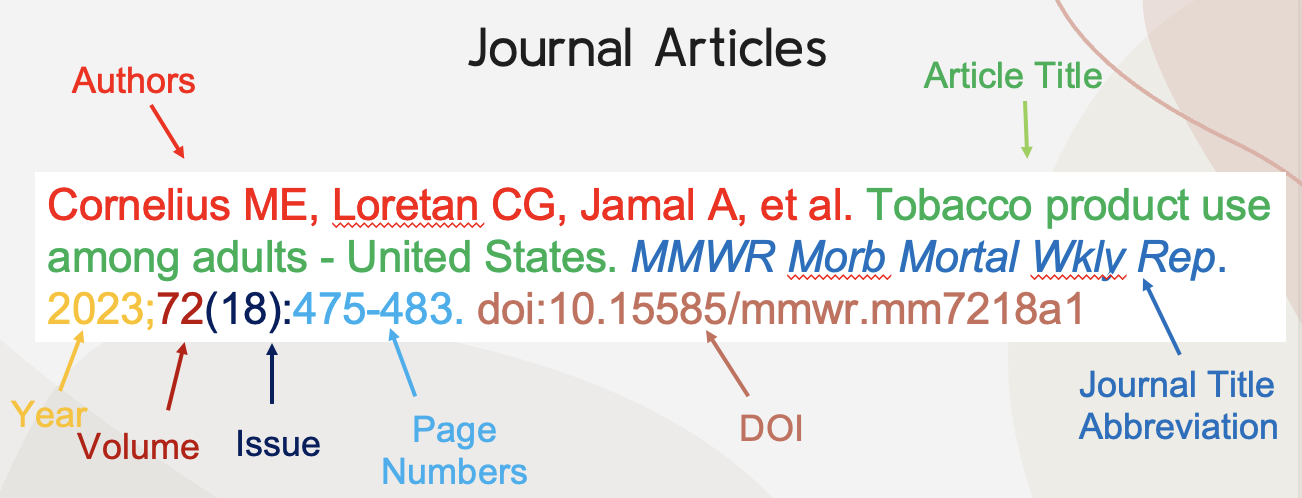
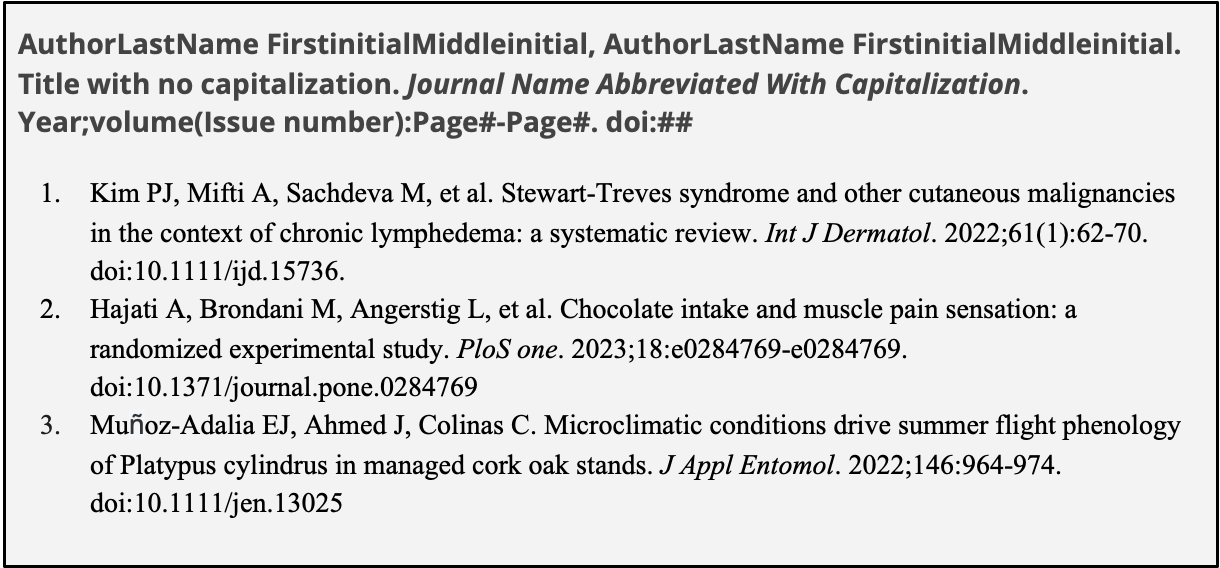
Referencing Journal Articles
Name
What to do with different numbers of authors
If under or at 6 authors, include all in your reference with no “and” to signify the last author
If over 6 authors → add the first 3 to the citation and add et al
No commas between last names and first initials
If no authors, can instead use name of group/organization that put out article (capitalized), followed by title
Titles
Keep in sentence form with no capitalization unless proper noun or abbreviation
Do not capitalize after a colon
Journal Name
Use ISO4 abbreviations
Needs to be italicized and capitalize abbreviations
No periods until the end of the journal abbreviation
Year and Journal Details
Year;volume(issue number):page#-page#. doi## (if included)
No space in between except for between page numbers and doi
No period after doi
If no page numbers, can put as volume(issue number). doi##
If e-page numbers provided, can include as e###
DOI
Ideal article identifier to include in reference: do not change, unlike URLs
If there is no doi, can use full URL and accessed date → accessed month day, year. Full URL
Pre-Prints and Forthcoming Articles
Forthcoming: have been accepted but are not yet published
Example: Tian D, Araki H, Stahl E, Bergelson J, Kreitman M. Signature of balancing selection in Arabidopsis. Proc Natl Acad Sci U S A. Forthcoming 2002.
Pre-prints: draft that has yet to be peer reviewed (not a great source)
Kording KP, Mensh B. Ten simple rules for structuring papers. BioRxiv [Preprint]. 2016 bioRxiv 088278 [posted 2016 Nov 28; revised 2016 Dec 14; revised 2016 Dec 15; cited 2017 Feb 9]: [12 p.]. Available from: https://www.biorxiv.org/content/10.1101/088278v5 doi:10.1101/088278
Articles with Retractions
Retracted
Feifel D, Moutier CY, Perry W. Safety and tolerability of a rapidly escalating dose-loading regimen for risperidone. J Clin Psychiatry. 2000;61(12):909-11. Retraction in: Feifel D, Moutier CY, Perry W. J Clin Psychiatry. 2002;63(2):169.
Partial
Starkman JS, Wolter C, Gomelsky A, Scarpero HM, Dmochowski RR. Voiding dysfunction following removal of eroded synthetic mid urethral slings. J Urol. 2006 Sep;176(3):1040-4. Partial retraction in: Starkman JS, Wolder CE, Gomelsky A, Scarpero HM, Dmochowski RR. J Urol. 2006 Dec;176(6 Pt 1):2749.
Re-published with corrections
Mansharamani M, Chilton BS. The reproductive importance of P-type ATPases. Mol Cell Endocrinol. 2002;188(1-2):22-5. Corrected and republished from: Mol Cell Endocrinol. 2001;183(1-2):123-6.
Articles in Other Languages
Keep in original language if it is read in original language
Translate reference to English, if used translated version of article
Website Citation
Author Last name First Initial Middle Initial. Title with no capitalization. Name of the website, [date published]. Updated [date]. Accessed [date]. URL
If the title can’t be found → put the name of the organization responsible for website creation
Example
Zika travel information. Centers for Disease Control and Prevention. January 26, 2016. Updated August 11, 2016. Accessed June 18, 2019. https://wwwnc.cdc.gov/travel/page/zika-travel-information
Books Citation
Whole book (no chapters)
Author Last name First initial Middle initial. Title of book and subtitle with capitalization and italicized. Volume #. Edition #. Publisher’s name: copyright year: page # - page #
Can include page number if applicable
Do not include edition number if first edition
Use Arabic numerals (1,2,3) unless Roman numerals included in book
If you want to cite entire book, then citation would end as “copyright year.”
If no author available, then you can include editor(s) followed by “, eds.” for multiple editors or “, ed.” for a single editor
Example
Riegelman RK, Kirkwood B. Public Health 101 : Healthy People-Healthy Populations. 2nd ed. Jones Bartlett Learning; 2015.
Specific Chapters
Chapter Author Last name First initial Middle initial. Chapter title not capitalized or italicized. In: Author Last name, First initial, Middle initial. Title of Book and Subtitle with Capitalization and Italicized. Edition #. Publisher’s name; copyright year.
Example
Bliss CM, Wolfe M. Common clinical manifestations of gastrointestinal disease. In: Andreoli TE, Cecil RL, eds. Andreoli and Carpenter’s Cecil Essential of Medicine. 8th ed. Saunders/Elsevier; 2010:382-400
Online Books
Similar to printed books except: include access date and full URL
Example
Riegelman RK, Kirkwood B. Public Health 101: Healthy People-Healthy Populations. 2nd ed. Jones and Bartlett Learning; 2015. Accessed May 5, 2024. URL
Package Inserts and Patents
Patent
Inventor 1, Inventor 2, inventors. Name of Assignee, assignee. Title of Patent. Patent number with country code followed by word “patent” and number with commas. Date of Publication.
Example:
Christiansen, GK, inventor; Interlego AG, assignee. Toy Building Set. US patent 3,597,875. August 10, 1971.
If pending, can instead include “US patent application” followed by number
Package Insert
Medication Name. Package insert. Manufacturer’s Name; Year
Example:
Byetta. Package insert. Amylin Pharmaceuticals Inc; 2007.
If found online, also include accessed date and URL, similar to how you cite online books
Tips for Reference List
Should be single spaced within each reference, but double spaced between each reference
Listed in the order that they appear in the body of the paper with associated numbers
In-Text Citations
Should be superscript: comes at the end of the sentence/paragraph
Is after periods/commas
Is before colons and semicolons
If more than one reference for a sentence or paragraph, can include as:
1,5,7
1-4,6
If including author’s last name in text, citation could come directly after name or names discussed
McCookie8 discusses
Do not place superscripts immediately after numbers or units of measure
NO: One study found that salt should be restricted to 2 grams.2
YES: One study2 found that salt should be restricted to 2 grams.
Plagiarism
Utilizing another individual’s work (writing, figures, tables) or intellectual property (ideas) and passing them off as your own without providing appropriate credit to the original creator
Tips to Avoiding Plagiarism
Cite all sources that you use in your literature review and throughout your medical writing
Even what you may consider background or common knowledge may need to be cited depending on audience
Be sure to cite appropriately, so that anyone that looks at your paper is able to find the original source
Be familiar with what constitutes as plagiarism
Learn to paraphrase appropriately and effectively
Paraphrasing
Conveying the message of another original piece using your unique voice/words
Helps to avoid plagiarism when done correctly
Unlike copying or quoting, paraphrasing is an effective way to capture meaning of original research, while adding in your own ideas and flare
How to Paraphrase Effectively
Start with an initial read-through of the original piece you are attempting to paraphrase
Garner an understanding of the meaning of the original work
Once ready, put aside the original piece and in your own words, write what you believe the meaning of the piece is
Once satisfied with paraphrased writing, compare to the original to assure that there is no overlap
Use of Quotation in Scientific Writing
Not frequently used in medical/scientific writing
Audience wants to hear your unique voice, which cannot be conveyed through the use of quotations
Some examples of when they might be used:
If interested in capturing qualitative data with patient/participant comments, may put those in quotes
If you notice that there are some novel phrases or words in an original piece of writing that you would like to use, then you can put that section in quotes and appropriately use in-text citations
If you do use quotes, typically the shorter, the better
Long quotations typically require specific permission from original author
Tables and Figures
Purpose: provide visual aid to further demonstrate your point
Can help summarize your data and put it in a more digestible format
Can provide a better understanding of the scale or impact of your topic
Generally, should not contain any new information and should help to enhance points made within the text as a supplement to the text
Can represent both qualitative or quantitative data
Quantitative– blood pressure measurement, morbidity and mortality, lab values
Qualitative – open-ended survey questions, observations
General Guidelines for Referencing Tables and Figures
Number figures and tables in the order that they are utilized within the paper
Figures are numbered separately from tables
If you need to explain anything within the table, can add a superscript letter and expand in footnotes
First letter (a) is typically reserved for your title and will be used in footnote to describe where data came from
Tables/figures should also originate from primary sources
Do not use algorithms from UpToDate or Epocrates
How to Reference within a Table/Figure
Changing the format of a table or figure from another source
Adapted from [Name of Organization]citation number
Adding new calculations or quantitative input to data, table or figure from another source
Ideal as you are synthesizing data to create new table/figure
Data adapted from [Name of Organization]citation number or Derived from [Name of Organization]citation number
Typically, tables and figures are not copied exactly from another original work
If it is, would want permission from original author(s) to use their tables or figures
Reproduced with permission from [Name of Organization]citation number
Figures
Types:
Any kind of graph
Line, dot, bar, pie chart, boxplot, histogram, etc.
Images
X-rays, US, MRI, CT
Images of clinical presentations
Algorithms
Ex. ACLS algorithms
Includes:
Title, Legend/key, Footnote
Can include axises (if graph)
Referring to Tables/Figures In Text
Number tables separately from figures
Should be labeled sequentially (as they appear in your paper)
Can directly reference tables/figures
Table 4 depicts … .citation number(s)
As seen in Table 4, … .citation number(s)
Can also indirectly reference tables/figures
There is a directly proportional relationship between number of pints of ice cream consumed and percent completion of didactic year (Figure 5).citation number(s)
Don’t refer to tables being above or below as they may not align if your work gets published
Primary Source
Literature focused on original research with author(s) that were involved in the original research
Not reviews of pre-existing literature
How to spot primary sources
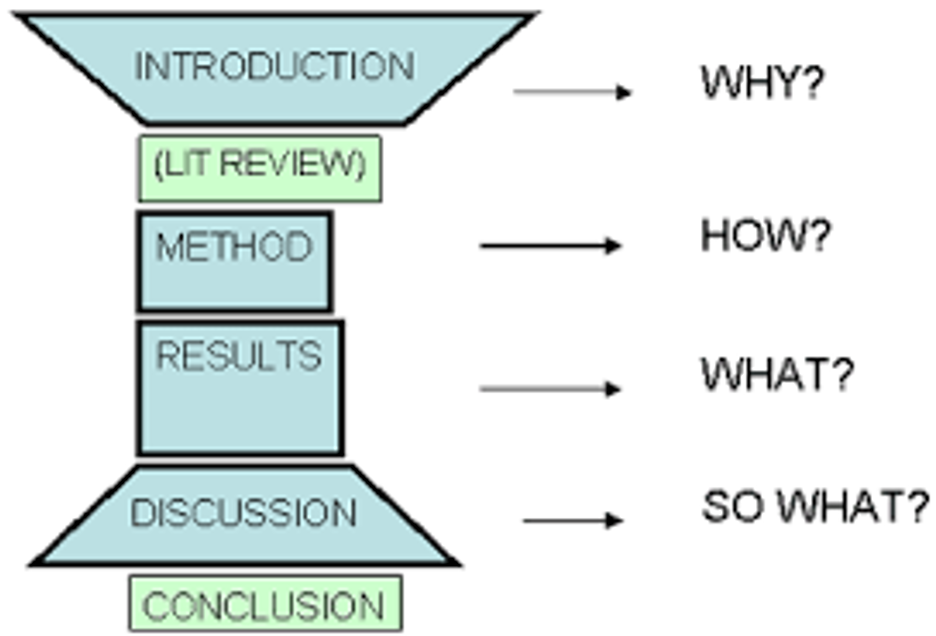
Materials/methods section to describe study set-up, operationalization of variables, and statistical analyses used
Results section with statistical analyses and study findings, often followed with a Discussion section
May have specific study aims
Doesn’t state a purpose of “reviewing”, unless it is a systematic review/meta-analysis
Look for “original research”, “original study”, or “primary”
Other Tips for Picking Good References
The more recent, the better
Tend to try within 2 years, then expand out to past 5 years if information is limited
May have to continue to do literature review even after you start the writing process, especially when writing about hot topics where new research is published regularly
Want to pay attention to parameters of study
Pay attention to sample size – if too small, findings may not be as meaningful
Where is the study completed?
Remote village in Northern Canada versus NYC, can greatly influence results
Take a peek at the methods, do they make sense?
What Primary Sources to Use
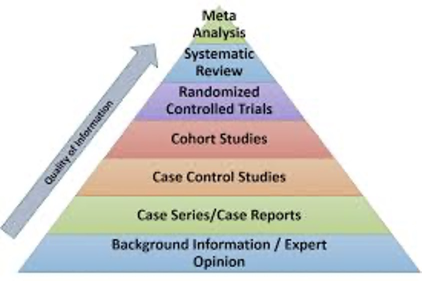
Types
Randomized control trial (RCT)
Cohort studies (retrospective and prospective)
Cross-sectional studies
Case-control studies
Clinical trials
Survey research
For clinical guidelines, try to find research that guidelines and gold standards originate from
Make sure these are also peer-reviewed!
Technically, meta-analyses and systematic reviews are not primary sources, but tend to be credible sources
Utilizing Resources
Do not cite the introduction or background of original research as this is often synthesized from other original research
Find the reference they used and trace it back to the original source
May find it hard not to use books for pathophysiology or clinical presentations
May be included in methods such as in inclusion and exclusion criteria or in results
Clinical Study Reports
Thorough report describing Materials and Results of clinical trials to mainly emphasize safety and efficacy of what is being studied
Often used to send to regulatory bodies to help further develop new medications or treatments
Typically longer and more meticulous than original research published within journals
Can include:
Study significance and importance
Found towards end of introduction (like thesis statement)
Study aims
Can be within Methods section
Research Questions and Hypotheses
Typically in methods section
Limitations
Often found in discussion section
How to Critique Medical Literature
Try to take a systematic approach
Assure thorough introduction/background that exhibits author(s) understanding and synthesis of pre-existing literature
Is this novel research or has this been done before?
Research Design
Adequate sample size? How is sample divided? Blinding? Random? Appropriate inclusion and exclusion criteria?
Can research design answer questions?
Was study type appropriate?
Was process of enrolling participants effective? Ethical study procedure?
Appropriate and accurate data collection tools? Variables defined appropriately?
Results
Are findings meaningful? Organized?
Do tables/figures help depict findings?
Discussion
Are meaningful conclusions drawn? Answered initial question or hypothesis?
Thorough list of limitations?
Provide any further considerations for moving forward?
References
Within past 5 years? Primary sources? Cited appropriately?
Other
Any conflicts of interest? Who is sponsoring the research? Pharmaceutical company?
Quality of the writing: is it proof-read well and edited appropriately?