CPrac I - Kinetic qns
 Call Kai
 Learn
Learn Practice Test
 Spaced Repetition
 Match
Match Flashcards
 Knowt Play
1/9

There's no tags or description
Looks like no tags are added yet.
Name | Mastery | Learn | Test | Matching | Spaced | Call with Kai |
|---|
No analytics yet
Send a link to your students to track their progress
10 Terms
Why is it important to ensure that the duration and speed of stirring are kept almost constant for all the experiments?
To ensure that the rate of reaction will not be affected by the duration and speed of stirring.
Consistent mixing ensures that reactants are evenly distributed in the solution, minimising variations in local concentrations that could affect the reaction rate.
Using graph, deduce order of reaction
Straight line passing through origin -> directly proportional -> 1st order
Use the graph to deduce the order of reaction with respect to sodium thiosulfate. Explain how you arrive at your answer.

Explain effect on ROR when concentration of both reagents are doubled
Since initial concentrations of both FA 1 and FA 2 are doubled, without a change in total volume, the concentrations of FA 1 and FA 2 in the mixture are double
Rate will increase by 4 times and time taken will be 1⁄4 that of experiment 1
Time taken = 1⁄4 24 = 6s
% error in the measurement of reaction time is higher due to shorter reaction time recorded

How do you ensure that the same amount of I2 is produced just before the colour change

Explain how you would deduce the order of reaction with respect to Na2S2O3 and HCl
For each experiment, calculate the value of 1/t (where t is the time taken for the cross to disappear.
Compare the results of Experiments 1 and 2, where the volume of Na2S2O3 is doubled while the volume of HCl is kept constant.
If 1/t doubles, the reaction is first-order with respect to Na2S2O3.
If 1/t increases by a factor of four, it is second-order.
If 1/t remains the same, it is zero-order.
Similarly, the order of reaction with respect to HCl can be found by comparing the results of Experiments 1 and 3
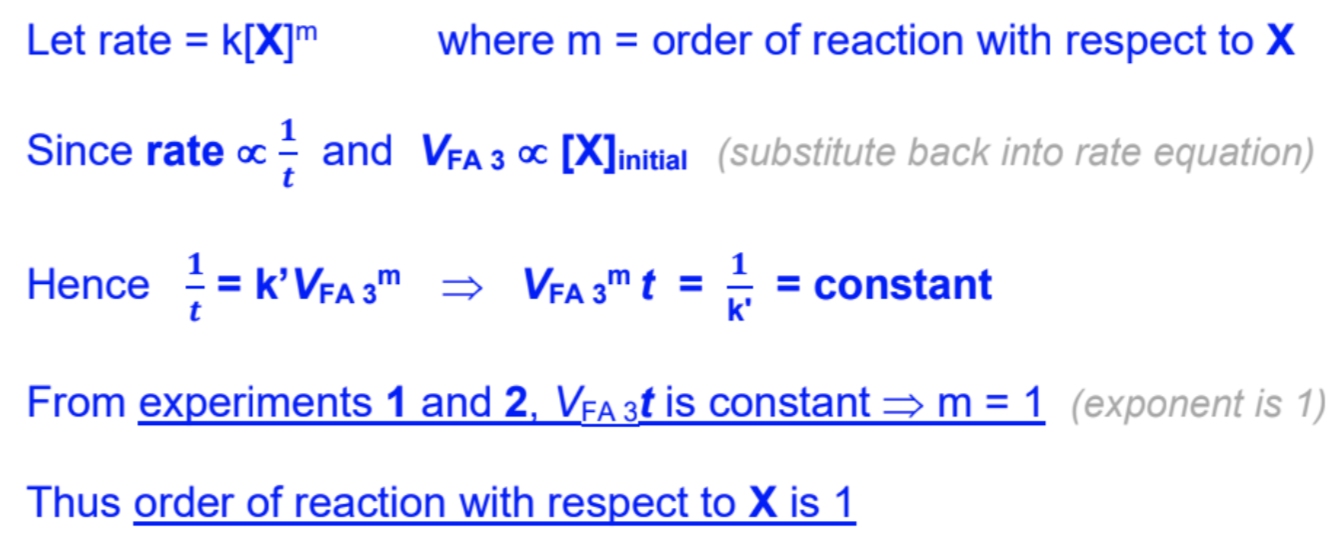
Deduce the order of reaction with respect to X (FA3)
Explain why titre obtained in last reading is the least accurate
Last titre volume is smallest volume -> greatest % error in volume measurement

Explain how to plot Ink’ against 1/T
Calculate the k’ value at each temperature using initial rate found in c(i)
k’ = initial rate / initial [H2O2] = initial rate / 0.170
Convert the temperature in C to K -> temperature in K = Temperature in C + 273
It will give a straight line with a negative gradient
Explain how to ROR affected by temperature using graph
Temp increase, ROR increase AND ROR increase at increasing rate due to increasing positive gradient