RC2 - Cognitive perspective on risk (keyterms, mp + scenario questions)

0.0(0)
Studied by 4 people
call kaiCall Kai
learnLearn
examPractice Test
spaced repetitionSpaced Repetition
heart puzzleMatch
flashcardsFlashcards
GameKnowt Play
Card Sorting

1/51

encourage image

There's no tags or description

Looks like no tags are added yet.

Last updated 2:39 PM on 5/29/26
Name
Mastery
Learn
Test
Matching
Spaced
Call with Kai

No analytics yet

Send a link to your students to track their progress

52 Terms

1
New cards

What is Prospect Theory?

A decision-making theory explaining that people evaluate outcomes as gains or losses relative to a reference point, and feel losses more strongly than equivalent gains — leading to loss aversion
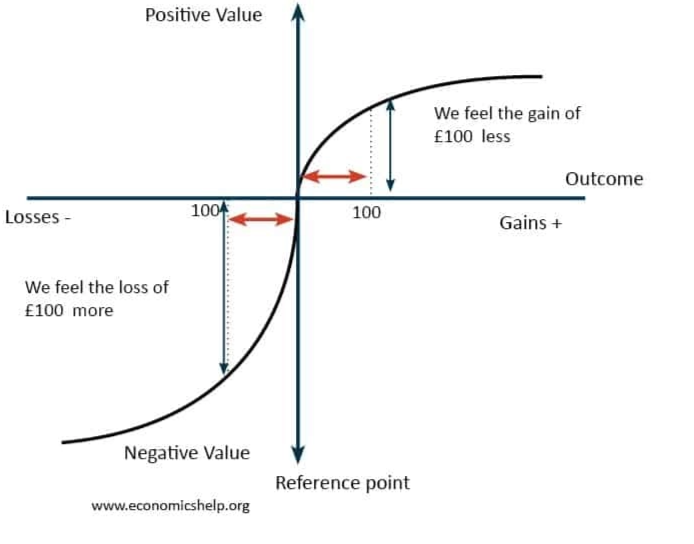
<p>A decision-making theory explaining that people evaluate outcomes as gains or losses relative to a reference point, and feel losses more strongly than equivalent gains — leading to loss aversion</p>
2
New cards
What is loss aversion in Prospect Theory?
The psychological tendency to feel the pain of a loss more strongly than the pleasure of an equivalent gain (e.g. losing £100 hurts more than gaining £100 feels good)
3
New cards
What is a reference point in Prospect Theory?
The status quo or current state against which outcomes are evaluated as gains or losses; it shifts depending on context
4
New cards
What is a framing effect?
When preferences change based on superficial differences in how information is worded, not its objective content (e.g. "200 people saved" vs "400 people will die")
5
New cards
What is a gain frame vs. a loss frame?
Gain frame = you can get something (emphasizes positive outcome); loss frame = you will lose something (emphasizes negative outcome)
6
New cards
How does Prospect Theory explain risk aversion and risk seeking?
People are risk averse when confronted with gains (prefer the safe option) and risk seeking when confronted with losses (prefer the gamble to avoid the loss)
7
New cards
Give a health communication example of gain vs. loss framing
Gain frame: disease prevention (e.g. skin cancer) — people avoid risk. Loss frame: disease detection (e.g. breast cancer screening) — people seek the risky option to avoid losing health
8
New cards
What is the key limitation of Prospect Theory?
It explains framing effects but cannot account for non-perceptual cognitive processes or individual differences in risk attitudes
9
New cards
What is Dual Process Theory?
A theory that distinguishes two types of thinking: Type 1 (fast, automatic, unconscious, emotional) and Type 2 (slow, deliberate, conscious, analytical)
10
New cards
What are the characteristics of Type 1 thinking?
Quick, instinctive, automatic, emotional, unconscious, little to no effort
11
New cards
What are the characteristics of Type 2 thinking?
Slow, rational, conscious, logical, effortful, used for complex decisions
12
New cards
What does Type 1 thinking lead to in risk contexts?
Attribute substitution, impulsive reactions, use of heuristics, and unawareness of actual risks
13
New cards
What is attribute substitution?
Replacing a difficult question with an easier one without realizing it (e.g. "how likely is this risk?" becomes "how scary does this feel?")
14
New cards
What are the three critical notes on Dual Process Theory?
1. There are no two physically separate systems in the brain 2. Both Type 1 and Type 2 thinking can be biased (e.g. confirmation bias) 3. It cannot explain counterintuitive findings like risk-taking based on reasoning rather than impulse
15
New cards
What is Fuzzy-Trace Theory (FTT)?
A cognitive theory stating that people encode two parallel mental representations simultaneously: verbatim (exact details) and gist (bottom-line meaning), and that decisions are primarily driven by gist
16
New cards

What are the three constructs of Fuzzy-Trace Theory?

  1. Hot motivational/affective factors (emotions, similar to Type 1) 2. Cold metacognitive factors (reflection and inhibition, similar to Type 2) 3. Gist and verbatim mental representations
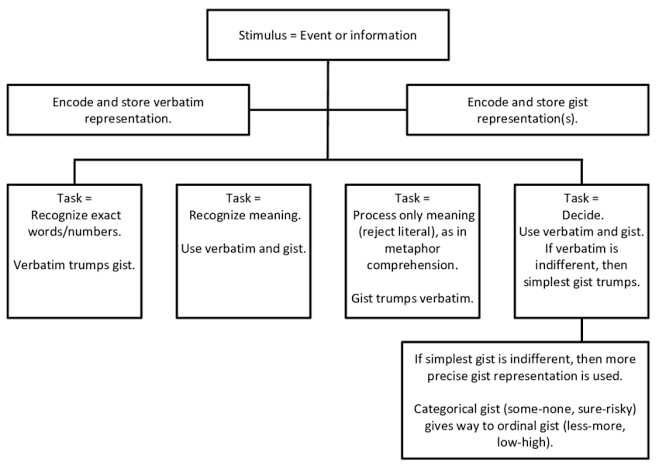
<ol><li><p>Hot motivational/affective factors (emotions, similar to Type 1) 2. Cold metacognitive factors (reflection and inhibition, similar to Type 2) 3. Gist and verbatim mental representations</p></li></ol><p></p>
17
New cards
What is gist in FTT?
A fuzzy, qualitative, bottom-line representation of information — the essential meaning stripped of precise details (e.g. "some risk" rather than "0.001% risk")
18
New cards
What is verbatim in FTT?
A precise, quantitative, literal representation of information — exact numbers, percentages, and surface details
19
New cards
How does reliance on gist change with age?
Reliance on gist increases with age and experience; adults and experts primarily use gist-based processing
20
New cards
How does verbatim processing lead to unhealthy risk behavior?
It causes people to "play the odds" — focusing on the low statistical probability rather than the bottom-line meaning ("it just takes once"), promoting risk-taking
21
New cards
What are the two routes to unhealthy risk behavior in FTT?
Route 1: failure to inhibit behavior/emotion (Type 1 thinking). Route 2: reliance on verbatim processing rather than gist ("playing the odds")
22
New cards
What is the key difference between Dual Process Theory and FTT?
Dual process theory equates Type 1 with intuition and emotion; FTT does not — gist-based intuition of experts is fundamentally different from the impulsive choices of adolescents
23
New cards

What is Construal Level Theory (CLT)?

A theory stating that psychological distance influences how people mentally represent events — greater distance leads to more abstract, high-level thinking; closer proximity leads to more concrete, low-level thinking
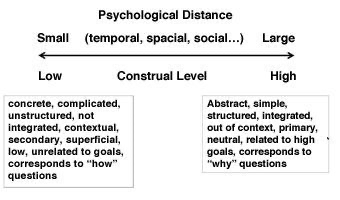
<p>A theory stating that psychological distance influences how people mentally represent events — greater distance leads to more abstract, high-level thinking; closer proximity leads to more concrete, low-level thinking</p>
24
New cards
What is psychological distance in CLT?
The perceived removal of an object or event from the self — can be temporal, geographic, social, or hypothetical
25
New cards
What are the four domains of psychological distance?
1. Temporal (time) 2. Geographic (space) 3. Social (perceived similarity to self) 4. Hypotheticality (perceived likelihood)
26
New cards
What is a low construal level vs. a high construal level?
Low construal = concrete, detailed, contextual, answers "how" questions. High construal = abstract, simple, structured, answers "why" questions
27
New cards
How does construal level affect risk taking?
Higher construal level (greater psychological distance) leads to more risk taking due to lower risk perceptions; lower construal level increases risk perception and reduces risk taking
28
New cards
Give a health example of CLT in risk communication
Mononucleosis risk framed as "1 incident occurs every day" (low construal, feels close) increases risk perception more than "365 incidents per year" (high construal, feels abstract and distant)
29
New cards
What cognitive question does each theory answer?
Prospect Theory: how does wording influence decisions? Dual Process Theory: what cognitive processes are involved? FTT and CLT: how are risks mentally represented?
30
New cards
What is Expected Utility Theory and why is it limited?
States that people choose the option with the highest subjective value; explains risk aversion in adults but cannot explain why choices change with superficial wording changes (framing effects)
31
New cards
What is denominator neglect?
The cognitive error of focusing only on the numerator (frequency of an outcome) while ignoring the denominator (total base rate), leading to distorted risk perception
32
New cards
What are the neurobiological findings on risk processing?
Reward sensitivity is linked to dopamine in the striatum; inhibition is linked to the prefrontal cortex (dlPFC); gist processing activates the posterior parietal cortex; verbatim processing is linked to the insula
33
New cards
Why do adolescents show reverse framing effects compared to adults?
Adolescents rely more on verbatim processing combined with reward sensitivity — they calculate exact odds rather than using categorical gist, sometimes leading to riskier choices when rewards are high and statistical risk is low
34
New cards
What did Chapter 4 (cognitive/developmental paper) conclude about adolescent risk taking?
Theories based only on reward sensitivity and lack of inhibition are insufficient; mental representation (gist vs. verbatim) is essential to explain why adolescents sometimes take more risks despite being capable of rational thought
35
New cards
What is the fuzzy-processing preference?
The natural tendency, increasing with age and expertise, to rely on gist (global meaning) rather than analytical facts when making decisions
36
New cards
What is a meaning threat in the context of vaccination?
The psychological discomfort that arises when unexplained side effects or rare events occur, driving a strong need to find causal explanations — which anti-vaccination narratives exploit
37
New cards
What are illusory correlations in vaccination decisions?
The cognitive error of assuming a causal link between a condition and a vaccine simply because they occurred close together in time
38
New cards
What are causal narratives and why are they effective?
Coherent, emotionally resonant stories that suggest cause-and-effect relationships; they succeed where official sources fail because they fill knowledge gaps with simple, plausible explanations
39
New cards
What is plausibility in risk communication?
Information is accepted faster when it fits existing beliefs (e.g. distrust of government, preference for natural products) — even if the information is inaccurate
40
New cards
What does the vaccination paper recommend for effective health communication?
Frame vaccine risk as nil (virtually zero) in direct contrast to the large danger of the disease, and emphasize shared social and moral values like herd immunity — rather than presenting statistical details
41
New cards
How does the status quo bias affect vaccination decisions?
Unvaccinated people in good health see vaccination as a gamble (risk of side effects) versus the safe option of doing nothing; this gist makes inaction seem rational
42
New cards
Explain why anti-vaccination messages spread more effectively than official health messages
Anti-vax messages provide simple causal narratives that satisfy the need for meaning, while official sources are fragmented, technical, and fail to communicate gist — making the simple story more persuasive
43
New cards
What is the key criticism of FTT?
It is difficult to test empirically; most evidence comes from medical decision-making; and the exact cognitive processes underlying gist representations remain unclear
44
New cards
How do the four theories relate to each other in explaining risk processing?
Prospect Theory explains framing effects via reference points; Dual Process Theory explains fast vs. slow thinking; FTT refines this by showing gist-based intuition is not the same as impulsive emotion; CLT adds that psychological distance shapes which level of representation people use
45
New cards
What is attribute substitution and why does it matter for risk communication?
Replacing a hard question ("what is the probability of this risk?") with an easier one ("how scary does this feel?") without realizing it — meaning emotional salience drives risk perception more than actual probability
46
New cards
What is the Asian disease problem and what does it illustrate?
A classic framing experiment: the same choice (save 200 people vs. 1/3 chance of saving 600) is framed as either a gain or a loss — people prefer the sure option in the gain frame and the gamble in the loss frame, illustrating that framing changes decisions even when outcomes are objectively identical
47
New cards
What are categorical gist representations vs. ordinal gist representations?
Categorical gist = some/none, sure/risky (simplest level). Ordinal gist = less/more, low/high (more precise but still qualitative). When categorical gist is indifferent, people move to ordinal gist
48
New cards
What is the "simplest gist trumps" principle?
When making decisions, people default to the simplest gist representation available; only if that is indifferent do they move to a more precise gist level
49
New cards
How does FTT explain the Asian disease problem differently from Prospect Theory?
Prospect Theory explains it via reference points and loss aversion; FTT explains it via gist — "save some vs. save some or save none" leads to "saving some is better than none," making the sure option dominant through qualitative reasoning rather than numerical calculation
50
New cards
What is background knowledge and why does it matter for vaccination communication?
The contextual understanding needed to correctly interpret health information and derive the right gist; when it is lacking, people cannot form accurate gist representations and become vulnerable to simple but misleading narratives
51
New cards
What is nil risk framing?
Presenting vaccine risk as virtually zero in direct contrast to the large danger of the disease — a gist-based communication strategy designed to make the safe choice obvious
52
New cards
How does anxiety (e.g. needle fear) affect vaccination decisions through an FTT lens?
The vaccine becomes a sure cost (certain pain) weighed against an uncertain benefit, making the gist "certain harm vs. uncertain gain" — which discourages vaccination even when the statistical benefit is clear



