2) The multistore model
 Call Kai
 Learn
Learn Practice Test
 Spaced Repetition
 Match
Match Flashcards
 Knowt Play
1/42

There's no tags or description
Looks like no tags are added yet.
Name | Mastery | Learn | Test | Matching | Spaced | Call with Kai |
|---|
No analytics yet
Send a link to your students to track their progress
43 Terms
who is Clive wearing?
Clive wearing was a highly educated talent musician and broadcaster who contracted a viral infection I his brain which left him with extensive brain damage
What was the case of clive wearing?
after his brain damage, Wearing was able to maintain most of his skills like reading but his memory for past events were fuzzy, his visual memory was impaired. He’s unable to make new memories.
Who introduced the multi store model of memory?
Atkinson and Shiffrin (1968)
What are the three stores of the multi store model?
Sensory memory, short then memory, long term memory
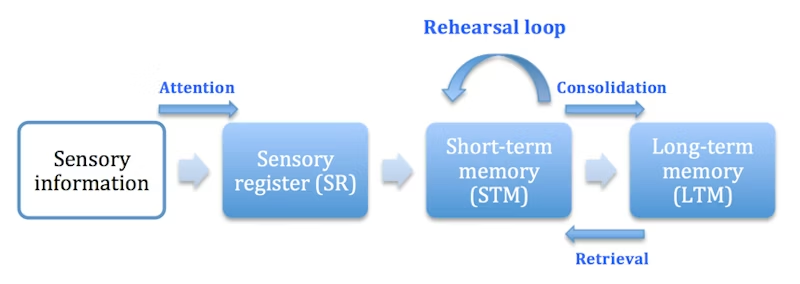
The multi store model of memory
What’s the sensory register?
the store that detects stimulus from the environment.
How many stores are in the sensory register?
five, one for each sense
What’s the coding in the sensory register ?
Morality specific (depends on the sense)
What’s the duration in the sensory register?
Half a second
That’s the capacity in the sensory register?
very high
How is information transferred from the sensory register to the short term memory?
If attention is paid to it
What’s the coding in the short term memory store?
Acoustic, according to the way it sounds
What’s the coding in long term memory?
Semantic, according to its meaning
What was the aim of Baddeley (1966) experiment?
To identify whether accounting coding is used in STM and semantic coding is used in LTM
What was the procedure of Baddeley (1966) experiment?
There were four types of word list, acoustically similar, semantically similar, acoustically dissimilar and semantically dissimilar. Participants eeee asked to recall the words in the same order as they were presented, either immediately or after times delay
What was the experimental design/condition of Baddeley (1966) experiment?
Laboratory experiment with independent measure design
What was the independent and dependent variable in Baddeley (1966) experiment?
IV- the type of worst list
DV- the number of substitution error made
What’s were the findings of Baddeley (1966) experiment?
With immediate recall there was more substitution error on acoustically similar lists than on the acoustically dissimilar list. With delayed recall substitution error did not differ between acoustically similar and dissimilar words however semantically similar lists words were confused more than semantically dissimilar.
What conclusion were drawn in Baddeley (1966) experiment?
That STM coding is acoustic and LTM coding is semantic
What was Bahrick et al (1975) procedure?
University graduates were shown photos from their high school yearbook. For each photo, participants were asked to select the name that matched
What was the sample of Bahrick et al (1975) experiment?
394 American university graduates
What were the findings of Bahrick (1975) experiment?
90% of the participants were able to correctly match the names to faces 14 years after graduating and 60% of participants were able to correctly match the names and faces 47 years after
What was Bahrick et al (1975) conclusion?
People could remember certain types of information such as names and faces for almost a lifetime
What was the procedure or Peterson and Peterson (1959) experiment?
Participants were briefly shown a consonant Triagram and then were asked to count backwards in three from a specified number. After intervals of 3, 6, 9, 12, 15 or 18 participants were asked to recall the original trigram, procedure was repeated using diffrent trigrams
What were the findings of Peterson and Peterson (1959) experiment?
The longer the interval the less accurate the recall, at 3 seconds, 80% was correctly recalled and at 18 seconds only 10 were recalled
What’s the duration of the STM?
About 18 seconds
What was the aim of Peterson and Peterson (1959) experiment ?
To investigate the duration of S when rehearsal is prevented
What was the conclusion from Peterson and Peterson (1959) experiment?
That the STM has a limited duration of 18 seconds. Also, if we are unable to rehearse information, it will not be passed to LTM, supporting the MSM on the idea of decay for forgetting in STM
What was Jacob’s (1887) procedure?
Participants were asked to recall an increasing number of digits in the correct order until they can no longer recall correctly
What were the findings of Jacobs (1887) experiment?
The mean span for digits was 9.5 and for letters it was 7.3
What did Miller (1956) come up with?
the magic number 7±2.
He also suggested that it can be increased through chunking, grouping sets of digits/letters
What’s the capacity of LTM?
Unlimited
What was standing et al (1970) procedure and finding?
He tested people’s memories for 2560 pictures, after a number of days about 90% was still recalled correctly in memory tests
How is information transferred from STM to LTM
Rehearsed or repeated
How is information lost in the sensory register?
Via decay
How is memory lost in STM?
Decay or displacement
How is memory lost in LTM?
Interference or retrieval failure
What’s the MSM being criticised for?
It’s simplicity and inability to fully explain all aspects of memory
Why is the research to support the MSM be seen as a weakness?
The research does not use everyday information like names and faces but instead digits and letters
What were Shallice and Warrington (1970 procedure?
They invested a patient with amnesia known as KF, when digits were presented to him visually rather than reading them out loud, his digits span was much better and closer to normal
What does Shallice and Warrington (1970) case study show?
That there is two types of STM, one to profess visual information and one to profess auditory information
What is elaborative rehearsal?
When a person links new information to existing knowledge or thinks about its meaning
What did Craik and Watkins (1973) argue?
That there are two types of rehearsal called maintenance and elaborative. Elaborative maintenance is needed for LTM