19 Cytoskelton I- Cell Bio
 Call Kai
 Learn
Learn Practice Test
 Spaced Repetition
 Match
Match Flashcards
 Knowt Play
1/64

There's no tags or description
Looks like no tags are added yet.
Name | Mastery | Learn | Test | Matching | Spaced | Call with Kai |
|---|
No analytics yet
Send a link to your students to track their progress
65 Terms
What is the cytoskeleton?
a network of protein fibers that extends through the cytoplasm that allows movement
What are the three main cytoskeletal filaments?
microtubules, intermediate filaments, microfilaments/actin
What is the size of microtubules?
25nm, the largest of the 3
What is the size of intermediate filaments?
10nm
What is the size of microfilaments/actin?
6-8nm (the smallest of the 3)
Characteristics of intermediate filaments?
throughout cells, abundant, ropelike, flexible, deform under stress
Characteristics of microtubules
protein tubulin (hollow cylinders), rigid, rupture when stretched, attached to the centrosome (microtubule-organizing center)
Characteristics of actin filaments
Helical polymers of protein actin, flexible, mostly in the plasma membrane
T or F: Microtubules serve as tracks for kinesin and dynein in vesicular transport.
True, motor protein can move in transport through those tubes
What is a single rope of intermediate filament called?
monomer
What is a double rope of intermediate filaments called?
coiled-coil dimer
What do two dimers of intermediate filaments make? Is it parallel or anti-parallel?
tetramer, staggered antiparallel
How many tetramers form and array together to add to either end of the intermediate filament?
8 tetramers
If you make a cross-section across an intermediate filament, how many monomers would you typically see in that section?
32
What are the four subtypes of intermediate filaments?
cytoplasmic: keratin filaments, vimentin and vimentin-related filaments, neurofilaments
nuclear: nuclear lamins
Characteristics of keratin filaments
in epithelial cells, lacelike network, most diverse class, high tensile strength, make up hair, nails, feathers, hooves, horns
What do desomosomes do?
connects keratin filament indirectly to adjacent cells
What do cadherins do?
connect filaments to desmosomes and bind to each other in extracellular space
What kind of strength to cytoplasmic intermediate filaments provide?
mechanical strength
T or F: Intermediate filaments are made up of fibrous proteins that assemble into rope-like fibers. This structure allows them to withstand stretching forces without breaking.
True
What happens when keratin is mutated?
Makes skin more prone to blistering (keratin molecules shorter than normal)
What is the nuclear lamina made of?
Intermediate filaments called lamins
What do Lamins do?
special type of intermediate filaments that support the nuclear envelope and provide attachment points for chromosomes
T or F: During interphase, Lamins play an important role in gene expression regulation by tethering euchromatin to the nuclear periphery
False
What do Lamins tether to?
heterochromatin (tightly packed and gene-poor, contributes to gene splicing) to the nuclear periphery
What is euchromatin?
loosely packed and gene-rich, located in the interior of the nucleus, actively transcribed
What are plectins?
A giant cytoskeletal crosslinker protein that measures over 4500 amino acids, stabilizes intermediate filaments and links them to other filaments, microtubules, and microfilaments.
T or F: the cytoplasm and nucleus are connected through the nuclear envelope
True, through protein complexes to be able to regulate gene expression by sending signals.
Which of the following statements is false regarding the structure and function of intermediate filaments?
A. IF can connect cells at cell-cell junctions called desmosomes.
B. IF protect cells from mechanical stress because they have high tensile strength and resist stretching.
C. IF are constructed of identical subunits found in all eukaryotic cells.
D. Each filament is made of eight strands, and each strand is made from staggered tetramers linked end to end.
C
What is the structure of microtubules?
stiff hollow tubes made of 13 aligned protofilaments composed of tubulin dimers
What are the parts of a tubulin dimer (parts of microtubules)?
a-tubulin, b-tubulin, GTP-bound
Which end of microtubules are positive and negative
a-tubulin end is negative, and b-tubulin end is positive
What do microtubules grow out of?
Organizing centers (centromere)
What are the parts of a centromere?
a pair of centrioles surrounded by pericentriolar material
What are basal bodies?
microtubule-based organelles that assemble cilia and flagella
Which way do the plus ends of microtubules extend?
They extend out toward the cell periphery
Where are the negative ends of microtubules?
nucleated from y-tubulin complexes in centrosomes (grow out +end)
What is the stability of microtubules?
dynamic instability = constant polymerization and depolymerization of microtubules
Do microtubules grow and shrink slow or fast?
grow and shrink rapidly and independently, depending on the local concentration in the cell
What is added to microtubules ends?
A dimer with b-tubulin-GTP
What do tubulin dimers hydrolyze?
GTP (into GDP) = b-tubulin (GTPase)
What does GTP hydrolysis do to the subunit conformation of GTP-tubulin dimers?
weakens binding affinity in the polymer, turning it to GDP (GDP to GTP exchange happens during depolymerization)
What does a GDP cap do?
increases the likelihood of depolymerization, hindering growth
Why does a GTP cap (when beta tubulin still has GTP bound instead of GDP) increase growth?
protects the growing end from disassembly, providing structural stability
When is the GTP cap on microtubules lost?
when GTP hydrolysis proceeds faster than tubulin addition and the microtubule disassembles
T or F: Tubulin dimers carrying GDP bind more tightly to one another than do tubulin dimers carrying GTP
True, GTP must be not tight to promote growth
What can modify the microtubule dynamics?
drugs that disrupt the spindle assembly (antimitotic action)
What three drugs modify microtubule dynamics?
Taxol, Colchichine, colcemid, and Nacodazole
T or F: Colchicine arrests cells in metaphase by inhibiting MT polymerization. This property makes colchicine useful in karyotyping.
True, helps with chromosome separation
What does taxol do?
binds to filaments and prevents depolymerization
What does nocodazole do?
binds tubulin dimers and prevents their polymerization
What are the four roles of microtubules in a cell?
intracellular transport, cell organization, structural support of eukaryotic cilia and flagella, spindle assembly, and function
What do microtubules do in intracellular transport?
guide the transport of organelles, vesicles, and macromolecules along a nerve axon
What do motor proteins do, and what are 2 common ones used on microtubules?
Mediate intracellular transport, Kinesin and Dynein (different motor proteins transport different types of cargo along MTs)
What does kinesin do?
move toward the plus end of microtubules using its globular head to transport organelles and vesicles within a cell
What does Dynein do?
move toward the minus end of microtubules using its globular head to transport organelles and vesicles within a cell
What is kinesin and dynein movement due to?
conformational changes powered by ATP hydrolysis
How does a microtubule help organize within a cell?
It helps position organelles in the cytoplasm, and motor proteins arrange the ER and Golgi Apparatus
Which motor protein is used to move vesicles from the Golgi apparatus to the ER?
Dynein
How do microtubules help with structural support?
Stable MTs that nucleate (act as a nucleus) from basal bodies help support cilia and flagella
What is cilia?
moves fluid over the cell surface (arrangement “9+2”)
What is flagella?
propel sperm and protozoa (arrangement “9+2”)
What motor protein coordinated cilia and flagella movement?
ciliary dynein
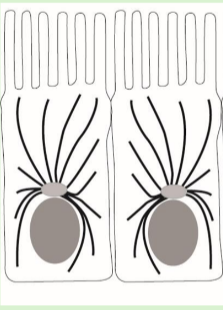
Identify the cytoskeletal structures depicted in the epithelial cells shown in the figure.
Microtubules
Which type of cytoskeletal filaments lines the inner side of the nuclear envelope?
Intermediate filaments