TAMU GEOG 203 EXAM 3
 Call Kai
 Learn
Learn Practice Test
 Spaced Repetition
 Match
Match Flashcards
 Knowt Play
1/172

There's no tags or description
Looks like no tags are added yet.
Name | Mastery | Learn | Test | Matching | Spaced | Call with Kai |
|---|
No analytics yet
Send a link to your students to track their progress
173 Terms
In terms of the global hydrologic cycle, land areas dominate both evaporation/evapotranspiration and precipitation. T/F
FALSE
Which of the following atmospheric moisture balance statements is correct?
a) evaporation is greater over land than over oceans
b) none of these statements is correct
c) over land, precipitation is greater than evapotranspiration
d) over the oceans, precipitation is greater than evaporation
over land, precipitation is greater than evapotranspiration
Potential evapotranspiration is a function of how much moisture actually evapotranspires, whereas actual evapotranspiration is a function of atmospheric energy. T/F
FALSE
If precipitation and soil moisture are not enough to meet the demand from potential evapotranspiration, which of the following situations will likely exist?
a) surplus
b) runoff
c) soil moisture utilization
d) a deficit
e) soil moisture recharge
A deficit
In terms of the surface water budget, __________ is the major input and __________ is the major expenditure.
a) insolation; radiative cooling
b) outgassing; dissociation
c) actual evapotranspiration; precipitation
d) runoff; precipitation
e) precipitation; actual evapotranspiration
precipitation; actual evapotranspiration
Moisture in excess of field capacity can become
a) gravitational water
b) hygroscopic water
c) wilting point water
d) hygroscopic and wilting point water
e) ranch water
gravitational water
Which of the following lists of drought types is in the correct order of increasing severity (weakest to strongest)?
a) hydrological, meteorological, agricultural, socioeconomic
b) meteorological, agricultural, hydrological, socioeconomic
c) agricultural, meteorological, socioeconomic, hydrological
d) socioeconomic, hydrological, meteorological, agricultural
e) hydrological, socioeconomic, agricultural, meteorological
meteorological, agricultural, hydrological, socioeconomic
Weather is characterized in terms of short-term temperature, pressure, precipitation, etc. conditions, while climate refers to the same variables, but over long-term climate "normals." T/F
TRUE
Which of the following is not a climate component used for climatic classification?
a) density
b) insolation/latitude
c) precipitation
d) air masses
e) temperature
density
Equatorial regions are dry because of convergence from the trade winds, convection, and ample moisture availability, while subtropical regions are wet due to high pressure and sinking air from the Hadley cells. T/F
FALSE
A genetic climate classification is based on actual data, while an empirical climate classification uses the underlying forcing factors that affect a region. T/F
FALSE
Tropical Rainforest
uniform, high rainfall amounts
Tropical Monsoon
brief dry season of at LEAST 1mo
Tropical Savanna
distinct wet and dry season of equal length
In which of the climate regions is College Station located?
a) Mesothermal
b) Tropical
c) Desert
d) Microthermal
e) Polar
Mesothermal
Mesothermal climates experience true seasonality, but winter temperatures remain mild. T/F
TRUE
Which of the following is not true regarding Polar and Highland climates?
a) They experience no true summer.
b) Permafrost is found in some regions.
c) They are extremely dry.
d) They are too cold for trees.
e) They are not found in the Southern Hemisphere.
They are not found in the Southern Hemisphere.
Which of the following factors does not cause Desert (arid and semiarid) climates?
a) Subpolar lows
b) Rainshadow effects
c) Cold ocean currents
d) Great distance to water
e) All of these factors are causes
Subpolar lows
What's the general sequence of climate regions, going from the equator to the North Pole?
a) Tropical, Arid, Microthermal, Mesothermal, Polar
b) Tropical, Mesothermal, Arid, Microthermal, Polar
c) Tropical, Arid, Mesothermal, Microthermal, Polar
d) Tropical, Mesothermal, Microthermal, Arid, Polar
Tropical, Arid, Mesothermal, Microthermal, Polar
As a consequence of climate change, precipitation has uniformly increased around the world. T/F
FALSE
All of the following are natural mechanisms of climate change, except which one?
a) atmosphere/ocean variability
b) land cover/land use change
c) changes in earth-sun relationships
d) volcanic activity
e) movement of continents
land cover/land use change
Despite what we learned earlier in the semester, which of the following is not actually constant on geologic timescales (~10,000 to 100,000 years)?
a) Earth's elliptical orbit
b) Earth's tilt
c) axial parallelism
d) solar output (1372 W/m2)
e) none of these are actually constant
none of these are actually constant
Temperature increases due to climate change are occurring most strongly in which part of the globe?
a) Tropics
b) Oceans
c) Arctic
d) Midlatitudes
e) Deserts
Arctic
In the short term, large volcanic eruptions can cause global warming. T/F
FALSE
On which time scales can changes in earth-sun relationships affect climate?
a) decadal (20-30 years)
b) seasonal (<1 year)
c) geologic (10,000-100,000 years)
d) diurnal (<1 day)
e) all of these
geologic (10,000-100,000 years)
Results from general circulation model simulations suggest that climate change is caused by a combination of anthropogenic (human) and natural factors. T/F
TRUE
Earth's Structure
Core, Mantle, Lithosphere, Crust
- congealed in nebula composed of dust, gas, and icy comets
- gravity sorted by density (core is heaviest so forth) which is known bc seismic shock waves
core distribution (mass/volume)
core - (1/6 volume, 1/3 mass)
inner core - most dense, solid iron
outer core - molten iron
magnetic field
the outer core is made of molten iron, producing a magnetic field that protects us from solar wind and cosmic radiation
lower/upper mantle composition
80% earth's volume
- probs contains lots of (crystalline) water
-contains hot spots ex. hawaii/volcano chains
hot spot
a volcanically active area of Earth's surface far from a tectonic plate boundary
lithosphere/crust
asthenosphere -> lithosphere (uppermost mantle+ crust -> crust ( oceanic 5km, continental 20-60km)
continental crust composition, texture, density differences
granite, crystalline, low density (2.7 g/cm 3 )
oceanic crust composition, texture, density differences
basalt, granular, high density (3.0 g/cm 3
Crust "floats" on denser layers belowCrust
radius of earth
6370km
how far have humans been able to drill?
12km over 20yr
geologic cycle
Crust is in a constant state of change
- Being formed by endogenic (internal) processes
- Worn down by exogenic (external) processes
common elements in earth's crust
oxygen 46.6%, silicon 27.7%, aluminum 8.1 %, iron5%, calcium3.6%, sodium2.8%, potassium2.6%, magnesium 2.1%
mineral
inorganic, non-living,natural compound§ has chemical formula & crystallinestructure Example = quartz (SiO2), pyrite (FeS 2)
rock
Rock: assemblage of minerals,mass of a single mineral, or solidorganic material§ Example = granite
THE ROCK CYCLE!
solidified (igneous)->sediment ->settled out (sedimentary rock/shale)-> altered (metamorphic) -> solidified -> .....
igneous
igneous (fire formed) — solidifies from cooling magma or lava
products of the crystallization of magma and lava
Intrusive- Slower cooling/ larger crystals
Extrusive - Faster cooling/ smaller crystals
Sedimentary
Sedimentary (sediments) — sediments wornfrom other rocks
Sediments are loose particles of former rocksranging from mineral grains to boulders
Acted upon by cementation, compaction, andhardening of sediments -> lithification
Metamorphic
Metamorphic (change form) — changing thechemistry, mineralogy, or texture of other rocks
Igneous or sedimentary rocks are transformed due to extreme pressure and heat, are physically and chemically different, harder & more resistant to erosion
Magma
molten rock beneath the surface (intrusive)
Lava
molten rock at the surface (extrusive)
Plate Tectonics
Changes in the configuration of theearth's crust due to internal forces ex. upwelling of magma, sea floor spreading/subduction, and plate movements
seafloor spreading
mechanism that drives plate movement through upwelling of magma along mid ocean ridges, creates ridges
dating the sea floor
As new crust is added, magnetic particles in the lava align themselves with the earth's magnetic field
- Provides a continuous record of the Earth's magnetic reversals
subduction
crust re-melts and is recycled as magma, creates deep trenches
Biosphere
Where atmosphere, lithosphere, & hydrosphere function together
- form the environment in which life exists
- Contains all plant and animal life
- Extends from sea-floor (−11ish km)to +8ish km above earth's surfaceBiosphere
Biogeography
Study of the distribution of plants and animals
- geographic relationships between organisms and their environments
- related to ecology, which is relationships of organisms and their environment
Survival of the fittest
all organisms are locked in a life death struggle for resources
- resources mean energy, growth, and reproduction
how many species went extinct on earth
99.9% of all species that ever existed on Earth
Producer
Plants - use CO 2 and light to form biomass
Consumers
ok eat
Primary consumers - herbivores (feed on producers)
Secondary consumers - carnivores/omnivores
Tertiary consumers - cooler carnivores/omnivores
decomposer
Break down organic matter - release nutrients
Food chain
~20 plant species provide 90% of world's foodR 3 plant species provide ~50%: wheat, maize, rice
Biomes
determined mainly by temperature and precipitation
Also: Solar radiation, Soil temperature, evaporation, wind, etc, and their seasonal distribution
warmest year since 1880
2024, 2023 is second warmest
top 25 warmest years
24 of those have been since 2001 (1998 was El Niño)
avg global temperature increase
increased by ~1.3C (2.3F) since 1880
Diurnal temperature range
decreased
Tmin (night) increases twice as fast as Tmax (day)
precipitation trend
+ 5-10% for 30-85°N since 1900
Sea level rise
+18.5 cm since 1900
Snow cover extent/duration
generally has decreased
spring melt and fall frost?
earlier spring melt, later fall frost = longer growing season
glaciers
retreating, tldr climate change
total sea level rise what ifs
all permafrost thaws: 3-10 cm (1-4 in)
all the (freshwater) sea ice would melt: 4 cm (1.5 in)
all of Greenland ice sheet melted: 6.5 m (21 ft)
all of Antarctic ice sheet melted: ~60 m (197 ft)
the entire cryosphere thawed/melted: 67 m (220 ft) Substantial areas of coastal plains would be flooded worldwide
causes of temperature change (natural)
natural mechanisms - solar output (solar constant is 1372 W/m^2)
- Earth/sun relationships (eccentricity/orbit, axial paralellism/precession, fixed tilt/obliquity
-movement of continents
- atmosphere/ocean variability
- volcanic activity
Causes of temperature change - human mechanisms
- land use/land cover change ex. urbanization/deforestation
- changing atmospheric chemistry ex. greenhouse gases
Greenhouse gas warming is 64% caused by what
CO2
General Circulation Models (GCMs)
numerical models that simulate Earth's circulation
-> physical processes in the atmosphere, ocean, cryosphere
simulates past climate, cause and effect, future climate
Projected temperature change (GCM)
projected 1.4-4.4C increase by 2100
precipitation likely to increase/derease in some regions 10-30%
decrease in snow cover/sea ice thickness
extremes - frequent and intense heat waves, droughts, heavy precipitation -> tropical cyclones may become more intense
Polar and Highland Climates
no true summer,
even during 24hr daylight, T<10C(50F)
too cold for trees
extremely dry "frozen deserts"
tundra
summers barely above freezing
permafrost
ce cap
below freezing year- round
Greenland and ANTARTICA
Desert (Arid and Semiarid) Climates
most extensive climate region
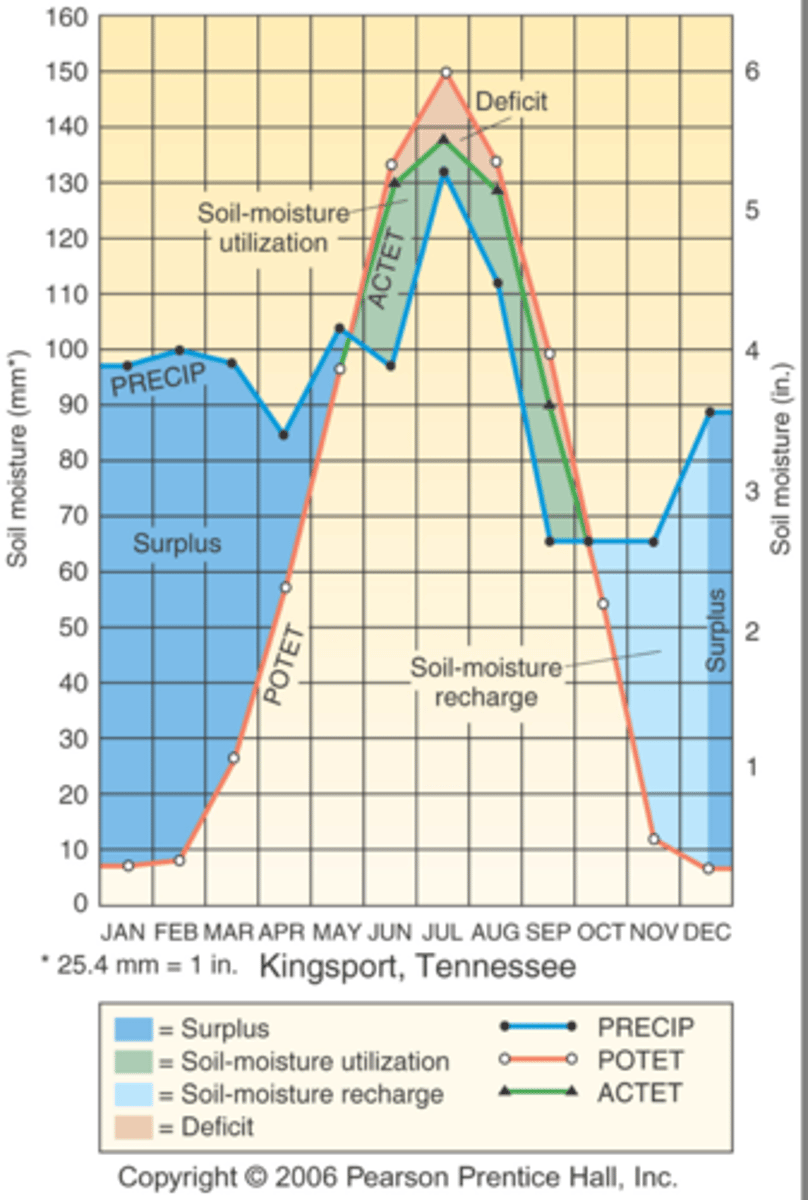
- moisture demand (POTET)>supply (PRECIP)
- always a water deficit
caused by: subtropical highs, stabilizing ocean currents, rain shadow effects, great distance to water
What is the Hydrologic Cycle?
A continuous cycle of evaporation and precipitation that circulates water through the atmosphere, the earth, and water bodies
Does land experience more evaporation or precipitation?
More precipitation over land.
1 multiple choice option
Does the ocean experience more evaporation or precipitation?
More evaporation over ocean.
1 multiple choice option
What is advection in the hydrologic cycle?
Movement of water between the land and ocean
Does land or ocean globally experience the most evaporation AND precipitation?
Ocean experiences the most.
1 multiple choice option
How much evaporation and precipitation does the ocean experience?
78% precipitation and 86% evaporation
1 multiple choice option
How much evaporation and precipitation does land experience?
14% evapotranspiration and
22% precipitation
1 multiple choice option
What is ACTET
actual evapotranspiration
What is transpiration?
The loss of water from a plant
What is evapotranspiration?
The combined processes of evaporation and transpiration.
What is POTET?
Maximum amount of water that could potentially evaporate/transpire under optimum conditions. (demand)
What is PRECIP?
Water supplied via precipitation. (supply)
What is the input in water budget?
Precipitation
What are the expenditures in the water budget?
Evaporation from land and water, and transpiration from plants.
What is runoff?
Runoff is water that falls on a watershed that does not soak into the ground to become groundwater.
What is gravitational water?
water that trickles downward as a result of gravity.
What is wilting point?
When there is no water available for plants. (a.k.a hygroscopic H2O)
What is field capacity?
when the soil moisture is high enough that the water becomes too heavy and moves further into the earth away from the plants usage. (a.k.a gravitational H2O)
What is capillary H2O?
When the soil moisture is at the perfect level for plant usage.
When is there a surplus in the water budget?
When the PRECIP is greater than everything
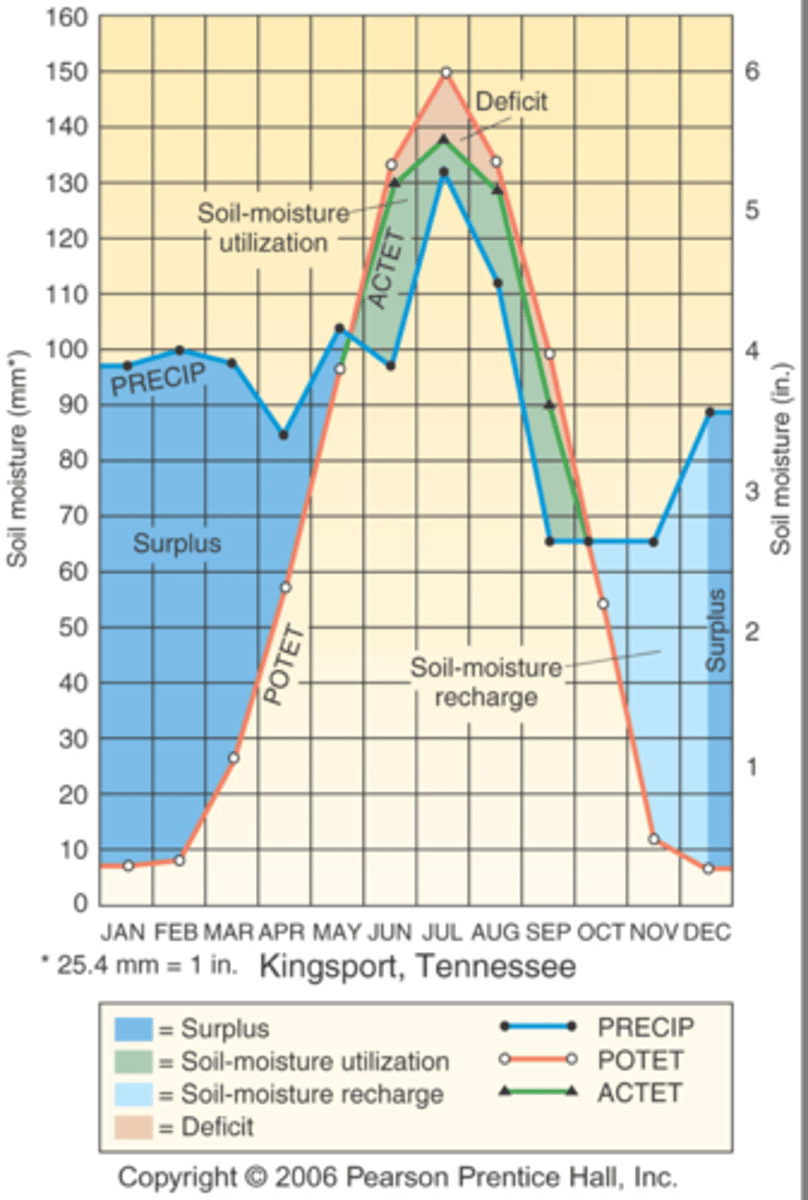
When is there soil-moisture utilization in the water budget?
When the ACTET is greater than the PRECIP
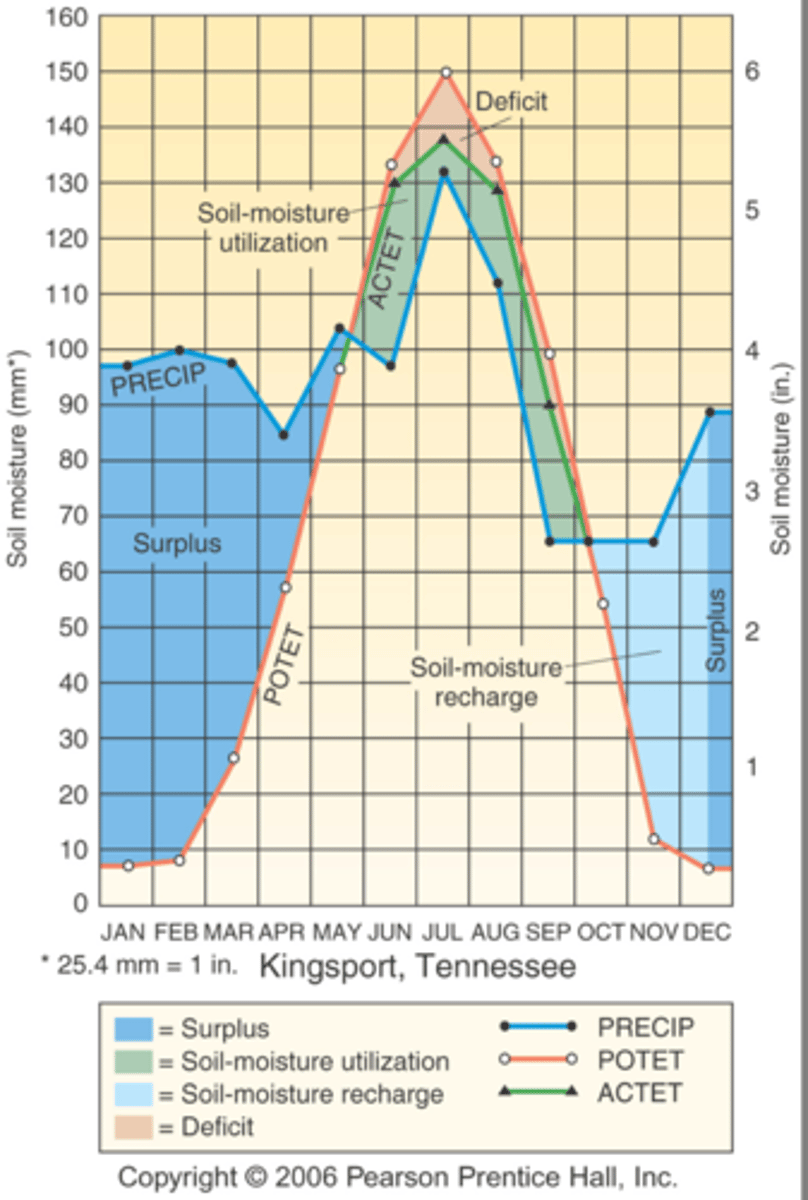
When is there soil-moisture recharge in the water budget?
When the PRECIP is greater than the POTET