Pre-partum conditions and approach to the normal calving
 Call Kai
 Learn
Learn Practice Test
 Spaced Repetition
 Match
Match Flashcards
 Knowt Play
1/20

There's no tags or description
Looks like no tags are added yet.
Name | Mastery | Learn | Test | Matching | Spaced | Call with Kai |
|---|
No analytics yet
Send a link to your students to track their progress
21 Terms
What is vaginal prolapse?
Describe key risk factors.
• Eversion of vagina +/- cervix
• Last trimester (mainly) due to pressure from abdomen
• Risk factors
Breed (Hereford and fat prone cattle)
High body condition score (BCS)
Lax sacrotuberous ligaments/vulva (If they had condition before)
Previous perineal trauma
Increased intra-abdominal pressure
Oestrogen - pastures and hormone treatments
Hypocalcaemia
• Highly repeatable: Cull
• Probably more common in sheep, esp if multiple foetuses
What is the grading system used for vaginal prolapse?
1. Intermittent only when cow lying down, vaginal tissue fine
2. Continuous prolapse, urinary bladder trapped,
Continuous prolapse, urinary bladder trapped, tissue starts to be compromised
4. As above but includes cervix, tissue infected, necrotic and sepsis/peritonitis possible
Rapid progression through grades
Becomes vicious cycle
Prompt intervention ideal
How are animals with vaginal prolapse given main medication?
Caudal epidural - USED A LOT IN OBSTETRICS!!!
• Lift tail up/down - ID junction between last stationary and first moving vertebrae (sacrococcygeal space S5 - C1)
• or first coccygeal space (C1 - C2)
• Clip and surgical scrub site
• 18g x 1.5 inch needle (pink) for adult cow
• Insert needle 90 degree to skin
• Hanging drop (see video) OR attached syringe - should inject with no resistance, due to negative pressure
• 1ml/100kg (increasing dose means nerves affected more cranially)
• Many licenced cattle local products say 'DO NOT USE IN EPIDURAL....! see later
• Adding xylazine 0.05mg/kg, (1.62ml Rompun 650kg) extends duration but....
• I always gave 4.5ml Local and 0.5ml Xylazine to a cow.........
Too much epidural - animal goes down
What sort of pain relief is given for cattle in the UK?
NSAID
> Limited licence
> 1 - 5 days repeat dosing (varies depending on product)
> Very different to the analgesia available for SA/EQ
> EXAM TIP - know what drugs are licenced for farm animals!
Metacam, Keprofen, Finadyne
What drugs will be used for local anaesthesia for epidural in cattle?
• No veterinary medicinal products specifically licensed for epidural anaesthesia in any farm animal species in the UK.
• Whenever you perform an epidural on a cow, sheep, or pig, you will always be prescribing and using drugs under the Cascade.
• The issues
• Products licenced in other species for epidural don't have an MRL and/or specify it should not be used in animals for human consumption e.g. Mepivacaine
• The Least-Worst Option in the UK currently - 'Pronestesic' or 'Procamidor'
Licensed for use in cattle, sheep, and pigs (though not specifically for epidurals, allowing cascade use).
It has no specific contraindication for epidural administration.
It DOES NOT contain chlorocresol, mitigating the significant neurotoxicity risk identified in human medicine (do contain Epinephrine/Adrenaline)
• You will see many practitioners using drugs that are not ideal for epidural without issues. You will likely have to go with the practice policy but make sure you discuss it!
What techniques are used to correct vaginal prolapse?
• Assess viability of tissue*
• Clean and apply plenty lube
• Replace back into vagina (watch fingers - perforation risk)
• Buhner's stitch with uterine tape (video PLEASE WATCH! or horizontal mattress)
• 2-3 fingers wide (need to pass U+)
• Easy knot (so can un-tie)
• NSAID, broad spectrum abs
What are the main features of Hydrops (Hydrallantois*/Hydramnios)?
• Increased production/ accumulation fluid
• Hydrallantois - allantoic sac (outside)
• Associated with placental disease
• 3rd trimester, acute (weeks)
• CS - Distended abd, +/- systemic signs, down, prepubic tendon rupture
• Rectal - can't feel placentomes, uterus everywhere (can use ultrasound to confirm)
• Tx - elective c section or induce (see CP 1.5)
Steroids but...causes immunosuppression
PGF 2 alpha but...placenta can maintain prostaglandin
Px- poor, cull as can recur
Hydramnios - amnionic sac
• Foetus can't regulate fluid (often dead)
• Chronic
• Can feel placentomes
• No reason to cull cow
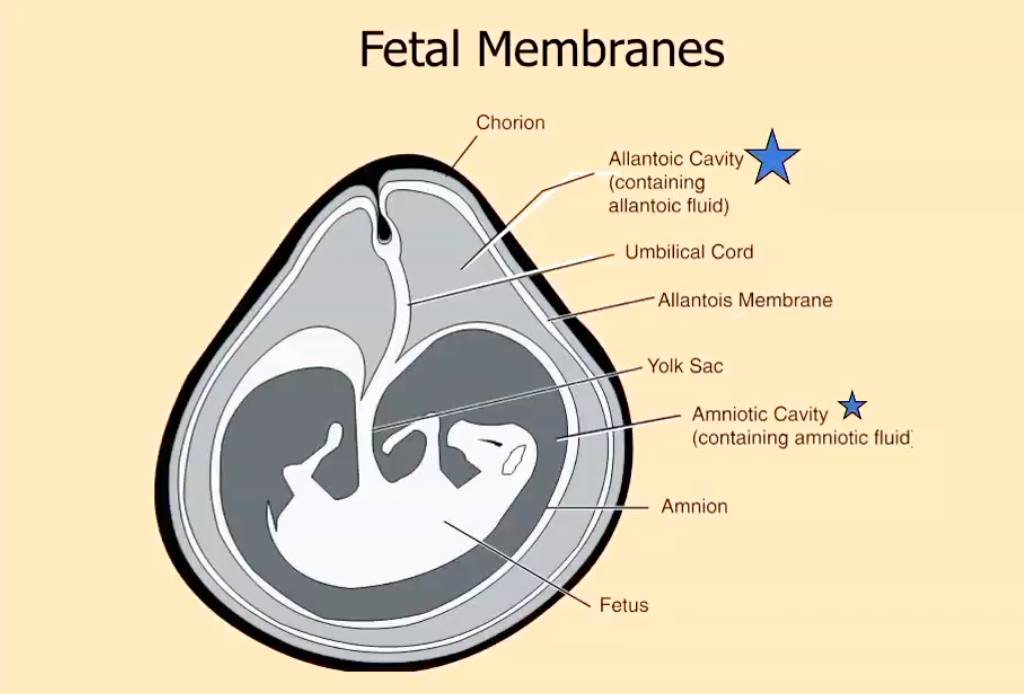
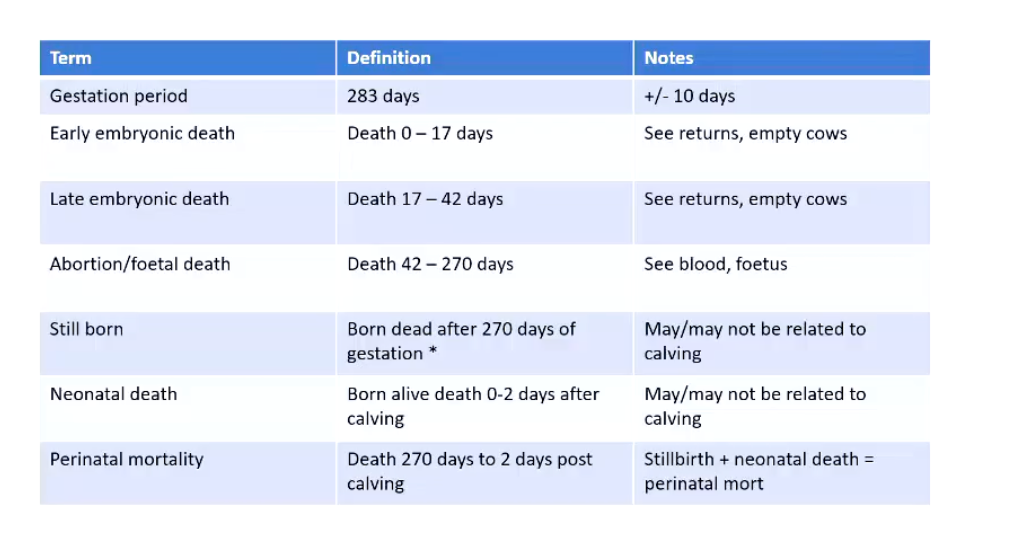
Describe the main terms used for fetal loss and abortion.
Describe how a “normal” calving typically occurs.
• It should happen very naturally
• 1st stage (variable time 0 - 24 hours)
Uterine contractions (not visible on outside, opens cervix and moves calf)
Behavioural changes
Tail head raises up and swishing tail etc
• 2nd stage (30 mins to 4 hours)
Water bag appears (marks the start of 2nd stage)
Abdominal contractions +++ (visible and cow may vocalise, caused by pressure from calf in pelvis, if don't happen, calf is stuck somehow as hasn't made it to pelvis)
Feet appear (should see some progress every 20 minutes thereafter)
Calf born (should be within 1.5 hours of water bag)
What are the main pieces of equipment involved in bovine dystocias?
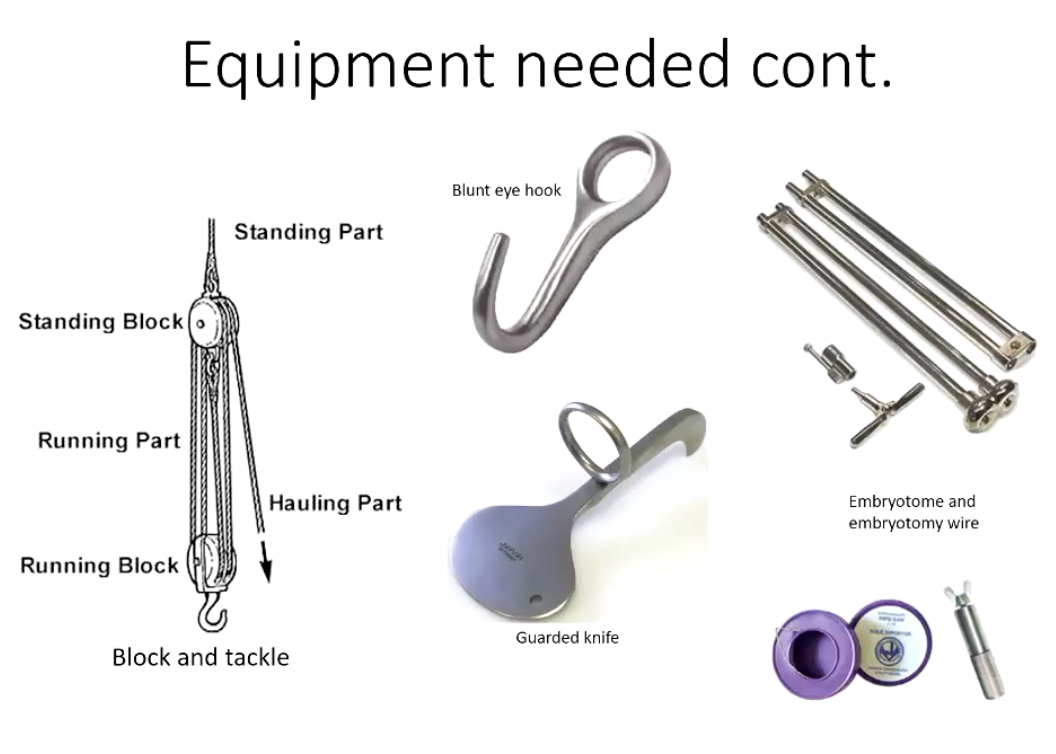
Calving aid - jack
The Gyn Stick - indications for upside down calf or twisted uterus
Other equipment: ropes, eye hook, embryotome, embryotomy wire, lube, disinfectant, c section kit, local, clenbuterol, oxytocin, NSAID, broad spectrum abs
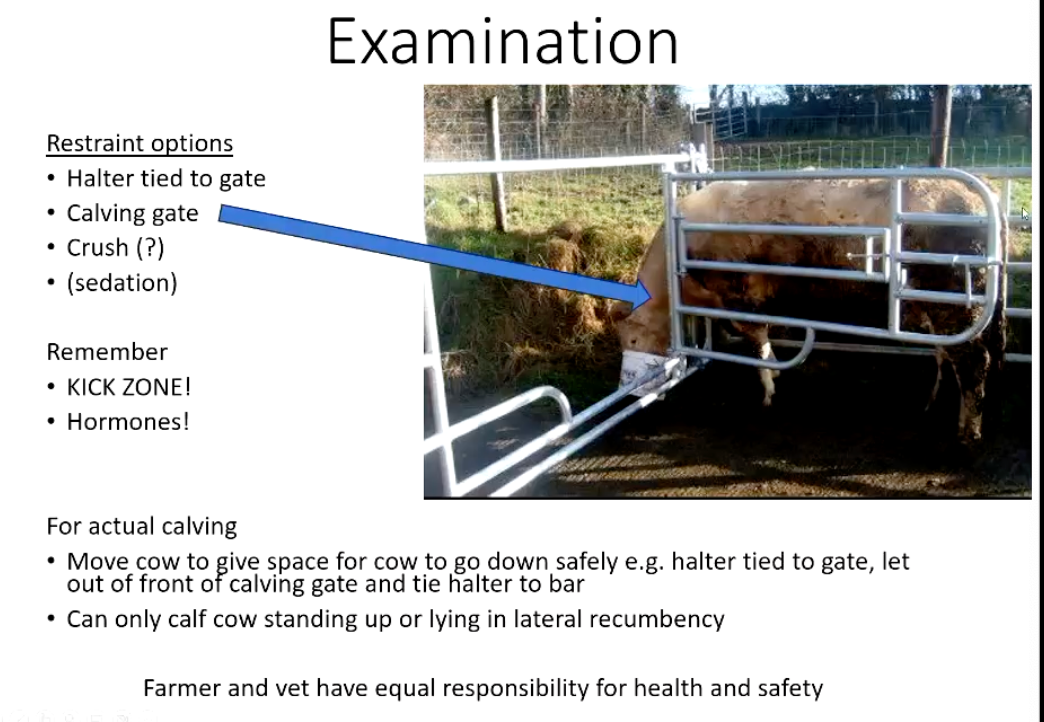
When performing an examination on a calving cow, what are your main considerations for restraint?
No time for full clinical exam but a few things to check
• Body condition score (BCS)
• General demeanour
• Udder
Then
• Clean and disinfect perineum (bucket of water and iodine/chlorhex)
• Gloves (?)
• Lube - Powder/liquid
• DON'T RUSH TO CONCLUSIONS!
What are the most important questions to ask when performing your exam on the cow for calving issues?
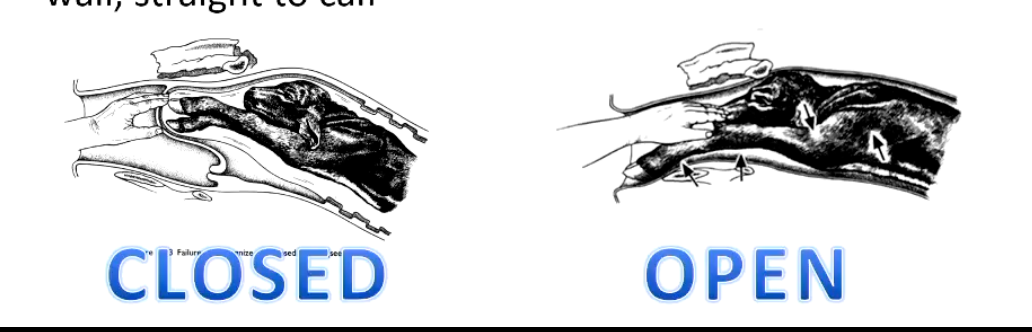
Q1 Is she calving? - is the cervix open or closed?
(see uterine torsion)
• Closed = Feel closed cervix/calf through uterine wall
• Half open = Feel ring
• Open = don't feel cervix at all, merges into vaginal wall, straight to calf
Q2 what have I got......?
E.g. (legs, back legs, head, etc.)
Q3 Do I have front legs or back legs?
• Head/hock/tail are obvious landmarks
• Can bend joints and see if bend in same or different directions
Q4 Is calf dead or alive?
• Pinch toe
• Fingers to back of mouth to test gag reflex
• Poke eye
• Anal reflex
• Feel heart/pulse
If dead - how dead?
A calf dead for a while would be - smelly, emphysematous and disintegrate
If alive - don't over commit this information to the farmer
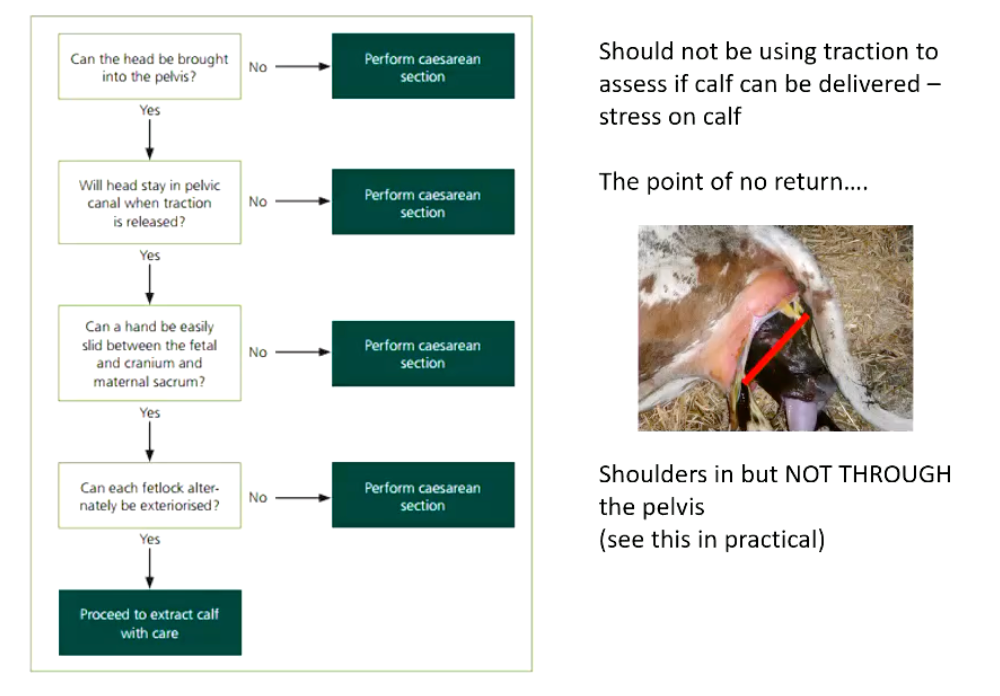
Q5 Can I deliver this calf per vagina........?
Should be ok if…
• Head comes into canal itself and stays there without being pulled
• Hand passes over head and shoulders when calf in pelvis
• Feet out 10cm beyond cow
• Pull from one person plus a push from the cow brings calf into pelvis
• One person pulls one leg to bring shoulder into canal, hold it there while the other person pulls the second leg
Warning signs.....
• Feet crossing, feet rotating inwards, no progress (water bag delayed)
• Experience has a huge influence on this - very difficult to teach......
What is the “point of no return” in calving?
Shoulders in but NOT THROUGH the pelvis (see this in practical)
If a calf is able to be pulled, how should you set up?
Legs/ ropes chains - applied above fetlock and tight, jury out on chain/rope coming from ventral or dorsal
Can also double hitch to spread the load
Head rope - Secure in mouth, watch doesn’t end up around the neck of calf, if need head tope to guide head, might not need to secure in mouth
• Stretch vulva/cervix (worth the effort, could spend up to 20mins)
• Attach ropes to calving aid/pull (head rope?)
• LUBE!
• Consider rotation of calf
• Ideally alternate traction on legs until shoulders through pelvis - 'walking' shoulders in
• should progress with 'reasonable force' = strength of two humans
• CHECK FOR ANOTHER CALF!!!!
How should you apply force to the calving aid when pulling out a calf?
- Lever down > ratch > rest cycle to mirnic in and out movements of natural calving
- Leverage downwards from calving jack provides force NOT the rachet (think about normal calving)
- Ideally apply leverage when cow contracts (blood supply to calf and pelvis opens)
- Rachet from calving jack = takes up strain (doesn't do the pulling/force)
- Can lift calving aid up to ease pressure on calf
Don't mix up diagnosis and treatment !!!
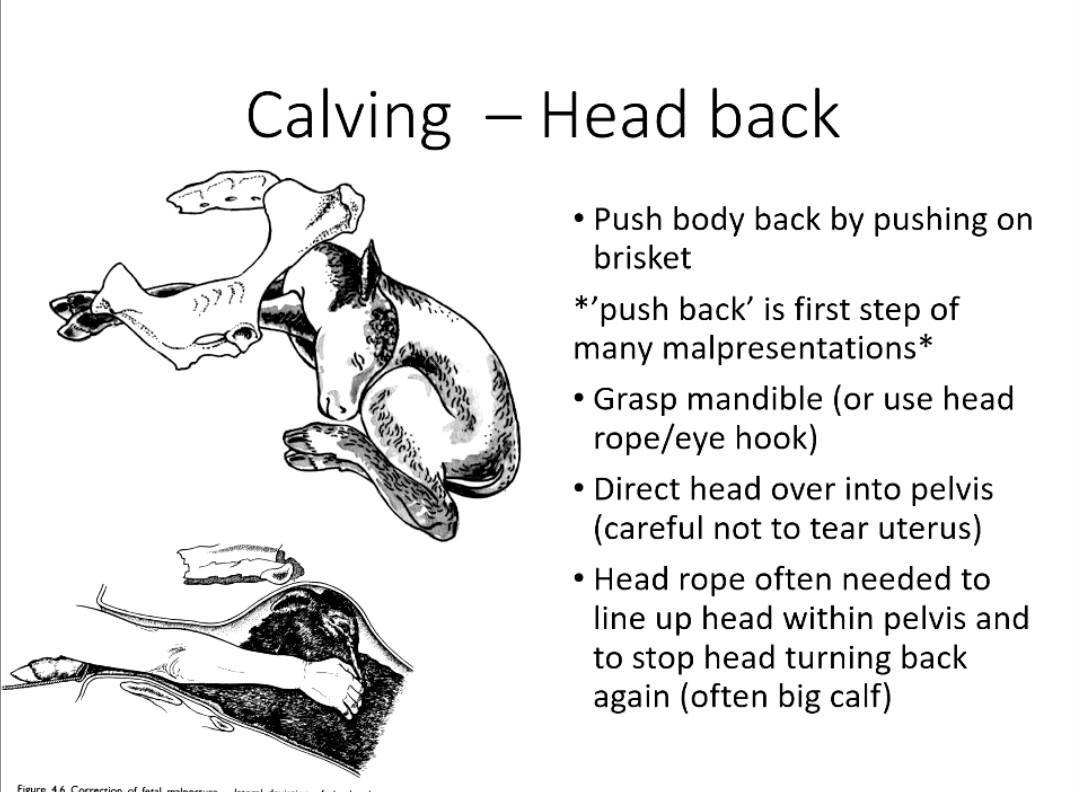
Describe how you would treat a malpresentation involving a head back in the bovine.
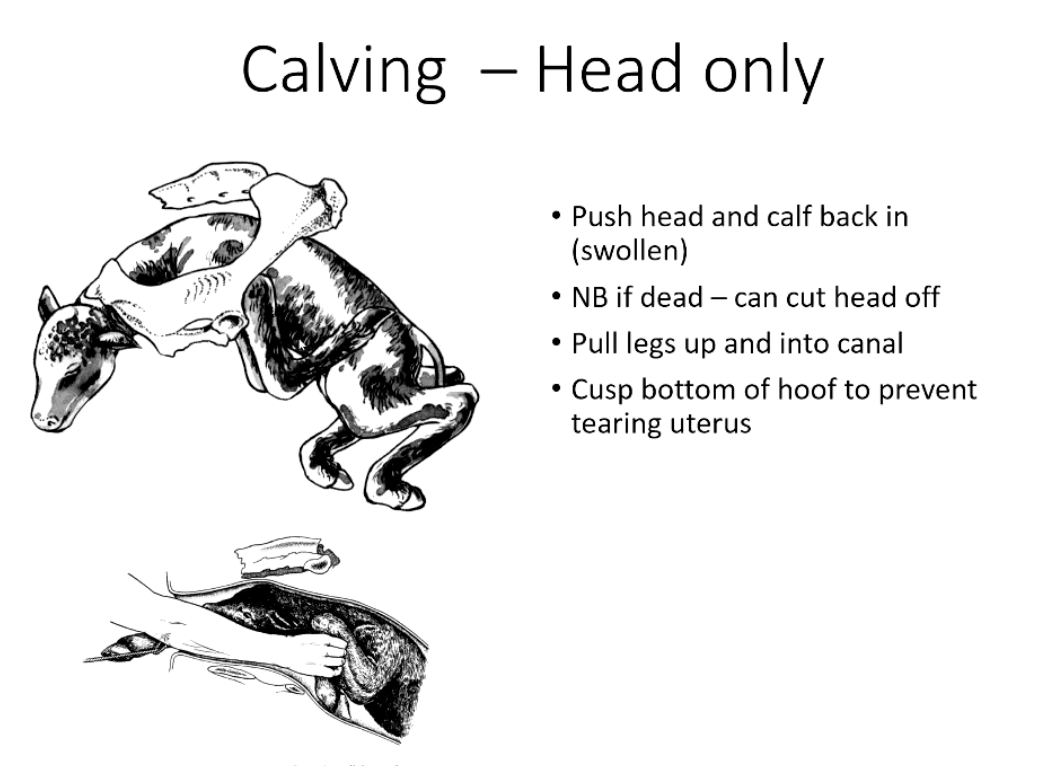
Describe how you would treat a malpresentation involving head only.
Describe how you would treat a malpresentation involving head and one leg only.
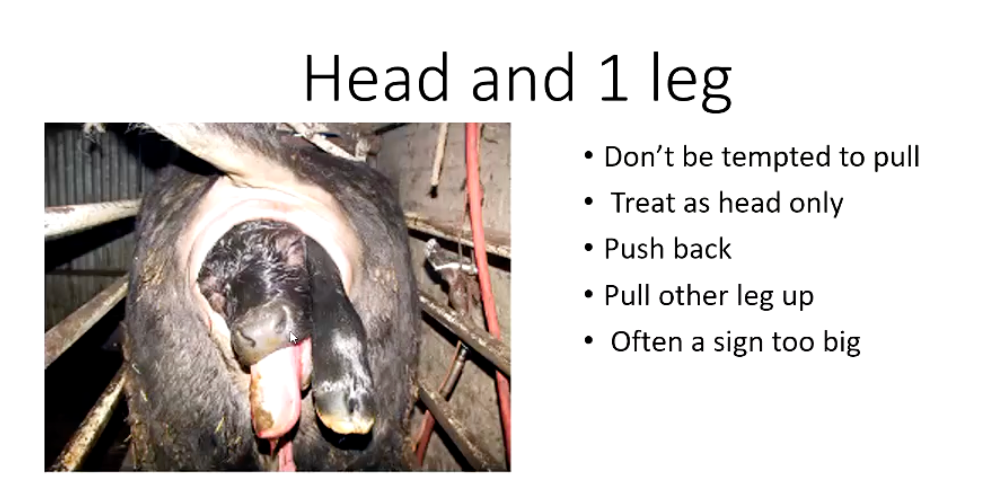
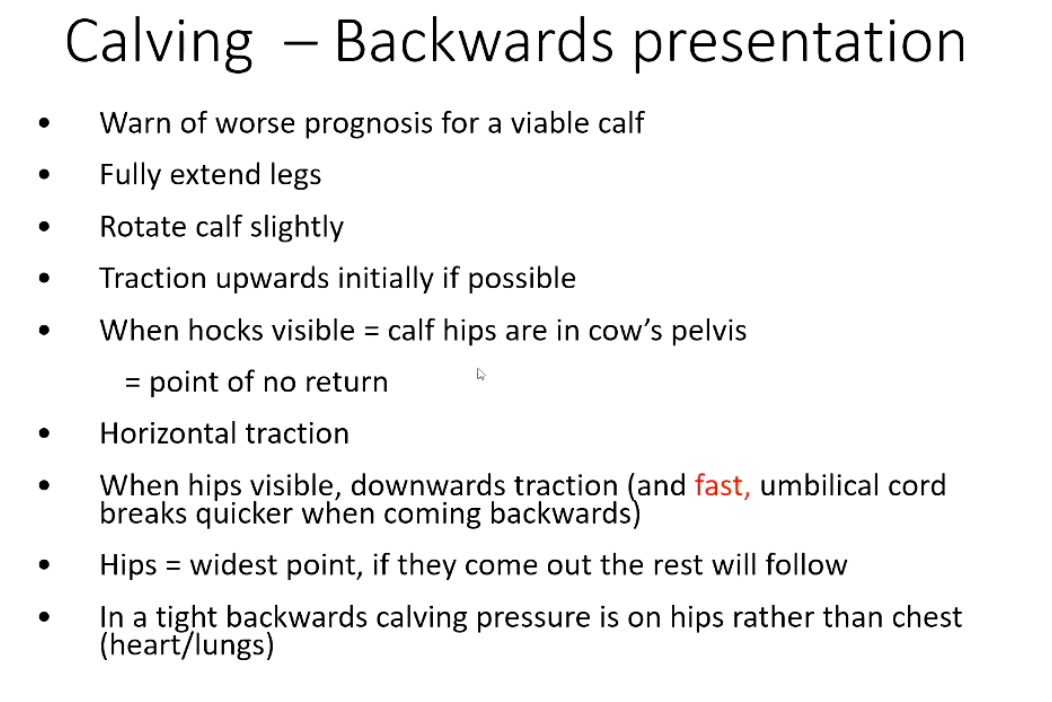
Describe how you would treat a backwards calving malpresentation.
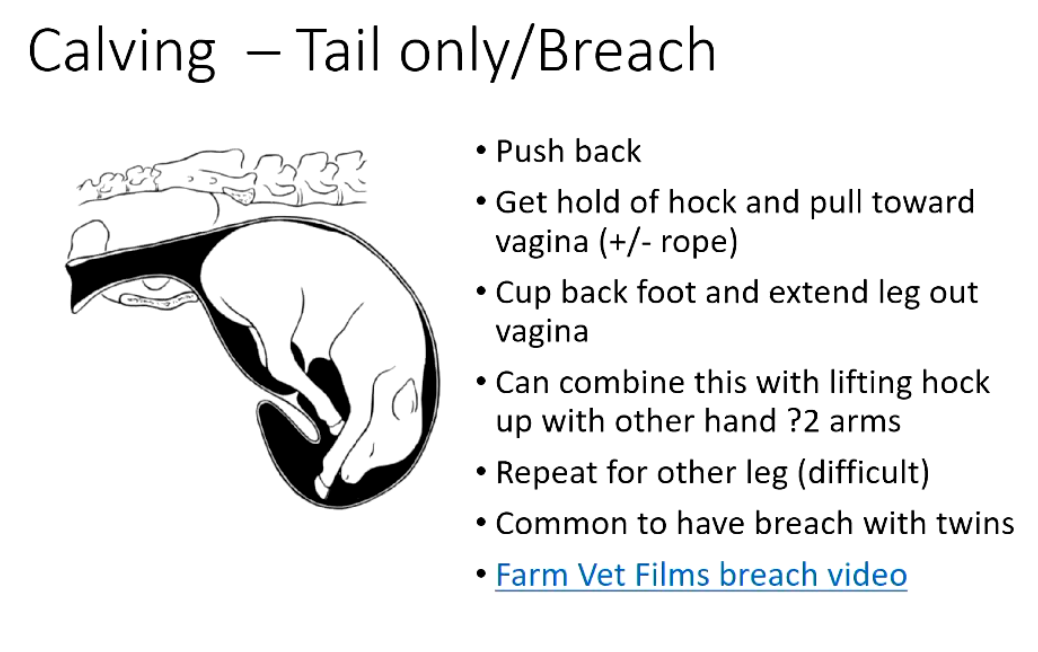
Describe how you would treat a tail only/breach calving malpresentation.
Describe some of the main drugs used in calving.
Clenbuterol (Planipart ® 10ml slow IV
• Relaxes uterus (Beta 2 agonist)
Gives space for correcting mal-presentation (pushing back)
C section - delays involution, stitching easier
Delays calving (highlands and islands)
Denaverine hydrochloride (Sensiblex®, 10ml IM, can repeat after 40-60 mins)
Promotes dilation of soft tissues of birth canal and regulates uterine contractions
Oxytocin (Oxytocin 5º) 1-4ml IM
Stimulates uterine contractions
Reverse Clenbuterol
Retained Foetal Membranes (RFM) - within first few hours
Post calving haemorrhage
Milk let down