Daily AS Chem
 Call Kai
 Learn
Learn Practice Test
 Spaced Repetition
 Match
Match Flashcards
 Knowt Play
1/69

There's no tags or description
Looks like no tags are added yet.
Name | Mastery | Learn | Test | Matching | Spaced | Call with Kai |
|---|
No analytics yet
Send a link to your students to track their progress
70 Terms
What is the functional group for an alkane?
Contains only C-H and C-C single bonds e.g. CH₃CH₃ (ethane)
What is the functional group for an alkene?
R-C=C-R e.g. H₂C=CH₂ (ethene)
What is the functional group for an alcohol?
R-OH e.g. CH₃OH (methanol)
What is the functional group for an amine?
R-C-N-R e.g. CH₃NH₂ (methylamine)
What is the functional group for an aldehyde?
R-CH=O e.g. CH₃CH=O (ethanal)
What is the functional group for a ketone?
R-CO-R e.g. CH₃COCH₃ (propanone)
What is the functional group for a carboxylic acid?
RCOOH e.g. CH₃COOH (ethanoic acid)
What is the functional group for an amide?
RCONR e.g. CH₃CONH₂ (ethanamide)
What is the functional group for a haloalkane?
R-X e.g. CH₃CH₂Cl (chloroethane)
Hydrogen (H2 ) test
pops with a lighted splint
Oxygen (O2 ) test
relights a glowing splint
Carbonate (CO 3 2- ) test
add dilute acid; effervescence, carbon dioxide produced
Sulfate (SO4 2- ) test
add dilute nitric acid then aqueous barium nitrate. Gives white precipitate
Chloride (Cl - ) test
add dilute nitric acid then aqueous silver nitrate. Gives white precipitate. Dissolves in dilute ammonia to give colourless solution (of [Ag(NH 3 ) 2 ] + )
Bromide (Br - ) test
add dilute nitric acid then aqueous silver nitrate. Gives cream precipitate. Dissolves in concentrated ammonia but not in dilute ammonia
Iodide (I - ) test
add dilute nitric acid then aqueous silver nitrate. Gives yellow precipitate. Does not dissolve in either concentrated or dilute ammonia
Unsaturated hydrocarbons test
turns bromine water from orange to colourless.
Test for sulfate ion
add nitric acid (removes carbonate ions so no other ppt forms), add barium chloride, barium sulfate forms, white ppt.
Test for NH4+
add NaOH
warm
test w/red litmus paper
red→blue
pungent smell
P subshell
Principal
3 types
x y z
D subshell
Diffuse
5 types
d_xy, d_xz, d_yz, d_x^2-y^2, d_z^2
F subshell
Fundamental
7 types
fz³, fz(x²-y²), fx(x²-3y²), fy(3x²-y²), fxyz, fxz², and fyz².
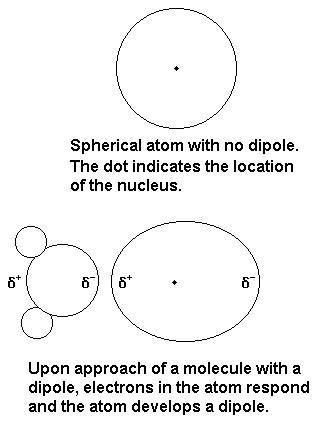
Permanent - induced dipole forces
when a permanent dipole approaches a non-polar molecule, it can induce a dipole in the non-polar molecule
Van der Waals force
Permanent-Permanent dipole
the δ+ of one dipole attracts the δ- of the other dipole
the dipoles act as bar magnets
Van der Waals force

London / Dispersion forces | Induced-Induced
Non-polar - Non-polar
Constant movement of atoms causes distortion of distribution of charge in the electron charge
makes an “instantaneous dipole”
these “instantaneous dipoles” can induce other dipoles in neighbouring atoms
these small induced dipoles attract one another, causing intermolecular forces, called “London Forces”

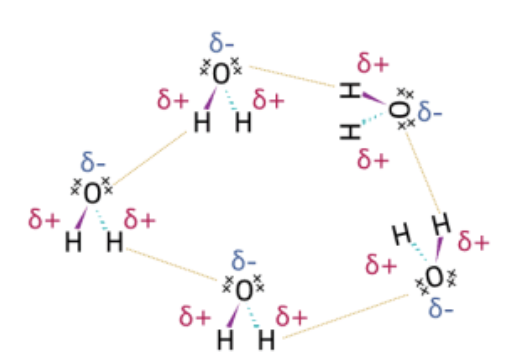
H bonding
Intermolecular bonding between molecules containing N, O, F and the H atom of -NH, -OH, -H
H attracts LP of N O F
the reason why ice is less dense than water
The reason for water’s high M.P. and B.P.
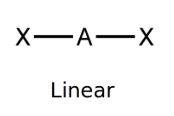
2 BP
0 LP
(shape)
linear
180°
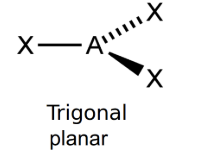
3 BP
0 LP
(shape)
trigonal planar
120°
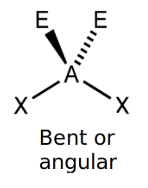
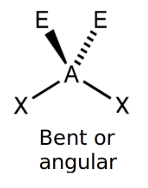
2 BP
1 LP
(shape)
non-linear/bent/Vshape
117.5°
(e=LP)
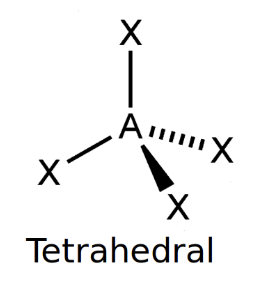
4 BP
0 LP
(shape)
Tetrahedral
109.5°
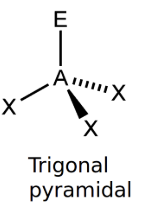
3 BP
1 LP
(shape)
Trigonal pyramidal
107°
(E=LP)
2 BP
2 LP
(shape)
Bent/Linear/V-shape
104.5°
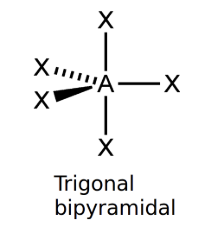
5 BP
0 LP
(shape)
trigonal bipyramidal
90° between the BP on the same plane or 120°
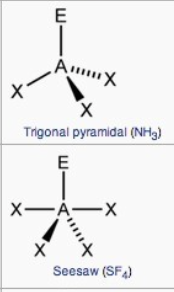
4 BP
1 LP
(shape)
trigonal pyramidal
119° or 89°
OR
see-saw
89°
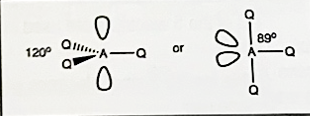
3 BP
2 LP
(shape)
Trigonal planar
120°
OR
T shape
89°
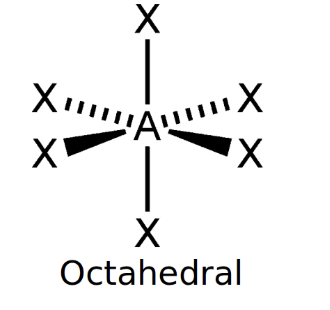
6 BP
0 LP
(shape)
Octahedral
90°
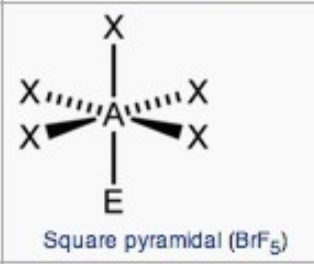
5 BP
1 LP
(shape)
square pyramid
89°
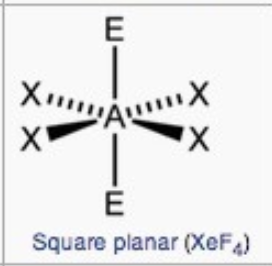
4 BP
2 LP
(shape)
square planar
90°
Sulfuric Acid
H2SO4
Hydrochloric Acid
HCl
Nitric Acid
HNO3
Sodium Hydroxide
NaOH
Potassium Hydroxide
KOH
Ammonia
NH3
Acid Definition
An acid is a substance that increases the concentration of hydrogen ions (H+) when dissolved in water.
A proton Donor
Base definition
a substance that can accept a proton (H+) from an acid
Alkali Definition
An alkali is a base that is soluble in water and releases hydroxide (𝑂𝐻−) ions into the solution.
+ve ion
Cation
-ve ion
Anion
Carbonate
CO32-
Acid + Carbonate →
→ Salt + Carbon Dioxide + Water
Acid + Metal oxide →
→ Salt + Water
Acid + alkali →
→ Salt + Water
Acid + Metal →
→ Salt + Hydrogen
Percentage yield equation

Atom economy

G2 metals
more reactive down group
bigger atomic radius
more e- shielding
less attraction on outer e-
2Ca(g) + O2(g) → 2CaO(s)
Ca(s) + 2H2O(L) → Ca(OH)2(aq) + H2(g)
Ca(s) + 2HClaq) → CaCl + H2
Hydroxides get more soluble down group
alkalinity increases down group
Ca(OH)2 is used as lime to neutralise acidic
Mg(OH)2 used for indigestion
CaCO3 is used for building
G17 Halogens
down group reactivity decreases
bigger radius
more e- shielding
less attraction on incoming e-
Chlorine oxidises both Br and I ions
Bromine can only oxidise I ions
Iodine does not oxidise either Cl or Br ions.
Cl(aq) + HO(l) → HCO(aq) + HC(aq)
used in water purification
Cl(aq) + 2NaOH(aq) → NaC(aq) + NaCIO(aq) + H2O(l)
cold dilute aq NaOH
Carbonate (CO 3 2- ) test
add dilute acid; effervescence, carbon dioxide produced
Sulfate (SO4 2- ) test
add dilute nitric acid then aqueous barium nitrate. Gives white precipitate
Chloride (Cl - ) test
add dilute nitric acid then aqueous silver nitrate. Gives white precipitate. Dissolves in dilute ammonia to give colourless solution (of [Ag(NH 3 ) 2 ] + )
Bromide (Br - ) test
add dilute nitric acid then aqueous silver nitrate. Gives cream precipitate. Dissolves in concentrated ammonia but not in dilute ammonia
Iodide (I - ) test
add dilute nitric acid then aqueous silver nitrate. Gives yellow precipitate. Does not dissolve in either concentrated or dilute ammonia
ΔrH⦵
The enthalpy change associated with a given reaction under stp
ΔfH⦵
Enthalpy change for 1 mol of a compound being formed under ⦵.
Use fractions to balance equations → HAS TO BE 1 MOL OF PRODUCT!!!!
ΔcH⦵
Enthalpy change when 1 mol of a substance is completely combusted in O2, forming products in standard states at step) under ⦵.
Exothermic
ΔneutH⦵
Neut. / n = neutralisation
Enthalpy change for the formation of 1 mol of water from a neutralisation reaction under ⦵.
Endothermic
-57 – -58 kj mol-1
oxidation of alcohol
Alcohol class | Reaction conditions | Product | Observation |
1º | Gentle heating | Aldehyde | Orange → green |
1º | Stronger heating under reflux | Carboxylic acid | Orange → green |
2º | Heat under reflux | Ketone | Orange → green |
3º | N/A | No reaction | Remains orange |
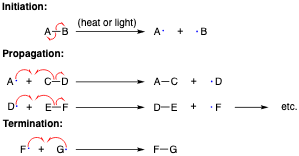
free radical substitution process