Biology Exam Review: Plant and Fungi Concepts
 Call Kai
 Learn
Learn Practice Test
 Spaced Repetition
 Match
Match Flashcards
 Knowt Play
1/39

Earn XP
Description and Tags
These flashcards cover key vocabulary related to plant and fungi biology, focusing on life cycles, structures, and reproductive strategies.
Name | Mastery | Learn | Test | Matching | Spaced | Call with Kai |
|---|
No analytics yet
Send a link to your students to track their progress
40 Terms
Many of the coal deposits we have today date to the Carboniferous Period and were formed from great forests that thrived at that time. Which of the following characteristics would you be LEAST likely to find among the plants in those forests?
sporopollenin, pollen, & ovaries
Where does meiosis occur in the pine life cycle?
within a megasporangium
What kind of animal fossils were found before the Cambrian Explosion (about 535 million years ago)?
soft-bodied animals looking like sponges or jellyfish
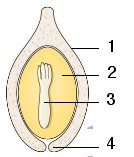
The illustration above shows a maturing gymnosperm seed. What does label 3 indicate?
young sporophyte
Both animals and fungi are heterotrophic. What distinguishes fungal heterotrophy from animal heterotrophy is that most fungi derive their nutrition by ________.
using enzymes to digest their food externally
If animals had alternation of generations like plants, ________.
the products of meiosis would undergo mitosis and become multicellular
A microspore
produces a male gametophyte
Which of the following is NOT one of the challenges that the first land plants needed to overcome for living in a land environment?
Land animals of that period were small and could not pollinate tall plants.
The cell wall of fungi contains ____.
chitin
What is the significance of fungi in the evolutionary history of first land plant?
Mycorrhizae helped early land plants with the water and mineral absorption before the development of true roots.
Which of the following structures allows certain fungus to form a massive colony?
mycelium
An animal that is diploblastic could not possibly have
a true coelom
Plasmogamy can directly result in which of the following?
cells in heterokaryotic stage
You are examining an unknown organism. If you find __________, you are CERTAIN that it belongs in the Animal Kingdom.
muscle tissue
The following question refers to the generalized life cycle for land plants shown in the figure. Each number within a circle or square represents a specific plant or plant part, and each number over an arrow represents meiosis, mitosis, or fertilization.
In the figure, which of the following numbers would you expect to find a structure called gametangia ?
7
Ginkgo trees are known to produce ____.
seeds
Arrange the following events in sequence from earliest to most recent:
1. first seed-bearing plants
2. multicellular charophytes invade shallow freshwater ponds
3. first land-dwelling bryophytes
4. first flowering plants
5. first seedless vascular plants.
2, 3, 5, 1, 4
Place these flowering plant life cycle steps in the correct sequence:
1. pollen reaches stigma
2. fertilization of egg
3. development of fruit
4. pollen tube grows
5. pollen develops in anther
5-1-4-2-3
Yeast infection is caused by
a fungus
In animal embryonic development, a primitive gut and germ layers are established in the ____ stage.
gastrula
If you cut an apple in half you will find a 'star' shape structure with five cavities, in which you can find seeds.
Based on your understanding of the flowering plant structure, the forming of this 'star' related to the ____
of the flower.
five carpels
What is the best description for the image shown above?
This is an endomycorrhizal association between a fungus and plant root cells with arbuscular mycorrhizae exhibited by members of the Glomeromycetes.
Which of these plant parts could belong to a Eudicot?
seed with two cotyledons.
Which of the following is the BEST description of pollination in a seed plant?
transfer of a pollen to a part of the seed plant that contains the ovule.
What do all protostomes have in common?
The pore (blastopore) formed during gastrulation becomes the mouth.
Which of the character(s) can be found in the members of Phylum Bryophyta?
have a sporophyte generation.
An organism that exhibits a head with sensory equipment and a brain probably also ________.
is bilaterally symmetrical
Why are Chytrids considered as a basal group of fungi on a fungal phylogentic tree, and they are often considered as simplest and primitive?
They are the only fungi that produce flagellated zoospores.
In what way(s) do the reproductive adaptations of flowering plants (angiosperms) make them so much more successful across the world today than other groups of plants?
ALL of the above.
Which of these is a CORRECT match of term with description?
endoderm -- germ layer that is the origin of digestive tract
The fact that choanoflagellates and collar cells of sponges resemble each other supports the inference that ________.
choanoflagellates and sponges are sister groups
The last common ancestor of all animals was probably a
flagellated protist.
The embryonic tissue layer called endoderm
ALL of the above.
Coelomates are characterized by
a coelom that is completely lined with mesoderm.
What is the purpose of apical meristems in plants.
allow plant cells to continue dividing at the tip of roots and shoots.
Members of _________ are only fungi that produce flagellated zoospores.
Chytridiomycota
Which of the following cells or structures are associated with asexual reproduction in fungi?
conidiophores
How are bryophytes and lycophytes alike?
In both groups, sporophytes develop without forming seeds.
The presence of vascular tissue allowed plants to ________.
transport nutrients and water from below-ground tissues to above-ground tissues and grow taller
Which of these is a CORRECT match of term with description?
Larval stage -- differs in form, function & often habitat from adult.