Module 4: Biodiversity
 Call Kai
 Learn
Learn Practice Test
 Spaced Repetition
 Match
Match Flashcards
 Knowt Play
1/40

Earn XP
Description and Tags
Ch 26 1-3 Prokaryotes | Ch 27 1-3 Evolution of Eukaryotes; Protists | Ch 28 1-3 Land Plants | Ch 29 1-3 Fungi | Ch 30 1-3 Animals | Ch 31 1 and Ch 32 1, 3-6 |
Name | Mastery | Learn | Test | Matching | Spaced | Call with Kai |
|---|
No analytics yet
Send a link to your students to track their progress
41 Terms
Are viruses alive?
No, cannot reproduce independently (require a host cell)
What are the 3-domain phylogeny of life?
Bacteria, Archaea, Eukaryotes
What is the structure of a virus?
DNA & RNA, Protein coat (capsid), sometimes lipid envelope
What is the evolutionary timeline of prokaryotes?
~3.7 Bya
What is the evolutionary timeline of eukaryotes?
~1.8 Bya
What is the difference between prokaryote and eukaryote cell structures?
Eukaryotes have a nucleus, internal membrane, mitochondria, (sometimes chloroplasts), bigger and multicellular
What are the three ways scientists determine prokaryotes?
gene transfer
morphology
metabolism
What is the process of Transformation?
bacteria or archaea that take in DNA from the environment that was released by cell lysis
What is the process of Transduction?
when viruses pick up DNA from one prokaryote and transfer it to another
What is the process of Conjugation?
when genetic info is transferred cell to cell directly
What are the 4 steps for a prokaryotic cell to be a eukaryotic cell?
develop a nucleus
develop inner membrane system (Er and GA)
acquire mitochondria
acquire chloroplasts (only in some lineages)
What happens to the cell from prokaryotic to eukaryotic?
grows bigger
loses cell wall
becomes multicellular
How does the nuclear envelope and endoplasmic reticulum improve the eukaryotic cells?
It improves gene expression
How does mitochondria improve the eukaryotic cells?
More efficient respiration (energy usage)
How do chloroplasts improve the eukaryotic cells?
Autotrophism (produces own food)
How does multicellularity (in some) improve the eukaryotic cells?
Greater specialization (more specific roles)
How does the haploid/diploid life cycle (meiosis) improve the eukaryotic cells?
Improves genetic variation and response to changing environments (adaptability)
What was the origin of the nuclear envelope? (draw out)
infoldings of plasma membrane surrounded chromosome
Eukaryotic cell arises with infoldings → production of nuclear envelope and ER
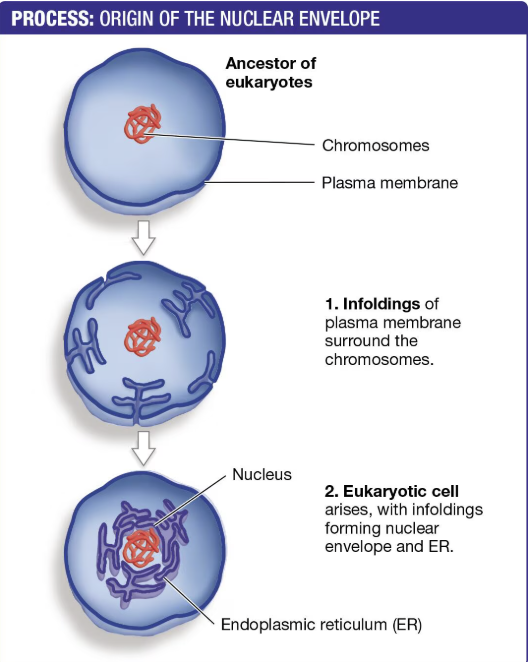
What is the origin of mitochondria?
The endosymbiosis theory
What is the endosymbiosis theory?
Host cell surrounds & engulfs bacterium
Bacterium lives in host cell
Endosymbiosis
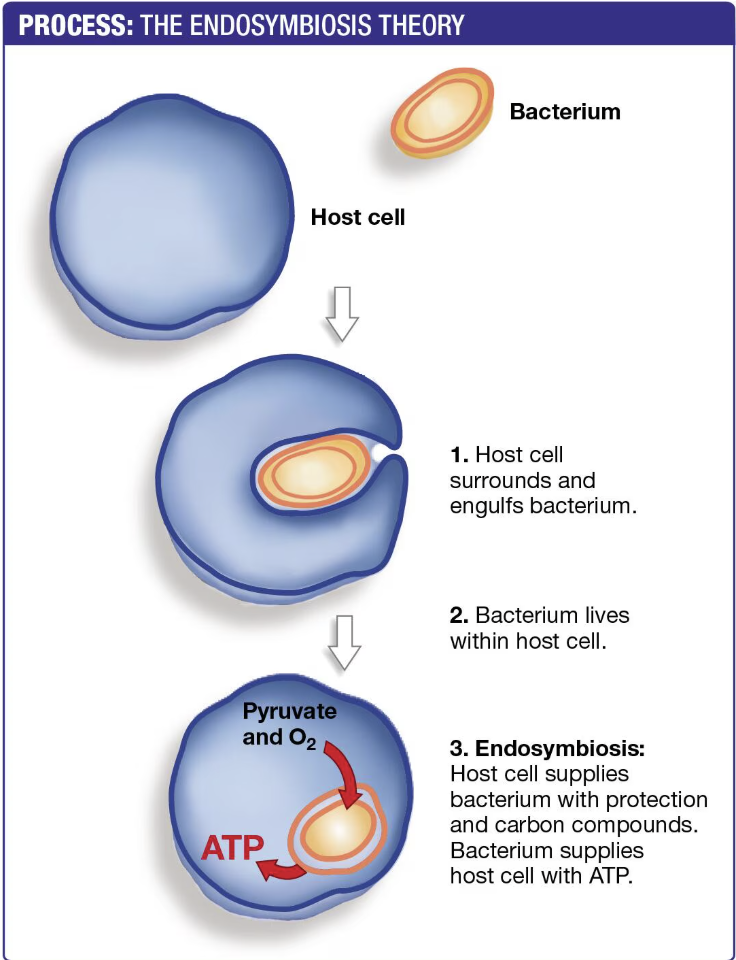
What is endosymbiosis?
When an organism lives inside the body or cells of another ~ mutualistic relationship
What are pieces of evidence for the endosymbiotic theory of mitochondrian?
mitochondria similar size as bacterium
double membranes ~ consistent with engulfing mech.
replicates fission ~ like bacteria
have own ribosomes to manufacture proteins
have genomes w/ genes to encode enzymes that replicate and transcribe
genes are phylogenetically closer to eubacterial genes than eukaryotic genes
What is the origin of chloroplast?
photosynthetic protist is engulfed
nucleus from photosynthetic protist is lost
organelle has four membranes
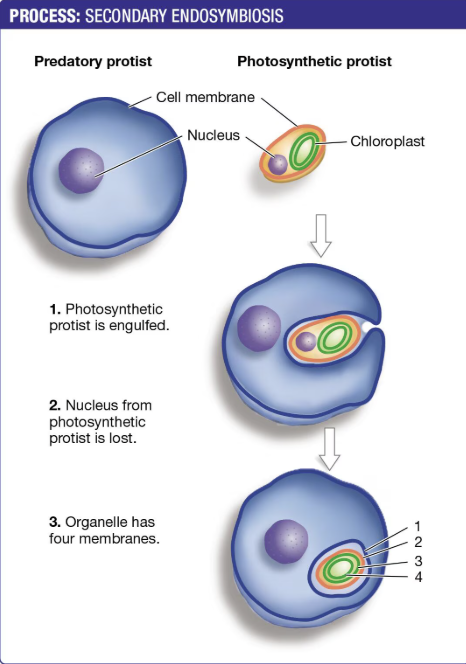
What evidence is there for the endosymbiotic theory for origin of chloroplast?
mutualistic relationship
same as mitochondria (same bacterial structure & chromosomes, DNA sequence similarities, photosynthetic machinery - chlorophylls -)
(more complicated due to multiple independent origins)
Are protists a monophyletic group or a paraphyletic group?
paraphyletic (represent some but not all descendants of common ancestor)
Approximately how many species of protists are there? Diversity?
~100,000, relatively low diversity but high abundance
What was the time of origin for protists?
About 2 billion years
What are major lineages of protists?
Crown groups (plants, animals, fungi)
What was the evolution of haploid-diploid life cycle for protists?
Prokaryotes originally reproduced asexually (haploid)
Eukaryotes began reproducing sexually (meiosis)
fusion of gametes → diploid
meiosis → haploid
Draw the life cycle dominated by haploid cells
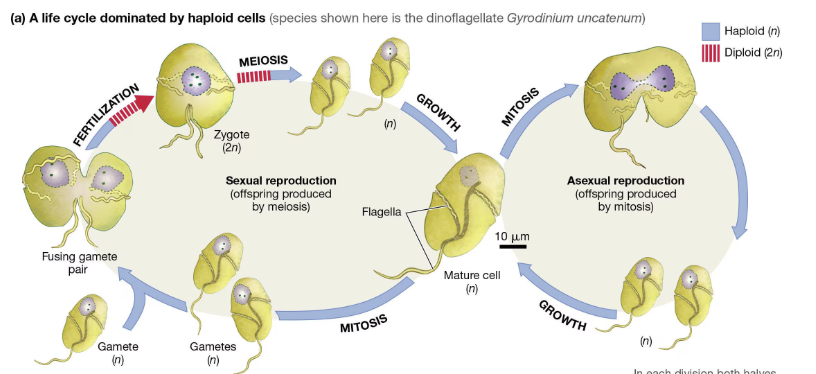
Draw the life cycle dominated by diploid cells
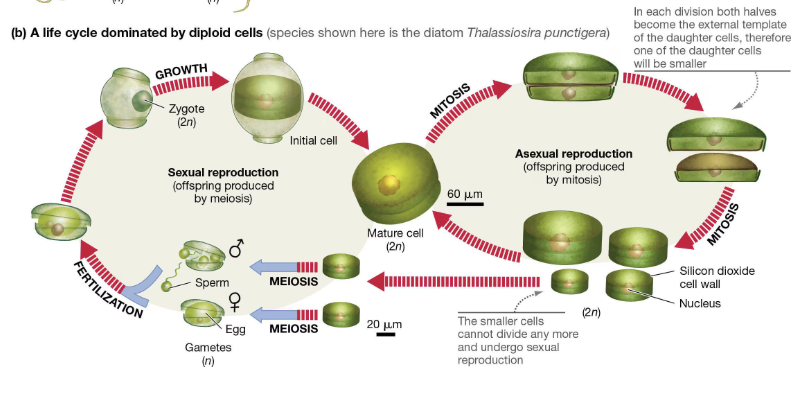
How are protists ecologically important?
primary producers
nutrient cycling & decomposers
responsible for crop killing infections (medical research)
How are photosynthetic protists ecologically important?
primary producers
take in CO2 and replenish with high # ATP (chemical energy) that plants use to grow and reproduce
What are land plants’ species diversity?
~300,000 species (up to 1 mil.)
What are land plants’ time of origin?
500 million years from algal ancestors
What are the major lineages of land plants?
Bryophytes: mosses, liverworts (non vascular, spore reproducing)
Fern & relatives: vascular, spore reproducing
Gymnosperms: “naked seed” (coniferous seed reproducing)
Angiosperms: “vesseled seed” (flowering plants w/ fruits reproducing)
Why are land plants ecologically important?
enhance life-supporting attributes (atmosphere, soil, surface water, etc)
produces oxygen
fallen leaves & decaying roots → food for works, fungi, bacteria, archaea, etc.
hold water and moderate climate
primary producers, provide chemical energy used other organisms
food, fuel, fiber, building materials, medicines