PSYCHOLOGY: Issues and Debates
 Call Kai
 Learn
Learn Practice Test
 Spaced Repetition
 Match
Match Flashcards
 Knowt Play
1/55

There's no tags or description
Looks like no tags are added yet.
Name | Mastery | Learn | Test | Matching | Spaced | Call with Kai |
|---|
No analytics yet
Send a link to your students to track their progress
56 Terms
What is ‘free will’?
The notion that, as humans, we are essentially self-determining and free to chose our thoughts and actions (how we behave)
What approach does ‘free will’ fall in line with?
Humanism
Explanation: Maslow’s hiearchy of needs - ‘self’-actualisation / Congruence - current vs ideal ‘self’
What is ‘hard determinism’?
All human behaviour has a cause (or causes)
What approach is ‘hard determinism’ in line with?
Psychodynamic - childhood over/under-indulgence have consequences in adulthood
In terms of the MAOA ‘warrior gene’, how does hard determinism explain this?
Someone with the MAOA gene is biologically pre-determined to have no control over aggressive urges
What is ‘soft determinism’?
Acknowledging that human action is caused by internal and external forces, allowing for elements of free will in that people can choose
In terms of MAOA ‘warrior gene’, how does soft determinism explain this?
A person may be biologically vulnerable to be more angry via MAOA, however they can use their free will and choose to override their urges and learn to control them
What is ‘biological determinism’?
Traits and behaviours are governed by internal biological factors like genes, neurochemistry, brain structure and function
Give an example of ‘biological determinism’?
MAOA ‘warrior gene’ - genetically pre-dispositioned to be unable to control aggressive urges
What is ‘environmental determinism’?
Traits and behaviours are governed by external forces such as experience, upbringing, learning, schools, parents, peers, etc.
Give an example of ‘environmental determinism’?
Behaviourist approach - classical and operant conditioning both involve the influence of external sources (stimuli in Pavlov and reinforcement in Skinner) to shape desired behaviours
What is ‘psychic determinism’?
Traits and behaviours are governed by unconscious instincts and drives, the cause of behaviour is rooted in childhood experiences such as the psychosexual stages
Give an example of ‘psychic determinism’?
Fixations in childhood i.e. oral stage, leads to traits in adulthood i.e. nail biting, pen chewing etc.
The ‘debate’ for free will and determinism?
Determinism is scientific - establishment of causal relationships - if all behaviour was down to just free will, scientists would not have much to study
Practical applications in treatment - ‘cause and effect’ useful for drug development in OCD etc. - alteration of serotonin levels leads to reduced symptoms
Both are unfalsifiable - forces that drive determinism have not been discovered yet i.e. deep within the mind, specific coding of genes etc. - additionally, individuals ‘could’ make a different choice + Skinner suggests free will is ‘just an illusion’
SZ - Tienari et al - 6.7% adopted with SZ mother compared to 2% control + Gottesman MZ twins 48% → 17% - But still 52% to account for environment, so soft determinism - NOT FREE WILL
What are the three parts of establishing a casual relationship?
All variables are controlled except for the IV
Any change in the DV must therefore be caused by the IV
Use of control enables the researcher to infer causality/cause and effect
What is the Nativist / Nature argument?
Fits with the idea of genetic transmissions of mental and physical characteristics from one generation to another
Give an example of a Nativist argument?
SZ - due to inheriting a variant of the SERT and / or COMT genes, allowing for genetic vulnerability
What is the Empiricist / Nurture argument?
Any influence on human behaviour is that is non-genetic
Give an example of an Empiricist argument?
Behaviourist approach - ‘tabula rasa’ or ‘blank slate’
SZ - environmental triggers i.e. high EE / double bind statements causing distortion and tapping into vulnerability
What is the Interactionist approach?
Nature and Nurture are linked to such an extent that it does not make sense to separate the two
Give an example of an Interactionist argument?
SZ - a person may be genetically vulnerable to SZ via SERT and / or COMT and this may be triggered via high EE / double bind behaviours, thus showing an interaction between the two
The ‘debate’ of Nature v. Nurture?
Nature and Nurture cannot be meaningfully separated - Hebb suggested it was similar to asking the importance of the width v. length - the ‘relative importance of…’ should be considered instead
Twin studies - Gottesman - Concordance if fully ‘nature’ should show 100% for MZ twins, instead shows 48% → 17% - interactionist more appropriate ]
Constructivism - Shy people will spend more time around other shy people, thus strengthening their shy characteristics - Nurture suited to Nature
PKU - genetic condition prevents amino acids phenylalanine from absorption, but can be avoided with specific diet - what is the condition due to?
What is ‘Holism’?
‘The whole is greater than the sum of its parts’ - any attempts to break up (reduce) behaviour would be inappropriate
Uses ‘qualitative’ data i.e. case studies and unstructured interviews
Give an example of a ‘Holistic’ approach?
Humanism - ‘the self’ is a functioning whole - a person’s behaviour must recognise their whole human experience
What is ‘Reductionism’?
Based off the scientific idea of ‘parsimony’ - all phenomena should be explained using the most basic principles
What is ‘biological reductionism’?
Behaviour should be studied by breaking it down to physical concepts within the body i.e. genetics, biochemistry etc.
Give an example of ‘biological reductionism’?
SZ - down to increased re-uptake of dopamine within brain - reduced down to neurochemicals as causation
What is ‘environmental reductionism’?
Behaviour should be studied by breaking it down to Stimulus — Response
Give an example of ‘environmental reductionism’?
Phobias - association between pain from the bite and snake, resulting in fear
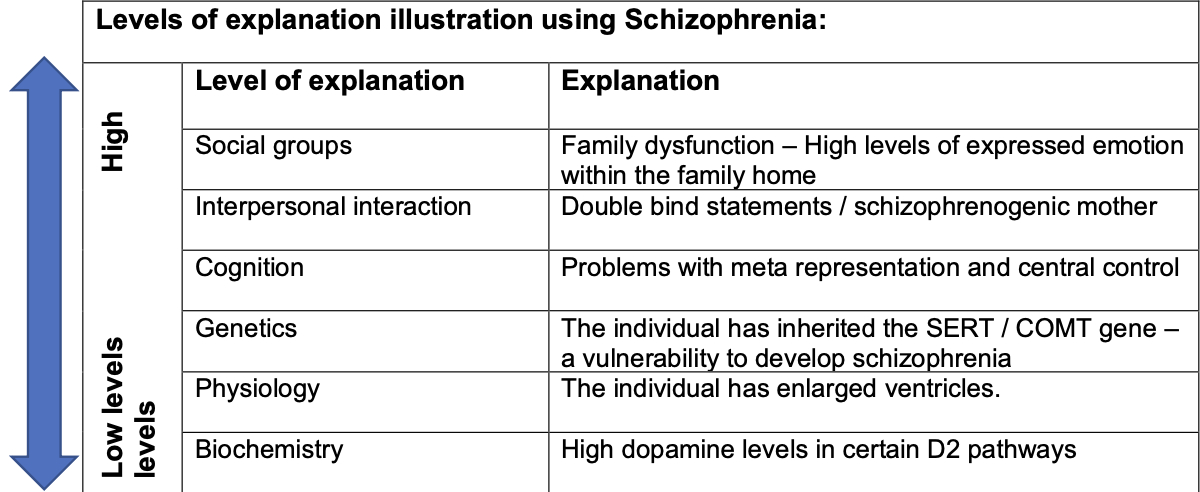
What are High levels of explanation?
Humanism
Social influence
Cultural and social explanations of how our social groups affect our behaviours
Viewed as unscientific
Give an example of a High level of explanation?
Depression - individualist culture focused on personal fulfilment, leading to feelings of inadequacy and thus, depression
What is Mid-level of explanation?
Cognitive approach
Behaviourist approach
Refers to psychological explanations
What are Low levels of explanation?
Biological approach \
Breaking behaviours down into a measurable format
Viewed as scientific
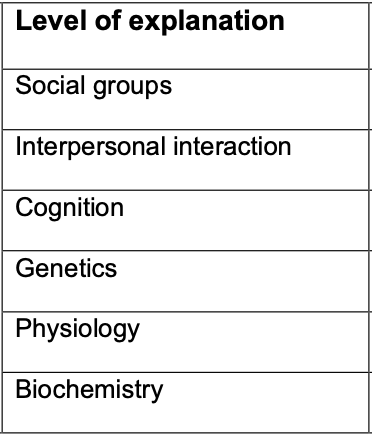
Explain each level of explanation for SZ:
The ‘debate’ for Holism and Reductionism?
Reductionism is scientific - use of studies, control, scientific methods etc.
Holism is unscientific - data is ‘qualitative’ - use of case studies, unstructured interviews etc.
Reductionism overlooks ‘meaning’ - low level reductionist explanations overlook complex human behaviours, thus giving a partial understanding
Interactionism - SZ - not everyone with biological vulnerability develops the disorder - thus, it cannot simply be genetic nor environmental, reductionism is not appropriate
Compromise - the more complex an explanation for human behaviour, the more difficult it is to test scientifically - holism has depth, but lacks scientific rigour - Reductionism is scientific, but lacks depth
What is the ‘Idiographic’ approach?
The study of the individual (or a small group)
Favours qualitative data:
Case studies
Open-answer questionnaires
Unstructured and structured interviews
Makes creating general laws difficult - use of marginalised groups i.e. Sperry’s split brain research - 11 in group, one women, all neurotypical
What approach fits the ‘Idiographic’ approach?
Humanism - study of the individual and ‘self’ emphasised
Roger’s Congruence - everyone’s ideal self is different and thus idiographic
What is the ‘Nomothetic’ approach?
Focus on the similarities between people
Favours quantitative data:
Experiments
Questionnaires
Numerical data
Making general laws is easier - generalisations formed from large groups
What approaches fit the ‘Nomothetic’ approach?
Behaviourist
Biological
Most people learn / possess the same brain structure, thus it is easy generalise findings to population
The ‘debate’ for Idiographic v. Nomothetic
Idiographic provides a more ‘complete’ understanding of the individual
Idiographic often leads to nomothetic - generalised laws applied to population from smaller research groups - Holt
Nomothetic is more scientific - larger groups, objectivity, measurability and replicability
Use of Reflexivity in Idiographic approach to address lack of scientific credibility - thus, can be evidence based
(Each point can be reversed to apply to the other approach)
What is ‘Universality’?
Characteristics of human beings that are capable of being applied to all, despite difference of experience or upbringing
If a behaviour is ‘universal’, it is applicable to everyone, regardless of culture
What is ‘Ethnocentrism’?
Judging behaviour seen in other cultures by the standards and values of one’s own culture
What is ‘Cultural relativism’?
Appreciating that behaviour varies between cultures and the relevance of data collected for its country of origin
What is an ‘emic’ study?
When the focus on behaviour comes from inside the country of origin - recognition that behaviour must be viewed within context
What is an ‘etic’ study?
When the focus on behaviour comes from outside the country - ‘outsider’s view’ - lacks recognition of behaviours with context and can lead to ethnocentrism
Discussion for Cultural Bias?
Reflexivity is KEY - ensuring that cultural bias is not a problem, but a factor taken well into account when designing and publishing research - however, even with awareness, sometimes it is difficult to disregard unconscious cultural bias
Indigenous psychologies - utilisation of researchers from country of desired research allows for cultural relativism, eliminating the ‘outsider’s view’
Expansion of sample - Smith and Bond - 66% American 32% European and 2% outside these areas in one Psychology textbook + pps tend to be middle-class, Psychology undergraduate males - using a wider sample would create a more representative set of data on chosen area
Worldwide psychology - psychologist are more likely to travel today than they were 50 years ago, thus reducing ethnocentrism when psychologists have a better grasp on cultural norms in behaviour than they did (again, eliminating the ‘outsider’s perspective’)
Why might ‘Gender bias’?
Male samples are often used to explain ‘human’ behaviours
Male behaviour is seen as the standard (and female behaviour is seen to ‘deviate’ from that norm)
Biological differences are emphasised (at the cost of societal factors), which leads to the idea of an ‘inferior gender’
What is ‘Alpha bias’?
Differences between men and women are highlighted - tends to lead to one gender undermined / undervalued (most often females)
Give an example of ‘Alpha bias’?
Freud - femininity as ‘failed masculinity’
The belief that women were inferior to men because they could not go through the Oedipus complex (castration anxiety)
The Electra complex was an afterthought to his theory to include women, but still did not mean they had the same ‘strength’ of moral character males did following puberty
Instead, women also go through ‘penis envy’, in which this need becomes sublimated into a need for a husband and children (or it will result in psychological disorder)
What is ‘Beta bias’?
Differences between men and women are minimised
Give an example of ‘Beta bias’?
The use of all-male pps in a study to apply something that affects the whole human condition i.e. Standford Prison experiment and conformity to set roles
What is ‘Androcentrism’?
The male-centred / based view of the world, judging male behaviours and masculine traits as the norm and therefore ‘superior’
Discussion of Gender bias?
Reflexivity is KEY - ensuring that gender bias is not a problem, but a factor taken well into account when designing and publishing research - however, even with awareness, sometimes it is difficult to disregard unconscious gender bias
Question formulation - a lack of women at a senior level of psychology means concerns may not be reflected in questions asked
The lab setting - Ealgly and Johnson - in real life situations, women and men are judged with a similar style of leadership than in a lab setting - tendency to act less natural in lab than men
Bias of publication - shows a strong bias towards studies that show ‘positive’ results i.e. showing a difference rather than no difference
What is ‘Socially sensitive’ research?
Includes studies in which there are potential consequences or implications, for either the pps in the research or the groups represented by the pps to i.e. women, POCs etc.
What process can be used to ensure research is appropriate?
The research question - asking a socially sensitive question? Don’t.
Treatment of pps - ensure protection from harm, confidentiality, the right to withdraw at any time etc. - make sure that ethically, your study is sound
Agenda - who is funding your research? i.e. government, yourself, private pharmaceutical company etc. - take this into account
Interpretation of findings - how will people who lack context interpret your data? - if it looks poor, adapt phrasing, provide context or don’t publish data - consider the wider impact of your research
Discussion of Socially sensitive research?
Cost-benefit analysis - are the costs of your research (stereotyping, faulty medication etc.) worth the benefits (fame, funding, grants for future projects, support etc.)?
However, harm is not always prevalent at time of researching and may only come about later on once published
Reflexivity is KEY - ensuring that own judgements / bias is not a problem, but a factor taken well into account when designing and publishing research - however, even with awareness, sometimes it is difficult to disregard unconscious researcher bias
Make limitations of research clear - i.e. ‘this study was carried out on middle-class, white American males all studying an undergraduate Psychology degree’ - ensures groups affected are recognised and that possibly problematic results are not more widely applied
Confidentiality - pps in most research (especially socially sensitive research) should remain anonymous at all costs - breach of confidentiality can lead to dire personal consequences for the pps