SG QUIZ 2 FUNDS
 Call Kai
 Learn
Learn Practice Test
 Spaced Repetition
 Match
Match Flashcards
 Knowt Play
1/17

Earn XP
Description and Tags
Class 3 Class 4
Name | Mastery | Learn | Test | Matching | Spaced | Call with Kai |
|---|
No analytics yet
Send a link to your students to track their progress
18 Terms
What is acute pain?
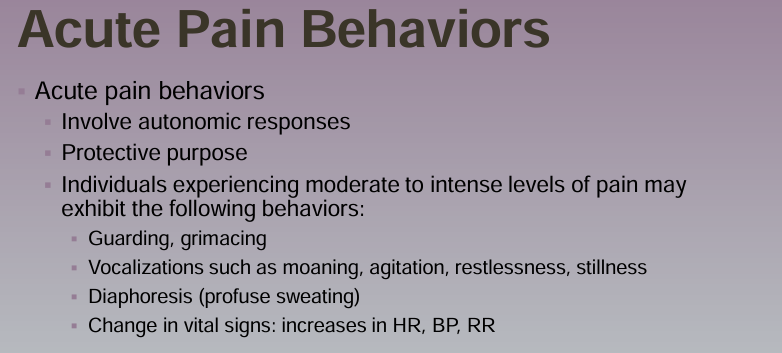
Acute: short term (less than 6 months)
Identifiable cause
Self limiting
Self protective
Responds to treatment of underlying cause
Severe, intensive, but usually short in duration
What is chronic pain?
Long term: (6+ months)
Pain usually comes and goes
Remissions and exacerbations
Malignant vs nonmalignant
What is PQRSTU and how would assess each element?
Provocation/Palliation
Quality
Region or Radiation
Severity Scale
Timing
You (U)
What is PQRSTU and how would assess each element? P (PROVOCATION/PALLIATION)
What makes your pain worse? What makes it better?
What is PQRSTU and how would assess each element? Q (QUALITY)
What does it feel like?
What is PQRSTU and how would assess each element? R (REGION or RADIATION)
Show me where you hurt. Does it stay there or does it spread somewhere else?
What is PQRSTU and how would assess each element? S (SEVERITY)
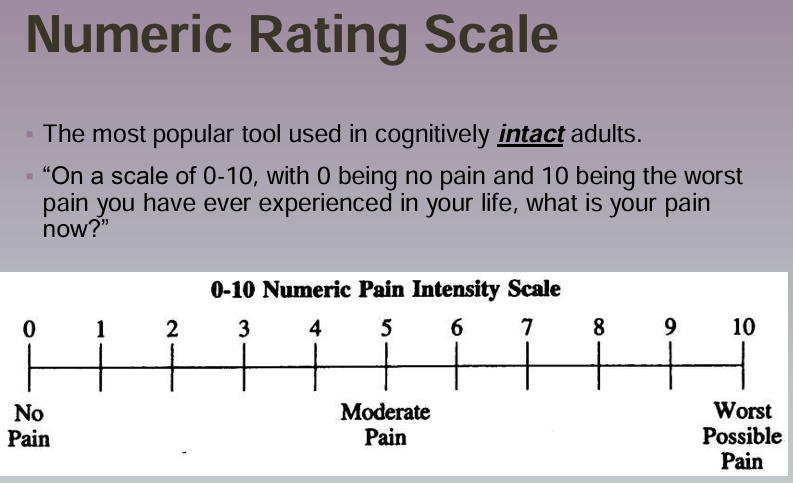
Please rate your pain from 0 to 10. 0 indicating no pain and 10 representing the worst possible pain, how bad is your pain right now?
What is PQRSTU and how would assess each element? T (TIMING)
Is your pain constant,
What is PQRSTU and how would assess each element? U (UNDERSTANDING)
What do you think is causing the pain? What are you not able to do because of your pain?
What are the special considerations in assessing pain in patients with cultural differences? How about with the older adult?
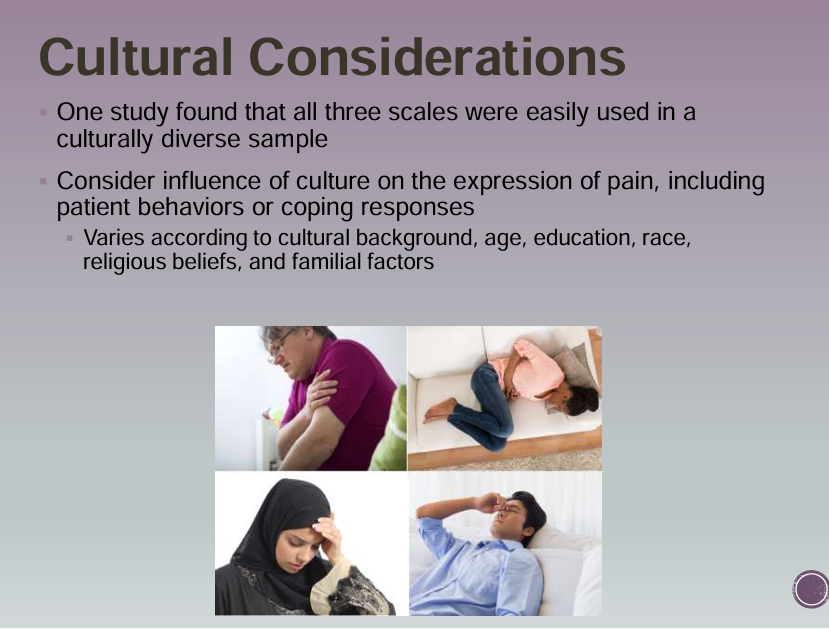
One study found that all three scales were easily used in a culturally diverse sample
Consider influence of culture on the expression of pain, including patient behaviors or coping responses
Varies according to cultural background, age, education, race, religious beliefs, and familial factors
What are the different pain scales and when would you each one?
Numeric Rating Scale: Cognitively intact adults
Verbal Descriptor Scale: “Would you please describe your pain for me, from ‘no pain’ to ‘mild,’ ‘moderate,’ ‘severe,’ or ‘pain as bad as it could be’?”
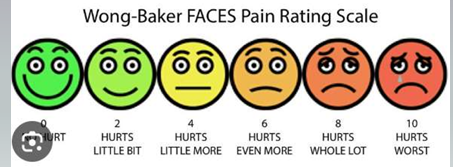
Faces Pain Rating Scale:
A visual scale on which patients choose the depiction of a facial expression that best corresponds with their pain.
“Would you please look at this card and point to the face that best represents the level of pain you are experiencing now?
How would you intervene for each pain level?
1 to 3 → Mild Pain
4 to 6 → Moderate pain
7 to 10 → Severe pain
Interventions
1 to 6 pain: Assess PQRTU
Assess PQRTU mnemonic
Then ask…. “At what level would you like your pain to be when you’re moving around?”
Report to your nurse or clinical faculty your patient’s response to this question AND the number they currently rate their pain
Over 7 Pain: Assess Q & R
Quality (Q) Ask “How would you describe your pain?*
Region or Radiation Ask “Show me where you hurt. Does it stay there & does it spread somewhere else?*
Then immediately instructor. report the QRS of pain to your nurse or clinical
What are nonverbal pain behaviors for acute and chronic pain?
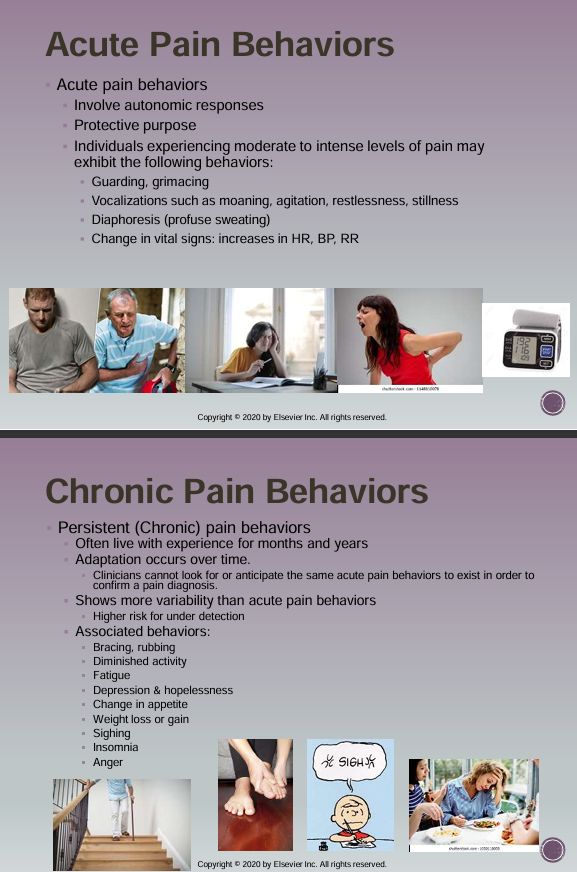
Acute Behaviors: Intense
Guarding, grimacing
Vocalizations such as moaning, agitation, restlessness, stillness
Diaphoresis (profuse sweating)
Change in vital signs: Increases in HR, BP, RR
Chronic Behaviors:
Bracing, rubbing
Diminished activity
Fatigue
Depression & hopelessness
Change in appetite
Weight loss or gain
Sighing
Insomnia
Anger
What pain scale do we use for those who are not able to communicate their pain?
A visual scale on which patients choose the depiction of a facial expression that best corresponds with their pain.
“Would you please look at this card and point to the face that best represents the level of pain you are experiencing now
What is the purpose of a psychosocial assessment?
Evaluation of one’s mental health and social well-being
A collection of subjective data
Can also include the use of screening tools for mental health or cognitive disorders
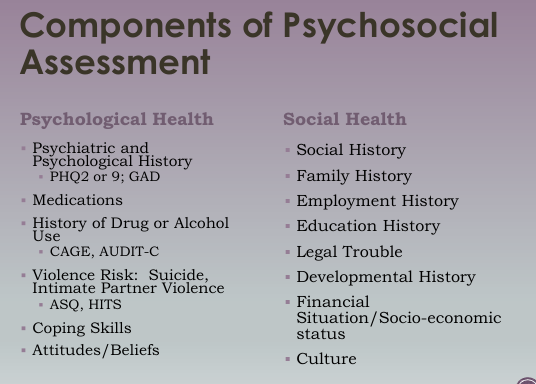
What are the key elements of a psychosocial assessment? What kind of data is collected? What tools/screening instruments can be used in a psychosocial assessment?
PHQ2 or 9 GAD: Psychiatric and Psychological History
CAGE: Alcoholism Screening
AS: Suicide Risk Screening Tool
HITS: Screening for Domestic Violence
What is the nursing process and what are its components? What are the steps of the nursing process?
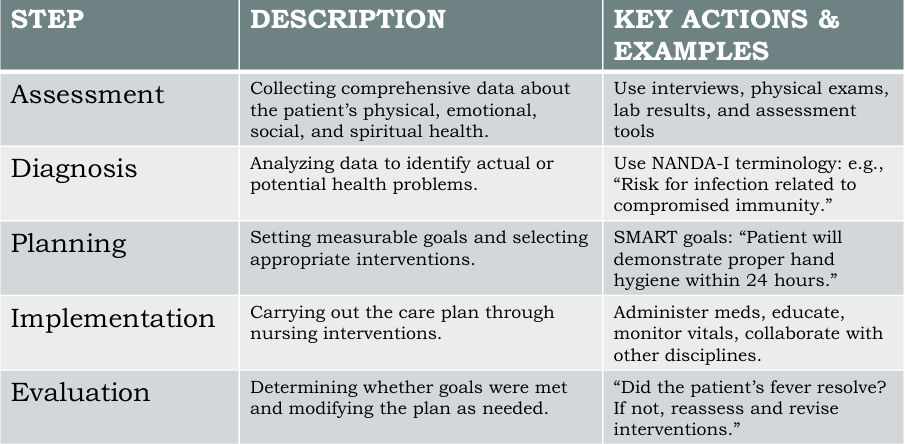
ADPIE (refer to diagram)
Assess
Diagnose
Planning
Implement
Evaluate
What is the purpose of assessing fluid balance? What are the 3 processes