3. Atoms and chemisty self-eval q's (2nd exam)
 Call Kai
 Learn
Learn Practice Test
 Spaced Repetition
 Match
Match Flashcards
 Knowt Play
1/19

There's no tags or description
Looks like no tags are added yet.
Name | Mastery | Learn | Test | Matching | Spaced | Call with Kai |
|---|
No analytics yet
Send a link to your students to track their progress
20 Terms
Isotopes of the same kind of element differ in their number of:
neutrons
An atom that has acquired an additional electron(s) is called a(n):
anion
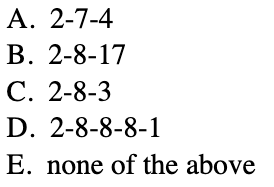
Aluminum has an atomic weight of 27, and an atomic number of 13. Which of the following indicates electron placement?
2-8-3

Which of the following is part of the atomic theory?
An atom of an element contains the same number of electrons as protons, and is electrically neutral

Which of the following is most correct, concerning the organization of elements in the periodic table?
elements progress horizontally with the addition of one proton
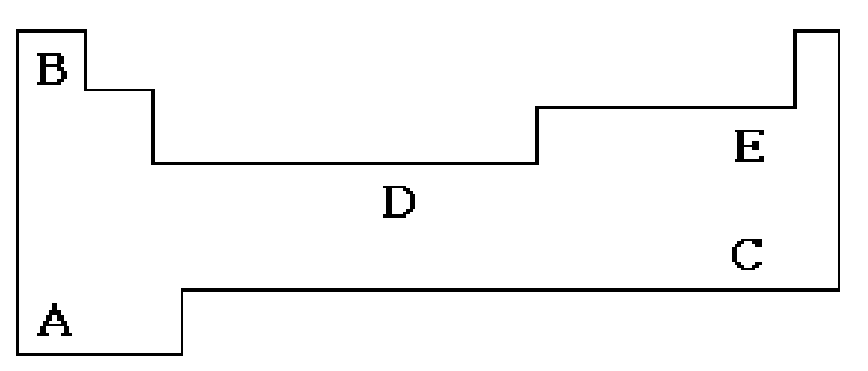
Using the following diagram of the periodic table, which metal would be most active? (Choose A, B, C, D, or E)
a
Covalent compounds are materials which tend to be __________ at room temperature:
liquids and gases
When forming molecules by either ionic bonding or by covalent bonding, the atoms seem to:
attain the outer structure of inert gases

Which one of the following represents an electron dot model of Na2S?
c

Which one of the following represents and electron dot model of LiCl?
b
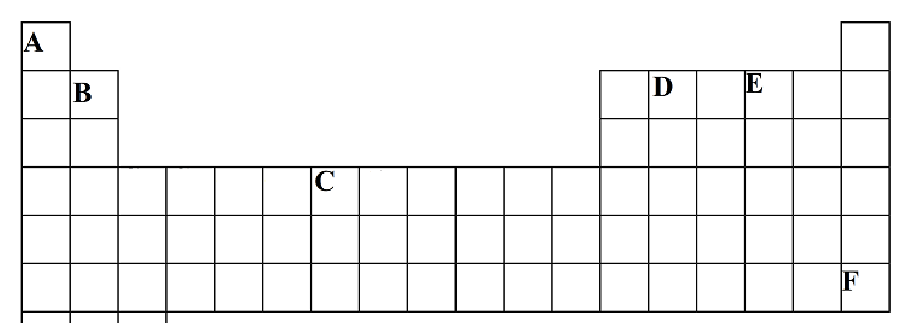
Using the following diagram of the periodic table, which two elements could be predicted to form a covalent bond?
D and E
Covalent compounds will most likely form between two neutral elements having the following number of valence electrons?
4 and 4

Which one of the following best represents a model of liquid?
Atoms are loosely bound and conform to the shape of whatever volume contains them

Which one of the following best represents a model of a solid?
Atoms which are very tightly bound to each other and organized
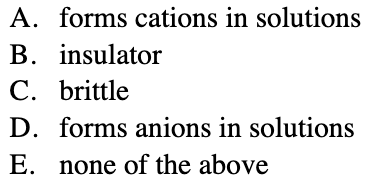
Which of the following is not a property of a nonmetal?
forms cations in solutions
The general properties of metals are:
high luster
The Law of Definite Proportions indicates:
the number of atoms of one element to another in a molecule
The statement which describes the way the number of atoms of one element combine with the atoms of another element to form a molecule is called:
Law of Definite Proportions
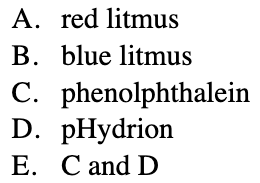
The following indicators will turn pink in a base:
phenolphthalein
This indicator will be yellow/green if it is neutral:
pHydrion