AMD Diet and Supplementation - Posterior Segment & Ocular Disease Spring 2026
 Call Kai
 Learn
Learn Practice Test
 Spaced Repetition
 Match
Match Flashcards
 Knowt Play
1/53

There's no tags or description
Looks like no tags are added yet.
Name | Mastery | Learn | Test | Matching | Spaced | Call with Kai |
|---|
No analytics yet
Send a link to your students to track their progress
54 Terms
True or False:
The effect of dietary carotenoids and supplements on AMD is a very active area of study
true
Why might carotenoids and other co-factors (supplements and dietary) be helpful for ocular and systemic health?
macular pigments are carotenoids in a macular that have antioxidant properties and blue light filtering (430 to 530nm)
Higher level of macular pigment will result in a (increased/decreased) MPOD score
increased
(Greater/reduced) macular pigment levels might reduce light scatter and improve low contrast acuity
Greater
True or False:
There have been studies that have concluded that MPOV was higher in patients with early and intermediate AMD (opposite of other literature)?
true
EXAM QUESTION:
How strong is the correlation between MPOD and the progression/development of AMD?
it is not well correlated
Based on questionnaires completed by AREDS subjects, AREDS Report No. 22 found that (lower/higher) dietary intake of lutein and zeaxanthin was independently associated with decreased likelihood of having neovascular AMD, geographic atrophy and large or extensive intermediate drusen
higher
What were the findings of the Blue Mountain Eyes Study (2008)?
-higher lutein and zeaxanthin intake was found to reduce long term incident risk of AMD
-as little as 1 serving of fish per week can result in a 40% reduction in the incidence of age-related maculopathy
CONCLUSION:
Dietary intake of what nutrients can be helpful at all stages of AMD and may provide prophylaxis against the development of AMD?
-lutein
-zeaxanthin
-omega-3
-fatty acids
-other anti-oxidants (zinc/vitamins)
EXAM QUESTION:
Are supplements preventative of AMD?
No
EXAM QUESTION:
Is diet preventative of AMD?
Yes -- will prevent AMD at any stage & provide prophylaxis
What is the problem w/ beta-carotene for smokers?
leads to lung cancer
According to the Rotterdam Study, __________ should be consumed minimally to reduce the risk of AMD progression
vegetable oils and animal fats containing omega-6 fatty acids and red/processed meat
What are the dietary considerations of fruits/vegetables that you want in your diet to reduce progression of AMD?
-5-13 servings of fruits and vegetables a day (2.5-6.5 cups/day)
-Green leafy vegetables
-Colorful fruits
Is there evidence that B vitamins may prevent AMD and slow the progression of AMD?
yes -- supplements usually DO NOT prevent AMD.
What are B vitamins the precursor to?
RBCs -- AMD is hypoxic stress
Several studies show that individuals with AMD have a significantly (higher/lower) intake of vitamins B1, B2, B6, B9, and B12 compared to individuals without MAD
lower
What is the most important study on B vitamins?
Women's Antioxidant and Folic Acid Cardiovascular Study (2009)
What did the Women's Antioxidant and Folic Acid Cardiovascular Study (2009) show about B vitamin intake?
showed that a combination of antioxidants with vitamins B6, B9, B12 in women with cardiovascular disease or cardiovascular risk factors decreased AMD incidence by 34% and decreased the risk of developing "visually significant" AMD by 41%
Does visual acuity and contrast sensitivity sometimes improve with macular pigment supplementation/antioxidants/vitamins/minerals?
yes
What AMD is present in Category 1 of the AREDS 1 study?
No AMD
What AMD is present in Category 2 of the AREDS 1 study?
Mild AMD; small drusen (>63 microns) and few intermediate drusen (63-125 microns)
What AMD is present in Category 3 of the AREDS 1 study?
intermediate AMD; having extensive intermediate drusen or large drusen (>125 microns)
What AMD is present in Category 4 of the AREDS 1 study?
Advanced AMD in one eye; either geographic atrophy in the center or neovasc AMD
What were the supplements in AREDS1?
-Vit C
-Vit E
-Beta carotene
-Zinc
-Copper
What was NOT in the AREDS1 supplement?
-lutein
-zeaxanthin
-omega 3 fatty acids
EXAM QUESTION:
What were the results of the AREDS 1 Study?
-The patients with intermediate or worse AMD had a 25% reduced risk of developing advanced AMD (geographic atrophy or CNVM) over a 5 year period if took prescribed supplement (Category 3 & 4 with most benefit)
-Mild forms of dry mac degen gained no benefit from supplements
-Higher dietary intake of carotenoids (lutein and zeaxanthin) was independently associated with decreased likelihood of progression at any AMD stage
AREDS Study Results
Should smokers avoid beta carotene? Why?
Yes -- d/t the increased risk of lung cancer
AREDS Study Results
Current smokers relationship to beta carotene?
SHOULD BE ADVISED NOT TO TAKE BETA CAROTENE
AREDS Study Results
Past smokers relationship to beta carotene?
CAUTION those who have recently quit within the last 5 years
AREDS Study Results
Passive smokers (second hand smokers) relationship to beta carotene?
CAUTION THOSE EXPOSED TO HEAVY SMOKERS
How was the AREDS2 Study designed?
-Participants already had relatively advanced macular degeneration: bilateral large drusen or large drusen in 1 eye and advanced macular degeneration in the fellow eye
-All of the participants took an AREDS(1) formula ALONG WITH the other nutrient that was to be tested
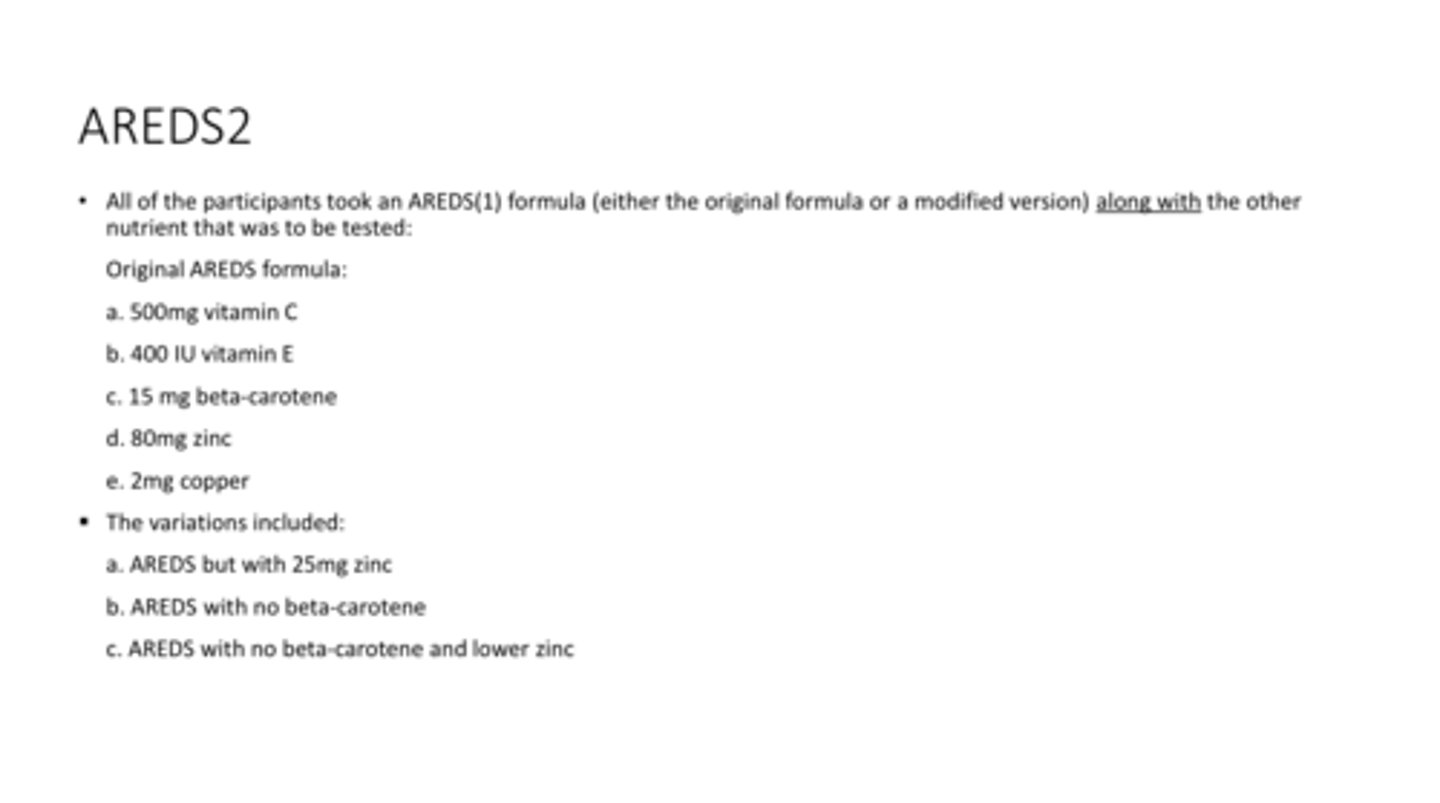
What are the 4 different groups included in the AREDS2 Study?
-AREDS1 formula
-AREDS1 but with 25mg zinc (less than org formula)
-AREDS1 with no beta-carotene
-AREDS1 with no beta-carotene and lower zinc
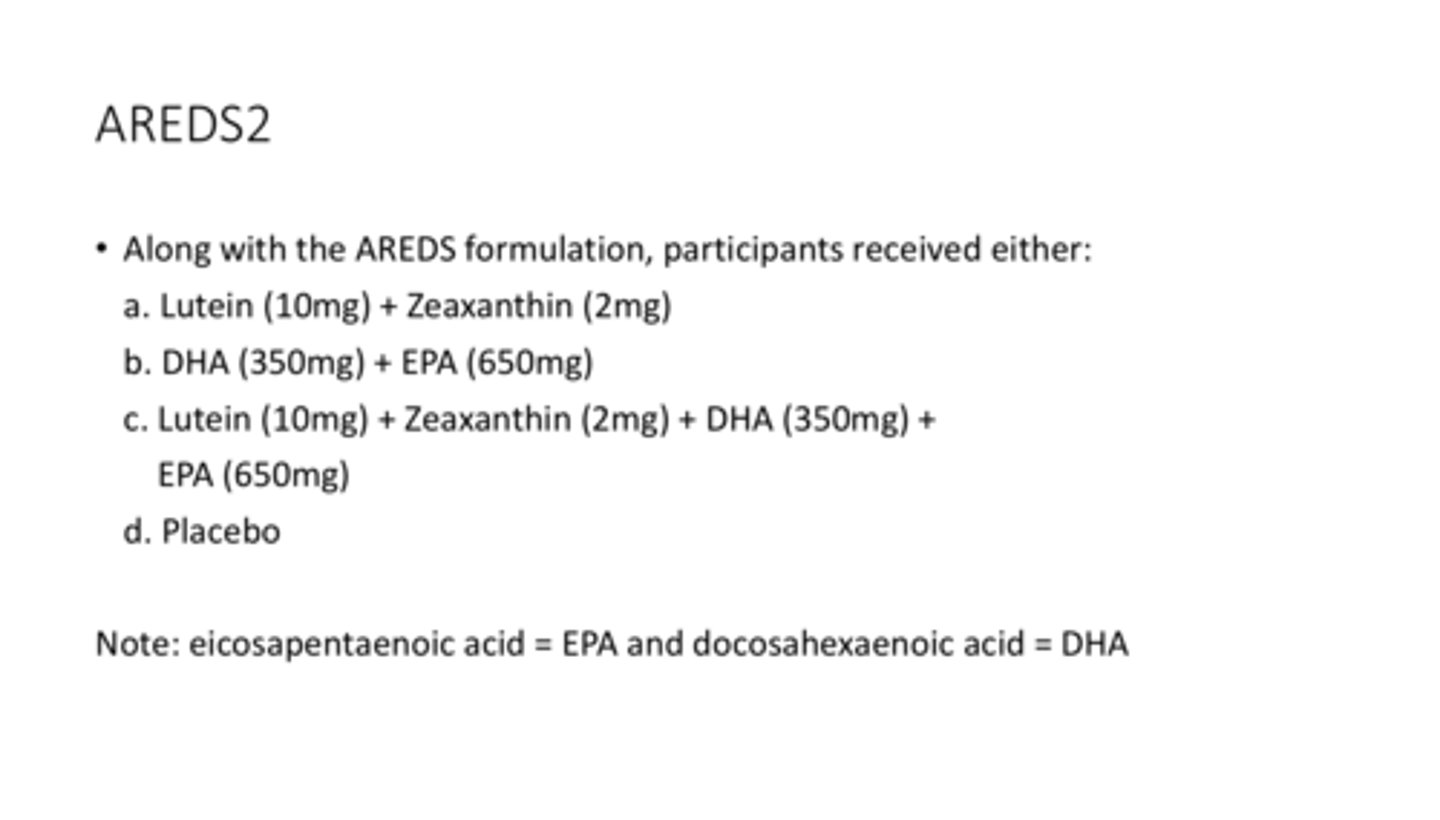
Along with the AREDS formulation participants ALSO received one of what?
-Lutein (10mg) + Zeaxanthin (2mg)
-DHA (350mg) + EPA (650mg)
-Lutein (10mg) + Zeaxanthin (2mg) + DHA (350mg) + EPA (650mg)
-Placebo
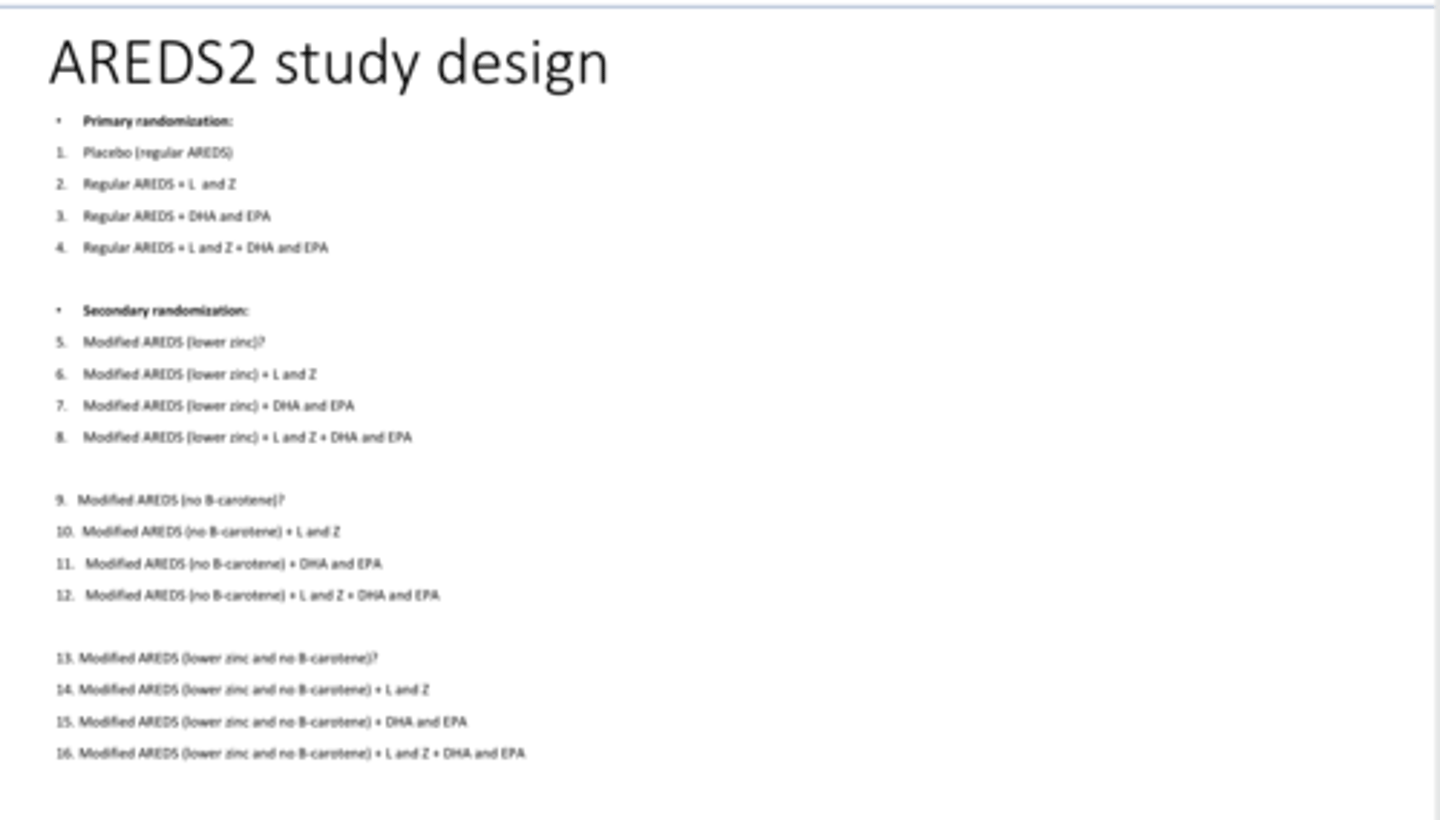
How many TOTAL groups are there in the AREDS2 study?
16 total groups
AREDS2 CONCLUSION:
From the primary randomization (orginal AREDS1) compared to the placebo, there (was/was not) statistical reduction in progression to advanced AMD or the development of moderate or worse vision loss when lutein + zeaxanthin, DHA + EPA were added
was not
AREDS Study Results
When did lutein + zeaxanthin help patients who were using the AREDS1 supplement?
When their dietary intake of lutein and zeaxanthin were low
AREDS Study Results
In cases where the supplement contained lutein & zeaxanthin (L&Z) but no beta-carotene, there was (reduced/increased) risk of developing advanced AMD compared to the supplement with beta-carotene but no L&Z
reduced -- 18%
AREDS Study Results
Is L&Z an appropriate carotenoid substitute in the original AREDS1 formulation for beta-carotene? Why?
Yes -- because of the increased incidence of lung cancer mostly in former smokers
AREDS Study Results
Did lowering the conc of zinc matter?
No
AREDS Study Results
Did the addition of omega-3 fatty acids matter?
No
What is the ONLY supplement to recommend right now?
AREDS supplement without the beta carotene (instead w L&Z) and lower dose zinc appears to be the only supplement to recommend
Who should you recommend AREDS2 supplements to?
only patients with moderate to advanced changes of AMD
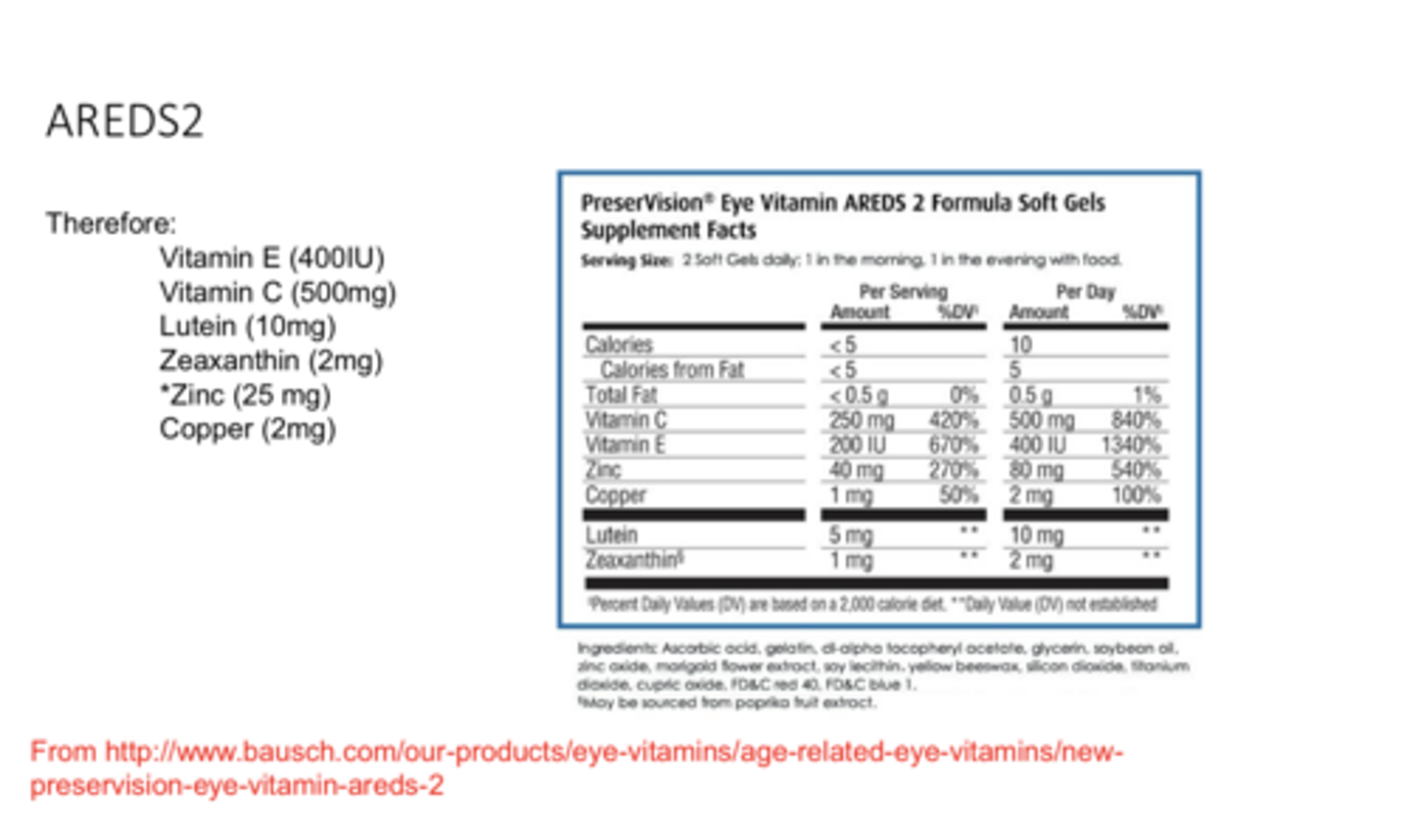
AREDS2 formulation (Pic)
AREDS2 formulation (Pic)
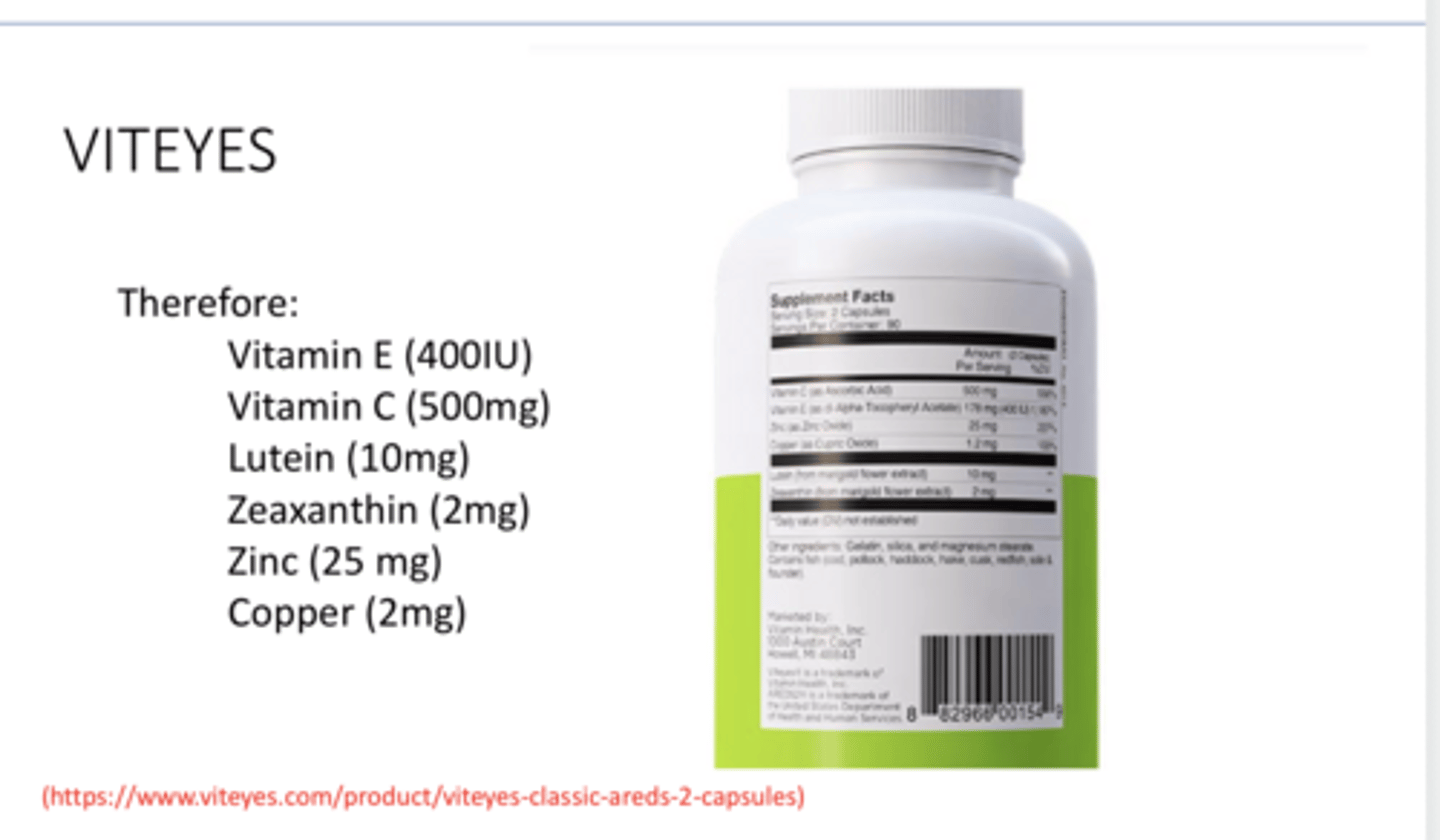
VITEYES (Pic)
VITEYES (Pic)
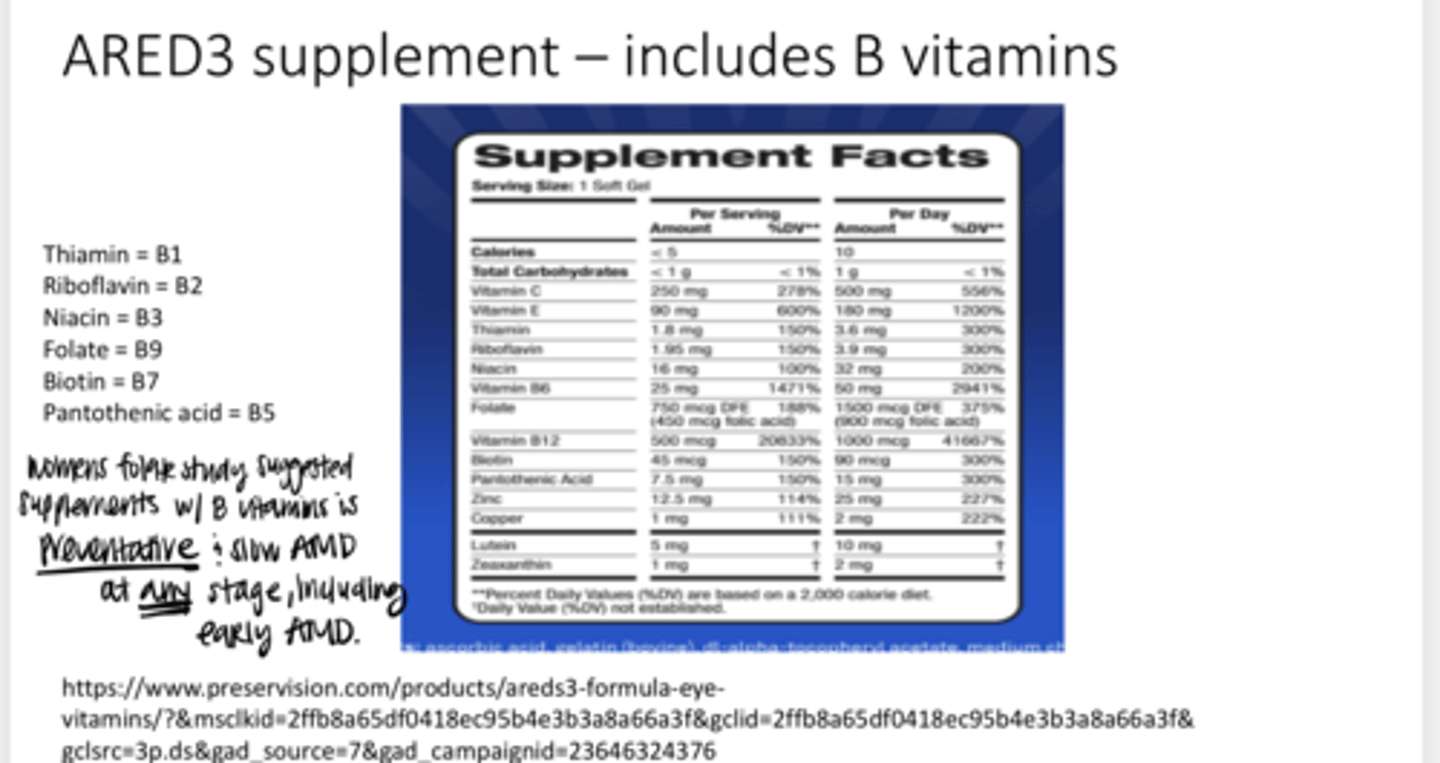
What is the addition to the AREDS3 supplement?
Includes B vitamins
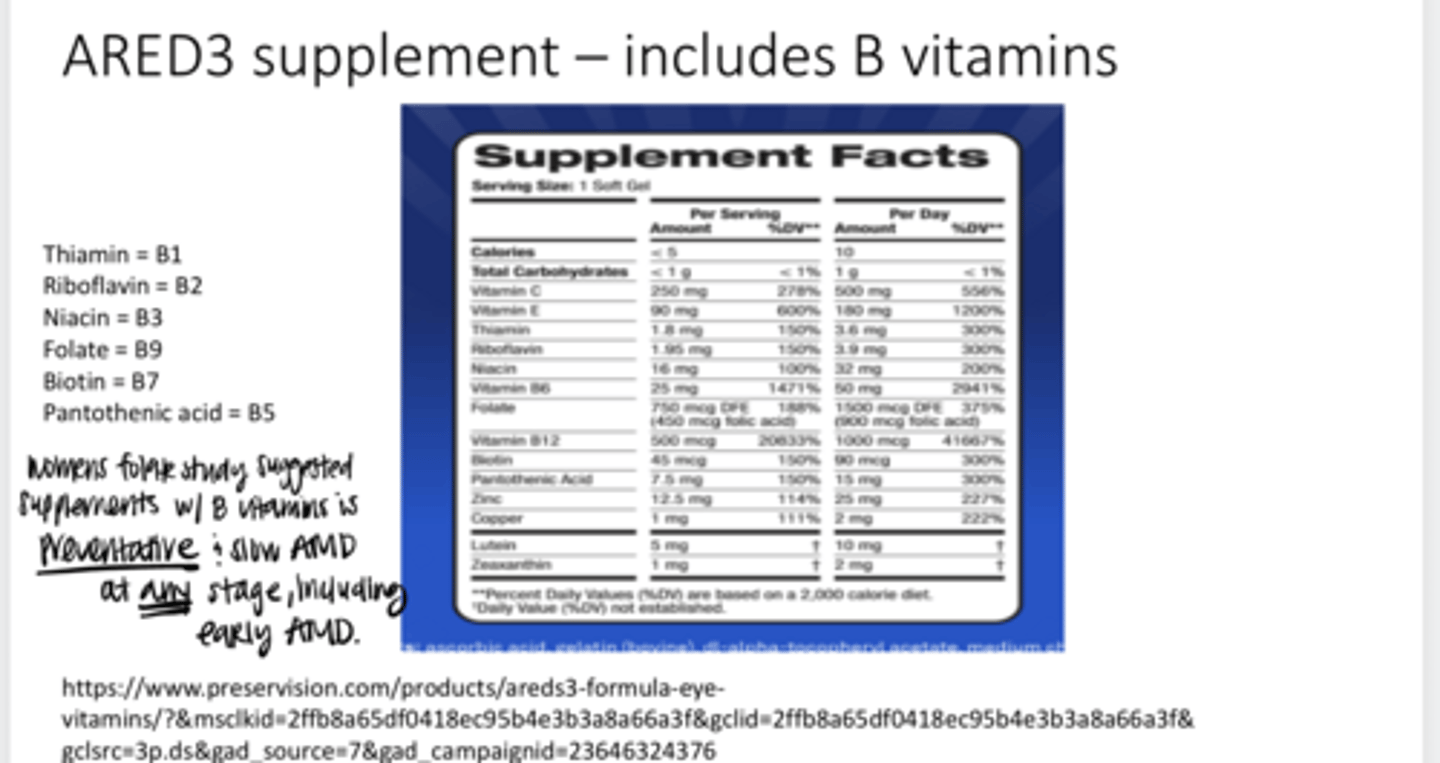
What is the ONLY formulation that is preventative of AMD & slows AMD at any stage, including early AMD?
AREDS3 supplement that includes B vitamins
True or False:
Vitamin D can PROTECT AGAINST AMD
true
What has zinc intake been associated with?
-UTIs
-latent Alzheimer's Disease
-prostate cancer
High doses of Vit E is supplementation associated with what?
may increase all-cause mortality
Does Vit E interact with some other medications?
Yes -- Vit E leads to abnormal bleeding in patients on Warfarin
Super high doses of Vit C can cause what?
stomach upset and diarrhea
Are supplemental fish oils (3g/day) generally safe?
yes -- although some may report nausea or stomach upset & may increase bleeding risk
Does the high dose Vit E in the AREDS formulations affect the risk of prostate cancer?
There is conflicting data